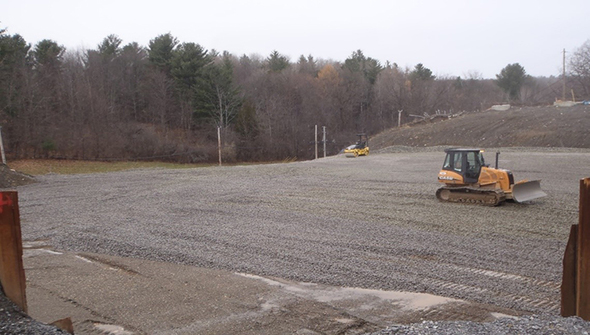
The demolition work concludes several years of cleanup operations by EM and AECOM. In May last year, they completed demolition of Buildings H2 and G2, a project that began in 2016. The buildings supported improvements in the chemical separation of plutonium for the nation’s strategic defense early in the Cold War.
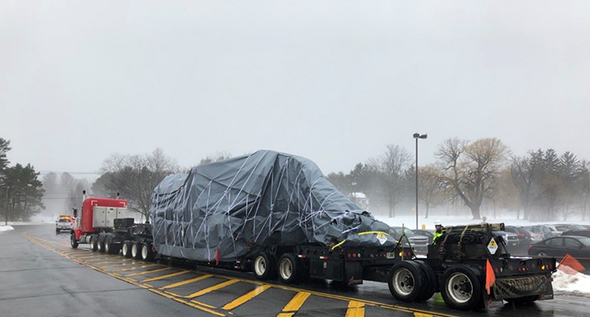
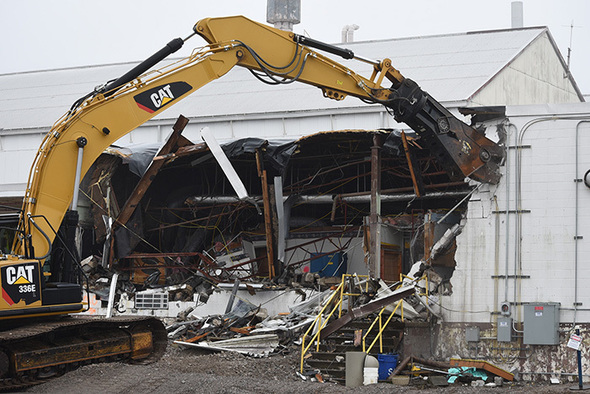
A truck ships the last excavator used in cleanup at the Separations Process Research Unit on Jan. 24.
By fall last year, crews removed all concrete debris, and remaining soil was verified to meet cleanup objectives. Workers then stabilized the excavation areas for the winter. The final excavator used during the demolition was shipped from the site late last month.
Completion of backfilling and site restoration are scheduled for this summer.
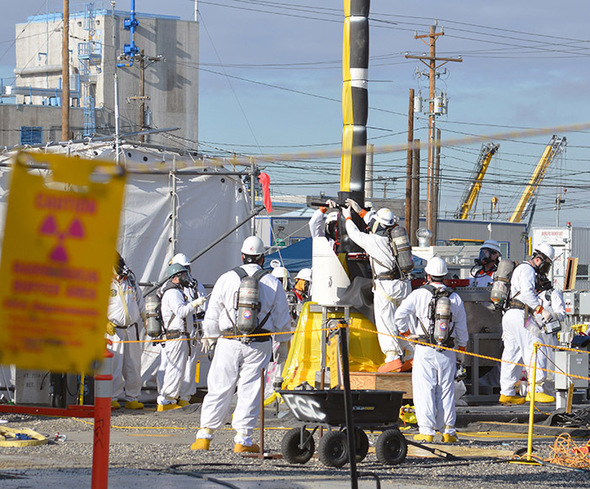
Members of the pump pull team secure a protective cover around the outdated and contaminated pump as it’s removed from the tank a few feet at a time.
RICHLAND, Wash. – EM’s Office of River Protection (ORP) and its tank farm contractor have safely completed a pump removal of outdated, contaminated equipment.
This recent high-risk operation, also known as a pump pull, was instrumental in laying the groundwork for AP Farm to store treated waste and later pump it to a vitrification facility on-site.
Washington River Protection Solutions (WRPS) is tasked with having a waste feed delivery system (WFD) ready to support Waste Treatment and Immobilization Plant (WTP) operations by 2023. It’s part of the direct feed low-activity waste (DFLAW) process adopted by ORP to begin treating tank waste as soon as possible. WRPS will pump treated tank waste directly to the LAW vitrification facility at WTP.
The pump pull from Tank AP-102 was among the highest risk portions of the WFD project, based on potential radiological hazard.
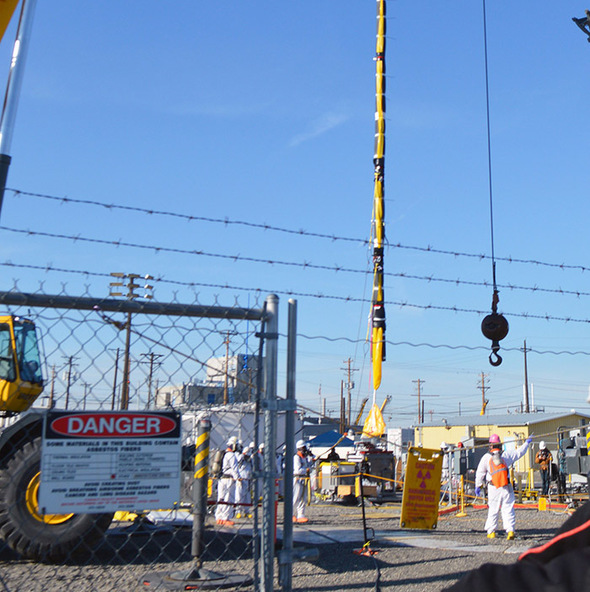
The crane that pulled the pump at the AP Farm eases it toward the disposal box.
With help from a second crane, the outdated pump is lowered horizontally toward the disposal box. Because of the complexity and risk of the removal project, the workers trained for months with mock-ups.
On Jan. 24, the pump pull team started work at daybreak and by a little after noon, the pump was removed and safely placed in a specially built disposal box.
“The team did an awesome job,” said Jason Engeman, an engineer with WRPS tank farm projects. “For some folks, this was the first pump pull they had been part of, for others it was just one of many in their careers.”
A construction crew dedicated to WFD work began training last fall for the complex pump pull. The team practiced on multiple mock-ups and did extensive contingency planning. Dozens of workers were involved in the planning and execution of the event.
“The entire tank farm pump team performance was outstanding,” said Ryan Stoner, tank farm pump team project manager. “It was incredible to see a team of people come together and execute flawlessly.”
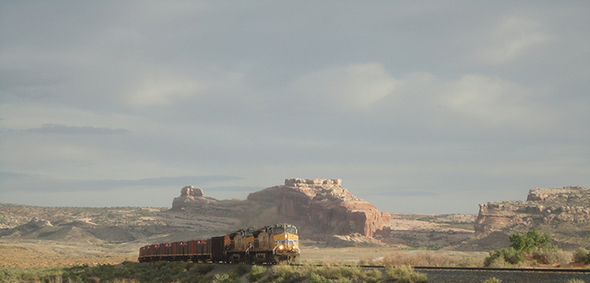
The tailings are a sand-like material that remain from processing uranium ore for national defense programs. EM workers ship them by train from the Moab Site to a permanent disposal cell about 30 miles north in Crescent Junction, Utah.
Each train can transport up to 144 sealed metal containers with approximately 4,700 tons of tailings. The tailings are being shipped away from the Colorado River and placed in the DOE-constructed, U.S. Nuclear Regulatory Commission-approved disposal cell.
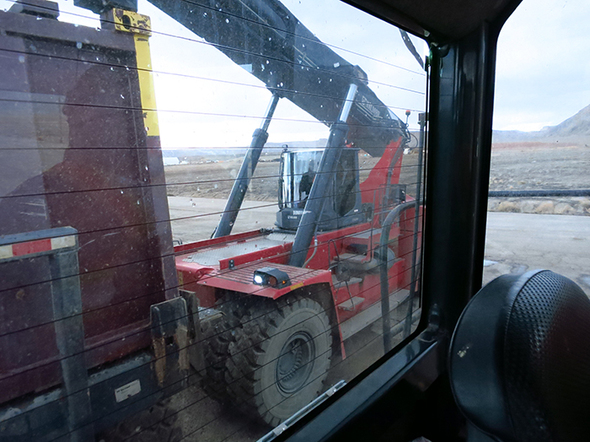
A reach stacker places a container of mill tailings from the train onto a haul truck for disposal at the Crescent Junction disposal cell, as seen from inside the truck’s cab.
North Wind Portage, the project’s remedial action contractor, hired more than 20 new employees to support the increased production. Most of the new employees are from Utah.
“All along, we have been focused on safely removing the tailings as efficiently as possible,” Federal Cleanup Director Russell McCallister said. “It feels great to see the project move additional material while putting more people to work.”
The Moab UMTRA Project began shipping activities in 2009 and is more than halfway to completing its mission of relocating 16 million tons of tailings.
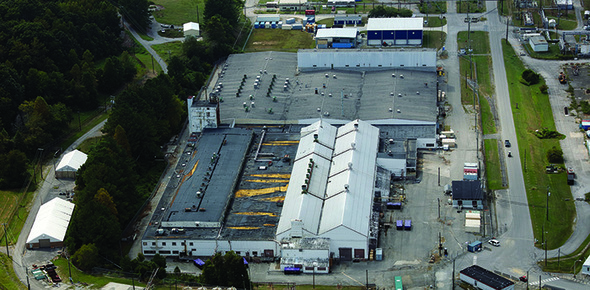
The Oak Ridge Office of Environmental Management and cleanup contractor UCOR began demolition this week on Building K-1037 at the East Tennessee Technology Park. The project is scheduled for completion later this year.
OAK RIDGE, Tenn. – Demolition of the largest facility still standing at the East Tennessee Technology Park (ETTP) is underway. Workers began tearing down Building K-1037 at the former uranium enrichment complex earlier this week. Watch a video about the project here.
“Removing the largest remaining building at ETTP radically changes the skyline, and it moves us forward in our efforts to complete all major demolition next year,” said Jay Mullis, manager of DOE’s Oak Ridge Office of Environmental Management (OREM). “When we complete this project, the building’s footprint will be a grassy area that will be available for reuse and redevelopment by the private sector in the future.”
OREM and cleanup contractor UCOR have spent the past several months deactivating the facility to prepare it for demolition — removing equipment and waste, performing asbestos abatement, and disconnecting utilities. The demolition is expected to be completed later this year.
The original structure was built in 1945. Through the years, additions to the facility brought its square footage to approximately 380,000 square feet.
Building K-1037 dates back to 1945, and at 380,000 square feet, it is the largest remaining building at the East Tennessee Technology Park.
As one of the earliest structures at the site, Building K-1037 was originally a warehouse, but it was later used to produce barrier material used in the gaseous diffusion process until 1982. In 1991, the high bay areas of the facility were remodeled to develop the Atomic Vapor Laser Isotope Separation Product Conversion Demonstration Facility, a new form of uranium enrichment technology.
Uranium enrichment operations ceased at the site in the mid-1980s, when it was known as the Oak Ridge Gaseous Diffusion Plant. Since then, OREM has taken down more than 400 facilities and transferred nearly 1,300 acres from government ownership in its goal to convert the site into a privately-owned and operated industrial park known as ETTP.
OREM is working to complete all major building demolitions at ETTP by the end of next year — a goal known as Vision 2020. The area also boasts a 3,000-acre conservation easement, and work is underway to open the K-25 History Center later this year. The center preserves and shares the site’s rich history and role during World War II’s Manhattan Project.
“Since UCOR took over the ETTP cleanup contract in 2011, we have seen significant changes throughout the site as numerous facilities have been demolished and privatization efforts move forward,” UCOR President and Chief Executive Officer Ken Rueter said. “Demolition of K-1037 will be another milestone that significantly advances us toward completing cleanup and transformation of the site.”
IDAHO FALLS, Idaho – EM and cleanup contractor Fluor Idaho at DOE’s Idaho National Laboratory (INL) Site created inventive new fuel buckets that allow them to store more Advanced Test Reactor (ATR) spent fuel elements in the remaining space of a spent nuclear fuel dry storage facility.
“It was exciting to watch the team as they shared ideas on how to accomplish the goal of increasing storage capacity,” said Russ Cottam, manager of Fluor Idaho’s spent nuclear fuel projects. “When they realized they had come upon a viable option, the energy of the team was palpable.”
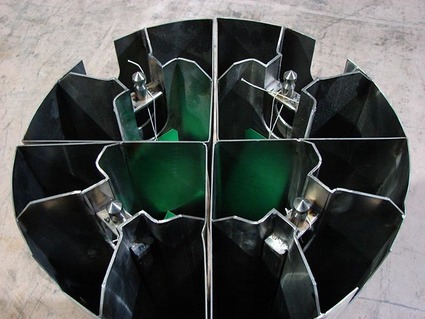
Using creative geometry, Fluor Idaho engineers, criticality safety and thermal analysis experts, operations personnel, and fabricators developed a four-compartment stainless-steel bucket that fits inside each fuel canister to provide for the storage of 24 ATR spent fuel elements per canister at the Irradiated Fuel Storage Facility of the Idaho Nuclear Technology and Engineering Center. Previously, only 16 ATR spent fuel elements fit in a fuel canister, which measures 18 inches in diameter and 10 feet, 9 inches in length.
The fuel storage facility is currently at 93-percent capacity. The Fluor Idaho Spent Nuclear Fuel Program needed to maximize the facility’s unused space so it can transfer the remaining spent nuclear fuel from a pool storage basin to dry storage by 2023 to comply with an Idaho Settlement Agreement milestone.
EM and Fluor Idaho previously used buckets that each held eight Advanced Test Reactor fuel elements. Crews stacked two of these buckets inside each fuel canister for a total of 16 spent fuel elements per canister in storage.
The new four-compartment bucket holds a total of 24 spent fuel elements in the same amount of space as the previously used buckets that held 16 of the elements.
It took several months to complete designs, conduct engineering analysis, and refine the fabrication process for the new fuel bucket, Cottam said.
“When the first production buckets were fabricated and passed the stringent inspections, we knew we had succeeded,” he said.
The new bucket is segmented differently than the previous version, allowing fuel handlers to stack spent fuel elements in different configurations, resulting in more of the elements being loaded in the same amount of space.
“After verifying that four new fuel storage buckets could be adjacently configured inside a fuel canister, the spent nuclear fuel program knew the goal to extend the mission of the dry storage facility was achievable,” Fluor Idaho ATR Wet-to-Dry Project Manager Roger Friesz said. “It was certainly a reason to celebrate the hard work of the many who were involved along the way.”
This innovative approach to spent nuclear fuel storage, combined with analyses that permit a shorter cooling period for the fuel in an existing dry storage facility, will extend the storage capacity of the INL Site dry storage facility. It will also contribute to the ATR mission by simplifying the process for storage and reducing costs of ATR spent fuel movements and storage.
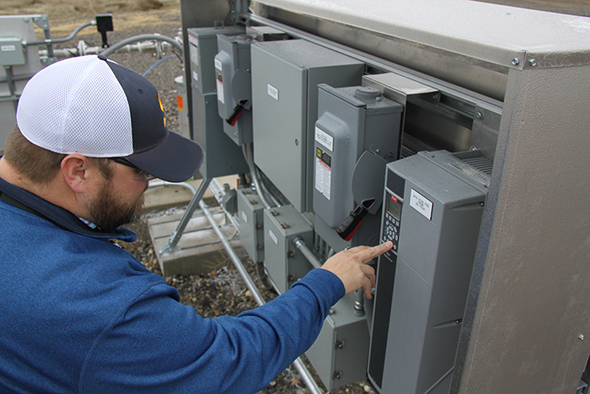
Buddy Cunningham, a construction project manager with CH2M HILL Plateau Remediation Company, checks equipment at the Hanford Site’s recently expanded groundwater extraction system.
RICHLAND, Wash. – A recent expansion of the Hanford Site’s groundwater extraction system allows EM’s Richland Operations Office (RL) and contractor CH2M HILL Plateau Remediation Company (CHPRC) to more efficiently remove, transfer, and treat contaminated groundwater.
The expansion involves connecting a third extraction well to a cross-site transfer line and pumping station in the central part of the Hanford Site, improving the ability to remove contaminated groundwater in this area. The connection to a third well completes an expansion project that began in 2017, and nearby monitoring wells will help track the performance of the remediation effort.
“We continuously look for ways to improve groundwater cleanup methods at Hanford,” RL Soil and Groundwater Federal Project Director Mike Cline said. “The success of this project is another positive step toward our goal of removing contaminants and reducing the threat to the Columbia River.”
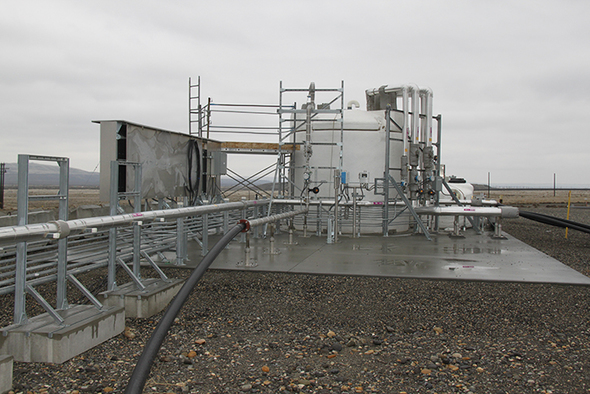
An expanded groundwater remediation system in the central part of the Hanford Site connects extraction wells to an existing pipeline and pumping station to more efficiently remove, transfer, and treat contaminated groundwater.
About 7 million gallons of contaminated groundwater are extracted monthly from the wells and transferred about 5 miles via an aboveground pipeline to the 200 West Pump and Treat facility. The project removes contaminants from past plutonium production, like uranium, technetium-99, cyanide, and nitrate.
Together with the U.S. Environmental Protection Agency and Washington state Department of Ecology, RL selected the pump-and–treat method as a suitable remedy for addressing uranium and technetium-99 in groundwater.
“This expansion significantly improves performance of our extensive groundwater treatment network,” said Bill Barrett, CHPRC’s vice president for the soil and groundwater remediation project. “Using existing infrastructure provides a safe, efficient, and cost-effective method to treat additional groundwater from across the Hanford Site and ultimately better protect our environment.”
Over the past several years, RL has been expanding its systems for treating groundwater in a 10-square-mile area in the center of the site, called the Central Plateau.
RL began operating its largest treatment system at Hanford in the western portion of the plateau, known as the 200 West Area, in 2012. In the last few years, RL has been expanding the system to also remove contamination from the eastern area of the plateau, known as the 200 East Area.
Plutonium production operations from the 1940s through the 1980s contaminated large areas of groundwater with radioactive waste and hazardous chemicals. The goal is to contain contamination and keep it from flowing to the Columbia River, located a few miles away.
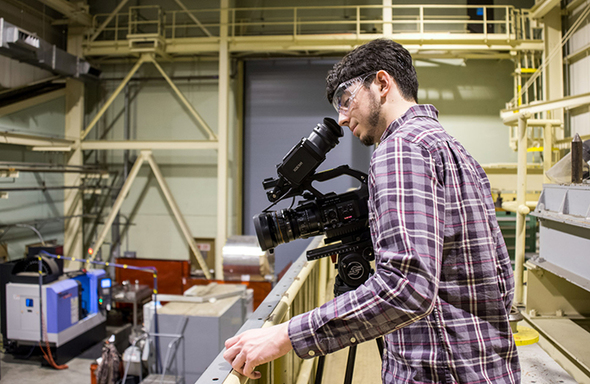
High school senior Micah Gilbert works on his skills as a videographer during Job Shadow Day at DOE's Savannah River Site (SRS). Dozens of local students visit SRS each year to explore a potential career.
AIKEN, S.C. – Area high school students recently experienced how classroom education intersects with the working world during a day of job shadowing at the Savannah River Site (SRS).
“The goal of the program is to ensure that each student, when he or she leaves the site, feels more confident about their decision to pursue a particular career or field of interest,” said Gladys Moore of the education outreach program at Savannah River Nuclear Solutions (SRNS), the site’s management and operations contractor. “We want this experience to have a positive impact on all involved — the student and the mentor — even if the end result is the student now believes another type of job needs to be explored instead.”
To date, most participants in SRS job shadowing have been interested in the field of engineering, though there are hundreds of different occupations at the site.
“February is Job Shadow Month for us; however, we provide the opportunity to shadow site employees throughout the school year,” Moore said. “We devote the resources needed to give students an up-close and personal insight into the job they would one day like to fill.”
South Aiken High School student Kayla Meyer recently spent a day with SRS medical personnel, observing medical procedures, health-related testing, and equipment calibration.
“My time at SRS was valuable and the people there were great," Meyer said. "This learning experience will help me decide which nursing field to choose. Right now, I think it will be emergency medicine."
The DOE-Savannah River Operations Office provides a variety of science and literacy outreach programs with the goals of drawing interest in science, mathematics, engineering, and technology (STEM) and improving education in the Central Savannah River Area.
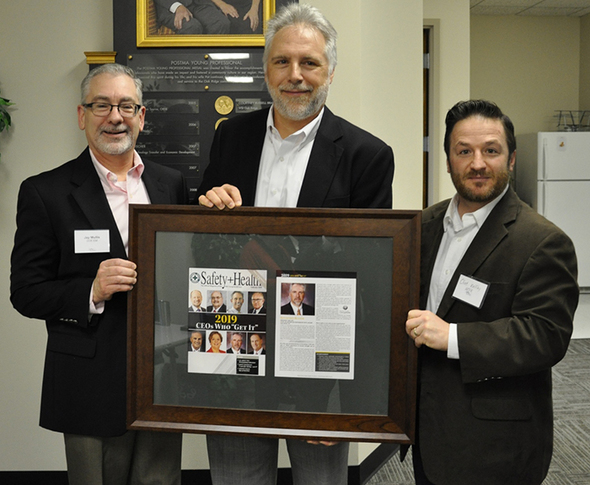
Oak Ridge Office of Environmental Management Manager Jay Mullis, left, and UCOR Environment, Safety and Health and Quality Assurance Manager Clint Wolfley, right, recognize UCOR President and CEO Ken Rueter for being named a 2019 CEO Who “Gets It” by the National Safety Council.
OAK RIDGE, Tenn. – The National Safety Council has recognized the head of Oak Ridge’s lead environmental cleanup contractor as a 2019 CEO Who “Gets It,” a designation that identifies leaders who go above and beyond to protect employees on and off the job.
Ken Rueter, president and CEO of UCOR, was among eight recipients from a cross section of industries to receive this prestigious award.
“Ken is very deserving of this award, which recognizes his role in establishing and maintaining a rigorous safety culture at UCOR,” said Jay Mullis, manager of DOE’s Oak Ridge Office of Environmental Management (OREM). “His efforts, along with those of his senior management team, have helped Oak Ridge earn a reputation as a site that successfully completes projects on time and on budget, while prioritizing the health and safety of those who perform the work.”
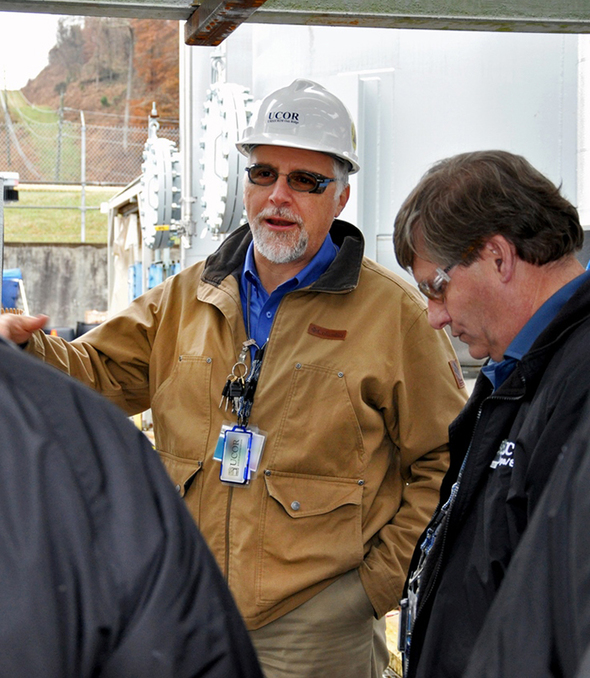
UCOR President and CEO Ken Rueter talks with UCOR employees at a project site, including Liquid Gaseous Waste Operations Project Manager Charles Curtis.
Each year, the council selects CEOs from national and international organizations who have demonstrated a commitment to safety in four key areas: leadership and employee engagement, safety management solutions, risk reduction, and performance measurement.
“I’m very honored to receive this designation,” Rueter said. “I share this honor with the entire UCOR team — the men and women who work hard each day to ensure that we maintain one of the most outstanding safety records in the DOE complex, while successfully accomplishing hazardous cleanup. They deserve the credit.”
UCOR has tackled numerous challenging cleanup projects. OREM and the company helped Oak Ridge become the first site in the world to successfully remove all of its former gaseous diffusion uranium enrichment buildings. Crews are also conducting significant risk reduction activities at the Y-12 National Security Complex and Oak Ridge National Laboratory, including stabilizing and demolishing high risk excess contaminated facilities.
In 2018, UCOR set a record in two key performance measures for reported work injuries — the lowest total recordable case and days-away rates — since its contract began in 2011. For the second consecutive year, UCOR received the DOEVoluntary Protection Program Star of Excellence and the National Safety Council recognized two managers with their 2018 Rising Stars of Safety Award.
“Ken and the other leaders we honor understand that safety is the cornerstone of every world-class business,” said Nick Smith, interim president and CEO of the council. “They have set a standard for their peers and colleagues, and we are proud to recognize their efforts.”
Savannah River Nuclear Solutions President and CEO Stuart MacVean addresses members of its mentor-protégé program at their quarterly continuous improvement event.
AIKEN, S.C. – DOE officials recently joined with Savannah River Nuclear Solutions (SRNS) and its subcontractors for a quarterly event focused on continuous improvement of the Savannah River Site (SRS) management and operations contractor’s mentor-protégé program and its Protégé Center of Excellence.
The SRNS Mentor-Protégé Program is a DOE initiative designed to help small businesses enhance their capabilities as subcontractors across the DOE complex.
“We are working together to drive the success of this program,” said Mark Lochbaum, manager of DOE’s Mentor-Protégé Program, who provided his vision for the program and its impact on DOE’s success. “The Center of Excellence is definitely a step in the right direction.”
SRNS contracts with four protégé companies under the program: UDR Consulting for staffing, ML Builders for construction, Strativia for IT, and US&S for facility management.
SRNS Executive Vice President and Chief Operations Officer Dennis Carr told the protégés that SRNS is committed to their success.
PK Hightower, SRNS corporate manager of continuous improvement, trained SRNS protégés on improving efficiency and quality and building cost savings into work processes. Representatives from the protégé companies discussed expectations of the center.