Site Tours at Portsmouth Offer Public Lessons on Shuttered Facility’s History
PIKETON, Ohio – The DOE and decontamination and decommissioning (D&D) contractor Fluor-B&W Portsmouth invited members of the public inside the security fences of the Portsmouth Gaseous Diffusion Plant for a visual history lesson before the shuttered facility is demolished.
About 20 comprehensive tours were held in 2011 for county commissioners, mayors, local media, high school students, economic development officials, educators, and even 40 residents of the Bristol Village retirement community in Waverly, located about 12 miles north of the plant. The retirement community is located in a former federal housing project constructed in the early 1950s for the more than 22,000 construction workers who built the plant.
Many local residents had never thought they would have the opportunity to see inside the massive 3,800-acre federal facility that was built during the height of the Cold War to enrich uranium under the nation’s nuclear weapons complex for national defense. Production ended in 2001 after nearly 50 years of operations, and the facility is now part of the world’s largest cleanup program.
DOE awarded Fluor-B&W a $2.1 billion contract in August 2010 for D&D of the more than 300 buildings and structures on-site, a project expected to take at least 10 to 15 years to complete.
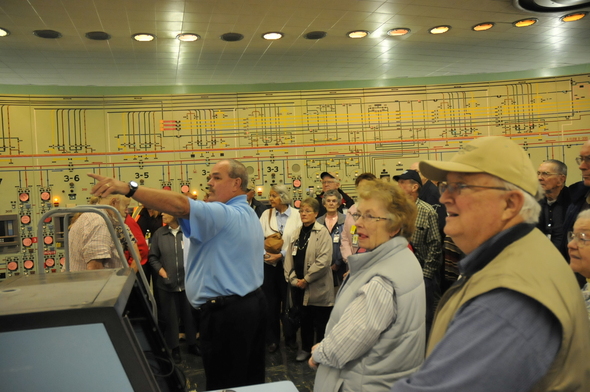
Residents of the Bristol Village retirement community receive an overview of the Portsmouth Gaseous Diffusion Plant’s control facility, the hub of the plant.
Tours Lead to Informed Input
“This is a part of our overall strategy to help educate the public on the history of this site,” said Dr. Vincent Adams, DOE site director. “We have so many decisions that will be made on the cleanup over the next couple years. It is important that we help our communities better understand the facility so they can provide more informed input for the future of this site.”
The enormity of the plant was a surprise to first-time visitors.
“I was impressed by the size of the plant and had no idea it was that large,” said Glenn Noble of Bristol Village. “I thought the tour was extremely interesting and getting to go inside the Control Center and seeing it in operation was the highlight to me.”
Participants Range from Retirees to High School Students
During a DOE-sponsored Science Alliance held at the site in October, more than 1,200 high school students were given a tour of the facility before participating in a dozen interactive science demonstrations and activities.
The alliance helped 18-year-old Piketon High School senior Kayla Crabtree learn about operations at the plant.
“I always thought that it was a dangerous place and that nobody could come here except for the people who work here,” she said. “Now I know better.”
Economic Development Officials Consider Future Uses of Site
In addition to the educational aspects of the tours, a concerted effort is being made by Fluor-B&W to bring together economic development experts to tour the Portsmouth facility and work toward potential future uses of the site. The plant is situated in the county with the highest unemployment rate — 15 percent — in Ohio.
Under a Community Commitment Plan that was submitted as part of the company’s proposal to DOE, Fluor-B&W is investing 5 percent of its fee toward the four-county region surrounding the plant. Of that amount, 80 percent will go toward economic development initiatives to provide the greatest impact to the region.
“Our intent is to safely and successfully complete the D&D of the plant for DOE and leave the site in a condition that best supports the community’s vision,” said Fluor-B&W Program Manager Jamie Jameson. “Our goal is to have this site ready for future users to bring jobs to southern Ohio.”
A regional collaborative network has formed to work toward a regional strategic plan. The network includes county economic development representatives, elected officials, industry organizations and organizations such as DOE’s community reuse organization called the Southern Ohio Diversification Initiative.
More Recycling Means Less Waste for DOE
LAS VEGAS – What do batteries, lead bricks, and mineral oil have in common?
They are all on the list of recently recycled materials at the Nevada National Security Site (NNSS). The goal of these recycling efforts is to minimize waste volumes at the site and encourage the repurposing of materials across the DOE Complex.
In September 2011, a total of 33,000 pounds of lead was shipped from the NNSS to the recycling company, Toxco Inc. A portion of this lead — 13,220 pounds — was recovered during environmental investigation activities at a number of NNSS industrial buildings and historic nuclear test locations. The remaining 19,780 pounds of lead was removed during demolition of the historic Test Cell C facility, one of three test cells located in the Nuclear Rocket Development Station that ceased operations in 1973. Toxco, which received the lead in the form of bricks, battery plates, and counterweights, plans to use the material to make protective shielding for government and commercial nuclear industrial operations.
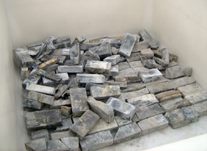
Lead removed during demolition of the historic Test Cell C facility was shipped from the Nevada National Security Site to Toxco, Inc. in the form of bricks for recylcing.
In the summer of 2010, NNSS personnel were able to recycle 7,300 gallons of mineral oil. The oil was removed from leaded-glass windows at the NNSS’ Engine Maintenance, Assembly, and Disassembly (EMAD) compound and taken to Evergreen Recycling Inc. Removal of the mineral oil — in addition to hazardous materials — was done in order to stabilize the facility for future closure and demolition.
Where did these recycled materials originate?Constructed in 1965 as part of the Nevada National Security Site Nuclear Rocket Development Station, the 100,000-square-foot Engine Maintenance, Assembly, and Disassembly (EMAD) facility was used for the assembly of prototype nuclear rocket engines. Mineral oil, which was removed from the facility and recycled, had been used in EMAD windows to increase visibility through thick glass.
“Part of our job is to stay conscious of how we can recycle or reuse the material we recover during cleanup activities,” said Rebecca King, a project manager for National Security Technologies, LLC, the management and operating contractor for the NNSS. “Otherwise the material is considered a waste stream and requires disposal.”
Also slated for recycling are various used fluids that have been gathered since 2009 during well drilling operations and activities associated with draining rail equipment and piping at EMAD. These fluids (626 gallons of oil, 369 gallons of diesel fuel, and 16 gallons of antifreeze) are being held at an onsite location until enough material has been accumulated to make shipping to an off-site recycling facility economical.
“Recycling is a major component of our commitment to restore the NNSS environment to the degree possible,” said Robert Boehlecke, Federal Project Director at DOE’s National Nuclear Security Administration Nevada Site Office. “We will continue to look for recycling opportunities wherever and whenever feasible.”
For more than two decades, the NNSS has been the focus of a massive cleanup effort involving some of the most highly-skilled scientists and engineers in the world. This environmental restoration team works on numerous sites and facilities associated with historic nuclear testing to remove contaminated soil and debris, decontaminate and decommission facilities, and examine potential contaminant movement in groundwater.
Oak Ridge’s New EM Contractor Completes 2,000 Shipments of K-25 Debris
OAK RIDGE, Tenn. – Earlier this month, URS | CH2M Oak Ridge (UCOR), Oak Ridge’s prime Environmental Management (EM) contractor since Aug. 1, made its 2,000th shipment of K-25 demolition rubble to the site’s Environmental Waste Management Facility.
The company reached the significant achievement after only four months of work at the East Tennessee Technology Park (ETTP) superstructure. All 2,000 shipments, comprised of processed steel, asbestos, concrete rubble, compressors, and converters, were completed safely.
UCOR is currently demolishing K-25’s east wing, which accounts for nearly half of the 1.64 million-square-foot former uranium enrichment facility. On Nov. 30, the project’s new federal baseline, which includes the project’s cost, scope and schedule, was approved by Deputy Secretary Daniel Poneman establishing a December 2015 completion date for the project.
“We have made a concentrated effort to accelerate waste disposition,” said Leo Sain, UCOR president and project manager. “The goal is to dispose of waste as it is generated, rather than stage it and dispose of it later. Our employees have embraced our new strategies, and we’ve made great strides toward that goal.”
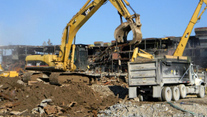
A truck at the K-25’s east wing is loaded with debris for shipment to the Environmental Management Waste Management Facility. URS | CH2M Oak Ridge has completed 2,000 waste shipments since beginning work there Aug. 1.
UCOR’s Waste Management & Disposition organization executed a new waste strategy that immediately increased efficiency and resulted in new records for shipments per day and volume shipped. The strategy requires all wastes to have disposal plans and eliminates double handling and storage through disposal from the point of origin. This practice allows debris to be removed as it is created, eliminating the “staging” process in which debris remains at the cleanup site, often for extended periods.
“We are very pleased with UCOR’s efforts and results,” said Sue Cange, assistant manager for Oak Ridge’s EM program. “UCOR proactively seeks strategies that allow them to complete more work, more efficiently — a sign of an outstanding contractor.”
UCOR is responsible for deactivation and demolition of the K-25 facility at ETTP, as well as other specific scopes of work at ETTP, the Y-12 National Security complex, and the Oak Ridge National Laboratory.
The U-shaped K-25 Building was built as part of World War II’s Manhattan Project. K-25 housed the world’s first gaseous diffusion plant for enriching uranium and became a key part of the industrial base supporting the nation’s nuclear weapons program. When it was built, K-25 contained more than 3,000 stages of gaseous diffusion equipment and 400 miles of piping.
Oak Ridge Uses Savings for Additional Cleanup
OAK RIDGE, Tenn. – Oak Ridge’s prime EM contactor, URS | CH2M Oak Ridge (UCOR), and its team of subcontractors recently cleaned a contaminated area of First Street at the Oak Ridge National Laboratory (ORNL). The $85,000 project was accomplished using cost savings from other UCOR projects in Oak Ridge and returned the area to a safe and useable state.
Radioactive contamination caused by a broken legacy waste line was discovered in May. Workers immediately isolated the area to prevent ORNL employees from receiving contamination. The line was repaired and the associated contaminated soil was placed in containers for disposal, but the area remained unavailable for use.
The project involved removing 120 feet of fencing, 30 cubic feet of contaminated soil, and thoroughly cleaning, surveying, and resurfacing the sidewalk and parking area. In addition to this effort, UCOR has taken steps to identify and plan for disposal of hundreds of containers and waste piles at East Tennessee Technology Park (ETTP), Y-12 National Security Complex and ORNL. Oak Ridge’s DOE and contractor employees have inventoried waste and developed independent cost estimates for disposition at the three sites.
“This is just one example of our company taking the initiative to clean up an area that contractually we were only supposed to monitor,” said UCOR President and Project Manager Leo Sain. “We are continuing to find other areas where it makes more sense to clean them up now, rather than watch them indefinitely.”
Since the waste is generally grouped in small, widely scattered units that are often difficult to track and manage, UCOR Surveillance and Maintenance Manager Bobby Smith advocates timely disposal.
“Ultimately, the best way to manage these small, discreet waste units is to properly characterize and dispose of them. Once that is done, resources that were being used to watch and maintain them can be applied to advance other cleanup projects throughout the site,” he said.
Energy Secretary Chu Honors Van Luik for Advancing International Relations
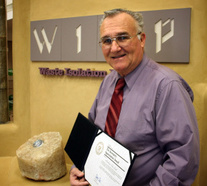
CARLSBAD, N.M. – Dr. Abraham Van Luik, Carlsbad Field Office (CBFO) International Programs Manager, was recently recognized by U.S. Energy Secretary Steven Chu for his efforts to further DOE international relations as part of the 8th meeting of the U.S.-Argentine Joint Standing Committee on Nuclear Energy Cooperation (JSCNEC) in Carlsbad, N.M. in July 2011.
“I really appreciate the management of the Carlsbad Field Office, the Office of Environmental Management and the Secretary of Energy for this award. I also would like to recognize the staff of Washington TRU Solutions (WTS), who made the logistic challenges of hosting this conference look easy,” said Van Luik.
Christine Martin, State Department Foreign Affairs Officer and joint host, summarized the four-day conference as “one of the best managed enterprises in which I’ve been privileged to be involved.”
As part of the conference, JSCNEC members held bilateral talks on international security, nonproliferation policies, technical collaboration, nuclear power and waste management.
“Uncontrolled radioactive materials do not recognize national borders,” Van Luik said. “Whenever we can demonstrate to other nations how to do something safely — in this instance the permanent disposal of radioactive waste — we help to make the world a safer place.”
“When one country properly manages its radioactive waste materials, it protects its neighbors and the world,”
-- Dr. Abraham Van Luik
The visitors toured WIPP’s surface and underground facilities to see firsthand the U.S. solution to safe isolation of nuclear defense waste. They observed waste handling operations on the surface and descended 2,150 feet underground to see how waste is permanently emplaced in the repository.
Representatives from CBFO, Los Alamos National Laboratory-Carlsbad Operations, Sandia National Laboratories-Carlsbad Programs and URS Washington TRU Solutions, the management and operating contractor, presented WIPP scientific and engineering data to JSCNEC members during a half-day session and fielded questions related to deep geologic disposal.
Local community leaders also joined the JSCNEC group at a DOE-hosted meeting to discuss the community involvement in WIPP and public acceptance issues related to WIPP. Community involvement dates back to the mid-1970s, when studies were conducted that led to the establishment of WIPP.
Van Luik believes international collaboration on nuclear safety has an enormous payoff.
“When one country properly manages its radioactive waste materials, it protects its neighbors and the world,” he said.
EM Program for Sharing Challenges and Solutions across DOE Complex Grows Quickly
EM Office Develops Technology to Revolutionize Subsurface Exploration
WASHINGTON, D.C. – In March 2009, EM’s Office of Environmental Compliance launched a platform for sites across the DOE complex to share challenges and potential solutions as they work to complete the world’s largest environmental cleanup.
Since then, the program, called the Compliance Community of Practice (CCoP), has grown from seven federal charter workgroup members to more than 100 environmental professionals from EM and the National Nuclear Security Administration (NNSA) across the U.S. who are responsible for environmental restoration, waste management, technology development, and deactivation and decommissioning.
CCoP offers these cleanup practitioners a dynamic, structured means to receive current information to help them resolve cleanup challenges and obtain notices on regulatory updates, training opportunities, conferences and other beneficial resources.
Conferences
Bring Together Environmental Professionals
Office of Environmental Compliance Director Bill Levitan holds the title of CCoP Champion. During the calls, he presents opening remarks and shares information such as budget updates and significant regulatory concerns being addressed by EM senior management.
In the calls, employees from each site are asked to share environmental concerns or solutions, and they have the opportunity to communicate information useful to other sites. They may choose to focus on specific topics, such as reliable groundwater monitoring tools or challenges involved in cleaning up polychlorinated biphenyls, which are toxic organic chemicals banned from production by the U.S. in 1979.
EPA
Guides EM, NNSA on Green
During the calls, EPA officials have talked about green remediation strategies that could help EM and NNSA conserve natural resources, minimize waste generation and reduce energy consumption. For example, one strategy is to maximize the use of renewable energy with a goal of using 100 percent renewable energy to power site operations, and identify methods for increasing energy efficiency.
Also, ITRC, a state-led coalition working to advance the use of innovative environmental technologies and approaches, gave a presentation to CCoP on how ITRC reduces regulatory barriers to the use of those technologies and approaches. The coalition offered CCoP members assistance from its Internal Remedy Review Committee and discussed its environmental-related Internet training courses. One of those courses highlights the use of biofuels and biofuel blends as a category of transportation fuels. The coalition has also discussed its publicly available documents, such as one titled, “Issues of Long-Term Stewardship: State Regulators' Perspectives.”
CCoP Draws on News Flashes, EM Internal Network
Other tools to promote communication and collaboration are CCoP’s news flashes and EM’s online internal information-sharing network, which features the program’s news flashes, meeting minutes and presentations from CCoP conference calls. The news flashes are contained in emails sent to the entire team, and they include information such as changes in environmental regulations, conferences, training opportunities, updates on EPA actions and other information beneficial to the environmental practitioners.
For more information on CCoP, contact the Office of Environmental Compliance Environmental Compliance Program Manager Connie Lorenz at 202-586-8289 or connie.lorenz@em.doe.gov.
WASHINGTON, D.C. - EM’s Office of Technology Innovation and Development (OTID) is integrating investments in basic science, applied research and site operations to address the most techno¬logically challenging and costly problems in the cleanup of the nation’s nuclear weapons complex.
The ability to locate and view contamination below the ground’s surface is one of the single most significant challenges to subsurface remediation and closure, particularly for the vadose zone, which is the area between the ground’s surface and the water table.
Advancements in geophysical exploration through high-performance computing provide a new means for accurate, high-resolution visualization of subsurface contaminant plumes.
Through a partnership, OTID’s Deep Vadose Zone–Applied Field Research Initiative (DVZ-AFRI) is developing technologies to successfully meet cleanup goals. The partnership includes EM’s Office of Groundwater and Soil Remediation and Pacific Northwest National Laboratory, which are leading the initiative; DOE’s Office of Science; Hanford site contractors CH2M HILL Plateau Remediation Company and Washington River Protection Solutions; subcontractor hydroGEOPHYSICS, Inc.; Richland Operations Office; and Office of River Protection.
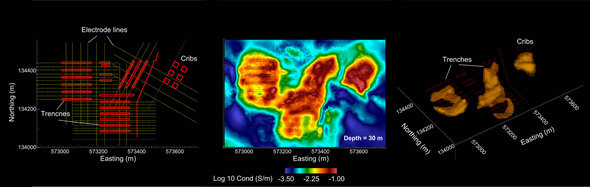
DVZ-AFRI developed technology — known as advanced high-performance geophysical inversion code — to reconstruct 3-D subsurface images using electrical imaging techniques.
EM’s Office of Technology Innovation and Development developed technology to produce 3-D images of subsurface electrical conductivity caused by subsurface contamination at BC Cribs and Trenches, one of many areas at the Hanford site that has deep vadose zone contamination.
Collaborating with members of the partnership, DVZ-AFRI demonstrated the capabilities of this technology at BC Cribs and Trenches, one of many areas at the Hanford site that has deep vadose zone contamination. Advanced Simulation Capability for Environmental Management — OTID’s program for developing next-generation simulation tools — provided high-resolution visualization of subsurface contaminant plumes.
These advancements provide methods to locate, characterize, and monitor subsurface contaminant plumes; reduce uncertainty in estimating the 3-D distribution of parameters that govern flow and transport; monitor and validate remediation activities as they take place; and monitor post-remedial performance.
Carlsbad Field Office Recognized by New Mexico and DOE for Environmental Excellence at WIPP
CARLSBAD, N.M. – New
Mexico and DOE recently recognized the Carlsbad Field Office (CBFO) for environmental
excellence in the Waste Isolation Pilot Plant (WIPP) South Access Road project.
The New Mexico Environment Department (NMED) recently selected CBFO for a
Bronze Award under its Green Zia Environmental Leadership Program, and CBFO was
a recipient of one of the 2011 DOE Sustainability Awards. In addition to CBFO, the
WIPP team included members of Washington TRU Solutions (WTS), LLC, the WIPP
management and operating contractor; WTS subcontractors Constructors Inc. and
Pettigrew & Associates; and the U.S. Department of Interior Bureau of Land
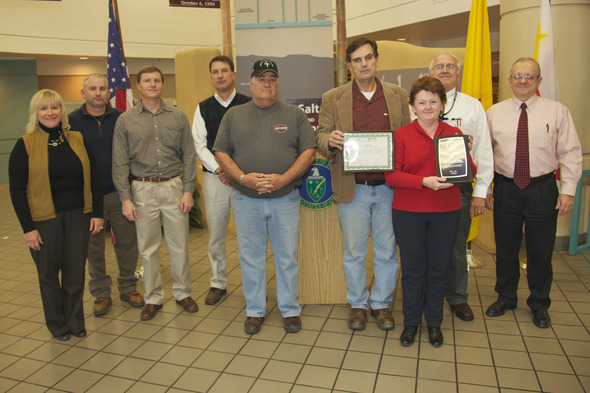
Management (BLM). In this photo, CBFO Interim Manager Ed Ziemianski (far right)
presents the Bronze Award and the 2011 DOE Sustainability Award to several
recipients. Shown from left to right are Debra Hicks and Randy Pettigrew of
Pettigrew & Associates; Owen Lofton of BLM; Hank Carey and Ronnie Crockett
of WTS; Dan Ferguson of CBFO; and Judy
McLemore and Bob Kehrman of Washington Regulatory and Environmental Services,
WTS environmental consulting subcontractor.
Savannah River Site Offers 30 Public Tours in 2012
AIKEN, S.C. – The Savannah River Site is hosting 30 tours to the public in 2012, offering up to 1,500 participants an opportunity to better understand the site’s history, current activities and future missions.
Each tour accommodates up to 50 people. Guests will be provided an overview presentation, safety briefing, tour of the Savannah River Ecology Laboratory and general driving tour of the site.
Tours are free of charge. Participants must be 18 years old or older and U.S. citizens.
AIKEN, S.C. – Savannah River Remediation (SRR), the liquid waste contractor at the Savannah River Site (SRS), began a major, planned suspension of operations at the Saltstone Production and Disposal Facilities this month to perform enhancements to increase reliability and production rates of the facilities.
The outage, called Enhanced Low Activity Waste Disposal (ELAWD), is expected to continue through August 2012. Planned improvements will add to Saltstone’s performance for years to come and will be necessary when the Salt Waste Processing Facility (SWPF) becomes operational in 2014, according to Steve Wilkerson, Waste Treatment Manager for the Saltstone Facilities.
“Saltstone will end 2011 tying last year’s record of processing nearly 1.5 million gallons of decontaminated salt waste,” Wilkerson said. “Once the ELAWD improvements are made, Saltstone will be able to support a 24/7 work schedule, which will be required when the SWPF comes online, and provide a more significant reliability factor for operations.”
An outage also will occur in the Interim Salt Disposition Process, a salt processing facility that will eventually be replaced by the SWPF. Planned upgrades will extend the life of the facilities until SWPF is operational.
Contributors Box
Sandy Childers, Portsmouth site
Tim Johnson, Pacific Northwest National Laboratory
Rick Kelley, Savannah River Site
Connie Lorenz, EM Office of Environmental Compliance
Angela Ramsey, Nevada Site Office
Susan Scott, Waste Isolation Pilot Plant
David Sheeley, EM Office of Communications and External Affairs
Dawn Wellman, Pacific Northwest National Laboratory