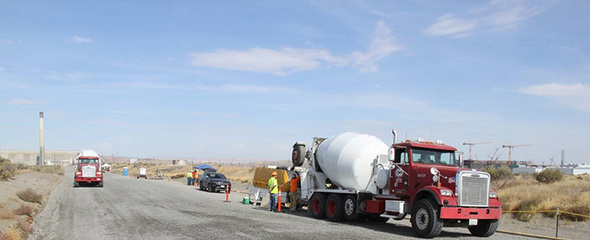
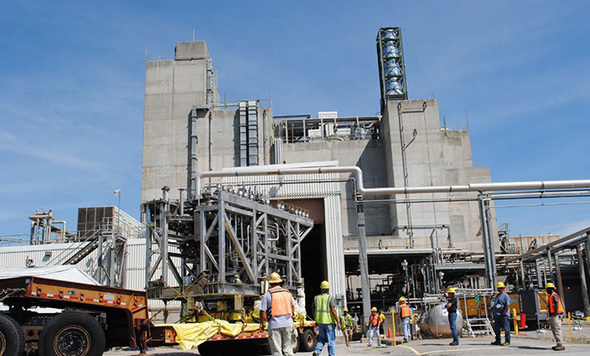
Trucks carry engineered grout from a nearby batch plant to the PUREX Plant Tunnel 2, where pumps insert the grout using piping connected to existing openings in the top of the tunnel.
RICHLAND, Wash. – Trucks are delivering engineered grout to stabilize a waste storage tunnel on the Hanford Site.
Last week, EM’s Richland Operations Office (RL) authorized contractor CH2M HILL Plateau Remediation Company (CHPRC) to begin filling Tunnel 2 at the Plutonium Uranium Extraction (PUREX) Plant.
PUREX Tunnel 2 is at risk of collapse, as documented in an engineering evaluation performed after PUREX Tunnel 1 collapsed in May 2017. The risk of collapse was further documented following video camera inspections from February through April 2018 that showed corrosion of steel support beams and brackets in Tunnel 2.
“Grout placement will protect workers, the public, and the environment, while not precluding future options for disposition,” said Al Farabee, RL project director for waste management.
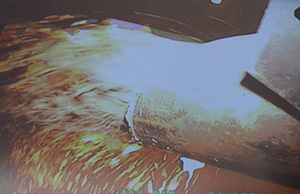
Lights and cameras recently installed inside the PUREX Plant Tunnel 2 allow workers to monitor the grout flowing into the tunnel.
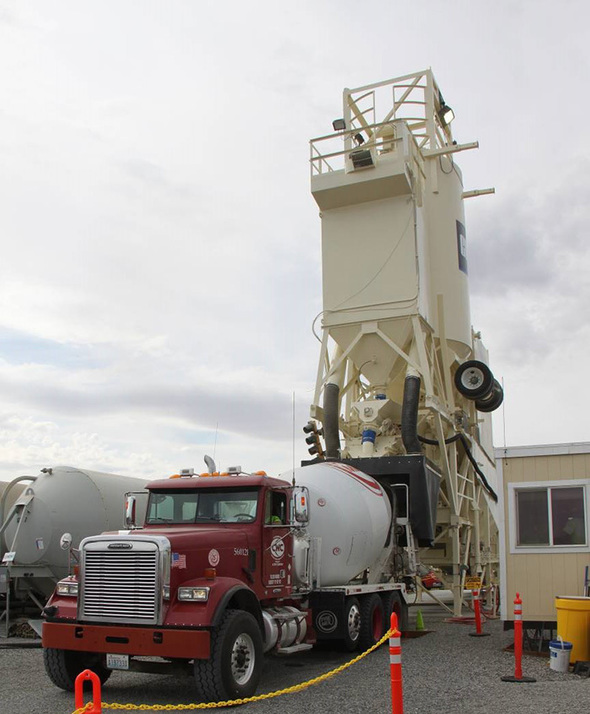
A mobile batch plant near PUREX Plant Tunnel 2 will mix approximately 43,000 cubic yards of grout to stabilize the tunnel.
It will take an estimated 5,000 truck trips to haul 43,000 cubic yards of grout to fill the 1,688-foot-long Tunnel 2. To reduce impact to site traffic, a nearby mobile batch plant mixes the grout.
Cameras and lights recently installed in Tunnel 2 help crews monitor the flow of the grout. This video explains the tunnel stabilization project.
“Thank you to everyone at CHPRC for helping to ensure we were ready to place grout,” said Mark Wright, vice president of CHPRC’s project technical services. “From purchasing, to environmental planning, engineering and radiological control — everyone across our company helped ensure a smooth, safe start to this important risk reduction effort.”
Stabilization is scheduled for completion in early 2019.
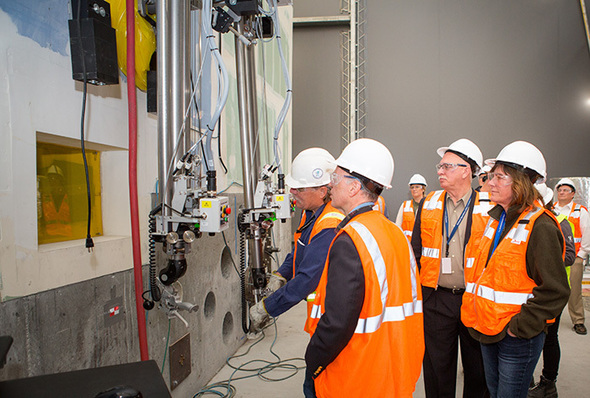
Dwight Bowman, 324 Building equipment operator, left to right, demonstrates a manipulator moving objects in the mock-up of a 324 Building hot cell for DOE Chief Financial Officer John Vonglis, Richland Operations Office Manager Doug Shoop, and EM Assistant Secretary Anne White.
EM Assistant Secretary Anne White visited the Hanford Site last week. Following is her report on the trip:
Another fantastic trip to Hanford completed, my fourth in the six months since I was sworn in. I hope to compile travel like this at all the sites.
On this trip I joined Jim Herz, Associate Director at the Office of Management and Budget for Natural Resources, Energy and Science, and John Vonglis, our DOE Chief Financial Officer. We had a great tour and managers Brian Vance, Doug Shoop and I worked with folks at the site to help Jim and John understand the complexities at Hanford, and, more importantly, how we can be better stewards of the taxpayers' money. They both asked some great questions and gained a real understanding of what we’re trying to do here. Making progress through partnerships with organizations external to EM is important (you’ll be hearing me say this a lot).
And I have to give a big shout-out to Dennis Myers with Mission Support Alliance, the driver on our tour. He was incredibly efficient, got us in front of a stunning herd of elk, and took such great care of us I barely noticed I was riding backwards the whole time! Thanks Dennis for all you do.
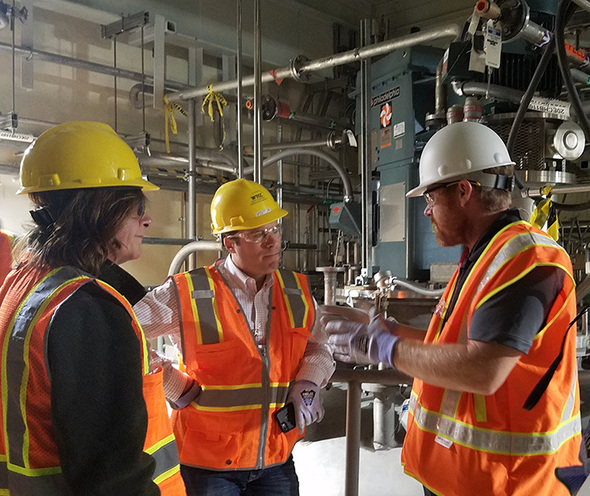
Tom Fletcher, EM Office of River Protection Assistant Manager and Federal Project Director, Waste Treatment and Immobilization Plant (WTP) Project, right, gave a walking tour of the WTP to Anne White, EM Assistant Secretary, and Jim Herz, Office of Management and Budget Associate Director of Natural Resources, Energy and Science, during their visit to Hanford Site Oct. 3.
I also spoke at the Tri-Cities Connect STEM event, a job fair that brings together labor, veterans, employers, educators, and students to see how many awesome STEM careers there are, including fantastic technical and trade opportunities. There was a student competition where teams had to try and figure out how to rescue 50 people from an island (remember the Amazon, anyone?) and those kids were impressive as all get out! The highlight of the event was presenting over $20,000 in scholarships to the top three teams: Chiawana High School in third place, Tri-Tech Skills Center in second (with impressive manners) and Kiona-Benton City High School in first place. Congratulations to all of you. I saw a lot of folks at this event, everyone from representatives of Senators Murray and Cantwell’s offices, TRIDEC, and labor unions, to science presenter Kevin Delaney, our site folks, and other members of our DOE team including Kelly Mitchell from DOE's Office of Economic Impact and Diversity – great turnout from all corners.
I was able to meet with several stakeholders, too, including the Yakama, Wanapum, Nez Perce, and Confederated Tribes of the Umatilla for a Tribal dinner. It was so important to share a meal. I feel I understood the meaning of their prayers and song. It is an unbelievable experience to work with these Nations and have them share their cultures and languages so freely. I am working to find more ways to make progress through partnership with our Tribes and appreciate all the efforts of our EM team to move the ball forward here.
The first transfer of radioactive waste to Saltstone Disposal Unit 6 at the Savannah River Site has been completed.
AIKEN, S.C. – About 8,500 gallons of low-level liquid waste from an underground waste tank at Savannah River Site (SRS) have been treated and transferred to Saltstone Disposal Unit (SDU) 6, making this the first transfer of radioactive liquid waste to the mega-volume unit.
The low-level liquid waste, known as decontaminated salt solution (DSS), was treated at the Saltstone Production Facility and placed into SDU 6, the newly constructed disposal unit with a 32.8-million-gallon capacity.
SDU 6 was designed and built by SRS liquid waste contractor Savannah River Remediation (SRR) and will accommodate the large stream of DSS from the Salt Waste Processing Facility (SWPF), currently undergoing testing and commissioning. Until SWPF comes online, SDU 6 will be filled with the DSS processed by the site’s interim salt waste processing facility, the Actinide Removal Process/Modular Caustic Side Solvent Extraction Unit (ARP/MCU).
ARP/MCU removes the highly radioactive isotopes, primarily cesium, from the tank waste, which are then transferred to the Defense Waste Processing Facility to be turned to glass and safely stored at SRS, awaiting permanent disposal. The remaining waste stream — the DSS — is transferred to the Saltstone Production Facility for stabilization into a grout-like waste form. The waste is then pumped into the SDU, where it solidifies into saltstone, a non-hazardous waste form.
SDU 6 will also receive DSS from the recently installed Tank Closure Cesium Removal (TCCR) demonstration project. TCCR is designed to remove cesium from the high-level waste currently stored in H Tank Farm.
DOE is committed to safe and efficient waste removal at SRS, according to Jim Folk, DOE-Savannah River assistant manager for waste disposition.
“Significant work has been performed to advance the SRS liquid waste program,” Folk said. “The start of SDU 6 radioactive operations is another step toward safe disposal of decontaminated salt solution.”
Tom Foster, SRR president and project manager, said SDU 6 demonstrates that the mega-unit concept is an excellent addition to meet the needs of the liquid waste mission.
“The award-winning Saltstone Disposal Unit 6 project is instrumental to the liquid waste system,” Foster said. “Processing the first radioactive transfer is a significant milestone in the life of this project.”
SRR is currently constructing the second mega-unit, SDU 7. Excavation was completed this summer, and the foundational mud mats and protective liners are being installed. SDU 7 cell construction will begin later this fall.
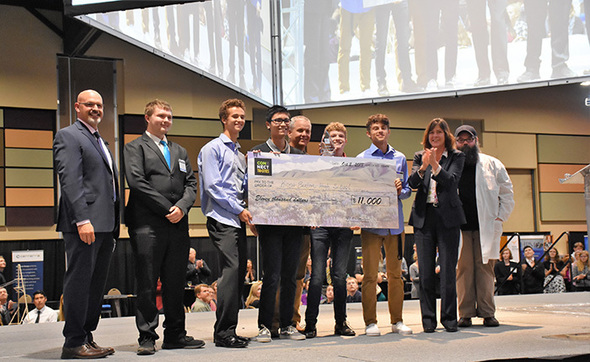
The winning team of the STEM Scholarship Competition was from Kiona-Benton High School of Benton City, Washington. Team members stand with Bob Wilkinson, president of EM Richland Operations Office contractor Mission Support Alliance, far left, science presenter Kevin Delaney, far right, and EM Assistant Secretary Anne White, second from right.
RICHLAND, Wash. – To help develop the future workforce, Hanford Site contractors and community leaders held the second annual Connect Tri-Cities event last week. Thousands of job seekers, including 1,000 high school students, met with local businesses, universities, and other organizations to discuss career paths.
A major highlight of the event was the STEM (Science, Technology, Engineering, and Math) Scholarship Competition for high school students. More than $20,000 in scholarships was awarded as part of the competition.
“The Department of Energy, and in particular EM, relies on every partner here tonight to deliver our mission,” White said. “Events like these show the power of partnerships.”
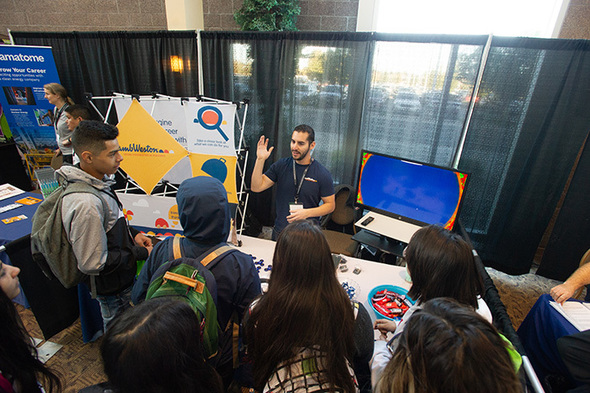
More than 1,000 local high school students and job seekers attended the Connect Tri-Cities event.
Bob Wilkinson, president of EMRichland Operations Office contractor Mission Support Alliance (MSA), said it’s exciting to see the eagerness of job seekers, especially veterans and students, as they learn about potential opportunities in the area.
“This event is significant for our community,” Wilkinson said.
Attendees met with experts to discuss resume writing and preparing for job interviews.
“I give a huge amount of credit to MSA and DOE for their commitment to Connect Tri-Cities,” said Carl Adrian, president of the Tri-City Development Council (TRIDEC). “I know this is only the second year for the event, but they have created partnerships with many organizations to focus attention on career opportunities and resources available in our community.”
The event also included several breakout sessions for veterans and a panel discussion focused on diversity and inclusion featuring several community leaders.
Connect Tri-Cities is a unique community event championed by TRIDEC and sponsored by MSA and its corporate partners, Leidos and Centerra Group.
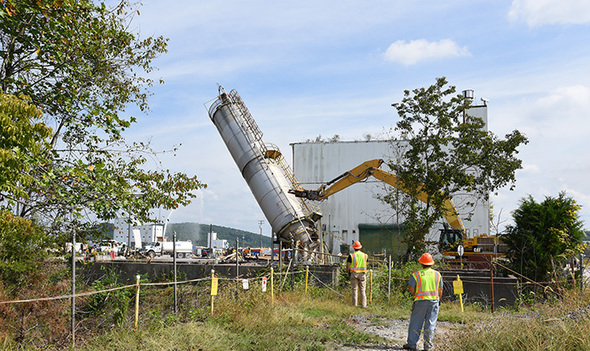
Crews began demolishing Building K-1232 by knocking down a 74-foot silo that was part of the structure.
OAK RIDGE, Tenn. – DOE’s Oak Ridge Office of Environmental Management (OREM) and its cleanup contractor URS | CH2M Oak Ridge (UCOR) have demolished five buildings in the Poplar Creek area of the East Tennessee Technology Park (ETTP) since last year, and one more will soon be added to that list: the K-1232 Chemical Recovery Facility.
Crews began demolishing K-1232 on Oct. 3, and the project is expected to be complete in a month.
This work is advancing OREM and UCOR toward Vision 2020 — the goal to complete all demolitions at ETTP in 2020. So far, OREM has torn down more than 400 facilities and transferred more than 1,000 acres to the community for economic reuse and development.
The Poplar Creek area contains the most contaminated buildings remaining at ETTP. Before demolitions began last year, the area housed several facilities —some dating to the 1940s and '50s — that supported the site’s former nuclear program and operations.
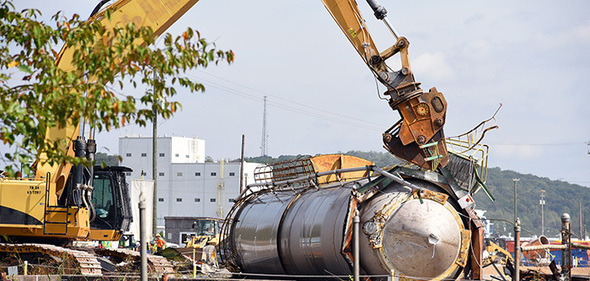
Made of stainless steel, the 74-foot silo will be shipped for recycling.
One by one, OREM and UCOR have removed old, dilapidated, and contaminated buildings to enhance safety and clear land to achieve EM’s goal of converting ETTP into a private sector industrial park, national park, and conservation area.
Teardown activities began in an impressive fashion with crews bringing down a 74-foot-tall silo that was part of K-1232. Made of stainless steel, the silo will be shipped for recycling.
The 140-foot-by-60-foot, two-story K-1232 facility was built in the early 1970s to recover chemicals resulting from site operations. Those activities ceased in 1982, and the facility was later used to treat wastewater from the Y-12 National Security Complex until the early 1990s.
“The K-1232 demolition continues a string of large Poplar Creek facilities that have been removed, moving us closer to our ultimate cleanup and reindustrialization goals for the site,” Acting ETTP Portfolio Federal Project Director Karen Deacon said.
The other major Poplar Creek facilities crews have removed to date include the K-832-H Cooling Tower, K-832 Cooling Water Pumphouse, K-1203 Sanitary Sewage Treatment Facility, Building K-633 Test Loop Facility, and K-1314 Complex. Workers also took out several tie lines, which are pipes that were used to transport enriched uranium. The tie lines connected the buildings.
IDAHO FALLS, Idaho – EM and its cleanup contractor at DOE’s Idaho National Laboratory (INL) Site recently completed a complex waste processing project that will allow 214 waste drums to leave the state for permanent disposal.
Fluor Idaho crews used an excavator to open the drums and process the waste form called “roaster oxides,” or reactive uranium, within the Accelerated Retrieval Project (ARP) IX facility at the Radioactive Waste Management Complex.
Like plutonium, americium, and hazardous solvents, roaster oxides were generated during Cold War weapons production at the Rocky Flats Plant near Denver. The uranium was roasted, or cooked, to force the reactive metal to oxidize and render it safe for transport to the INL Site, which received the waste from 1954 until the late 1980s.
Crews characterized the contents of more than 200 drums as roaster oxides at the Advanced Mixed Waste Treatment Project. The ARP IX facility is intended for retrieving buried waste. However, that work hasn't taken place yet, so EM is using the facility to safely process the roaster oxides.
“This project was very successful,” Fluor Idaho Project Manager Jason Chapple said. “We adapted an existing waste treatment process and utilized the expertise of our workforce to safely address this challenging waste stream.”
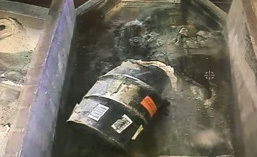
Waste containing roaster oxides is emptied from a drum into a tray at the Accelerated Retrieval Project prior to being raked through with an excavator.
Chapple noted that Fluor Idaho’s waste generator services team did a great job supporting the processing of the difficult waste stream. The waste material, now safe for transport, will be sent to an offsite disposal facility.
Crews will soon exhume buried waste within the ARP IX structure in support of a 2008 record of decision between DOE, the U.S. Environmental Protection Agency, and the state of Idaho that requires the removal of targeted waste from a combined area of 5.69 acres of the 97-acre Subsurface Disposal Area.
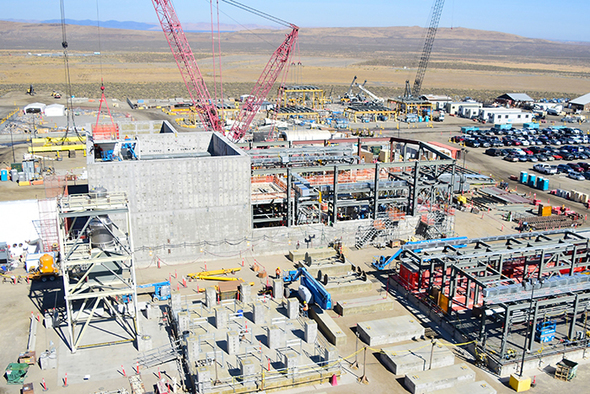
Hanford’s Waste Treatment and Immobilization Plant has received the necessary permit approvals from the state of Washington to complete construction of the Effluent Management Facility.
RICHLAND, Wash. – The Washington State Department of Ecology has granted the permits needed for Hanford’s Waste Treatment and Immobilization Plant (WTP), or Vit Plant, to finish construction of the Effluent Management Facility (EMF).
The permits enable EM’s Office of River Protection (ORP) and contractor Bechtel National Inc. (BNI) to install mechanical and piping systems inside the EMF. This work includes process tanks, pumps, pre-fabricated piping modules, heating, ventilation, and air conditioning ducts, and other equipment.
“With the major EMF concrete work complete, having the necessary permits now allows us to safely make a series of heavy-crane lifts to install major pieces of process equipment, followed by bulk installation of all remaining commodities,” said Felice Presti, BNI’s deputy project director for WTP.
EMF work crews are pre-fabricating and pre-assembling many of the equipment and pipe rack modules outside the facility before lifting them into place inside. This allows installation work to continue inside the building, making more efficient use of space and enhancing safety.
During vitrification operations, secondary liquids will be generated from the Low-Activity Waste (LAW) Facility melter off-gas system. These liquids will then go to the EMF where excess water is evaporated and transferred to the nearby Liquid Effluent Retention Facility, while the remaining concentrate is sent back into the vitrification process.
“The permit approvals for EMF are another key step toward achieving the start of DFLAW as soon as possible,” said Jason Young, ORP’s federal project director for the EMF. “We are nearing construction completion on the LAW Facility and are now working to perform startup testing on individual systems. Additionally, more than 80 percent of the systems for the Analytical Laboratory have initiated component testing, and nearly half of the Balance of Facilities systems have completed startup testing and are well into the early commissioning phase.”
The DFLAW approach is expected to enable treatment of low-activity waste to begin in advance of a court-ordered milestone date of 2023. This approach will increase available double-shell tank space and provide valuable lessons learned to aid startup and commissioning of other portions of the WTP.
Savannah River Nuclear Solutions was awarded the Project Management Institute’s Award for Project Excellence for work completed at the Savannah River Site’s D-Area Ash Basins.
LOS ANGELES – The Savannah River Site (SRS) management and operations contractor, Savannah River Nuclear Solutions (SRNS), received the Project Management Institute (PMI) Award for Project Excellence at the PMI Professional Awards Gala on Oct. 6 for its work cleaning up a coal ash basin.
The prestigious award recognizes global, large, and complex projects with superior project management practices and organizational results, and positive impacts on society.
SRNS was recognized for completing the first of two phases of work at the SRS D-Area Ash Basins ahead of schedule and significantly under budget. SRNS expects to complete the project with cost avoidances totaling $8.7 million.
DOE-Savannah River and SRNS are cleaning up the basins used to manage ashes from the D-Area Powerhouse, which provided steam and electricity for SRS missions for more than 59 years. The project aims to protect human health and the environment and prevent ash migration to the Savannah River.
“When the D Area Powerhouse closed in 2012, the cleanup of the ash basins was projected for closure. SRNS supported federal regulators to define a cleanup plan that was respectful of federal tax dollars and given a reasonable timeframe for completion, while also achieving cleanup goals and adherence to regulatory compliance,” said Stuart MacVean, SRNS president and CEO.
DOE-Savannah River and SRNS implemented a $70 million five-year phased approach for the project.
In the first phase, workers consolidated 131,000 cubic yards of ash and dirt from a 15-acre basin into an adjacent ash landfill. They covered the landfill with a clay liner and fill dirt that serves as a drainage layer — more than 926,000 square feet over an estimated 21-acre area — to protect the landfill from rainwater and prevent ash from migrating into the environment.
“Utilizing the cleanup approach agreed upon by SRS regulators and DOE, SRNS was able to capitalize on its exemplary project management expertise to complete the first phase of the D-Area Ash Basin Project at a cost savings of $300,000 while accelerating the completion date by more than one year,” MacVean said.
In the project’s second phase, ash and soil from three additional D-Area basins were consolidated into an adjacent landfill. The landfill was then covered with a geosynthetic cover. Final closure of the second phase of the D-Area Ash Basin Project is expected later this month.
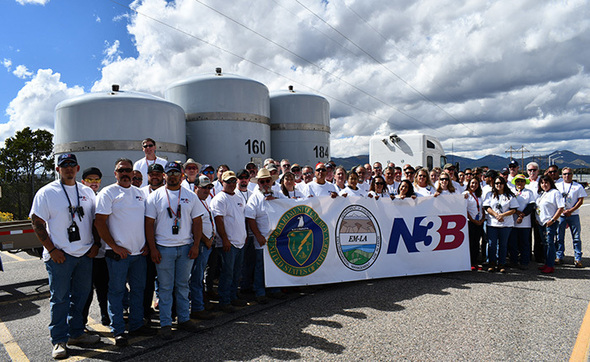
The waste management teams for the EM Los Alamos Field Office and Newport News Nuclear BWXT-Los Alamos gathered to mark the completion of the first waste shipment from Technical Area 54’s Area G at Los Alamos National Laboratory to the Waste Isolation Pilot Plant (WIPP) since WIPP resumed operations in January 2017.
“The resumption of waste shipments from Area G to WIPP is a significant milestone for the EM mission at LANL,” EM Los Alamos Field Office Manager Doug Hintze said. “Our contractor, N3B, accelerated the process of standing up mobile loading operations at Area G. With that capability, EM is ready to ship waste to WIPP as the shipment schedule permits. We look forward to continue to ship waste offsite from LANL on a regular basis.”
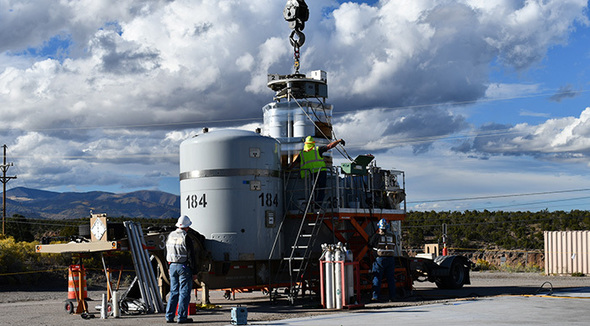
Newport News Nuclear BWXT-Los Alamos waste management staff prepare the waste shipment for transport to the Waste Isolation Pilot Plant.
The latest Area G shipment — the second shipment from LANL to WIPP since WIPP’s resumption of operations — contained waste from NNSA. In November 2017, NNSA sent a waste shipment to WIPP from LANL’s Technical Area 55.
Future Area G shipments to WIPP will consist of legacy transuranic waste from the EM program.
Melter 3 enters the Defense Waste Processing Facility in June 2017. It poured its first canister of vitrified high-level radioactive waste in December 2017.
Savannah River Remediation’s (SRR) noteworthy achievements for the period include:
Completion of repairs of known leak sites on the 3H Evaporator vessel, post-maintenance leak testing, and restarting of the 3H Evaporator. The technology and techniques used in this successful effort can be applied to projects throughout the EM complex. The evaporator reduces tank waste volume.
Resolution of issues with the tank closure cesium removal effort. This work will remove cesium, a radioactive chemical element, from the Cold War legacy salt waste at SRS, accelerating waste removal and tank closure.
Achieving the Tank 15H Bulk Waste Removal Efforts Federal Facility Agreement milestone a month ahead of the Oct. 31, 2017 commitment date.
Addressing DOE concerns regarding technical safety requirements and operation issues through corrective actions.
“SRR management demonstrated a significantly high level of involvement in achieving key milestones toward resumption of operational activities,” said DOE-Savannah River (SR) Deputy Manager Thomas Johnson, the fee determining official.
Johnson said SRR management provided timely prioritization of work scope, clear focus on safe operations, and a demonstrated effort to minimize worker dose during key system evolutions.
DOE-SR identified few notable weaknesses during the period. However, DOE-SR issued a letter of concern regarding deficiencies in the critical lift program. Although no actual events resulted from these deficiencies, DOE-SR recommended the contractor consider an enhanced review of longstanding programs and practices.
This performance period is for a six-month extension of SRR’s contract to accommodate DOE’s competitive procurement process for the award of a new SRS liquid waste services contract.
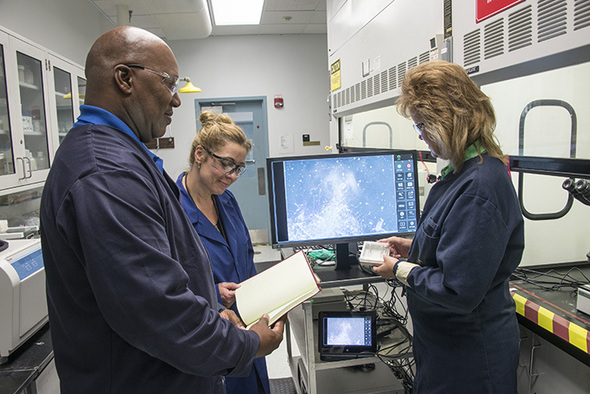
Left to right, Rodney Gantt, laboratory specialist, Linda Youmans, director of the Industrial Hygiene Laboratory, and Becky Chavous, laboratory specialist, test the new radiological asbestos monitoring equipment to ensure it meets laboratory accreditation requirements.
AIKEN, S.C. – EM and its Savannah River National Laboratory (SRNL) continue to consolidate critical analytical capabilities and reduce the Savannah River Site’s (SRS) operational footprint with the latest transfer of radiological asbestos monitoring equipment.
SRNL moved the equipment from its F/H Laboratory to the site’s Environmental Bioassay Laboratory (EBL), the third transfer of analytical capabilities as EM and SRNL complete modifications to aging infrastructure.
EM, SRNL and Savannah River Nuclear Solutions (SRNS), the site’s management and operations contractor, are consolidating the F/H Laboratory into SRNL space, a cost savings move that realigns resources at the site for future missions.
The F/H Laboratory serves EM by evaluating radiological and non-radiological samples for process, product, accountability, and criticality safety analyses. It’s located several miles from most SRNL operations at the 310-square-mile site.
Removing F/H Laboratory operations from the F Area facility allows SRS to place that building in a low-cost surveillance and maintenance mode similar to the F Canyon chemical separations facility, which was deactivated in 2005. This mode allows for a minimal number of employees in the area to perform periodic activities to ensure the facility is safe and poses no risk to the environment.
Asbestos analysis for radiological contamination is a critical need and one-of-a-kind capability at SRS.
“By transferring this analytical capability and merging it with ongoing analytical services performed by EBL, SRNS has retained a unique capability that is difficult to find in commercial laboratories,” SRNL Deputy Director Sharon Marra said.
According to Mary Flora, the SRNS environmental stewardship, safety and health representative in the SRNL modification project, “much of SRS’s infrastructure was constructed in the early 1950s, when asbestos was commonly used. The site’s ability to perform radiological asbestos monitoring is critical to ensure worker safety and health is maintained as SRNS safely and cost effectively executes its mission.”
Prior to the transfer of the radiological asbestos monitoring equipment, the EBL was only able to perform asbestos analysis on non-radiological samples, while those samples suspected to contain radiological contamination were taken to F/H Laboratory.
Typically, asbestos is found in old construction materials such as roofing, ceiling tiles, gaskets, siding and insulation. Most recently, it was discovered in below-ground piping during road construction work on C-Road.
“EBL was able to quickly analyze samples from piping that was uncovered during culvert work on C-Road and ultimately determine the presence of asbestos. Our ability to provide this analysis onsite prevented delays in road construction and most importantly, it provided Industrial Hygiene with accurate data to establish protective measures to prevent employee exposure,” Flora said.
The two F/H Laboratory capabilities SRNL previously transferred to EBL include analysis of tank corrosion chemistry samples and processing of radioactive beryllium samples.
“These transfers yield cost savings and provide centralization of analytical methods, which better aligns laboratory resources for future needs,” Marra said.
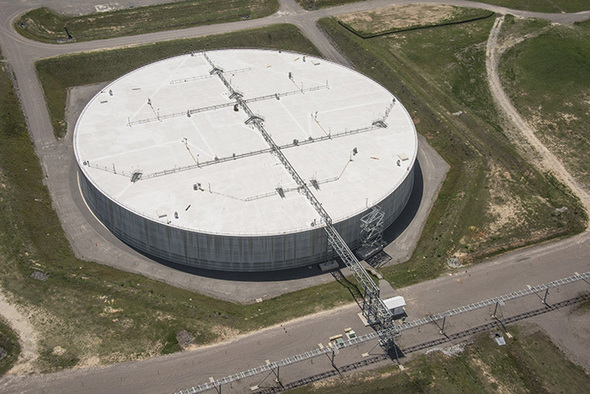
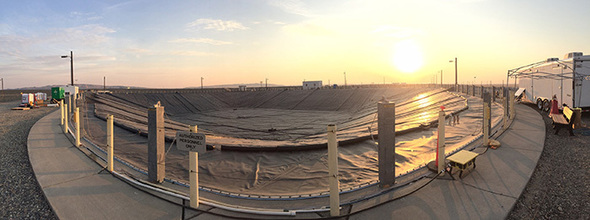
LERF stores wastewater generated by 242-A Evaporator campaigns, which create needed storage space in the double-shell tank storage system by periodically concentrating liquid tank waste, and other Hanford cleanup activities.
The wastewater is stored in three basins at the Effluent Treatment Facility (ETF) complex until it can be treated for disposal. Each basin is permitted to hold about 7.8 million gallons of material.
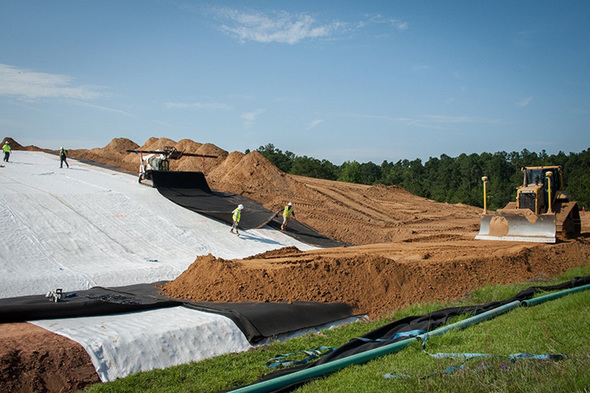
In July and August, workers rolled out panels of the rubber cover material and bonded them together inside the massive basin, roughly the length of a football field and nearly twice as wide. Last month, equipment was reinstalled around the basin perimeter to allow movement of the cover as it floats on the surface of the wastewater in the basin.
Work on the project began in June with removal of the previous cover that had been in use for more than 20 years.
The new cover material is resistant to chemicals, temperature extremes, and ultraviolet light. Basin covers have a variety of functions including helping to prevent potential contamination being spread by birds or other animals and keeping foreign materials out of the wastewater, which could affect its processing at ETF.
The cover for another LERF basin was replaced last year. Replacement of the third basin cover is planned for fiscal 2019.
“ORP is encouraged by the team’s efforts and ability to overcome challenges in safely completing the second cover replacement project,” said Richard Valle, ORP’s LERF and ETF program manager. “Lessons learned from this project will aid in planning and performance when work begins to replace the third and final basin cover this fiscal year.”