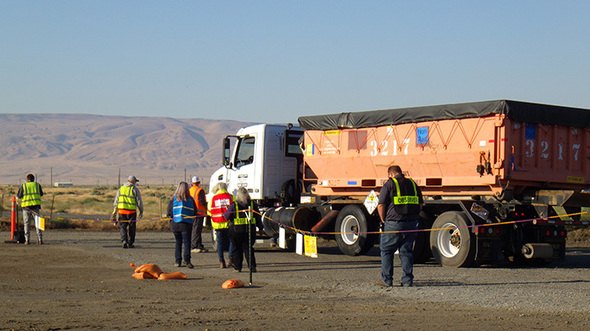
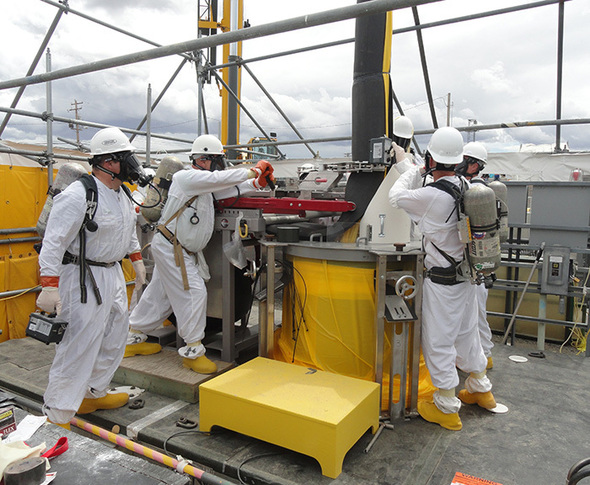
Plutonium Finishing Plant workers conduct mock-ups of waste loadout activities during a management assessment in August to determine preparedness to resume demolition-related activities.
Crews are loading out demolition debris that has been on the ground since December, when work stopped after a spread of contamination.
Since the incident, EMRichland Operations Office (RL) and contractor CH2M HILL Plateau Remediation Company (CHPRC) performed recovery actions and developed a revised demolition strategy.
“The new strategy and enhanced safety controls will help protect workers, the public, and the environment,” said Tom Teynor, RL federal project director. “Additional oversight from DOE and the contractor will ensure those controls are protected.”
Workers have resumed lower-risk demolition-related activities at the Plutonium Finishing Plant. Their first task is loading out demolition debris already on the ground, pictured in this August 2018 aerial image.
The demolition and its related activities will occur in two phases. The first phase involves two lower-risk activities: processing and packaging of existing debris from the Main Processing Facility demolition, followed by the teardown of the remaining lower-risk portions of that facility and an associated vault.
Following another management assessment with DOE oversight, and DOE and regulatory approval, the second phase, consisting of higher-risk work, will begin. That work includes demolishing the Main Processing Facility’s two former processing lines and the tunnels beneath, and removing the remaining rubble from the Plutonium Reclamation Facility demolition.
This animation shows the revised demolition approach and enhanced controls, which reflect worker input. Pauses are built into the schedule to review lessons learned and incorporate additional input before proceeding.
“I want to thank the PFP team for providing valuable input into the plan,” said Jason Casper, demolition resumption manager for Jacobs, parent company of CHPRC. “Our key goal while moving forward is to perform the work safely and compliantly.”
RL will post weekly updates on PFP activities here.
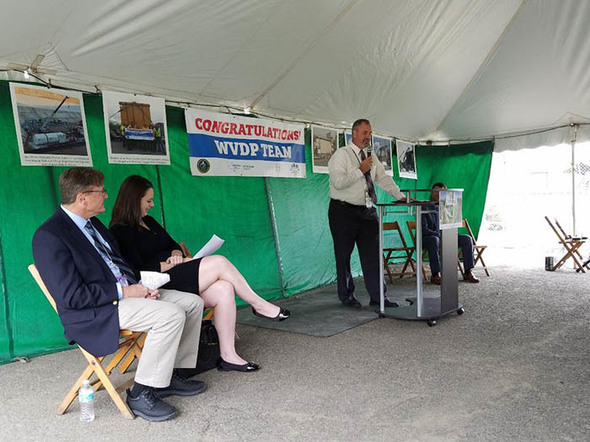
EM West Valley Demonstration Project (WVDP) Site Director Bryan Bower recognizes employees for their hard work and diligence in completing their latest cleanup accomplishments. At left are Paul Bembia, the WVDP project director for the New York State Energy Research and Development Authority, and Alison Hunt, district director for U.S. Rep. Tom Reed of New York.
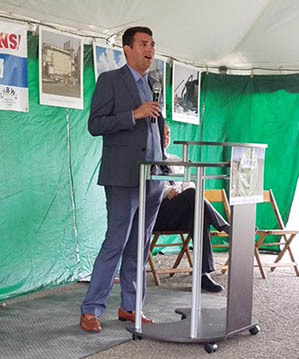
EM Senior Advisor Taylor Playforth speaks to employees and guests at last week’s celebration at the West Valley Demonstration Project Site.
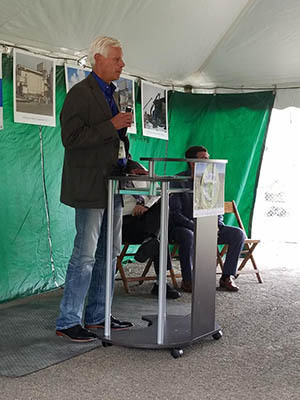
Scott Anderson, president of EM cleanup contractor CH2M HILL BWXT West Valley, told people gathered at last week’s celebration that the site’s crews worked safely and creatively to complete the Vitrification Facility demolition and disposal of more than 3,000 containers of waste from past cleanup activities.
Officials with EM and CH2M HILL BWXT West Valley also recognized the workers for disposing of more than 3,000 containers of waste resulting from past cleanup activities.
EM WVDP Site Director Bryan Bower noted that the latest accomplishments demonstrate EM’s commitment to safe and compliant cleanup.
“I want to thank the WVDP team for achieving these major accomplishments in a safe and environmentally sound manner,” Bower said. “It is the dedicated men and women at this site that make this cleanup possible.”
EM Senior Advisor Taylor Playforth conveyed greetings from EM Assistant Secretary Anne White to the West Valley workforce, “and she asked me to personally thank you for all you’ve accomplished in the safe cleanup of environmental legacy resulting from previous operations.”
Teardown of the 10,000-square-foot vitrification plant — once used to solidify thousands of gallons of radioactive waste at the WVDP — is EM’s largest and most complex environmental cleanup achievement at the West Valley site to date.
Work continues on remaining cleanup, including deactivation of the Main Plant Process Building and demolition of its ancillary buildings and structures.
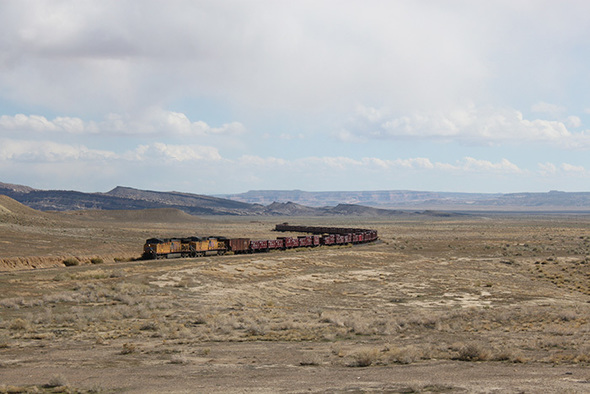
MOAB, Utah – EM’s Moab Uranium Mill Tailings Remedial Action (UMTRA) Project surpassed its fiscal 2018 target to ship uranium mill tailings from the Moab Site to a disposal cell. Crews safely moved 477,667 tons of the residual radioactive material away from the Colorado River, outpacing the project goal of shipping 445,421 tons by about 7 percent. Overall, the project has removed more than 9 million tons of tailings from the Moab Site, or 58 percent of the estimated 16-million-ton total. The project is relocating tailings and other contaminated material from a former uranium-ore processing facility in Moab to the disposal cell near Crescent Junction, about 30 miles north. The tailings are a sand-like material that remain from processing uranium ore. The project ships two trains a week, each carrying 144 containers of the material. In fiscal 2018, crews added an additional rail car to each train, allowing for more material to be shipped.
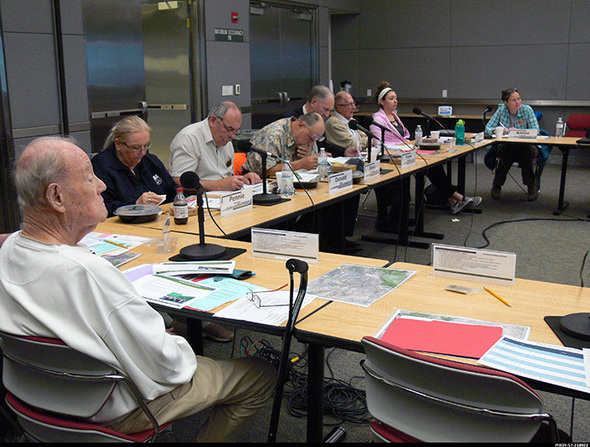
The new members will serve two-year terms, filling vacancies on the EM Nevada Program’s NSSAB, a volunteer citizen panel that provides advice and recommendations to EM on its environmental cleanup operations on the Nevada National Security Site (NNSS). They are William DeWitt and Connie Wissmiller of Amargosa Valley, Nevada; Anthony Graham of Henderson, Nevada; Tanya Henderson of Shoshone, California; and Hepburn Klemm and Janice Six of Tonopah, Nevada.
The reappointed board members will serve additional two-year terms. They are Amina Anderson and Dick Gardner of Beatty, Nevada; Frank Bonesteel, Raymond Elgin, Chuck Fullen, Don Neill, and Dina Williamson-Erdag of Pahrump, Nevada; Karen Eastman and Pennie Edmond of Las Vegas; Autumn Pietras of Henderson, Nevada; Steve Rosenbaum of North Las Vegas, Nevada; Dick Stephans of Boulder City, Nevada; and Richard Twiddy of Mesquite, Nevada.
“During the membership recruitment campaign, we targeted geographic areas that are affected by EM activities at the NNSS, but were not adequately represented on the NSSAB," said Kelly Snyder, the NSSAB’s deputy designated federal officer. "I’m very impressed with the caliber of the new appointees, and I’m confident they will be valuable additions to the current board with their extensive knowledge and experience.”
The NSSAB typically meets the third Wednesday of each month in Las Vegas, although meetings are occasionally held in rural communities within southern Nevada.
Meetings of the board are open to the public, and notices are posted on the board’s website. Visit the website for more information on the board members.
Employees from Hanford tank farms contractor Washington River Protection Solutions accept the 2018 Innovation Award. From left, Rob Cantwell, environment, safety, health and quality manager; Doug Kennedy, tank farm projects (TFP) engineering; Dustin May, TFP project management; Travis Barnes, TFP engineering; and Chris Thursby, industrial safety manager.
This year, WRPS received the award for developing and implementing innovative tools to reduce radiological and industrial hazards to workers removing pumps and other long-length equipment from Hanford’s waste storage tanks.
“ORP values WRPS’s continued commitment to worker safety,” said Jeremy Johnson, ORP deputy federal project director for tank farms. “The development of these tools is critical to effectively managing Hanford’s tank waste.”
The tools include a gadget that penetrates the pump column in strategic locations while the pump is raised, allowing the waste to drain back into the tank. Another tool spools foam insulation, or shielding, around the pump as it is raised from the pump pit, further reducing radiation levels. A remotely installed spray ring system also was developed to clean external surfaces of the pump during removal, eliminating the need for an employee to enter the pit.
“WRPS has built a tradition of developing safe and cost-effective methods and tooling to get critical high-hazard work done,” said John Eschenberg, who was recently named WRPS president and project manager. “I’m proud of our team’s continued ingenuity and for always putting safety first.”
The Voluntary Protection Programs Participants’ Association honored Washington River Protection Solutions for creating new tools to reduce hazards to workers. Employees used the tools while removing a failed pump from double-shell tank AW-106 last year.
Last year, WRPS won the VPP Innovation Award for establishing a physiological monitoring program that has helped eliminate heat stress cases the past two-plus years in Hanford’s tank farms.
In 2016, the award was for developing a shield that protects a worker wearing full face respiratory equipment from an arc flash. And in 2015, the contractor was recognized for developing a tool to help reduce worker exposure during surveys of radioactive equipment used to retrieve tank waste.
More VPP awards
WRPS also received the Legacy of Stars award, given to companies that obtain the VPP Star of Excellence in four consecutive years by demonstrating outstanding cooperative efforts among employees, management, and DOE to continuously improve safety and health programs.
Chris Thursby, WRPS industrial safety manager, was the recipient of the DOE Contractor Champion Award for “outstanding performance and leadership in furthering the advancement of VPP.”
The awards were presented last month at a national Voluntary Protection Programs Participants’ Association conference in Nashville.
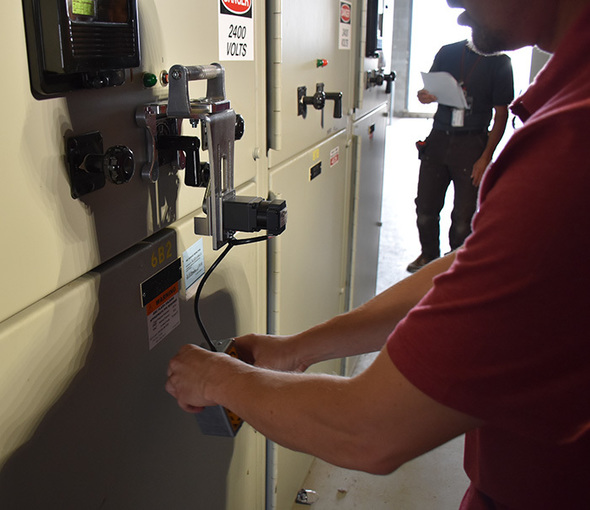
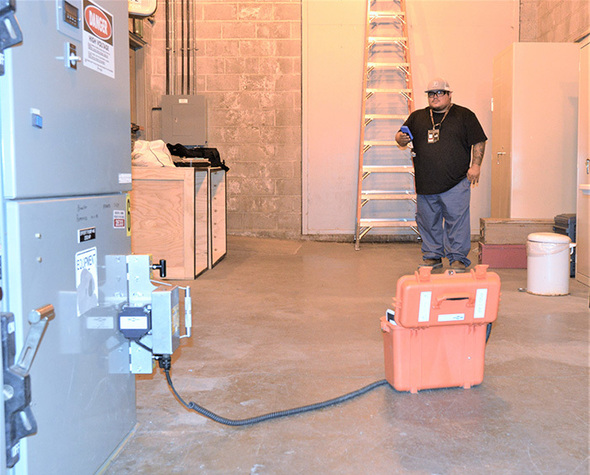
Field Work Supervisor Nic Croft led an effort to procure and use remote switches for water systems for Hanford contractor Mission Support Alliance. The switch allows workers to connect or disconnect a pump motor from its power source while standing outside of the arc flash boundary, eliminating a significant safety hazard.
RICHLAND, Wash. – Hanford Site workers have developed an innovative approach to keep them safe from the dangers of an arc flash, which occurs when an electric current leaves its intended path and travels through the air to another conductor. These discharges can cause serious injury or death.
Recognizing an opportunity to improve the process for how workers disconnect power from a pump motor, the water and sewer utility team from EMRichland Operations Office (RL) contractor Mission Support Alliance (MSA) implemented a plan to use remote operated equipment when working with electrical components.
“Ensuring the safety of Hanford workers is the most important aspect of the work we do,” said Jeff Frey, RL assistant manager for mission support. “We appreciate the foresight of MSA and its workers for creating a safer working environment.”
Michael Mendoza, a stationary operating engineer with Hanford contractor Mission Support Alliance, demonstrates a new remote switch used by the water and sewer utilities division. Workers are able to connect or disconnect a motor from its power source without being in the arc flash danger zone.
Instead of using additional resources and staff to disconnect the power, the team can safely complete that work themselves using the remote equipment. With a remote switch, workers are able to stand at a safe distance from the electric source while disconnecting a pump motor from its power source for maintenance and repairs.
“I want to commend the water utility team for developing the plan to use remote operated equipment,” said Todd Synoground, MSA vice president of public works. “Thanks to their dedication, we are creating a safer work environment that utility groups from other EM sites can follow and implement.”
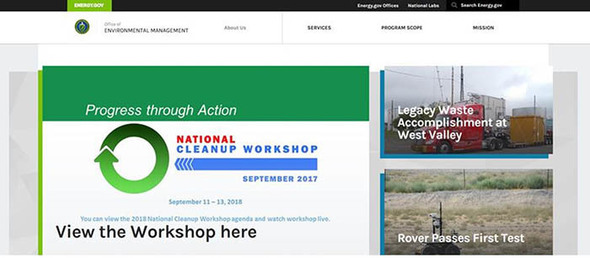
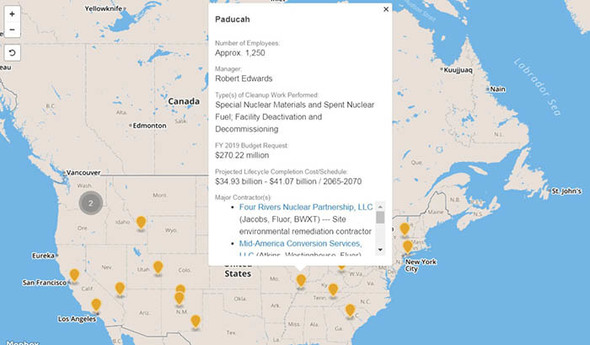
WASHINGTON, D.C. – EM has revamped its website, creating more ease of use and intuitive navigation for visitors. Employees updated more than 1,500 webpages as part of the reboot, which features a new interactive map that allows users to click on sites and pull up details about them, including the number of employees, type of cleanup being conducted, budget information, and the major contractors working at the site. Also check out the website’s improved history section that breaks segments of EM history into distinct timelines, from the inception of the Manhattan Project to the current tenure of Energy Secretary Rick Perry.