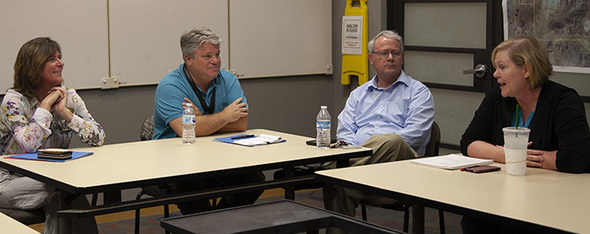
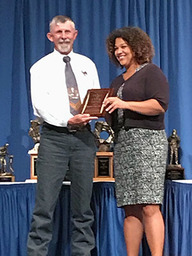
Left to right, EM Assistant Secretary Anne White talks with Bill Wilborn, Jhon Carilli, and Christine Baker of the EM Nevada Program during an all-hands meeting.
NORTH LAS VEGAS, Nevada – EMAssistant Secretary Anne White visited the EM Nevada Program this week for the first time as head of the cleanup program, touring facilities and meeting with staff.
White, who worked in Nevada as a contractor earlier in her career, began her visit with a tour of the Nevada National Security Site (NNSS). White learned about past and present missions, receiving information about historical locations that played a role in the development and testing of nuclear weapons and the sites of current EM missions.
The next day, White met with EM Nevada Program staff and explained her immediate and long-term priorities to ensure the EM mission is successful.
“It is always great when your site can have an executive level manager take time out of their busy schedule to share their thoughts and visions with staff on a more personal level,” EM Nevada Program Operations Manager Bill Wilborn said. “Having Anne come out to the field, take a site tour, and visit with EM staff provided time for formal and informal communication and adds an additional level to the sense of personal value staff have for the work they do.”
Sitting down for an all-hands meeting with EM Nevada Program staff, White shared her observations of the EM Nevada Program mission and what she learned during her visit to the NNSS. She also received input on improving work efficiencies.
-Contributor: Marc Klein
Field Note from Assistant Secretary White
Many thanks to Bill Wilborn, Rob Boehlecke, and the rest of the EM Nevada Program team for a wonderful tour and meeting in Nevada. My trip to Nevada took me both to the EM Nevada Program offices in North Las Vegas as well as out to the field at the Nevada National Security Site.
The week began with a stop at the badge office in North Las Vegas where Brenda Moore greeted us with a “Hello Sunshine!” and a big smile. What a great way to start my day! Thank you Brenda for having such a sunny disposition and positive attitude — it really brightened up our day.
Following our stop in the badge office, we set out for our journey to the NNSS — about 65 miles north of Las Vegas — where we learned about the different historical locations as well as current facilities and missions. The NNSS serves as a critical piece to the EM mission and is definitely a national asset.
The next day, I was back in North Las Vegas where I was able to sit down and meet the hard-working and dedicated EM Nevada Program staff. I always appreciate the opportunity to have these types of casual, open-forum conversations. It’s important to me that everyone feels comfortable and is willing to be open and honest about how we can improve as a department. Management Analyst Christine Baker offered a prime example of this type of casual conversation that I look for when she gave me a no-nonsense response when I asked her if a current business practice was working well. Thank you Christine for your candid feedback!
Overall, I had a wonderful trip to Nevada. Everyone, both at the NNSS and North Las Vegas, was so welcoming and committed to their roles in the overall EM mission. Earlier in my career, I lived and worked in Nevada and, even though I am not there anymore, it still had such a familiar and comfortable feel. Thank you for a great visit and I look forward to coming back.
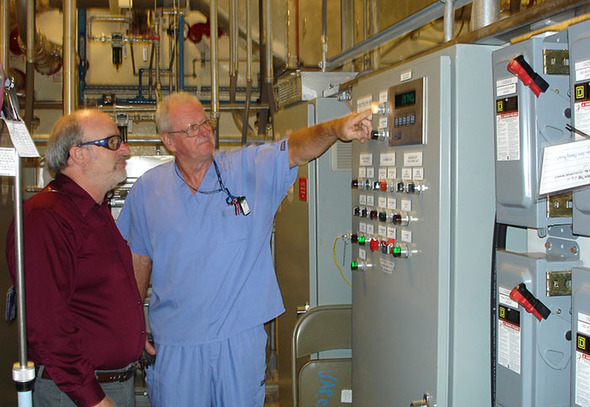
Mid-America Conversion Services Operator Bobby Ferren, right, is pictured with EM Depleted Uranium Hexafluoride Deputy Federal Project Director James Johnson at the Paducah cylinder transfer system startup.
LEXINGTON, Ky. – EM recently launched long-planned systems to help safely handle the disposition of non-standard storage cylinders containing depleted uranium hexafluoride (DUF6) at its Portsmouth and Paducah gaseous diffusion plant sites.
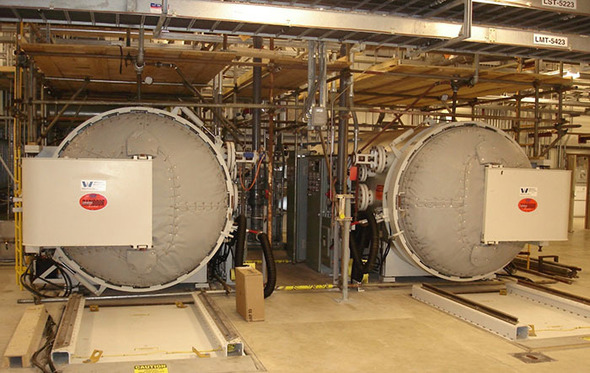
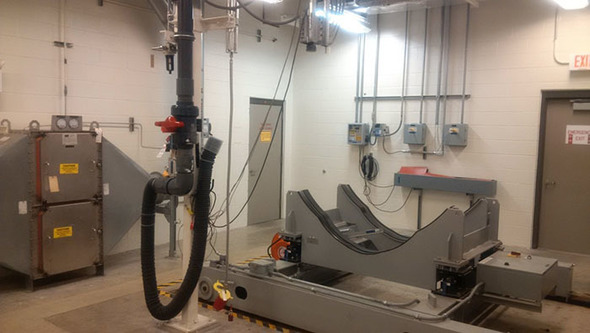
The DUF6 conversion facilities at Piketon, Ohio, and Paducah, Kentucky transform DUF6 into a more stable form of uranium for eventual disposition. The newly operational cylinder transfer system (CTS) and cylinder evacuation room (CER) will allow plant operator Mid-America Conversion Services (MCS) to process cylinders that do not meet the requirements or specifications for normal processing due to damage, corrosion, overfilling, or unusual size.
The cylinder transfer system.
The CTS and CER allow operators to heat the contents of the non-standard cylinders differently than the plants’ 14 vaporization systems used for standard cylinders. Approximately 8 percent of EM’s remaining 750,000-plus metric tons of the Cold-War-era uranium-enrichment byproduct is in non-standard cylinders.
“Standing up these systems to process non-standard cylinders is vital to completion of EM's cleanup mission on schedule at both sites,” said Reinhard Knerr, the DUF6 project’s federal director for the Portsmouth/Paducah Project Office (PPPO). “The CTS/CER systems were specifically designed to process those types of cylinders.”
PPPO oversees EM’s environmental cleanup efforts at Portsmouth and Paducah that began in the late 1980s, as well as the DUF6 conversion plants. The DUF6 project converts the material to depleted uranium oxide — a slightly radioactive crystalline powder suitable for long-term storage or disposal — and hydrofluoric acid that is recycled for commercial use. The conversion plants began operating in 2010 at the Portsmouth Site and 2011 at the Paducah Site, and have processed approximately 62,000 metric tons of DUF6 to date.
The cylinder evacuation room.
The DUF6 cylinders typically measure about 12 feet by 4 feet and weigh more than 10 tons when full. All cylinders undergo regular maintenance and testing by MCS to determine their level of structural and operable integrity.
The MCS team, led by CTS/CER project manager Sarah Sykes, recently brought both the Paducah and Portsmouth CTS systems up to operational status individually in a phased sequence under EM oversight.
“Starting the CTS/CER system is a significant milestone for the life-cycle of the DUF6 Conversion Project,” said Fred Jackson, DUF6 deputy project manager and chief engineer for MCS. “Led by operations and engineering, every department contributed to the successful launch of this important system. We are very proud of everyone and their accomplishment."
LEXINGTON, Ky. – Richard “Stik” West of EM’s Waste Isolation Pilot Plant (WIPP) has been inducted into the Metal and Nonmetal National Mine Rescue Hall of Fame.
West received the honor during last week’s National Mine Rescue Competition in Lexington, Kentucky, sponsored by the U.S. Department of Labor’s Mine Safety and Health Administration.
The hall of fame recognizes individuals who through their accomplishments and commitment stand out as exceptional in the field of mine rescue.
“I am extremely proud of Stik and his many accomplishments,” said Bruce Covert, president and project manager of Nuclear Waste Partnership, the WIPP management and operations contractor. “He is very deserving of this recognition. I also want to congratulate members of all our mine rescue teams. They represent the company, DOE, and the project extremely well. I cannot think of a more qualified group of employees who are prepared to answer the call in the event of a mine emergency.”
Richard “Stik” West of EM’s Waste Isolation Pilot Plant is inducted into the Metal and Nonmetal National Mine Rescue Hall of Fame.
West, who started his mining career in 1979, has served as the team trainer at WIPP for 14 years, with his teams winning national titles in 1994, 2014, and 2016. He tied for this year’s national trainer of the year honor, finishing second in a tiebreaker, and has won 10 team trainer awards during his career. He serves on the National Mine Rescue Rules Committee and is the former president and current director on the Southwest Regional Association. He won a national title in the bench competition in 2000.
Mine rescue competitions are designed to sharpen skills and test the knowledge of team members who are called upon to respond in a mine emergency.
Two WIPP teams, Red and Blue, competed at the four-day, 42-team event. The WIPP Blue team finished fifth in the Mine Rescue Field Competition, with the Red and Blue teams finishing second and fifth, respectively, in the first aid competition. The field competition requires team members to solve two separate hypothetical problems on consecutive days while being timed and observed by judges.
The WIPP Red team placed sixth in the Technician Team Award, a two-person bench competition where teammates have 30 minutes to inspect an air breathing apparatus and mine gas detector, and find any “bugs” planted on them.
Blue team members include captain Nico Dominguez, Misty Long, Colton Ridgway, Manny Marquez, Lyndon Dufty, Chris Dominguez and Gary Kessler.
Red team members are captain Matt Ridgway, Mark Long Jr., Ty Zimmerly, Matt Carnathan, Jim Pearce, Lance Turnbow, Tony Mihelic, Justin Bailey and Hank Miller.
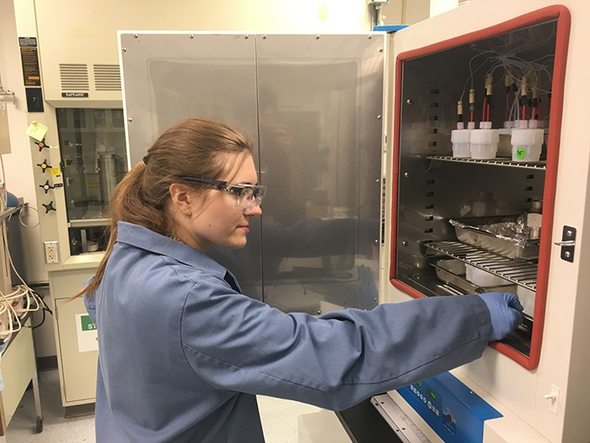
Dr. Joelle Reiser of Pacific Northwest National Laboratory checks the status of experiments focused on the durability of glass waste.
RICHLAND, Wash. – Researchers at DOE’s Pacific Northwest National Laboratory (PNNL) and Washington State University (WSU) are seeking insight into the long-term behavior of glassified nuclear waste to ensure its durability hundreds of years into the future.
The research supports EM’s plans to turn nuclear and chemical waste currently stored in underground tanks at Hanford and other EM sites into a durable glass form. Specifically, it adds to the science that helps provide assurances for the safe disposition of waste and protection of the environment.
Glass has exceptional durability but can corrode over long periods with exposure to water. The rate of corrosion is dependent on factors including particular glass formulation, chemistry of the corroding water, presence of minerals, and temperature.
Glass corrosion does not represent a simple dissolution of material. Instead, the exposed glass undergoes changes in structure and composition to form rinds of new material called “alteration layers.”
Dr. Joelle Reiser used state-of-the-art characterization tools to compare the structure of alteration layers created from exposure of glass to corrosive conditions with similar materials created synthetically. Comparing the well-known formation of the synthetic material to those of the glass alteration layers gives insight into how corrosion proceeds over long periods.
“We will be disposing of nuclear waste in a glass waste form, and it will be stored for a long time. Understanding these dissolution processes is not easy, but it will allow us to model the performance of the waste glass over these long time periods and under various geologic conditions,” said Dr. Nicholas Machara, a physical scientist in EM’s Technology Development Office. “That information will allow the Department to bound the long-term risks from nuclear waste, inform the selection of storage options, and perhaps expand the processing conditions and formulations for producing nuclear waste glass.”
Reiser conducted her work on glass waste forms at PNNL in the laboratory of Dr. Joe Ryan as part of her doctorate research at WSU. Her work included pioneering the use of the annihilation of small particles of anti-matter to characterize the alteration layers of glass and better understand their structure. Reiser recently received her doctorate from WSU and works at PNNL to extend this work to glasses that can immobilize a wider variety of waste.
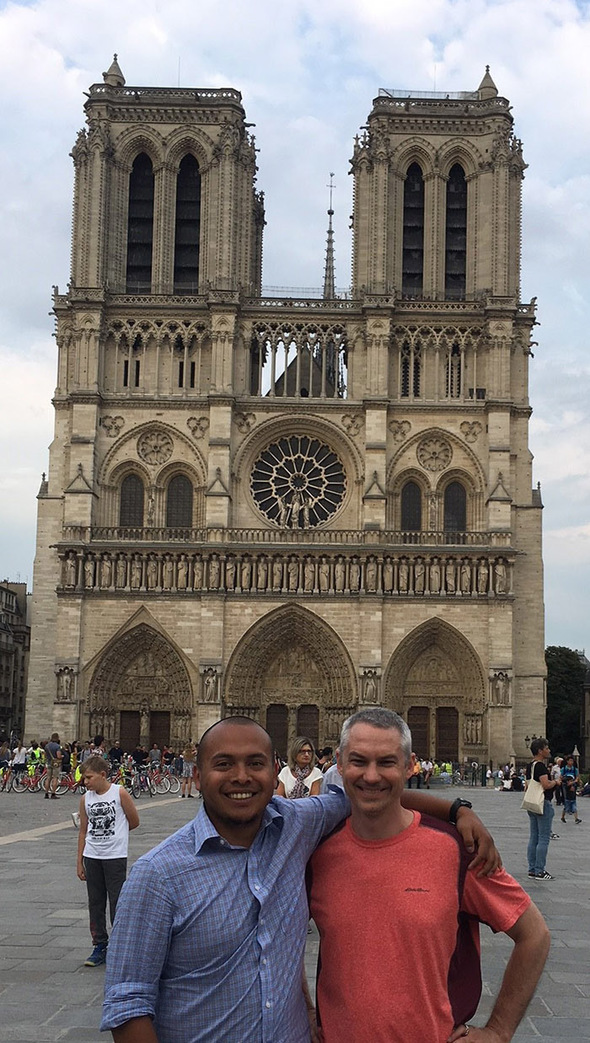
Jose Marcial, left, and his doctoral advisor, Dr. John McCloy, of Washington State University visited Notre Dame Cathedral in Paris after presenting this month at the 15th International Physics of Non-Crystalline Solids conference in St. Malo, France.
His involvement in the Hanford cleanup mission introduced him to a new world of science, afforded him with a community of mentors, and highlighted the magnitude of the challenges surrounding nuclear waste vitrification at the site. Vitrification involves combining waste from underground tanks with glass-forming materials and then heating the mixture to 2,100 degrees Fahrenheit.
“I grew up locally, but had no idea how the scope of the work here at Hanford can implement such positive and direct impacts on the regional community. I knew it was important,” Marcial said.
The internship inspired him to consider waste vitrification research as a profession — an intimidating prospect at the time.
“I was a first-generation college student,” Marcial said. “Thinking about attending a university and obtaining a degree was daunting.”
Marcial attended Washington State University (WSU) and studied materials science and engineering, returning to Hanford as an intern each summer for the next several years. His mentors, including ORP glass scientist Albert Kruger, supported him by offering advice throughout college and encouraged him to pursue graduate studies.
“There are few greater pleasures than those that come from watching the progression of a student into an accomplished contributor in such an important domain of endeavors,” Kruger said.
Marcial dove into the discipline of vitrification and completed his doctoral studies at WSU in 2017, performing research that has taken him all over the world. From attending an international glass science school in Brazil to presenting at a physics conference in France, he has sought opportunities and expertise to better understand how to prevent crystallization to maintain the long-term durability of nuclear waste glass.
In September, he will start a postdoctoral appointment at the University of Chemistry and Technology in Prague, as part of a collaborative research effort between PNNL and the Czech Republic.
“The Czech Republic is a leader in commercial glass vitrification,” Marcial said. “There are concepts we can derive from their process to refine our own approaches to waste vitrification.”
Marcial has advice for this year’s summer interns.
“Be open to learning new things, and ask questions. People do not expect you to know everything. Don’t hesitate to knock on people’s doors,” Marcial said. “Also, don’t let the little things hold you back. The only thing I had on my resume was lawn care before I came here. You can accomplish so much more than you think.”
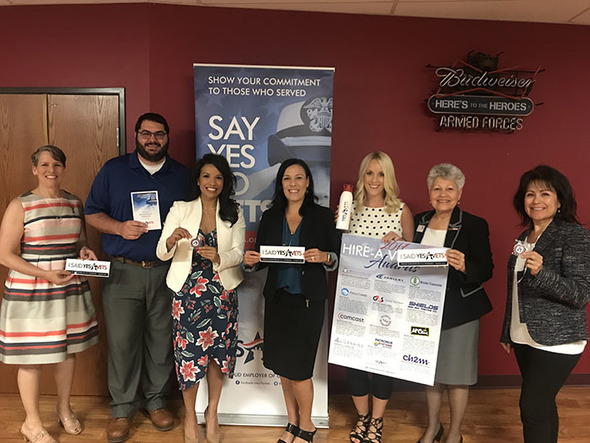
Human resources representatives from CH2M HILL Plateau Remediation Company (CHPRC) and Mission Support Alliance (MSA) attended a recognition ceremony for hiring veterans. Pictured, left to right, are Washington State Employment Security Department Commissioner Suzi LeVine; Gabe Galbraith, Jessica Esparza, and Julie Lindstrom of MSA; Ashley O’Konek of CHPRC; Washington State Department of Veterans Affairs Director Alfie Alvarado-Ramos; and Lily Parnell of CHPRC.
RICHLAND, Wash. - EMRichland Operations Office (RL) contractors CH2M HILL Plateau Remediation Company (CHPRC) and Mission Support Alliance (MSA) at the Hanford Site recently received state recognition for hiring veterans through the YesVets program.
The program is a collaboration among Washington state’s employment security, veterans affairs, and commerce departments; Washington State Military Transition Council; and local chambers of commerce across the state. With more than 700 employers enrolled throughout Washington, YesVets was responsible for more than 2,800 veterans receiving employment in 2017.
“At Hanford, we’re proud of the commitment our contractors make to hire veterans,” said Greg Jones, RL assistant manager for business and financial operations. “These men and women not only bravely served our country, but many developed the impressive set of skills that make them uniquely qualified for the work we do at Hanford.”
CHPRC received the 2017 Hire-A-Vet Award from the Washington State Employment Security Department for increasing employment opportunities for veterans. CHPRC employs more than 200 veterans, approximately 13.7 percent of the CHPRC workforce.
YesVets honored MSA with its Business Award Salute for continued dedication to the program and hiring of veterans. Julie Lindstrom, MSA’s manager of staffing, diversity and development, gave a testimonial at the recognition event and was joined by new veteran hire Gabe Galbraith. MSA employs 240 veterans — 14.2 percent of its workforce — and hired 18 of those veterans within the last year, through YesVets.
Alfie Alvarado-Ramos, director of the Washington State Department of Veterans Affairs, spoke at the recognition ceremony about the importance of hiring veterans.
“Meaningful work brings financial stability to veterans and their families. When employers make that commitment to hiring veterans, it’s contributing to something bigger than themselves,” Alvarado-Ramos said.
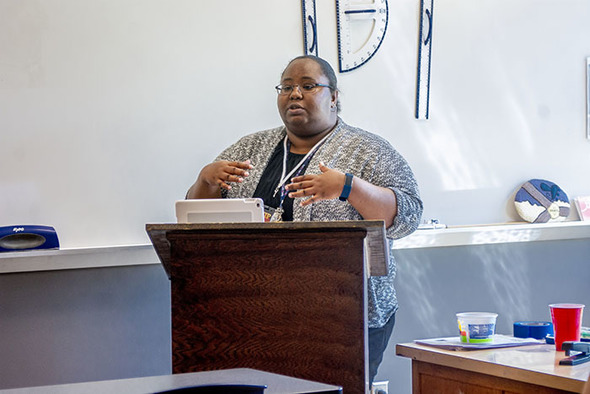
The Oak Ridge Office of Environmental Management’s Vanna Gaffney speaks about radiation protection at Oak Ridge City Schools’ Back to School Professional Development Day.
The Oak Ridge City Schools’ event offered nearly 40 free educational courses to the district’s teachers — giving them an opportunity to learn about interesting subjects and enjoy being students for a day.
OREM’s Vanna Gaffney led a one-hour session about radiation protection to participants ranging from middle school English teachers to high school chemistry teachers.
Gaffney joined OREM’s engineering branch seven years ago after earning a bachelor’s and master’s degree in nuclear engineering. In her current role, she supports the organization’s facility representatives and its safety, security, and waste management operations.
“I really enjoyed meeting and speaking with local teachers who were very engaged, inquisitive, and interested in learning more,” Gaffney said. “We have a great story to tell about the steps we take to keep our employees safe and how our mission keeps the community safe.”
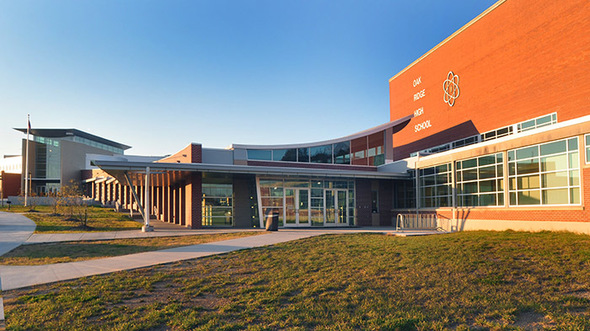
Oak Ridge High School hosted the event that offered nearly 40 free educational courses to teachers in the district.
It was OREM’s fifth outing with Oak Ridge’s school district this calendar year, highlighting the significant role community involvement plays for the organization.
“We constantly keep our eyes open for opportunities to interact with new audiences to share information about our mission and the progress happening in Oak Ridge that they can be proud of,” OREM Manager Jay Mullis said.
Gaffney’s presentation began with an overview of radiation to help clarify misconceptions. The audience also learned the difference between alpha, beta, gamma, and neutron waves, and how people are protected against exposure to each.
There was heavy interest and questions about what workers experience in the field during cleanup. Gaffney detailed all of the equipment EM uses to detect and monitor radiation levels, and she explained how EM works to understand the conditions in areas where workers will perform cleanup projects.
Teachers left the session with a better understanding of DOE’s expertise in occupational health physics, and the lengths the agency goes to ensure the safety of its employees and surrounding community — a message they can share with their students when school begins this fall.
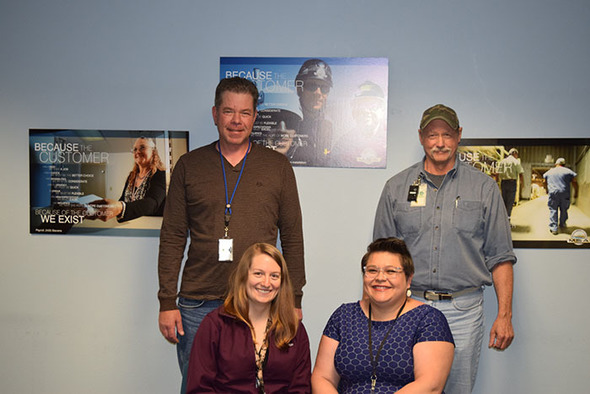
The EM Richland Operations Office Radiological Access Control Program team members are, left to right, Garrett Loehding, Heather Healy, Tami Escamilla, and Wayne Schofield.
RICHLAND, Wash. – A new program at the Hanford Site brings consistency and safety to a higher level for employees working in and entering radiological areas.
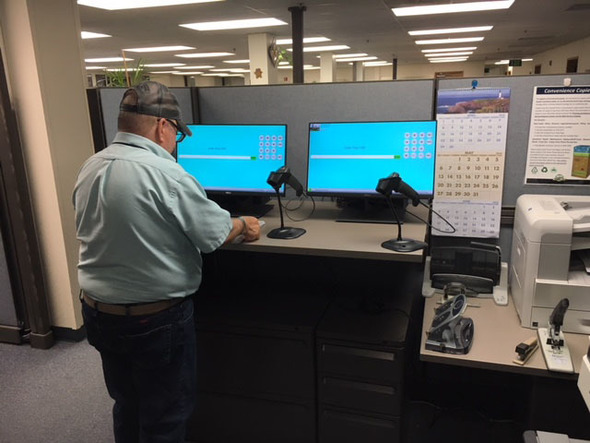
The program, called Sentinel, is a convenient, computer-based, self-entry process that verifies employees’ training, dosimetry, and medical qualifications before they are allowed to enter a radiological area.
Sentinel kiosks are located at or near work sites that require radiological access control. Employees who access these areas receive special training because of the potential for exposure to radiation and contamination. Workers check in at the kiosks to verify they meet the proper medical and training qualifications.
While the stations are sometimes staffed by personnel, qualified and trained radiological workers must ensure they have the proper prerequisites to enter radiological work areas. If a person without the proper credentials or with expired credentials logs in to Sentinel to enter the work zone, that person receives a red screen with an alert not to enter the area.
“I cannot say enough good things about the team and the incredible way that they worked together to bring the new radiological access control system online,” said Wayne Schofield, director of worker protection at EMRichland Operations Office contractor Mission Support Alliance. “The team worked with representatives from the Waste Treatment Plant, Washington River Protection Solutions, and CH2M HILL Plateau Remediation Company to incorporate all the necessary Hanford-specific data, and guide the development process. It was a year-long effort by a dedicated team that worked hard to ensure that, once deployed, the program worked flawlessly.”
A worker signs into Sentinel, the new radiological access control program, prior to entering a radiological work area in the 200 East Area of the Hanford Site.
“Having a program that verifies a worker’s medical and training qualifications streamlines the entry process and provides a safer entry program for all Hanford Site employees,” said Bill Hamel, RL assistant manager for safety and environment.
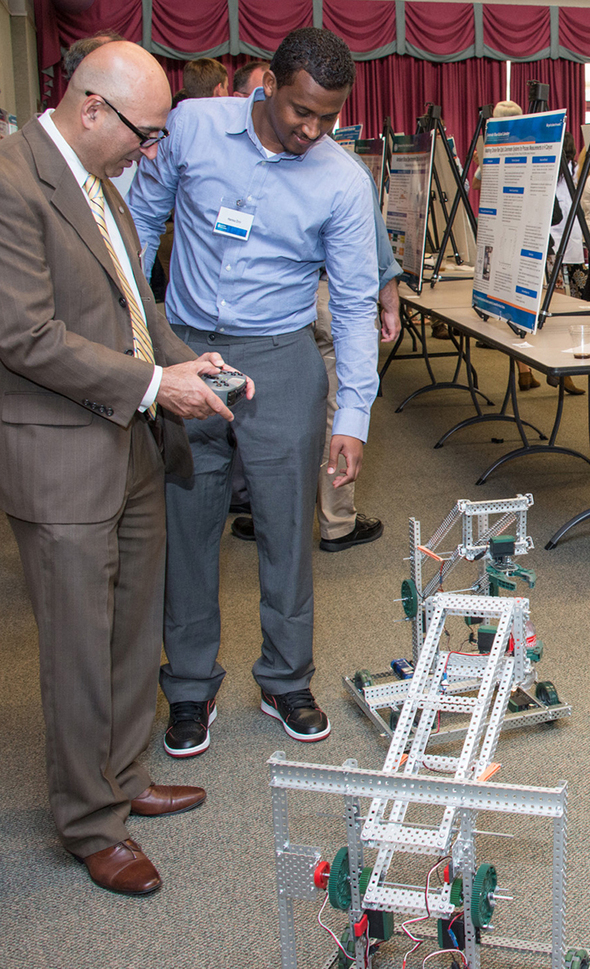
AIKEN, S.C. – More than 50 undergraduate and graduate students presented their research at the EMSavannah River National Laboratory’s (SRNL) annual summer intern poster session July 25.
The event was the culmination of a summer spent in scientific inquiry for lab interns who participated in real life research projects ranging from environmental remediation and robotic sensors to nanomaterials and 3D imaging.
Hamsa Dirir from the City College of New York discusses his robotics project with Savannah River National Laboratory Director Dr. Vahid Majidi.
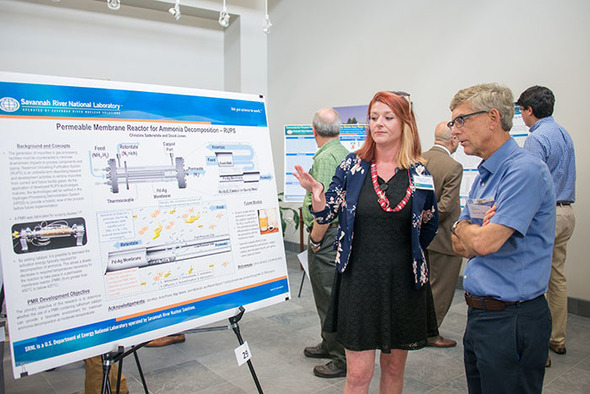
Christin Satterwhite, chemical engineering major from University of South Carolina, explains her research on the use of permeable membrane reactors which can serve as a catalyst for ammonia decomposition. Satterwhite interned with Savannah River National Laboratory’s national security directorate.
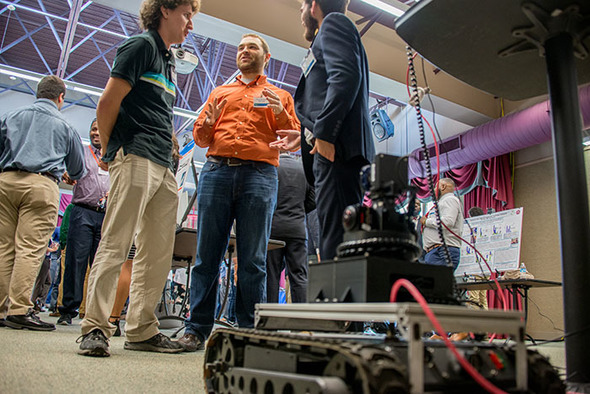
Left to right, University of Texas at Austin mechanical engineering students Connor McMahon and Chris Suarez discuss robotics with Florida International University electrical engineering major Manuel Losada.
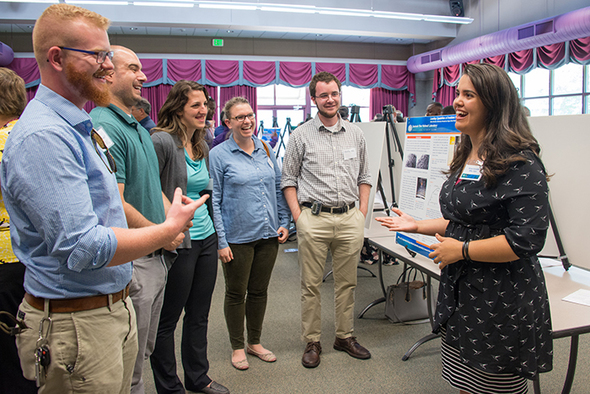
Returning summer intern Aimee Gonzalez, far right, shares the details of her project focusing on the strengths of 3D printed metal objects that have been irradiated. Gonzalez is enrolled at the University of Nevada, Reno, studying nuclear engineering.
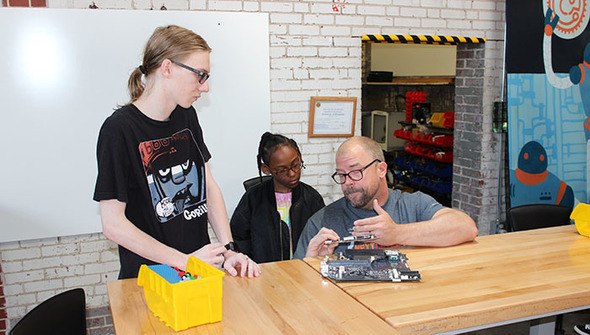
Sprocket Director Jimi Gwinn, right, uses circuit boards to teach Paducah students Chris McVickers, left, and Miya Patterson about computer technology.
PADUCAH, Ky. – Swift & Staley Software Development Manager Brandon Hall recently read a post on social media about Sprocket, Inc., a nonprofit makerspace, needing pre-owned circuit boards for an upcoming student technology project.
Makerspaces are for groups of individuals to share online tools and space for information-technology development. Swift & Staley is EM’s infrastructure support services contractor for the former Paducah Gaseous Diffusion Plant site.
Hall knew the Paducah Site had several excess circuit boards that would meet Sprocket’s needs. He reached out to Swift & Staley, which agreed to donate 50 outdated circuit boards to the non-profit organization. The contractor was pleased to support a program promoting science, technology, engineering, and mathematics (STEM) education for area youth.
“With the donated boards we hope to build a prototype for Bitcoin mining with our summer interns,” said Monica Bilak, president of the board for Sprocket. “Each Sprocket intern picks a personal summer project to develop, and thanks to Swift & Staley and DOE, we can build on our ideas.”
Jennifer Woodard, Paducah Site lead for EM’s Portsmouth/Paducah Project Office, said she is pleased with the initiative taken by site employees to fill a need in the community.
“It is exciting to see outdated equipment at the Paducah Site being utilized by local youth,” she said.
Swift & Staley Vice President Tammy Courtney agreed.
“Swift & Staley is thankful to see students utilizing the IT equipment and gaining valuable knowledge that may help them in their future career opportunities,” Courtney said.