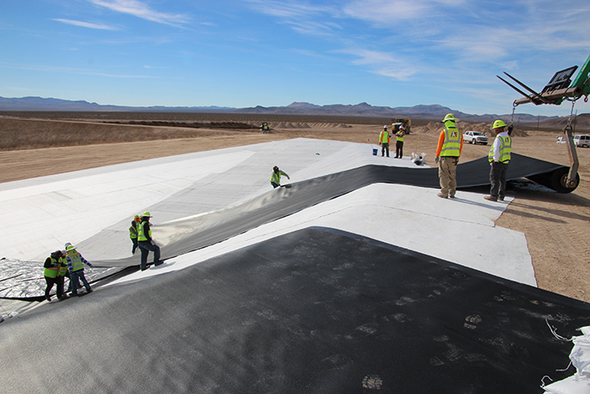
Workers install the first of the two liners for the disposal cell.
LAS VEGAS – Workers recently completed construction of a mixed low-level waste (MLLW) disposal cell at the Nevada National Security Site (NNSS) to support environmental cleanup in Nevada and across the U.S.
The EM Nevada Program worked closely with the National Nuclear Security Administration Nevada Field Office and the State of Nevada throughout a two-year process to obtain a modified Resource Conservation and Recovery Act (RCRA) permit for the project. The state-issued permit sets forth conditions for the disposal of low-level radioactive waste containing hazardous constituents at NNSS.
The RCRA-regulated permit process included several engineering design reviews, a 2,085-page permit application, and a public meeting – all of which was coordinated with the Nevada Division of Environmental Protection (NDEP), the state agency responsible for overseeing RCRA-related activities and issuing permits.
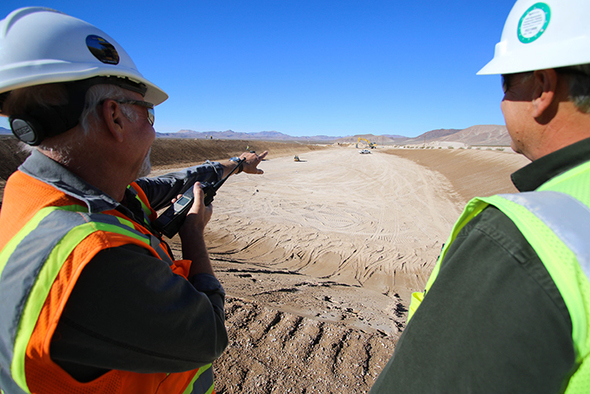
Crews used surveying equipment to fine-tune grading of the disposal cell.
NDEP provided comments that were addressed in the permit application, which saved time and taxpayer dollars, and enhanced the quality of the permit application. NDEP signed the permit in July 2017 after extensive review and a formal public engagement process that resulted in no comments or appeals.
Before sunrise on Aug. 21, 2017, a Consolidated Group of Tribes and Organizations representative blessed the land to reaffirm the group’s cultural connection to it before the groundbreaking.
“Providing access for this important event reinforces DOE’s longstanding commitment of working closely with 16 culturally-affiliated tribes with ties to the NNSS,” EM Nevada Program Manager Rob Boehlecke said.
The 20-foot-deep cell was constructed with a double liner. The primary, upper layer captures and moves any precipitation collected into a sump where it is pumped into a tank. The lower, secondary layer serves as a leak detection system by collecting any water that penetrates the primary liner. Water in the tank from both liners is regularly sampled. To ensure the liners are not compromised by the heavy weight of disposal operations, an engineered layer of soil was placed over the liners.
The cell has a capacity of 37,000 cubic meters. NNSS will need to apply to renew the permit in 2020 and every five years thereafter. As with all radioactive waste disposed at the NNSS, MLLW must meet the requirements of the NNSS Waste Acceptance Criteria, which includes satisfying U.S. Environmental Protection Agency land disposal restrictions and prohibiting waste containing free liquids.
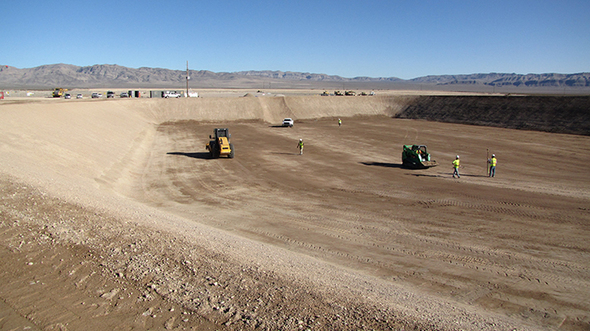
Supervisors oversee excavation and grading of the disposal cell.
“Ensuring compliance with the NNSS Waste Acceptance Criteria contributes to the safe operation and long-term performance of the disposal facility for the protection of workers, the public, and environment,” Boehlecke said.
To monitor MLLW cell performance, water collected in the tank is analyzed for hazardous and radioactive constituents. Historically, the results of water samples collected from the tank of the existing MLLW cell indicate that any constituents identified comply with regulatory limits.
A groundwater monitoring system comprised of three wells is positioned along the perimeter of the Area 5 Radioactive Waste Management Complex. The wells are sampled twice a year and no radioactive or hazardous contaminants from waste disposal operations have been detected by routine analysis. Results of sampling are published annually. An additional well down-gradient from the new cell will be installed within four years.
DOE requires additional monitoring to ensure buried waste is not creating a risk to NNSS workers, the public, or the environment. These activities include monitoring direct radiation, air, soil gas, and biota. With so many cleanup programs depending on the availability of NNSS disposal, including onsite remediation activities, the EM Nevada Program is committed to carrying out its mission to the highest level of safety, integrity, transparency, and regulatory compliance.
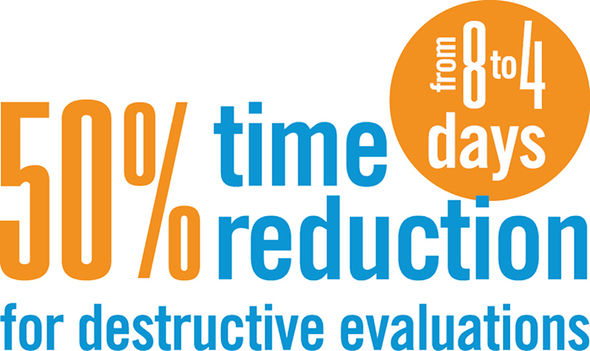
AIKEN, S.C. - Process advancements by the EM program at Savannah River Site’s K Area have increased efficiency, reducing the time needed to complete an annual safety evaluation by half.
Each year, personnel complete the assessments, known as destructive evaluations, to validate the site’s commitment to maintaining the safety and security of the nuclear materials stored there. The evaluations ensure the integrity of containers holding plutonium-bearing materials.
Operators open the containers using a specialized steel glove box with glass panels and glove-port openings. It shields and segregates them from radiological hazards. They retrieve samples of the materials inside and examine the containers for any corrosion or other signs they’re losing their integrity.
The glove box is also used for plutonium down-blend, a process of mixing plutonium oxide with an inert material before shipment to an out-of-state repository for disposition.
“We were challenged by the senior management team to shorten the time it takes to perform the annual destructive evaluations, which would allow us more time in the glovebox to perform down-blend,” K Area Facility Manager Janice Lawson said. “We took that challenge to our employees in the field and their innovation helped us lower the time it takes to complete a destructive evaluation from eight days to four days.”
K Area Deputy Operations Manager Chris Crawford said the operations and engineering personnel definitely stepped up to the challenge.
“They identified a number of process and procedure improvements, while always making sure to keep safety and security at the forefront of the process,” Crawford said.
Employees updated a procedure to allow for mass-based inventory of materials instead of allowing only one item to be handled in the processing area at a time. This allowed the material inventory to be performed more efficiently and reduced exposure to workers.
In other improvements, personnel developed activities to reduce downtime between sending samples of oxide to the Savannah River National Laboratory for testing and receiving the results.
“We are especially impressed with the ingenuity of our personnel considering that with the implementation of the down-blend program last year, their jobs have changed from surveillance and maintenance facility duties to operating facility duties,” Lawson said. “It has been a mindset change and our personnel have shown that they are flexible and up for any challenge.”
K Area personnel will continue to look for ways to improve operating time.
“We will continue to come up with innovations to make sure we are meeting the needs of the Department of Energy, our state, and our country,” Lawson said. “We are the best trained people to do it.”
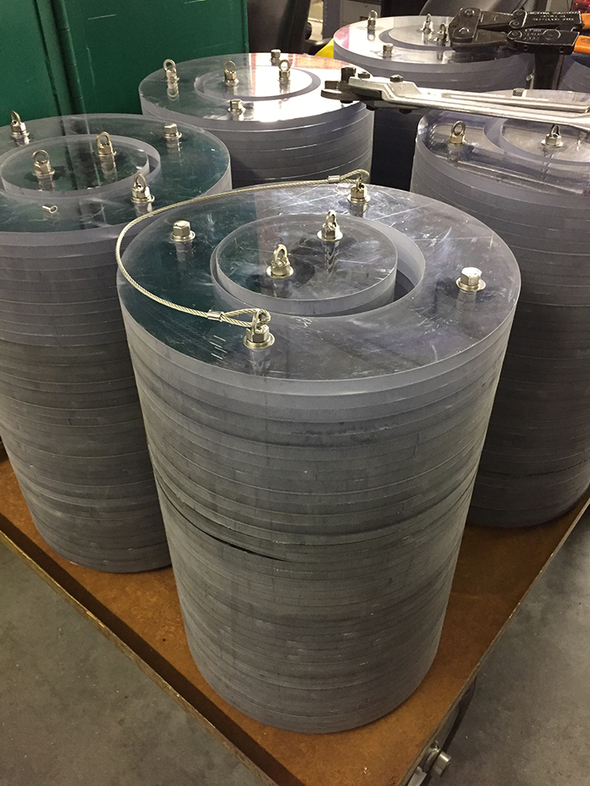
Workers at the Idaho Nuclear Technology and Engineering Center Maintenance Shop fabricated several of the shielded containers.
IDAHO FALLS, Idaho – A team working for the Idaho Site EM program recently built a shielded container to ship a unique waste to the Waste Isolation Pilot Plant (WIPP), an in-house project that saved time and money over procuring the product off-site.
Ken Krivanek and his team from EM cleanup contractor Fluor Idaho worked with fabricators in the Idaho Nuclear Technology and Engineering Center (INTEC) Maintenance Shop to develop the container to shield neutron-emitting transuranic sources fabricated at the Monsanto-Dayton Laboratory prior to its demolition in the late 1980s. Neutron-emitting sources are extremely rare at INTEC, a facility that has extensive experience handling gamma radiation sources most often shielded by lead.
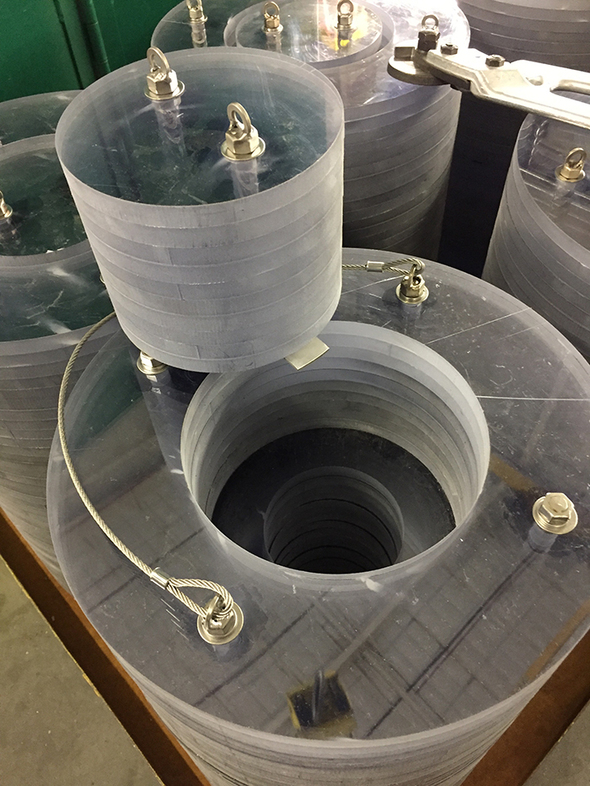
A closeup of a shielded container with the plug in the out position.
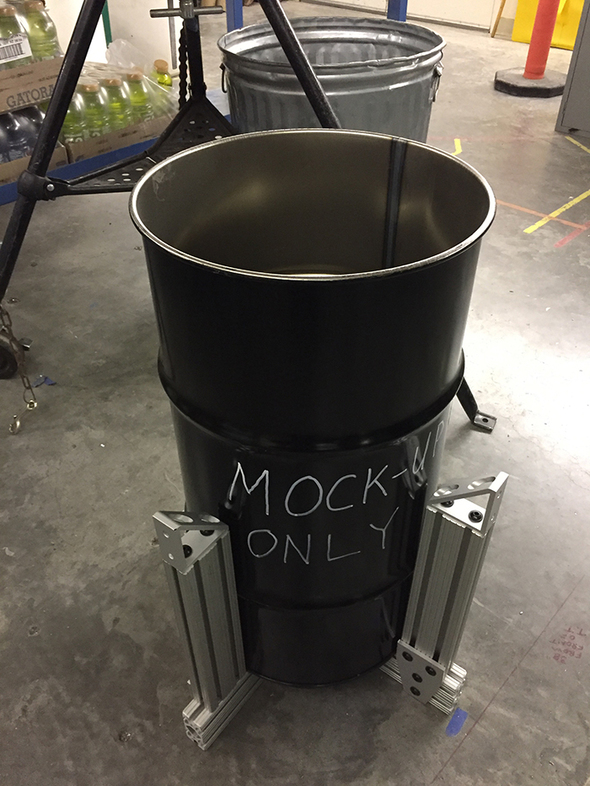
A view of a 16-gallon drum mockup with a centering device attached to allow insertion of a shielded container into a 55-gallon drum.
A type of plastic called lexan was chosen as the preferred container material because neutrons are best shielded with materials containing lots of hydrogen, such as plastics, which are composed of carbon and hydrogen molecules.
The containers go inside 16-gallon drums that are placed in 55-gallon drums for characterization prior to disposal. Placing the contents in 55-gallon drums is necessary to use a chamber at INTEC built to determine the radiation dose rate and curie content inside standard 55-gallon drums.
“Usually a company would contract out the fabrication of these types of shielded containers,” Krivanek said. “But we have the talent in-house, which saved time and money.”
Once approved for shipment, the high-activity waste will be loaded into specialty casks and shipped to the New Mexico repository for permanent disposal.
“Using the Lexan containers to house this waste really serves two purposes,” Krivanek said. “They protect workers who have to handle the drums and they provide extra shielding that’s necessary for the material to go to WIPP.”
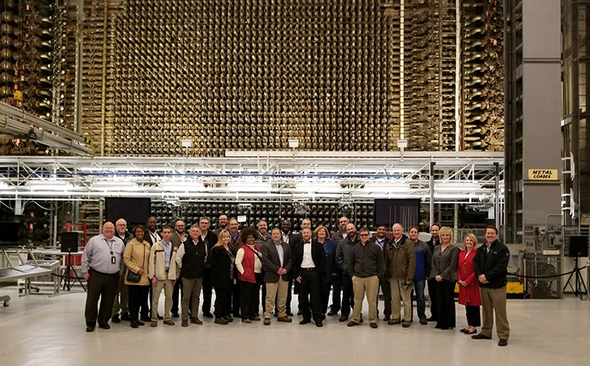
RICHLAND, Wash. - EM federal and contractor employees from across the DOE complex recently gathered at the Hanford Site to collaborate on information technology (IT) and cybersecurity topics, including how best to support the cleanup program’s focus on safe, environmentally responsible, and cost-effective risk-reduction cleanup activities. The semi-annual EM IT Collaboration Meeting allows participants to share innovative technical solutions to cross-site issues and consider sharing services. DOE headquarters representatives also discuss organizational changes and new or upcoming changes to requirements, regulations, and directives. For example, DOE Chief Information Officer Max Everett provided insight into federal IT and cybersecurity initiatives such as the Modernizing Government Technology Act. The group toured the B Reactor, the world's first full-scale plutonium production reactor, and other parts of Hanford to understand the site’s cleanup mission and the role of IT and cybersecurity.
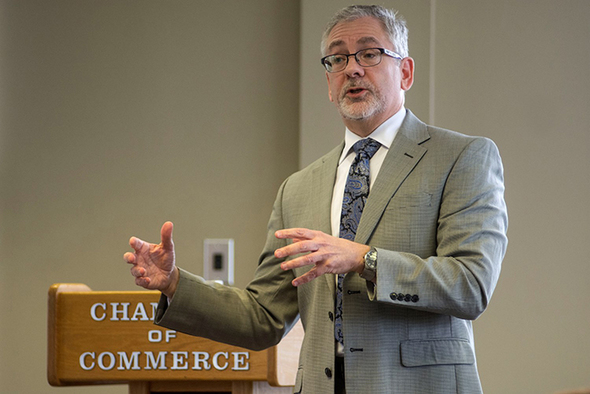
Jay Mullis, manager of DOE’s Oak Ridge Office of Environmental Management, speaks to junior and senior high school students participating in Youth Leadership Oak Ridge.
OAK RIDGE, Tenn. – Jay Mullis, manager of DOE’s Oak Ridge Office of Environmental Management, recently spoke to local high school juniors and seniors about a wide range of topics, including leadership, career planning, and the complex federal budgeting process.
Mullis provided insight about the federal government to students participating in the Youth Leadership Oak Ridge program. Previous sessions, led by Oak Ridge Mayor Warren Gooch and Tennessee Lt. Gov. Randy McNally, focused on lessons from local and state government.
During the three-hour program at the Oak Ridge Chamber of Commerce, Mullis began with stories of choosing his electrical engineering major and the unpredictability and evolution of his career.
Through a question-and-answer period, the students learned more about the EM mission in Oak Ridge, the different opportunity paths for an engineer, and the many steps and considerations required to pass a budget.
“It was really encouraging getting to meet and interact with local students who are already working and planning for their future,” Mullis said. “They asked great questions, and I’m looking forward to the new leaders this program is helping mold.”
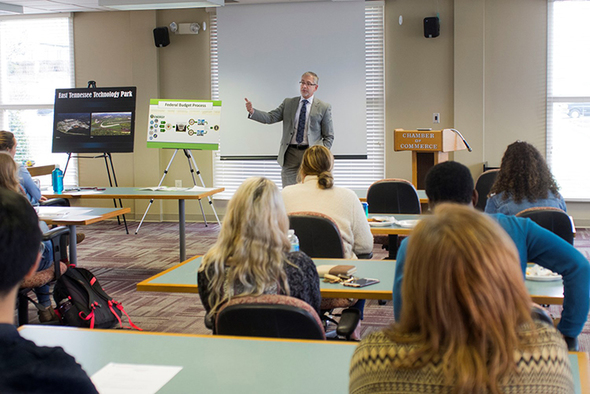
During a Q&A period, Jay Mullis, manager of DOE’s Oak Ridge Office of Environmental Management, shared more about EM’s missions in Oak Ridge, his opportunities as an engineer, and the steps and considerations required to pass a budget.
Much of the interest centered on jobs. Mullis took the opportunity to highlight the diverse skills needed to perform the environmental cleanup mission in Oak Ridge. He noted employees in his organization have backgrounds ranging from master’s degrees in economics and MBAs to engineering, communication, law, project management, and vocational training.
“The discussion opened my mind to the different jobs here,” said junior Steven Qu.
To emphasize the difficulty of finalizing a federal budget, the students ended the session with a timed exercise requiring them to collectively prioritize and agree on the ranking of 15 topics to pass their budget.
“Today showed how hard, but necessary, compromise can be,” said senior Chloe Nussbaum. “We also realized the demands and time pressures involved with getting a budget approved.”
Youth Leadership Oak Ridge is comprised of 25 high school juniors and seniors from Oak Ridge High School, with the goal of teaching students valuable lessons and traits from leaders in business, government, and the community.
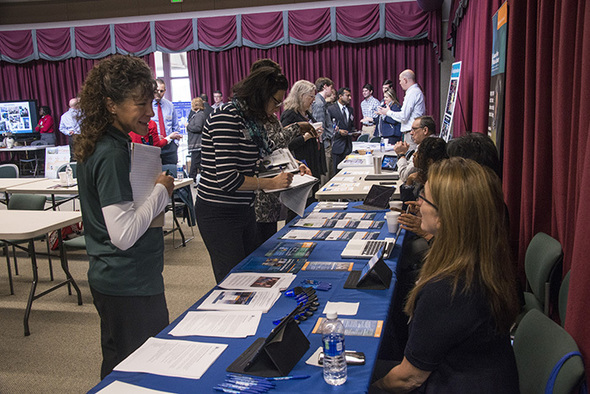
Donna Wendt, left, director of career services at Augusta Technical College, visits the Savannah River National Laboratory’s exhibit at the reverse career fair.
AIKEN, S.C. - At a traditional college career fair, students meet potential employers and describe their job qualifications.
A different dynamic was underway at the Savannah River Site (SRS) as the management and operating contractor Savannah River Nuclear Solutions (SRNS) hosted its first “reverse career fair” at the Applied Research Center earlier this year.
Career counselors and professors from nine local colleges and universities met with SRNS employees to learn about internships and full-time positions available to students.
“I’ve been on the tour of SRS before, and I’m familiar with the site and its missions, but this event has given me a comprehensive overview of what companies here are looking for from students in terms of internships and long-term opportunities,” said Corey Feraldi, director, Office of Career Services, University of South Carolina Aiken. “The Savannah River Site is so large that sometimes it’s hard to know exactly who does what. But now I have a better understanding of the application process, which will help me bridge that gap for our students.”
The event kicked off with an introduction from SRNS President and CEO Stuart MacVean, who described a wide range of career paths available to prospective employees.
“We have jobs that range from janitorial and lawn care to operations and maintenance to engineering and the sciences, as well as teachers for our training department. And at the pace we’re hiring, the training needs are even higher,” MacVean said. “Our work at the Savannah River Site has a tremendous impact not just for national security, but for global stability, and will continue for many generations, as we have new missions coming to us that are projected to last for decades into the future.”
SRNS employee Michael Roeber was among the exhibitors. After starting his internship with SRNS Site Automation Engineering in January 2017, he became a full-time employee six months later after he graduated from Augusta University with a bachelor’s degree in computer science.
“I think an internship is a great way to go because it’s the best way to gain hands-on learning experiences,” Roeber said. “Your group can get a feel for what you enjoy doing, while they observe what you’re capable of and how quickly you apply what you’ve learned. My advice for anyone starting an internship at SRNS would be to enjoy learning, ask questions and have fun. Work can be enjoyable.”