WASHINGTON, D.C. – The second segment of the November issue of EM Update is contained in this email. Read about the accomplishments of the Office of Environmental Management (EM) in fiscal year 2011 as the organization advances the world's largest nuclear cleanup program. Achievements in fiscal year 2011, which spanned October 2010 through September 2011, occurred across the DOE complex at sites such as Hanford, Idaho, Paducah and Savannah River.
The first segment of the November issue appeared earlier this month, and included stories on fiscal year 2011 accomplishments from EM's Office of Disposal Operations and Office of Deactivation and Decommissioning and Facility Engineering, as well as sites such as Moab and the Waste Isolation Pilot Plant.
Paducah Site Focuses on Groundwater Remediation, Waste Disposition in Fiscal Year 2011
PADUCAH, Ky. – The Paducah site continued to address remediation options for contaminated groundwater in fiscal year 2011 and disposal options for projected large waste volumes generated by deactivation and decommissioning cleanup.
The primary source of contamination in Paducah groundwater is a cleaning building at the center of the site that leaked trichloroethene (TCE) in the past. TCE is a chlorinated hydrocarbon typically used as an industrial solvent. It is a human carcinogen and is regulated as a drinking water contaminant.
Two plumes comprising approximately 2,100 acres of contaminated groundwater extend northerly from the center of the site toward the Ohio River. Two pump-and-treat facilities have extracted and cleansed nearly 3 billion gallons of groundwater since the mid-1990s to reduce the amount of contamination migrating off-site. A third, smaller plume of contaminated groundwater is confined to the southwestern area of the Paducah site.
In September 2011, DOE issued a Proposed Plan to address heavy levels of TCE in the ground at three locations contributing to the southwest plume. The Proposed Plan and subsequent Record of Decision for this project address TCE contamination confined to about 10 to 60 feet below ground at each of those three areas. The heaviest concentrations, at a former waste oil landfarm, are about 400 times the maximum level for TCE in federal drinking water standards.
DOE provides free municipal water to about 100 homes and businesses in or near the contamination area because of the offsite groundwater TCE plume. Affected groundwater wells are also capped in the area to prevent use until groundwater remediation is complete.
Groundwater cleanup is being conducted in two phases. In 2010, during Phase I, electrical resistance heating was successfully used to vaporize TCE, which could then be removed and treated, from shallow soil and groundwater (about 10 to 60 feet below ground surface). Testing in 2011 confirmed that Phase I remediation work in the cleaning building area removed a total of about 2,500 gallons of TCE.
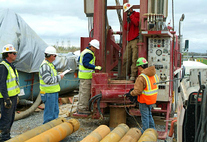
Workers drill one of two new extraction wells in 2010 that increased the pump-and-treat mass capture rate of TCE of the contaminated groundwater plume that extends northwesterly from the Paducah Site.
While the Phase I system was effective at shallow depths, it was not at deeper depths of 60 to 100 feet. In 2011, Phase II efforts are focused on developing a new cleanup strategy for the deep aquifer since an estimated 600 to 7,000 gallons of TCE remain. A variety of cleanup alternatives are being considered, and one technology involves in situ chemical treatment of the TCE sources. DOE and remediation contractor Los Alamos Technical Associates (LATA) Environmental Services of Kentucky, LLC, are working with regulators to reach a consensus on the new remediation strategy. A Proposed Plan and Record of Decision are anticipated in 2012, with operations set to begin in 2013 to 2015.
Deep soil mixing, which blends a hardening agent such as cement grout with soil, is the preferred remedy at the old landfarm, with implementation starting in 2013. Either bioremediation or long-term monitoring is the preferred remedy for the other two sites, where solvent releases occurred near a machine shop. Additional data will be collected to determine which remedy is needed. If bioremediation is the remedy, construction will start in mid-2014. Bioremediation uses microorganisms or their enzymes to return a contaminated area to its original condition.
Long-term waste disposal
Paducah is the site of the nation’s only active U.S.-owned uranium enrichment plant, and a closure date has not been determined. After closure, ultimate cleanup — chiefly the demolition of large enrichment facilities — will generate an estimated 3 to 4 million cubic yards of waste. Most of the waste will be hazardous, requiring either a new on-site engineered disposal cell or off-site disposal. The waste would fill more than 24 trucks per workday for 20 years.
Two public information exchanges were held in January 2011 to seek public input on these options with additional exchanges planned for 2012. A Record of Decision is anticipated in late 2012. If the decision calls for on-site disposal, the Department anticipates starting construction in 2014.
IDAHO FALLS, Idaho – In fiscal year 2011, cleanup at the Idaho site continued to reduce environmental and financial liabilities created by World War II-era conventional weapons testing, government-owned reactors, Cold War defense activities and nuclear energy research.
The Idaho site and its main cleanup contractor, CH2M-WG Idaho (CWI), have significantly reduced risks to the Snake River Plain Aquifer, workers and neighboring communities through cleanup completed using EM base program funding.
With safety leading every task, successful performance has followed. In March 2011, the 216th and final contractual remote-handled transuranic (RH-TRU) waste shipment was sent to the Waste Isolation Pilot Plant (WIPP), resulting in 96.86 cubic meters of RH-TRU from Idaho in safer, permanent storage. Through September 2011, 122 cubic meters of RH-TRU waste have been shipped from Idaho.
“Completing the RH-TRU shipping campaign was a major milestone for CWI. We achieved this first-of-a-kind TRU packaging, characterization and shipping safely, compliantly and ahead of schedule,” said Scott Anderson, Vice President of Waste Management for CWI.
In addition to RH-TRU, CWI shipped 5,111 cubic meters of contact-handled (CH) TRU waste to WIPP. Crews on the buried waste retrieval effort exhumed 2.93 acres of targeted buried waste, completing their contractual obligation in September 2011, more than a year ahead of schedule. The effort advanced protection of the aquifer.
“I’m so proud of our crews on this project,” said Hoss Brown, CWI Vice President of Accelerated Retrieval Project Operations. “This was originally envisioned as an 18-month task, and with a lot of hard work and process improvements thought of and implemented by the team, they successfully completed the work in half the time.”
In 2011, crews completed the D&D of an additional 17 buildings and structures totaling 333,935 square feet. Since starting the D&D work in May 2005, 219 of 223 buildings and structures have been demolished for a total footprint reduction of 2,127,856 square feet.
“These teams have performed highly complex and hazardous work a year ahead of schedule and millions of dollars under budget,” said Jim Barker, CWI D&D director.
Despite the challenges associated with the complexity and intricacy involved in the construction of the $570 million Integrated Waste Treatment Unit (IWTU), workers completed construction on June 3, 2011, marking a major milestone in the project’s progress. Testing and startup activities of the IWTU’s 73 systems are under way. Following those activities, this first-of-a-kind facility that will treat 900,000 gallons of liquid radioactive waste, thus allowing the cleanup and closure of the remaining four underground storage tanks.
Hanford Site Lists Groundwater Treatment Facility Among Accomplishments
RICHLAND, Wash. – Here are highlights of the fiscal year 2011 accomplishments by CH2M HILL Plateau Remediation Company, Richland Operations Office’s Central Plateau Contractor:
Completion of construction of the 100-HX pump-and-treat facility, which expands groundwater treatment capabilities near the Columbia River by 30 percent.
Construction of another groundwater treatment facility — known as 100-HX — is complete and the facility is now operational. In the past two years, DOE and CH2M HILL built this and another facility, the 100-DX, to treat groundwater contaminated with chromium near the Columbia River, which runs through the Hanford Site. The chromium was an anti-corrosive agent that was added to cooling water before it went through the reactor so that the pipes didn’t corrode. The form of chromium used for this task — hexavalent chromium — is being cleaned up because it is a toxic form of chromium, and can contaminate drinking water. With the help of lessons learned from building 100-DX, crews finished construction on the 100-HX facility three months ahead of schedule. The 100-HX process plant uses 31 extraction wells and over 61 miles of piping to bring groundwater to the facility to treat up to 35 million gallons per month. The treated water is then returned to the aquifer through a series of injection wells. Chromium contamination is in the groundwater near former processing reactors, where an anti-corrosion chemical was added to water for cooling the reactors in the Cold War. The two new facilities bring DOE closer to meeting its commitment to contain chromium contamination and prevent it from reaching the river in 2012.
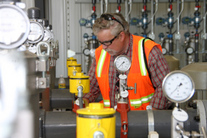
Joe Guyette, Quality Assurance, inspects equipment ready for operations to begin in the 100-HX groundwater treatment facility.
Treatment of a record amount of groundwater during the year.
Hundreds of new groundwater wells, miles of piping, and the 100-DX helped DOE and contractor CH2M HILL treat more than 850 million gallons of groundwater in a single year — a record for the Hanford site. The 100-DX, along with the recently constructed counterpart, 100-HX, uses a new treatment resin to remove chromium from the water that is proving to be efficient. The resin is expected to reduce lifetime operation costs nearly equal to the approximately $20 million cost of constructing the 100-DX. When work is complete on a third groundwater treatment facility being constructed on Hanford’s Central Plateau — the 200 West Groundwater Treatment Facility — more than 150 million gallons of groundwater per month will be treated. By 2015, pump-and-treat facilities across the site are expected to treat up to 2.4 billion gallons of groundwater annually.
Reducing the Hanford site footprint
Through September 2011, the Hanford site reduced its environmental footprint by 66 percent, or 385 square miles, exceeding a goal of 49 percent, or 290 square miles.
Sampling of radioactive sludge in the K West Basin.
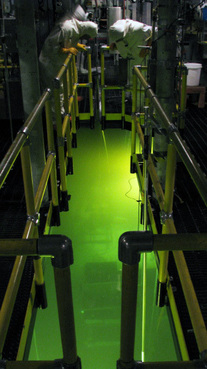
During Hanford’s operational days, the K West Reactor basins stored spent fuel from the reactor’s operations, and later took in additional spent fuel from neighboring K East Reactor’s fuel-storage basins. When the bulk of the fuel was removed from K West, the sludge — corroded, highly radioactive particles of spent fuel less than one quarter inch in diameter — remained, settled on the bottom of the 24-foot-deep basins under 17 feet of water. Workers are safely characterizing and retrieving the reactive sludge and consolidating and shipping it for interim storage away from the river. Progress in 2011 included transport of samples of the radioactive sludge for analysis, pretreatment of the next sludge material planned for retrieval and the start of demolition of an annex facility to support modifications for sludge transport. The sludge is one of the major cleanup challenges facing the site as it works to reduce the cleanup footprint to 75 square miles by 2015.
This photo shows the inside the K West Basin facility, where workers are retrieving highly radioactive sludge material under 17 feet of water.
Waste Disposal, D&D of Hundreds of Buildings Among DOE Contractor Accomplishments
RICHLAND, Wash. – Following are some of the achievements by Richland Operations Office’s River Corridor Closure Project contractor Washington Closure Hanford (WCH) in fiscal year 2011:
•Disposed a record 2.25 million tons of waste at the Environmental Restoration Disposal Facility (ERDF), breaking the previous record of 1.6 million set in fiscal year 2010; ERDF is Hanford’s landfill for low-level radioactive and hazardous mixed waste generated from cleanup activities throughout the Hanford site;
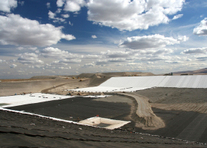
A view from the northwest corner of super cell 9 at the Environmental Restoration Disposal Facility shows the placement of gravel used for the gravel drainage layer.
• Marked an achievement in June 2011 in which truck drivers working on the River Corridor Closure Project surpassed 8 million miles of safely transporting waste to ERDF since 2005;
•Provided nearly 212,000 tons of concrete rubble from ERDF for use as fill for other projects at Hanford, which saves valuable landfill space and avoids substantial disposal costs.
•Decontaminated and demolished 187 of 329 buildings, and transported all debris from those demolitions to a disposal site;
•Remediated 230 of 552 hazardous waste sites and burial grounds;
•Began excavation of hazardous waste trenches at the 618-10 Burial Ground, which contains low- and high-activity radioactive waste from Hanford’s laboratories and fuel development facilities;
•Completed cleanup of miscellaneous debris in the 220-square-mile River Corridor, reducing the amount of land in active cleanup by 60 square miles;
•Completed a 630-ton scrap metal recycling campaign in an area of the site near the Columbia River;
DOE Contractor Mission Support Alliance Details Fiscal Year 2011 Achievements
RICHLAND, Wash. – DOE contractor, Mission Support Alliance (MSA), provides integrated infrastructure services for the Hanford site cleanup mission. In fiscal year 2011, MSA:
•Engaged all site contractors in planning the infrastructure needs of Hanford, including its diverse cleanup projects and contractors, establishing the first comprehensive and site-wide look at infrastructure needs for future cleanup phases;
•Received EM’s “Best in Class” Environmental Sustainability (E-Star) award for the Data Center Consolidation effort, which reduced the number of data centers from nine to two, cut energy use by 50 percent and resulted in more than $1 million in cost savings;
•Received four “Honorable Mention” E-Star awards for innovative projects and initiatives that resulted in efficiencies and a dramatic reduction in energy use and greenhouse gas emissions; the projects and initiatives include transitioning Hanford’s fleet vehicles to alternative energy vehicles and the implementation of wireless Internet access across the site;
•Facilitated the production of “The Hanford Story” in response to a request from DOE; this Emmy-winning video helps spread the word of Hanford — its historical significance, successes and future;
•Implemented numerous initiatives to achieve efficiencies and cost savings, including:
Waste Sampling & Characterization Facility (40 percent increase in productivity with $2.4 million of funding given back to the government to be made available for other contractors);
Warehouse Operations (53 percent increase in productivity); and
•Incorporated highly fuel efficient vehicles and alternative fuel vehicles into the Hanford fleet along with an overall streamlining of the fleet, reducing fleet vehicles by 13.6 percent and carbon dioxide emissions by 44 percent.
Savannah River Site Marks Achievements in Cleanup, Nuclear Materials Operations
AIKEN, S.C. – The Savannah River Site (SRS) marked many accomplishments in fiscal year 2011.
•Nuclear Materials Operations (NMO) at SRS continued to make headway in significant projects:
H Canyon, which supports DOE’s enriched uranium and plutonium disposition program, accelerated the production of low-enriched uranium (LEU) from highly enriched uranium; in fiscal year 2011, SRS shipped 16 trailers of LEU to the Tennessee Valley Authority for use in nuclear power production;
HB Line, the only chemical processing facility of its kind in the DOE complex, has completed Operational Readiness Review to repackage plutonium-contaminated waste for disposition at the Waste Isolation Pilot Plant in New Mexico;
H Canyon was used for repackaging transuranic (TRU) waste stored in large steel boxes and concrete casks; the boxes vary in size, with some as large as 12 feet long by 20 feet wide by 6 feet high; TRU waste repackaged at H Canyon generated 17 standard large boxes and 60 standard waste boxes; and
A study for the National Nuclear Security Administration (NNSA) on the feasibility of providing up to one metric ton of plutonium oxide per year using H Canyon and HB Line for the Mixed Oxide Fuel Fabrication Facility (MOX) was recently completed and received approval from the NNSA Administrator; this new mission would reduce the site's inventory of surplus plutonium; the MOX Facility, which is under construction, will blend surplus weapon-grade plutonium with depleted uranium oxide to make mixed oxide fuel for use in existing nuclear power plants;
•Workers in L Area completed activities necessary to provide additional storage for used nuclear fuel in L Basin;
•Workers in K Area constructed the Purification Area Vault, which is a location within a K Area facility formerly used as a DOE production reactor that is being converted into a plutonium storage area, and established the Material Access Area ahead of schedule and under budget;
•As part of a surveillance campaign, workers performed examinations and measurements of a group of sealed stainless steel containers, five inches wide and 10 inches in length, primarily used to store and transport plutonium; many of the containers had been packaged at the Hanford site and sent to K Area for storage;
•SRS successfully received four foreign research reactor casks containing 59 used nuclear fuel assemblies and 10 domestic research reactor casks; the casks are used to transport spent nuclear fuel used in research reactors; SRS stores nuclear materials in support of national defense and U.S. nuclear nonproliferation efforts; the site’s K Area Complex provides an interim safe storage location for much of DOE’s excess plutonium; and
•SRS’s Environmental Bioassay Laboratory, which is certified and accredited, played a key role in DOE’s efforts to assist Japan following the Fukushima Daiichi Nuclear Power Plant accident; the lab helped by analyzing soil and air filter samples for radiological contaminants related to the incident.
Savannah River Remediation Ends Fiscal Year 2011 with Safety, Production Records
AIKEN, S.C. – Savannah River Remediation (SRR), the liquid waste contractor at the Savannah River Site (SRS), surpassed safety and waste production records in fiscal year 2011 as it continued to clean up and close hazardous waste tanks.
Removing Cold War waste from massive underground tanks involves many intricate steps over several years before the tanks are clean enough for closing. During the fiscal year, SRR employees moved 15 tanks toward closure, more than at any other time in the site’s history.
SRR employees also performed work safely. SRR operations employees achieved more than 6 million hours of work without a day away from work due to an injury. SRR construction employees have worked 24 million hours without a day away from work due to an injury. During the two-year American Recovery and Reinvestment Act Program, which ended for SRR on Sept. 30, 2011, Recovery Act employees worked 1.5 million without a day away from work due to an injury.
“We put a major emphasis on safety,” SRR President and Project Manager Dave Olson. “Our operations and construction employees have proven their adherence to our safety culture.”
SRS has 51 underground hazardous waste tanks. Two of them were closed in 1997 and 49 waste tanks remain in some form of liquid waste service or closure phase.
In fiscal year 2011, SRR employees:
•Advanced operational closure activities on old-style waste tanks;
•Completed bulk waste removal — a multi-phase process that involves removal of nearly all liquid salt waste and peanut-butter like sludge — in three tanks. That’s a record number of tanks in one year to undergo bulk waste removal;
•Prepared two tanks for operational closure in 2012; and
•Readied two additional tanks for final sampling and analysis and subsequent closure.
“We take highly contaminated constituents from waste tanks and bind them in glass, and we solidify slightly contaminated salt waste into concrete. Both of these methods turn a liquid waste into a solid form, keeping it from contaminating the environment. By doing this work safely, we help to eliminate the highest environmental risk in the state,” Olson said.
Interim Salt Disposition Process (ISDP):
In August 2011, ISDP reached a production milestone by processing 1.4 million gallons of liquid salt waste. Facilities at ISDP, which are designed to remove chemicals and radioactive particles from the salt waste stream, surpassed records by processing over 50,000 gallons in one week.
Defense Waste Processing Facility (DWPF):
DWPF, which began operations in 1996, eclipsed two significant records during the year while employees solidified the highly-radioactive waste sludge into a glass form suitable for permanent storage. During fiscal year 2011, DWPF employees poured a record 267 canisters, beating the previous record of 260 in 2004. In August 2011, employees poured a record 32 canisters in one month, the most in a month in the facility’s 15-year history. The previous record was 31 canisters poured in February 2011.
The Defense Waste Processing Facility set a record by producing 267 canisters filled with glassified waste in a year.
Saltstone Production and Disposal Facilities:
At the Saltstone facilities, low-level salt solution is mixed with a cement-like grout and disposed in permanent on-site concrete vaults. Employees at Saltstone surpassed the previous year’s production performance of 1 million gallons by processing nearly 1.5 million gallons of salt solution.
The Saltstone facilities recently surpassed a major milestone by processing 10 million gallons of low-radioactive salt waste since beginning operations on June 12, 1990, at the Savannah River Site. During fiscal year 2011, Saltstone processed nearly 1.5 million gallons of salt waste, surpassing a previous record.
All SRS liquid waste facilities are critical components in the DOE’s mission to close waste tanks.
“These processing milestones demonstrate real progress in the safe removal and permanent disposition of liquid waste and supports DOE’s ultimate priority to close our tank farm system and reduce risk,” Olson said.