National Cleanup Workshop Highlights; Deputy Secretary Brouillette Outlines DOE Cleanup Commitments; EM to Continue Ramping Up Shipments to WIPP; and Much More!
DOE Office of Environmental Management sent this bulletin at 09/28/2017 01:07 PM EDT
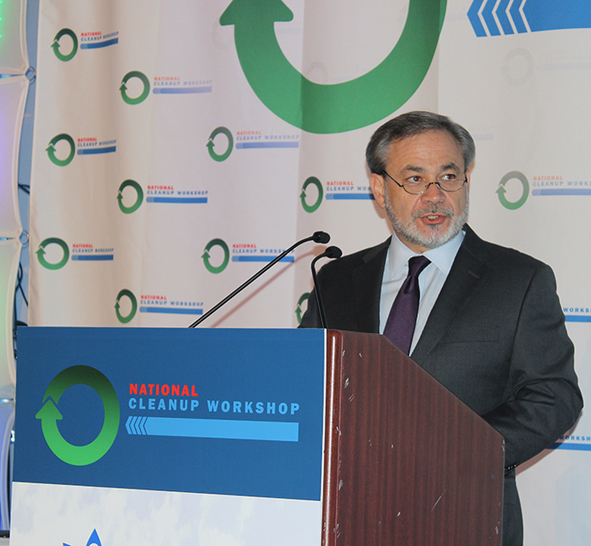
Deputy Energy Secretary Dan Brouillette was the keynote speaker at the 2017 National Cleanup Workshop.
ALEXANDRIA, Va. – Expressing pride for EM progress, Deputy Energy Secretary Dan Brouillette told participants in this year's National Cleanup Workshop held here earlier this month he is committed to completing cleanup more quickly and safely at less cost to taxpayers.
Brouillette, who served as DOE assistant secretary for congressional and intergovernmental affairs from 2001 to 2003, was confirmed to his new post in August. He said EM accomplishments quickly became evident during a recent return trip to the Hanford Site.
“I have to say I am very proud of the progress the program has made since I last served in DOE,” he said. “Honestly, I didn’t recognize a lot of Hanford when I drove through the facility.”
Among Brouillette’s observations at Hanford: All 20 tons of plutonium have been removed from the site; demolition of the Plutonium Finishing Plant is in the final stages; significant progress has been made at the Waste Treatment and Immobilization Plant; the 200 West Pump and Treat facility was built and now filters groundwater; and the historic B Reactor is now part of the Manhattan Project National Historical Park.
“To those of you who played such a vital role in these successes as well as EM’s other achievements in recent years, let me say on behalf of the Secretary: Thank you. Thank you,” Brouillette said.
But at Hanford and other EM sites, “there is much more work to be done, and I am aware of that as well,” Brouillette said. The cleanup “has to be on a final path that is sooner, safer, and at less cost to the taxpayers. It requires a sustainable approach that minimizes risk while maximizing opportunities to shorten schedules and life-cycle baselines.”
While discussing Department priorities with Energy Secretary Rick Perry, Brouillette mentioned that some cleanup projects carry completion dates stretching to 2060.
“His immediate reaction to me was, ‘Dan, I’m not going to be here then. Move it up. Get it done faster. Move it up. Move it up.’ And that is my responsibility and my charge and my priority,” he said.
Brouillette served as keynote speaker at the third-annual workshop, which brought together more than 600 EM stakeholders. The workshop was organized by the Energy Communities Alliance, which represents local communities near DOE sites, with EM and the Energy Facility Contractors Group as cooperating organizations in the event.
Brouillette said DOE cleanup enjoys support from many members of Congress, which he saw firsthand as staff director of the House Energy and Commerce Committee from 2003 to 2004.
EM work has “caught the eye of people in the highest places,” Brouillette said, pointing to the Administration’s proposed fiscal year 2018 budget containing $6.5 billion for EM — the highest requested amount in a decade.
“This clear White House vote of confidence in EM’s progress sends a positive, positive signal to the entire EM workforce, to the local communities, and the Tribal nations near our sites, and to all our stakeholders,” he said.
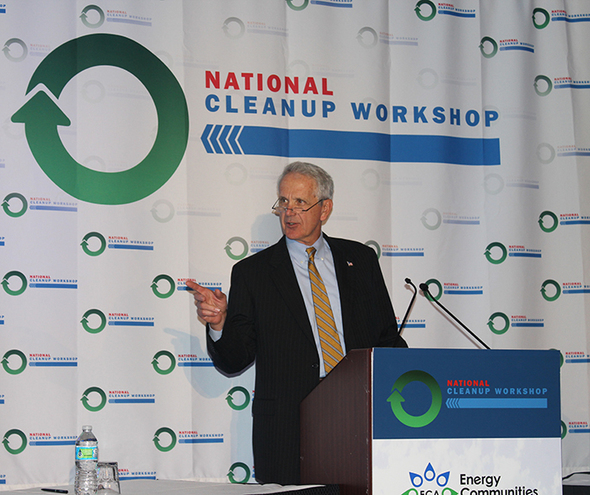
Acting EM Assistant Secretary Jim Owendoff addresses the National Cleanup Workshop audience.
ALEXANDRIA, Va. – Acting EMAssistant Secretary Jim Owendoff pledged a sense of timeliness and urgency necessary to tackle decisions within the cleanup program during an address at this year’s National Cleanup Workshop, held here earlier this month.
Owendoff, who assumed EM leadership in June, told the more than 600 people in attendance he is focused on paths to closure on potential issues that have languished or might ripen in the next year or so, and might benefit from added timely emphasis.
An aim is to build on a “can-do” atmosphere.
“What is the ability to say, ‘How can we get timely decisions?’” Owendoff said. “How do we collectively come together and say, ‘You know what? We can get together to make that decision.’”
“I believe we have the ability to put in place a sense of urgency,” he said.
Owendoff said a recent 45-day review he initiated had directed EM site managers and headquarters staff to pinpoint potential issues for additional analyses and identify paths for potential decisions.
“I wanted the team to take a first look at what are the decisions that we have out there that are coming up, in the next year, year and a half or so, that we need to ensure we get those decisions made,” he said.
“All this was, was a mechanism to energize site managers and the federal staff, and say, ‘You know what? Some of these decisions that are the tough decisions, we are willing to take those on.’”
“How do we use the juice that they have today?” Owendoff said. “We are blessed with both of them. Having been on trips with both of them, I feel [Brouillette’s] thumb on my chest and the Secretary’s thumb on my chest to (say) let’s get on with it.”
“I will try to do my best to ensure that decisions get teed up,” he said.
ALEXANDRIA, Va. – EM officials and cleanup contractor representatives from across the complex shared strategies for moving past challenges in major cleanup projects during the “Path to EM Successes in 2017” session at this year's National Cleanup Workshop, held here earlier this month.
“I’ve had several opportunities to travel to WIPP, which plays an integral role in our cleanup work across the entire program,” she said. “I’m proud of the work WIPP and our generator sites have done to allow TRU (transuranic) shipments to resume this year.”
“These, and other successes we’ve realized over the last year, all further demonstrate our continued commitment and capability to tackle our mission, to address decades of nuclear weapons production and nuclear energy research,” Charboneau said.
Hanford 618-10 Burial Ground and Plutonium Finishing Plant
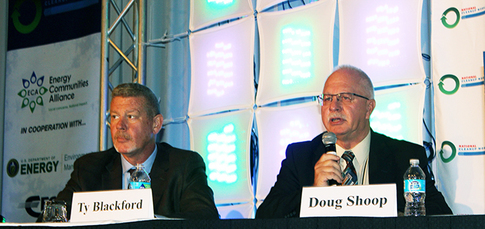
EM Richland Operations Office (RL) Manager Doug Shoop and Ty Blackford, president of contractor CH2M HILL Plateau Remediation Company, recounted progress in remediating the 618-10 Burial Ground and demolishing the Plutonium Finishing Plant (PFP).
Ty Blackford, president of contractor CH2M HILL Plateau Remediation Company, left, and EM Richland Operations Office Manager Doug Shoop.
Blackford described the difficulty of not knowing the types of waste in vertical pipe units that needed to be removed. RL collaborated with industry on extensive mockup testing to prepare for the work.
“Every day is something new. Every day presents you with something you didn’t expect,” he recalled.
Despite such challenges, crews succeeded.
“This was the job everyone said couldn’t be done, it couldn’t be accomplished,” Blackford said. “And I’m glad to tell you it is done. They’re gone, they’re out.”
Shoop and Blackford also talked about overcoming obstacles in D&D of the PFP, such as the facility’s outdated infrastructure.
“A lot of these challenges are just based on a very old facility. As Doug likes to say, and I agree with it, ‘It needs to go away,’” Blackford said of PFP. “We’re at the last stages of that right now. I’m very proud of our workforce. I’m very proud of the long history. It’s been 20 years to get here.”
Los Alamos Remediated Nitrate Salt Drums
Doug Hintze, manager of the EM Los Alamos Field Office, and Randy Erickson, associate director for environmental programs at Los Alamos National Laboratory, explained the changes that led to advancements in treating remediated nitrate salt drums. Workers have treated more than half of the 60 drums so far.
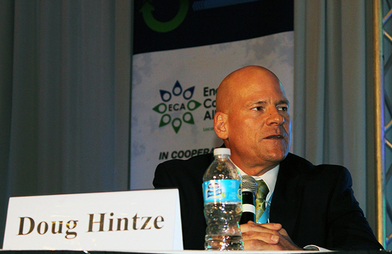
EM Los Alamos Field Office Manager Doug Hintze.
Hintze said he’d be remiss if he didn’t acknowledge the hundreds of workers critical to improvements.
“These people wanted to make it right so they did step up and take that accountability,” he said.
After a drum of remediated nitrate salts ruptured at WIPP in 2014, contributing to the facility’s suspension of operations until earlier this year, the Accident Investigation Board ordered full-scale drum testing. That testing provided insight to improve safety, such as the need to manage pressure inside the drums, according to Erickson.
“We did implement some pressure relief devices as a result of those full-scale drum tests,” he said.
Erickson attributed project progress to a “very strong and effective collaboration” between EM and the National Nuclear Security Administration and a “wealth of technical expertise” provided by EM headquarters.
Hintze reflected on other lessons learned, including the importance of peer reviews, clear expectations for stakeholders, respect for all project partners, and the need to “go slow to speed up.”
That means work stops when an operator raises a hand after seeing something unexpected.
“Schedule is not important,” Hintze said. “Remediating this risk, eliminating the hazard, is the number one thing.”
Portsmouth’s X-326 Process Building
For Portsmouth, success means deactivating the X-326 Gaseous Diffusion Process Building, according to Robert Edwards, manager of EM’s Portsmouth/Paducah Project Office.
Demolishing the estimated 2.5-million-square-foot facility, one of three process buildings on the site, will create the “first major skyline change at Portsmouth,” he said.
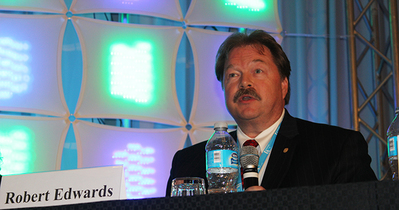
EM Portsmouth/Paducah Project Office Manager Robert Edwards.
“Getting there wasn’t that easy,” Roberts added, emphasizing the benefits of lessons learned from Oak Ridge’s ETTP D&D.
Dennis Carr, site director for contractor Fluor-BWXT Portsmouth, said transitioning the site from commercial nuclear power operations to D&D while adopting DOE’s Integrated Safety Management System and work planning proved challenging.
“I think now there is a very vibrant and very effective safety culture at the facility,” Carr said. “We’ve gone all year without a recordable injury.”
Early on, the project underestimated the need for nondestructive assay (NDA), which measures the quantities of uranium in pipes and equipment, Carr said.
“Now we have met those needs,” Carr said, noting the site’s trained and qualified 250-person NDA organization that has taken more than 1.1 million of the required 1.3 million NDA measurements.
Carr also discussed progress toward building the 5-million-cubic-yard Onsite Waste Disposal Facility.
“We are at the field mobilized today, excavating soil at a pretty blistering rate,” he said. “Our objective is first waste placement by the end of calendar year 2020 before we have to shut down for the winter freeze. I’d love to beat that.”
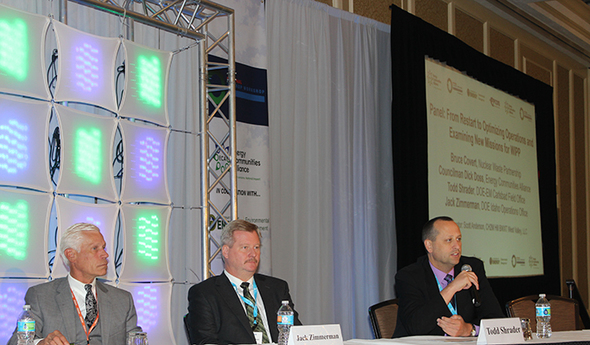
Carlsbad Field Office Manager Todd Shrader, far right, speaks during the panel discussion. Moderator Scott Anderson, deputy general manager of CH2M Hill BWXT West Valley, LLC is at far left and Jack Zimmerman, deputy manager of DOE Idaho Operations Office, is at center.
ALEXANDRIA, Va. – EM’s Waste Isolation Pilot Plant (WIPP) expects to receive more shipments of transuranic (TRU) waste in fiscal 2017 than initially planned, Carlsbad Field Office (CBFO) Manager Todd Shrader said at this year's National Cleanup Workshop, held here earlier this month. As of this week, the total shipment tally was 68.
EM site managers, contractor executives, and a Carlsbad elected official discussed the remediation and disposal of TRU waste from across the DOE complex at WIPP during the panel discussion.
Shipments to WIPP resumed this past spring after the facility reopened in January. EM suspended operations at WIPP in 2014 after a truck fire and breach of an improperly remediated nitrate salt drum from Los Alamos National Laboratory (LANL). Located about 33 miles southeast of Carlsbad, the EM facility is the nation's only deep geologic repository for nuclear waste. CBFO oversees the facility.
Panelist Dick Doss, member of the City of Carlsbad, N.M., Council and Energy Communities Alliance, said three to four shipments go to WIPP weekly, and the rate of shipments is anticipated to increase.
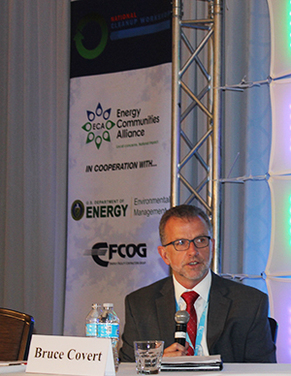
Approximately 450 containers have been placed in the WIPP underground since January, according to Bruce Covert, president of Nuclear Waste Partnership, WIPP’s management-and-operating contractor. Shipments to the facility are currently underway from EM’s Idaho Site, Savannah River, Oak Ridge sites, and the commercial Waste Control Specialists (WCS) facility.
Dick Doss, member of the Carlsbad Council and Energy Communities Alliance.
Bruce Covert, president of Nuclear Waste Partnership.
Shrader said WIPP is expected to receive approximately 250 shipments in the next calendar year; that waste will continue to be emplaced underground in Panel 7. According to Shrader, that panel is expected to be filled with TRU waste in approximately two-and-a-half to three years. Mining on Panel 8 will start later this year and is expected to take three years to complete.
Less than 1 square mile of the 16 square miles allotted for waste at WIPP has used, according to Shrader.
Jack Zimmerman, deputy manager of the DOE Idaho Operations Office, said the Idaho Site has approximately 1,000 shipments ready to go to WIPP.
The Idaho Site sends about two to three shipments to WIPP weekly, Zimmerman said. The site’s shipments will continue to comprise about half of all DOE complex shipments to WIPP for the foreseeable future, he added.
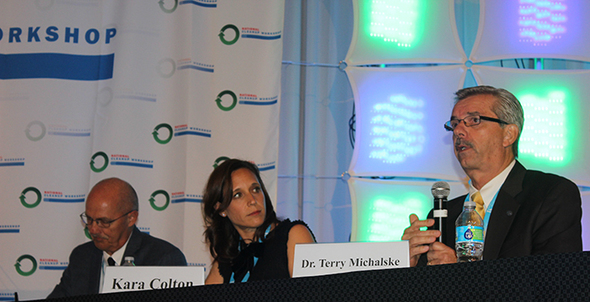
Dr. Terry Michalske, director of EM’s Savannah River National Laboratory, speaks during the high-level waste panel discussion. Kara Colton, director of nuclear energy programs for the Energy Communities Alliance, is at center, and moderator David Olson, vice president of operations at Fluor, is at far left.
ALEXANDRIA, Va. – A panel discussion at the recent National Cleanup Workshop highlighted the importance of new technologies and other fresh approaches to tackle high-level tank waste challenges.
Panelists included Kevin Smith, manager of the EMOffice of River Protection (ORP) at Hanford; Dr. Terry Michalske, director of EM’s Savannah River National Laboratory; Karthik Subramanian, chief technology officer at Hanford tank farms contractor Washington River Protection Solutions; and Kara Colton, director of nuclear energy programs for the Energy Communities Alliance (ECA), which represents local communities near DOE sites.
The communities, regions, and states have no greater priority than the disposition of waste — high-level waste in particular, according to Colton. She referenced a recent ECA report calling for DOE to create a new waste management approach.
“The report outlines five near-term actions that we think can help EM save $40 billion…and move waste out of our communities more efficiently using a risk-based approach,” Colton said.
The panelists agreed that new techniques are needed to help manage and treat Hanford’s mix of low-activity and high-level tank waste.
“We need a science-based approach to dispositioning [of the waste],” Subramanian said. “If we are able to do that on a constituent-based disposition, that kind of science-based approach will open up a lot of opportunities while maintaining a safe environmental disposition.”
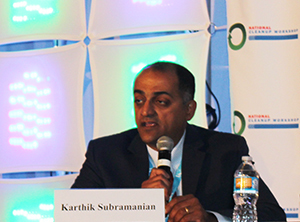
Karthik Subramanian, chief technology officer at Hanford tank farms contractor Washington River Protection Solutions.
Subramanian stressed that industry partners need to incorporate new ideas into current cleanup contracts.
Michalske said technology development must be part of the culture and expectation.
“Think of the national laboratories as the world’s largest scientific engineering operations,” Michalske said. “We probably have expertise in almost anything you can imagine.”
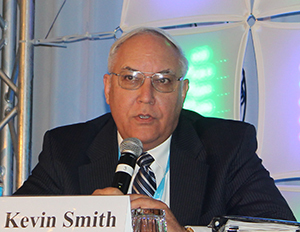
Kevin Smith, manager of the EM Office of River Protection.
Smith emphasized the importance of technology and the EM National Laboratory Network, which links the capabilities of DOE national laboratories supporting the agency’s nuclear cleanup mission.
“What was not possible yesterday might be possible today with the advancement of tech and other opportunities. EM has gotten a little disconnected from the national lab network and using that talent to boost our ability to address technical issues is a great opportunity to expand our mission,” Smith said. “Way too often we default to the most conservative approach and we find ourselves with a stack of conservatisms which we think are the most cost effective but some level of risk acceptance is healthy to accomplishment.”
ALEXANDRIA, Va. – During a 2017 National Cleanup Workshop panel discussion on future uses for EM sites, Jay Mullis, acting manager for the Oak Ridge Office of EM, addressed how his organization is working to transform one of its active cleanup sites into an economic asset to benefit the region. Mullis highlighted efforts to clean and transfer land at the former K-25 site to private industry, and the future uses cleanup is enabling, including economic development, conservation, and historic preservation.
Mullis emphasized the value of partnerships and community input when making decisions about the future uses of cleanup sites. Oak Ridge was DOE’s first site to employ a Reindustrialization Program. Mullis noted that the site began accepting input and developing a future use report in 1997 with a working group comprised of members from local community groups, environmental groups, city government, and city council members.
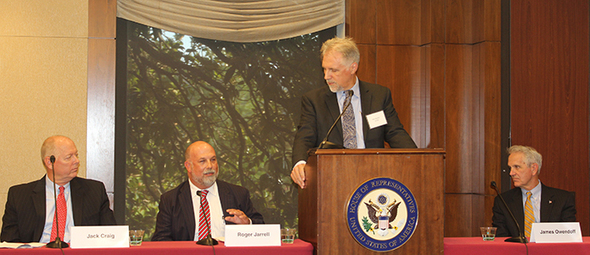
Panelists at the event for the House Nuclear Cleanup Caucus, left to right: Savannah River Operations Office Manager Jack Craig; Roger Jarrell, Senior Advisor to the Energy Secretary for EM; Ken Rueter, president of URS/CH2M Oak Ridge; and Acting EM Assistant Secretary Jim Owendoff.
WASHINGTON, D.C. – DOE leaders discussed efforts to bring increased urgency to decision-making across the EM complex in an event for the House Nuclear Cleanup Caucus on Capitol Hill on Sept. 13.
Drawing from his experiences touring EM’s Hanford, Savannah River, Oak Ridge, and Portsmouth sites this past summer, Jarrell noted the diversity of EM’s sites, the cleanup progress he witnessed, and the desire of the sites and surrounding communities to execute the cleanup mission.
“These sites and communities want to get cleanup done and transition to a bright future,” Jarrell said. “The Trump Administration is all about doing that.”
Panelists discussed the recent 45-day review to enable timely and effective EM decision-making. Owendoff outlined EM’s work on the review to date, described his “bias toward action” approach, and laid out next steps, which involve engagement with regulators, Tribal nations, elected officials, stakeholders, and other cleanup partners before final decisions are reached.
“We owe to each one of these communities an obligation to clean those communities up,” Owendoff said. “Where can we make the best decisions at each one of the sites? How can we be more effective, more efficient?”
Craig emphasized the importance of aligning as a team to achieve results.
“From my work going back to closed sites like Fernald and Mound, I know the power of alignment, the power of focus, and the power of a sense of urgency,” Craig said. “When we can get that between headquarters, the field, our contractors, the regulators, and the communities, the job gets done.”
Panelists also highlighted work planned under President Trump’s fiscal year 2018 budget request demonstrating a significant commitment to cleanup. The $6.5 billion request for EM is the highest in a decade and enables stable, steady cleanup progress, including continued deactivation and decommissioning progress at Portsmouth, an increase in shipments to the Waste Isolation Pilot Plant, design for a mercury treatment facility at Oak Ridge, and progress on the Direct-Feed Low Activity Waste initiative, key to Hanford’s tank waste mission.
The event was organized by the Nuclear Energy Institute. Led by Reps. Chuck Fleischmann (Tennessee) and Ben Luján (New Mexico), the bipartisan caucus serves to educate lawmakers about EM and advocate for cleanup in Congress.
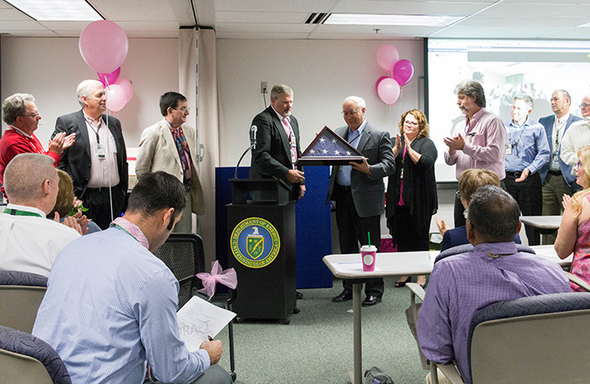
Ben Harp, Office of River Protection (ORP) Deputy Manager (center) and the rest of ORP senior leadership team present retiring ORP Manager Kevin Smith (center right) with the flag that flew over the ORP building during his tenure as ORP manager. Pictured, from left, are Scott Stubblebine, Office of the Chief of Counsel; Brian Harkins, Office of Hanford Acquisitions; Marc McCusker, director of Contracts and Procurement Management; Harp and Smith; Carrie Meyer, director of Communications and Information Management; Bill Hamel, Assistant Manager and Federal Project Director for the Waste Treatment and Immobilization Plant (WTP) project; Rob Hastings, Assistant Manager for Technical and Regulatory Support; Glyn Trenchard, Assistant Manager for Tank Farms Project; and Delmar Noyes, Acting Assistant Manager for WTP Startup, Commissioning and Integration.
During a Sept. 27 ceremony marking his retirement, Smith summarized the progress he believes ORP has made during his tenure as manager, saying the office has paved “a solid path for mission completion.”
Smith began serving as ORP manager in early 2013, working to secure focus on the Direct Feed Low Activity Waste approach at the Hanford Waste Treatment and Immobilization Plant (WTP), intended to begin processing tank waste at Hanford as soon as 2022. ORP continued progress on other portions of the WTP, including completing a Preliminary Documented Safety Analysis — the basic nuclear safety document for design — for the WTP High-Level Waste Facility. In addition, ORP made headway retrieving waste from Hanford’s aging single-shell tanks for storage in the site’s double-shell tanks.
Smith said he had worked to “leave things better than when I arrived.”
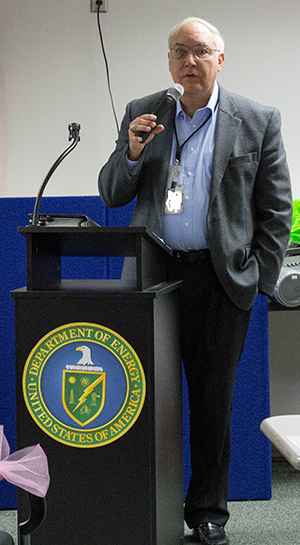
Retiring Office of River Protection Manager Kevin Smith speaks at the Sept. 27 ceremony marking his retirement.
He joined DOE in 2004 after a career as an officer in the U.S. Air Force, which included serving in several senior positions, including the commander of the 49th Operations Group at Holloman Air Force Base and F-16 Squadron commander at Luke Air Force Base.
Smith held key leadership positions at DOE, including assistant manager of the Nuclear Materials Stabilization Project at the Savannah River Site; deputy manager for NNSA’s Y-12 Site Office; acting manager for the NNSA Kansas City Plant; and site manager for the Los Alamos Site Office.
In 2005, Smith was awarded the DOE John B. Whitsett Technical Manager of the Year Award, in 2006 the DOE Exceptional Service Medal, in 2013 the NNSA Distinguished Service Gold Medal, in 2015 the Secretary of Energy’s Honor Award, and in 2016 the Presidential Rank Award.
“I want to thank you personally and professionally,” Smith said at the ceremony. “Please know that ORP is in a different place and you have a lot to be proud of. I encourage you to keep being a high-performing organization and to keep your eye on the prize, keeping the Columbia River safe for future generations.”
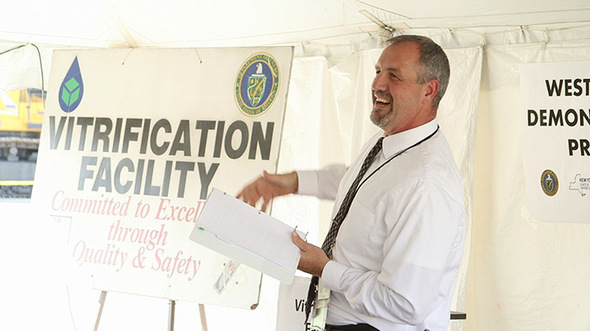
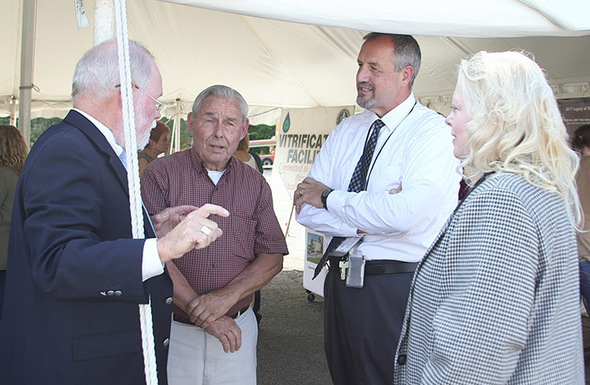
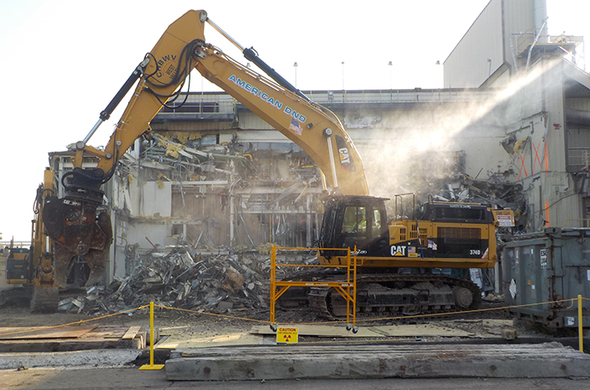
WEST VALLEY, N.Y. – At top, West Valley Demonstration Project (WVDP) Director Bryan Bower addresses
the audience at a recent celebration marking the start of the Vitrification
Facility demolition. At center, the celebration, from left, Willis Bixby, past WVDP
project director; Bill King, former Town of Ashford supervisor; Bryan Bower,
current WVDP project director; and Stacy Charboneau, EM Associate Principal
Deputy Assistant Secretary, Field Operations. At bottom, with demolition underway,
heavy equipment prepares to take another bite out of the Vitrification
Facility.
EM contractors across the complex were recognized for safety and health excellence in DOE’s Voluntary Protection Program (VPP) at a recent symposium in New Orleans.
Working through cooperative efforts among labor, management, and government at DOE contractor sites, the VPP promotes improved safety and health performance through public recognition of outstanding programs.
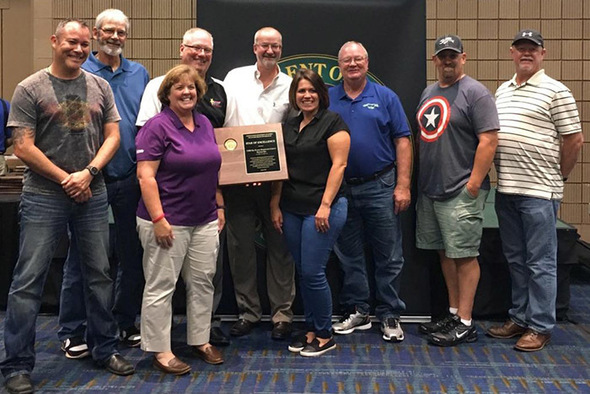
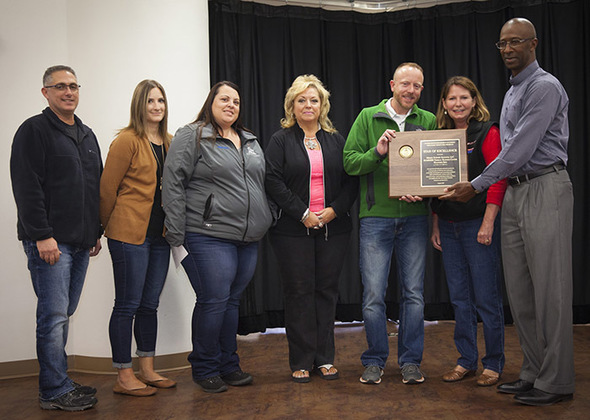
CH2M HILL Plateau Remediation Company Employees received the Voluntary Protection Program Star of Excellence award at the 2017 Safety+ Symposium. CH2M’s goal is to set the gold standard for safe, compliant cleanup at the Hanford Site by performing safely at work and home and reducing risk through project performance.
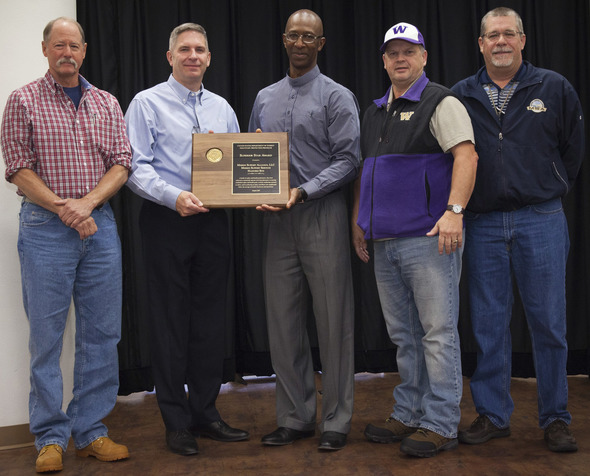
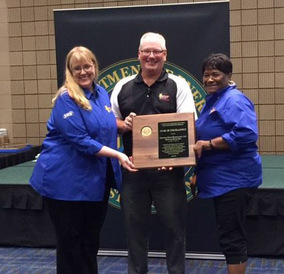
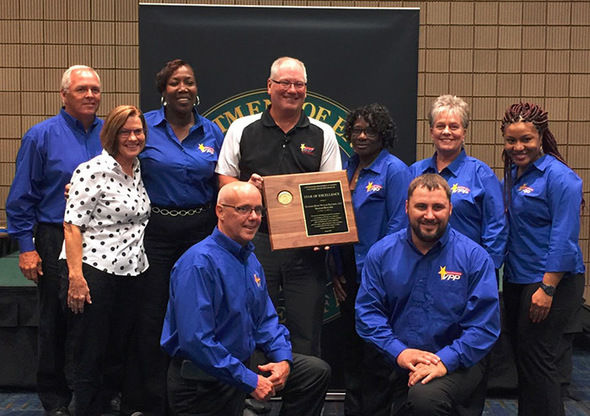
Hanford Site contractor Mission Support Alliance (MSA) (at top) won the Voluntary Protection Program (VPP) Superior StarAward. MSA’s Safeguards & Security (at center) and Volpentest Hazardous Materials Management and Emergency Response Federal Training Center (at bottom) teams each received the VPP Star of Excellence award. At MSA, the number of reported incidents over the last 3 years correlates with a decrease in recordable injury rates, demonstrating that increased reporting helps reduce injuries.
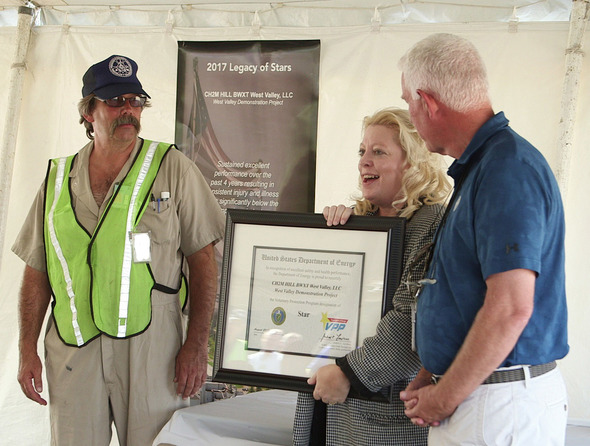
Stacy Charboneau, EM Associate Principal Deputy Assistant Secretary for Field Operations, presents a Voluntary Protection Program (VPP) recertification certificate and VPP flag to Rob Dallas, president of the International Association of Machinists and Aerospace Workers, Lodge 2401, representing the unionized workforce at EM's West Valley Demonstration Project (WVDP) site. WVDP cleanup contractor CH2M HILL BWXT West Valley President and General Manager Jeff Bradford is at right. The event was held earlier this month.
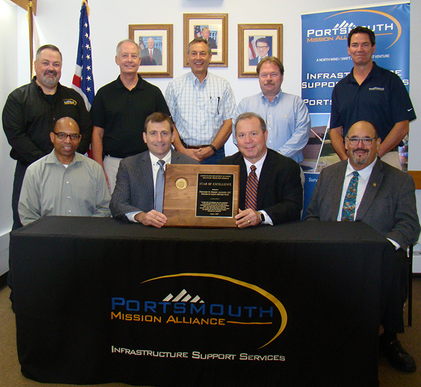
PMA has not experienced a recordable injury/illness or lost work day during its contract to date, amounting to 400,000 safe work hours in less than a year and a half. This is the seventh consecutive VPP Star of Excellence award received by Portsmouth Site ISS contract employees.
“Portsmouth Mission Alliance’s outstanding safety culture is a reflection of our motto, ‘Where Safety Leads - Performance Follows,’” said John Bukowski, president of PMA and parent company North Wind Solutions.
The award is presented to DOE VPP Star sites that maintain an injury/illness rate at least 75 percent below the Bureau of Labor Statistics industry average, meet annual VPP goals, actively mentor other companies, and demonstrate strong community involvement.
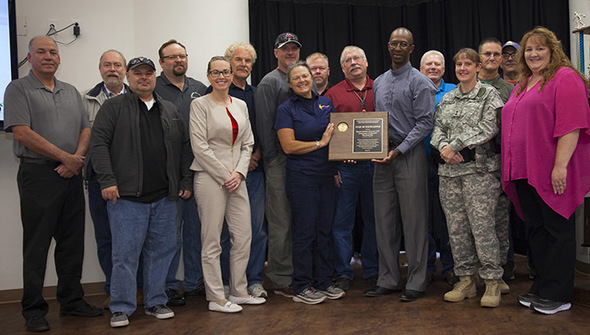
Pictured with Portsmouth Mission Alliance’s (PMA) Voluntary Protection Program award are, top row, from left, Brent Clark, North Wind Group Northeast Regional Manager and PMA Deputy Project Manager (PM); Damon Detillion, PMA PM; EM Portsmouth/Paducah Project Office (PPPO) Site Lead Joel Bradburne; PPPO Manager Robert Edwards; and North Wind’s Matt Miller; front row, from left, Leon Owens, PMA Board of Directors; North Wind President John Bukowski; North Wind CEO/President Chris Leichtweis; and Greg Razo of CIRI Government Contracting.
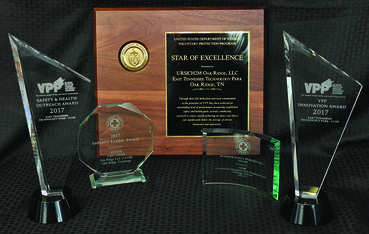
The VPPPA honored Oak Ridge Office of Environmental Management contractor URS|CH2M Oak Ridge (UCOR) with the Star of Excellence award, VPP Innovation Award, and Safety and Health Outreach Award. UCOR was awarded VPP Star status in 2015.
“We are pleased to receive this recognition from VPPPA,” UCOR President and Project Manager Ken Rueter said. “This is yet another in a series of recent awards that recognize UCOR and underscore our commitment to a strong safety culture.”
UCOR completed reverification of its Integrated Safety Management System this month.
“This award reminds us of the robust safety culture that characterizes UCOR’s work on the Oak Ridge Site every day and our commitment to a zero accidents policy,” Rueter said.
Oak Ridge Office of Environmental Management contractor URS|CH2M Oak Ridge received several safety-related awards this year.
Savannah
River Remediation (SRR), EM’s liquid waste contractor at the Savannah River
Site (SRS), garnered the Star of Excellence award. SRR has been a VPP site
since 2009, when it became the SRS liquid waste contractor.
SRR President and Project Manager Tom Foster said receiving the award exemplifies SRR’s commitment to safety and health.
“Winning the DOE-VPP Star of Excellence award is a testament to SRR’s strong safety culture,” Foster said. “We employ approximately 2,000 employees who come to work every day with a mindset of working safely not only for themselves, but for their families, coworkers, and their community, and I congratulate them for their commitment.”
Savannah River
Remediation (SRR) Tank Farm Facility Support Operator Arlene Williams, right,
and SRR Training / Media Technologies Support Team Senior Instructor Penny
Miller attend the 2017 Safety+ Symposium in New Orleans. They accepted the Star
of Excellence award on behalf of SRR. DOE Office of Worker Safety and Health Assistance Director Brad Davy is at center.
Savannah
River Nuclear Solutions (SRNS) employees pose with DOE Office of Worker Safety
and Health Assistance Director Brad Davy after receiving the company’s 16th
DOE-Voluntary Protection Program Star of Excellence award. Bottom row, from left,
Bobby Hill and Curtis Crenshaw, SRNS; back row, from left, Darrell Freeman,
Kliss McNeel, and Brenda Legons, SRNS; Davy; and Loretta Williams, Brenda
Kelly, and Candice Williams, SRNS.
The VPPPA awarded Savannah River Nuclear Solutions (SRNS) the Star of Excellence award. SRNS has received more than 110 safety-related commendations since becoming the site’s management-and-operations contractor in 2008.
“SRNS employees take a non-negotiable stance when it comes to workplace safety. Receiving our 16th Star of Excellence serves as continued validation that our safety programs, training, and culture continue to perform to world-class standards,” SRNS President and CEO Stuart MacVean said.
New employees have noted that the safety culture at SRNS is unlike any they’ve experienced in past jobs, according to SRNS Safety and Health Program Employee Engagement Lead Barbara Guenveur.
“We get a great deal of satisfaction when we hear that feedback from our newest team members,” Guenveur said. “SRNS employees feel a personal responsibility for workplace, community, and national safety.”
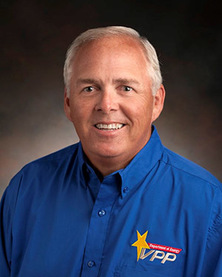
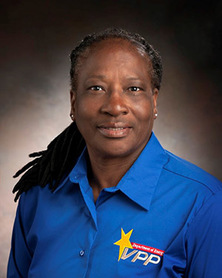
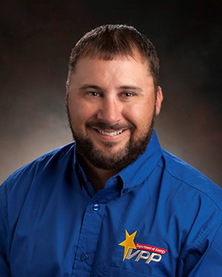
SRNS employees Curtis Crenshaw, Darrell Freeman, and Loretta Williams were recipients of Safety and Health Achievement awards. The VPPPA bestows that award to employees who exemplify a commitment to safety and health initiatives on and off the job through outreach, training, and implementation of health and safety best practices.
Darrell Freeman of Savannah River Nuclear Solutions.
Loretta Williams of Savannah River Nuclear Solutions.
Curtis Crenshaw of Savannah River Nuclear Solutions.
“SRNS employees have a strong commitment to health and safety at work, and in the community. But for some, that commitment is truly noteworthy, as is the case with Curtis, Darrell, and Loretta,” said Kliss McNeel, SRNS senior vice president for the environmental stewardship, safety and health division. “Their ongoing work to ensure that our employees go home to their families in the same condition that they arrived is heartwarming and inspiring. We are very proud of them for achieving this award.”
-Contributors: Angie Benfield, Mike Butler, Patrick Conrad, Destry Henderson, Tina Melton, Anne Smith, David Sheeley, Rachel Stroth
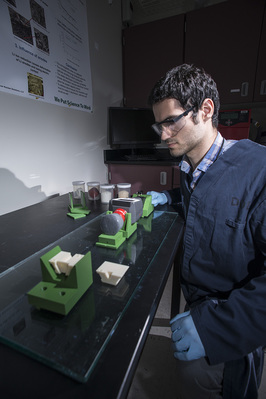
Alexander Piedra, Florida International University senior and DOE Fellow, spent the summer evaluating high-density polyurethane foam for radiation shielding and deactivation and decommissioning applications.
Promising science, technology, engineering, and math
(STEM) students gain critical skills for their future careers through this
collaborative program.
The three worked with SRNL mentors on research related
to their academic disciplines for 10 weeks, delving into scientific projects ranging
from environmental engineering to chemistry and materials science.
Alexander Piedra, a senior at FIU, worked with Connor Nicholson, senior engineer, and Aaron Washington, principal scientist, on an EM-funded project to evaluate high-density polyurethane foam for radiation shielding as well as deactivation and decommissioning applications.
“I gained a better understanding of certain aspects of chemistry and material science,” Piedra said. “I’ve learned and experienced some of the nuances of projects and how they function through securing funding, following protocols, respecting deadlines, and how it is to be a part of a professional team.”
Piedra added that he strengthened his professional and communications skills by working with a variety of people on- and offsite.
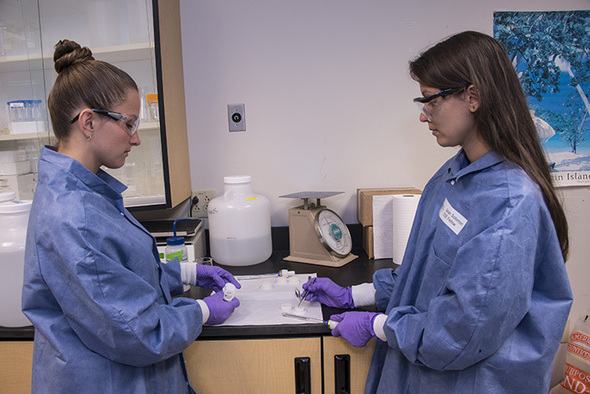
Florida International University students and DOE Fellow interns Ripley Raubenolt and Sarah Solomon researched sorption of methyl mercury species for soil and groundwater applications at Savannah River National Laboratory this summer.
Sarah Solomon and Ripley Raubenolt worked with Michael Paller, senior fellow scientist, and Brian Looney, senior advisory engineer, on sorption of methyl mercury species in soil and groundwater applications.
“Working at SRNL this summer not only sharpened my technical skills in the lab, but it also allowed me to get involved with experiments that required critical thinking,” said Solomon. “This internship also made me realize how diverse the field of environmental engineering is and the many opportunities there are to work on different projects.”
Raubenolt reflected on the value of her summer experience: “This internship allowed me to see the process of how laboratory research is conducted and conveyed along within an established professional network. The value of being able to work on this project has shown me that thinking outside the box and using knowledge from previous experiences gives you an edge that expands experimental research at hand.”
Solomon and Raubenolt believe their internships will greatly benefit their progression as environmental engineers.
The DOE FIU Science and Technology Workforce Development Program is a collaborative program between EM and FIU’s Applied Research Center. The DOE Fellows Program, which addresses DOE’s future workforce needs, is designed to attract minority scientists and engineers into the Department’s technical workforce.
DOE Fellows are some of FIU’s brightest students in STEM disciplines. Fellows are competitively selected to work independently and as a team on projects.
SRNL hosted 58 student interns this summer from eight programs, including: the DOE Fellows Program, the DOE Office of Environmental Management Minority Serving Institutions Partnership Program, the Energy Efficiency and Renewable Energy Robotics Program, and the Augusta University Nuclear Workforce Initiative. The interns came from 26 universities in 12 U.S. states and territories and worked with more than 50 SRNL staff mentors.