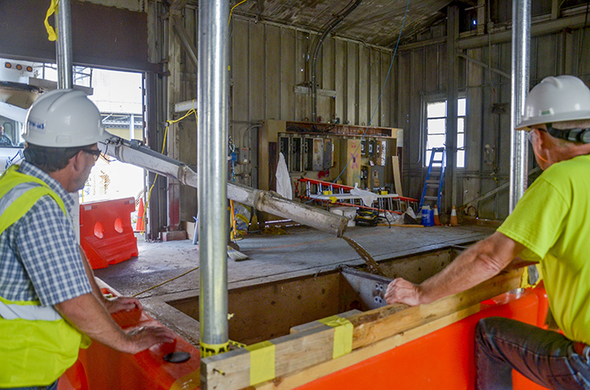
Savannah River Site H Canyon Senior Control Room Operators Deborah Thomas (top) and Audrey Davis start the first cycle unit operations for the first time in five years in August 2016, making all H Canyon units operational.
AIKEN, S.C. – The DOESavannah River Operations Office (DOE-SR) awarded its management-and-operations contractor an overall rating of “very good” for its fiscal year (FY) 2016 performance in an award fee determination scorecard. The assessment allowed Savannah River Nuclear Solutions (SRNS) to earn $39,157,202, or 87 percent, of the total available fee for the period.
DOE-SR noted several milestones SRNS achieved in FY 2016 in its environmental management work at Savannah River Site:
SRNS achieved significant progress in nuclear facility operations in FY 2016:
o All units in H-Canyon became operational for the first time since 2011;
o Achievement of startup and operation of plutonium down blending in K-Area in September 2016; and
o Effective use of limited resources to address emergent issues in L-Area from fuel receipts, including changes necessary for receipt of target residue material.
Progress with 235-F risk reduction and execution of Defense Nuclear Facility Safety Board 2012-1 Implementation Plan requirements.
Strong management of the D-Area Ash Project.
Establishment of Savannah River National Laboratory (SRNL) as an independent business unit and creation of a new governance framework, allowing greater flexibility for SRNL and delivering more efficient and timely research, development and engineering support to the EM complex and other SRNL customers.
Cybersecurity improvements and accomplishments.
Fee-bearing work is identified prior to each fiscal year and managed through the baseline earned value management and work authorization systems. The work must be planned, funded, and approved to establish an approved baseline for the new fiscal year. Strategic decisions relative to agency and program initiatives are incorporated in the baseline work.
DOE-SR focused efforts in FY 2016 in three areas: contractor assurance systems, emergency management and conduct of operations. To strengthen conduct of operations, SRNS used lessons learned and actions identified from an HB-Line event to improve employee and supervisory training, quality of site procedures, readiness evaluations for site nuclear activities, and overall nuclear operations. This has been evident by operators demonstrating willingness to stop work for safety concerns; increased emphasis by management on procedure compliance; and revisions to procedures when needed in a more efficient manner.
SRNS improved emergency management by being proactive in the site's active shooter awareness program. SRNS developed and shared active shooter response videos on employee's desktop computers and created posters, information pamphlets and educational tables at site events. The contractor improved resource management and planning, and emergency response drills and exercises, according to DOE-SR.
SRNS developed an effective contractor assurance system structure in FY 2016. The system includes an improved system description and upgraded metrics allowing for improvement in all contractual areas.
The scorecard outlines areas for improvement in FY 2017, including:
Corrective action closure not timely, closure not documented adequately and without consistent post-closure effectiveness reviews;
Incomplete metrics required to track progress;
Insufficient subcontract acquisition planning and management; and
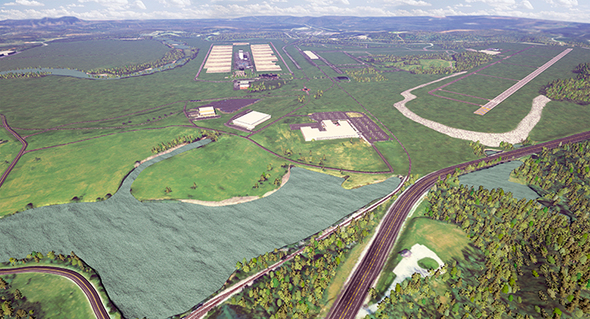
A rendering of East Tennessee Technology Park (ETTP) in 2020, when cleanup there is scheduled for completion. ETTP offers robust infrastructure and multiple parcels spanning hundreds of acres, capable of attracting and supporting large-scale industry.
OAK RIDGE, Tenn. – Community leaders and area economic development officials joined DOE’s Oak Ridge Office of Environmental Management (OREM) and the Community Reuse Organization of East Tennessee (CROET) on Dec. 8 to celebrate the 20th anniversary of an innovative program designed to attract new industries and jobs to a former uranium enrichment complex.
Oak Ridge’s reindustrialization program launched in 1996 as a first-of-a-kind DOE program intended to bring new jobs and economic opportunities. Watch a video about the program here.
“The past 20 years have been an incredible journey,” said EMPrincipal Deputy Assistant Secretary Sue Cange, who was a member of the task force formed to kick-start the program. “The leadership at the time were trailblazers, and their courage to embrace new approaches, led to significant achievements and has positioned the community for greater success in the future.”
Through the program, DOE has transferred hundreds of acres to CROET and the City of Oak Ridge to create two private-sector industrial parks, the 1,200-acre Heritage Center and the 1,000-acre Horizon Center.
EM Principal Deputy Assistant Secretary Sue Cange speaks at the reindustrialization program’s 20th anniversary event.
OREM has conducted significant cleanup across the East Tennessee Technology Park (ETTP), which includes the Heritage Center, with the goal of completing its work there in 2020. The reindustrialization program transfers properties after OREM removes old, contaminated buildings and cleans parcels.
This approach led to 20 companies moving to the Heritage Center, accounting for more than 200 private-sector jobs. As ETTP cleanup advances, larger tracts of land are available for commercial use.
The land transfers have paid significant dividends. DOE has avoided $110 million in costs associated with overseeing land, infrastructure and onsite emergency services.
Reasons to be optimistic about the program’s impact continue to grow. LeMond Composites announced recently it would be the newest addition to the Horizon Center. The company has licensed Oak Ridge National Laboratory carbon fiber technology to manufacture a new breed of less expensive carbon fiber bicycles. Its $125 million investment is expected to create more than 240 new jobs over the next five years.
“OREM is cleaning land in a way that makes the site reusable and marketable for the community to begin a new chapter there,” Cange said. “At its heart, Oak Ridge’s reindustrialization program has always been about giving back to the community, and through our cleanup progress and transfers, we are setting the stage for exciting growth in the region.”
Technicians with Fluor Federal Services monitor pit filling in a Paducah storage facility deactivated in 2016.
LEXINGTON, Ky. – EM’s Portsmouth/Paducah Project Office (PPPO) has issued new award fee determinations for three of its prime contractors, including the contractor responsible for deactivation services at the Paducah Gaseous Diffusion Plant and the outgoing operating contractor for EM’s two depleted uranium hexafluoride (DUF6) conversion plants.
Contractor award fee evaluations determine the portion of annual contractor fees to be paid based on performance against stated objectives in accordance with annual award fee plans. EM releases information relating to contractor fee payments — earned by completing the work called for in contracts — to further transparency in its cleanup program.
Scorecards summarizing the evaluations and other information can be accessed here.
Fluor Federal Services – Paducah
Fluor Federal Services (FFS), the deactivation and environmental remediation contractor at the Paducah Gaseous Diffusion Plant, earned approximately $3.32 million, or 55 percent of the available award fee, for the performance period through July.
PPPO noted “good” program and project support and found FFS’s environmental safety and health, quality assurance, project, documents and associated support to be “satisfactory.” PPPO also found that FFS’s program and project management rating improved to “satisfactory” thanks to improved baseline management, cost projections and funds management.
Despite noting a continued need for management focus on safety compliance and other programs, PPPO said corrective actions are satisfactory, and found “continuous improvement in all areas of performance this evaluation period.” EM also recognized FFS for a $2-million site-wide cost-savings initiative.
“Overall FFS project support organizations are responsive and continue to seek cost savings,” PPPO noted.
FFS earned $2.3 million, or 54.7 percent, of performance-based incentive fees payable for specific tasks. These included facility deactivation and stabilization, utility and laboratory optimization, and surveillance and maintenance tasks. FFS reconfigured a power distribution system, deactivated the C-727 Building, replaced large roof systems on the C-335 and 331 buildings at a cost under budget, and removed lubrication oil from the uranium-enrichment process buildings.
The Paducah deactivation contract was awarded to FFS in July 2014 and is scheduled to expire in July 2017. A new contract for deactivation and remediation is currently in a competitive procurement process.
BWXT Conversion Services – Portsmouth & Paducah
BWXT Conversion Services LLC (BWCS), which operates the two facilities that convert DOE’s inventory of depleted uranium hexafluoride (DUF6) for reuse and disposal, earned $3.82 million. That’s approximately 70 percent of the available fee award for the performance period through September.
Of that amount, $1.1 million was earned under six performance categories in which BWCS was rated from “satisfactory” (schedule) to “excellent” (small business use). BWCS was rated “very good” for cost control, and “good” for quality, management and regulatory compliance.
Of the total fee, the contractor earned approximately $2.72 million, or 60 percent, of the amount available for several performance-based incentive activities. Many activities relate to completing corrective actions and work to restart the conversion plants following the contractor’s suspension of operations due to safety and maintenance issues. The resulting lack of DUF6 conversion production since the first quarter of fiscal year 2016 led to most of the fee loss.
PPPO credited BWCS with progress toward a procedure-driven maintenance and operations culture, avoiding $2 million in costs, and developing video surveillance methods for hydrofluoric acid tank inspections.
A follow-on, five-year contract for DUF6 conversion operations and management of the DUF6 storage-cylinder yards was awarded Sept. 29 to Mid-America Conversion Services (MCS). MCS is anticipated to assume project operations by Feb. 1, 2017.
Restoration Services, Inc. – Portsmouth
The Portsmouth environmental technical support services contractor, Restoration Services (RSI), posted a strong evaluation, scoring “excellent” in all categories of performance and earning $381,172, or 96 percent of the available award fee.
RSI excelled in administrative support, environmental safety and health, project support, and program management for the performance period through September.
“RSI has provided excellent support throughout the fiscal year and has met contract requirements and exceeded almost all of the performance goals and objectives for the period,” PPPO noted on RSI’s scorecard.
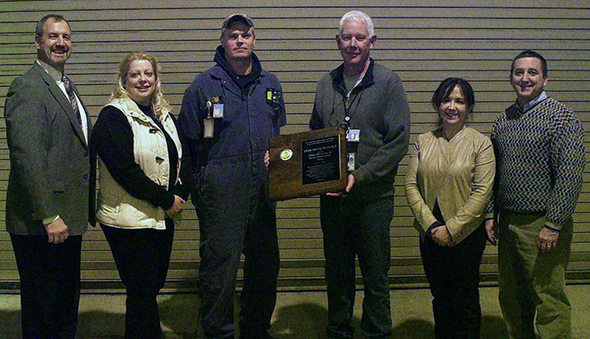
WVDP received DOE’s Volunteer Protection Program Star Award for the second consecutive year. Left to right, Bryan Bower, WVDP Director; Stacy Charboneau, EM Associate Principal Deputy Assistant Secretary, Field Operations; Andy Rupp, International Association of Machinists and Aerospace Workers, Lodge 2401; Jeff Bradford, CH2M Hill BWXT West Valley, LLC President; Monica Regalbuto, EM Assistant Secretary; and Kash Grimes, EM Consolidated Business Center Deputy Director.
Regalbuto commended the employees for completing the site’s high-level waste (HLW) relocation project, for successfully managing the transport offsite of oversized containers that once held equipment used to solidify radioactive waste, and for continued deactivation and decommissioning and waste management progress. Watch a video about WVDP’s 2016 accomplishments here.
“Your ability to achieve real results demonstrates that the federal investment in cleanup is money well-spent,” Regalbuto told the workers at the site celebration, adding “It’s an honor to join you in marking these major cleanup achievements.”
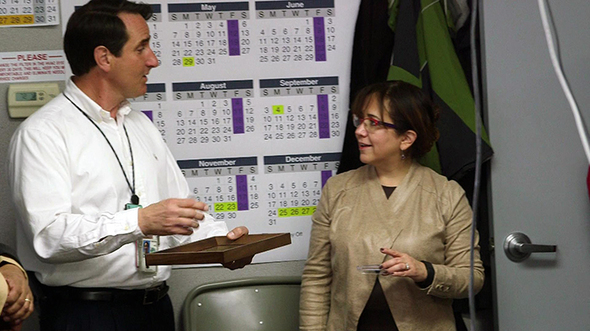
EM Assistant Secretary Monica Regalbuto congratulates WVDP Federal Project Director Dan Sullivan for the successful completion of the site’s high-level waste relocation project, and the waste shipment project that transported three oversized vitrification components to a disposal facility in Andrews, Texas.
Regalbuto further emphasized the work was performed safely. For the second consecutive year, West Valley received the DOE Voluntary Protection Program Star of Excellence Award in recognition of more than 2.3 million safe work hours.
WVDP Director Bryan Bower, New York State Energy and Research Development Authority West Valley Program Director Paul Bembia and CH2M Hill West Valley, LLC President and General Manager Jeff Bradford recognized the workforce on its accomplishments and encouraged all employees to remain focused on other cleanup milestones: legacy waste disposition, and the demolition of the Vitrification Facility, Main Process Plant Building and other ancillary facilities.
WVDP is the nation’s first and only commercial nuclear fuel reprocessing plant to successfully vitrify HLW — convert liquid waste into a glass substance. The site added to its history of firsts in November when employees safely completed the task of transferring vitrified HLW canisters into storage casks and relocating them from the Main Plant Process Building to an interim storage pad. What’s more, the job was completed a year ahead of schedule.
Just weeks later, workers transported a melter used in the vitrification process and two tank components — oversized packages weighing more than 500 tons combined — to Waste Control Specialists in Andrews, Texas for permanent disposal. Watch a video about the melter shipment here.
EM Update recently spoke with Stuart MacVean, the new president and chief executive officer of Savannah River Nuclear Solutions (SRNS), the management and operations contractor at DOE’s Savannah River Site (SRS) and its EM program, about his new role and the contractor’s objectives and challenges ahead.
You’ve been president of SRNS for a little over two months. How has the transition gone for you and what are your biggest priorities going into 2017?
It is an exciting time to be at the Savannah River Site and it’s a great opportunity for me to be able to serve in this capacity. I was really able to hit the ground running from day one because of my past experience at Savannah River. Previously, I led the tank farms mission at SRS as president of Savannah River Remediation and that certainly gave me a good foundation to start from, but my real leg up was that I was responsible for the nuclear materials disposition program in 2007 and 2008. I’m very much enjoying working with both Jack Craig, manager at DOE’s Savannah River Operations Office, and Doug Dearolph, manager at the National Nuclear Security Administration’s (NNSA) Savannah River Field Office.
I’m impressed with the depth of the nuclear production and nuclear materials expertise at SRNS and the execution of those missions in parallel with the growth of Savannah River National Laboratory (SRNL) and the important site infrastructure responsibilities.
My predecessor, Carol Johnson, worked hard to put in place a culture of continuous improvement and it was clear to me upon taking over in October that such a culture was taking hold. It’s having a dramatic impact on how the site is operating — we are becoming much more efficient and those dollars are being redeployed to invest in our infrastructure.
From a priority perspective, I am focused on delivering good, strong performance from our nuclear production facilities, a top-notch safety record and more efficient site operations. Everything we do for both our EM and NNSA customers flows from those priorities.
Stuart MacVean, SRNS president and chief executive officer.
SRNS has made a significant effort over the past several years to address a common challenge across the complex — an aging workforce. Have you started to see results?
We absolutely have. Not long ago, it appeared we were facing a very real “retirement cliff” in the near future and we took a number of very important steps, made quite a bit of investment, to address that. Today, we are no longer facing that cliff and, in fact, the average age of our workforce in now 49 as compared to 54 just a few years ago. We’ve added more than 1,300 new workers in the last three years, 80 percent of who were hired right out of the local area.
One of the more interesting things we are doing is using predictive analysis to forecast attrition and retirement impact by department and work function so that we know precisely what skills are needed over the next five years. We use that planning to understand insertion times for targeted recruitment and focused retention that allows us to focus on targets including minority-serving institutions and veterans programs as well as specific skill areas like fire protection engineers, occupational safety and health, and engineering.
We are also looking down the road to build our workforce. In addition to establishing a nuclear operations program at Aiken Technical College last year, participation in our internship program is up 34 percent from 2015, with 145 students in summer 2016. We have hired approximately 20 percent of our graduating interns since 2014.
Perhaps most importantly, once we get the employees onsite, we are making sure they are part of a system that rewards their hard work, invests in their development and provides opportunities for growth and advancement.
How will SRNS enable the continued growth of SRNL?
We are exceptionally proud of SRNL and the contributions the lab makes to the nation. SRNL’s unique capabilities are increasingly being called upon to solve problems at DOE sites and for a host of national security missions. Growing SRNL has been one of the primary objectives for SRNS since the inception of our contract and by any measure, there has been amazing progress.
In recent months, we’ve taken steps to make it easier to utilize the resources SRNL has to offer. Beginning on Oct. 1, SRNL began operating as a separate business unit under SRNS, which will enhance the independence of the laboratory and its ability to maintain a strategic relationship with the Department of Energy.
At the same time, DOE has changed its governance model for the lab so that SRNL now has a more direct relationship with EM headquarters rather than being primarily managed as part of Savannah River Site operations.
All of these steps will further enable the growth of SRNL and allow the lab’s unique capabilities to be fully utilized.
A little over a year ago, SRNS made the decision to halt all operations not essential to the safety and security of the site after it became apparent that workers at the HB Line facility were not following proper procedures. Has the ‘safety pause’ been successful in refocusing operations?
The last year has been what I would term our year of recovery. We have demonstrated to the workforce that when problems become apparent — at any level of the organization — it’s important to take proactive and positive action. Our workers have seen that our safety culture is not just a slogan on a poster somewhere — it’s something we live every day. That has made a tremendous, positive impact on our safety culture.
I’m immensely proud of how our workforce responded to the safety pause. Through their hard work, we actually ended the year meeting all our targets, the performance-based incentives in our contract.
Additionally, by focusing our attention on training and procedures, we’ve put in place a system that not only will alert us to issues before they become big problems, but also has helped us make our operations more efficient and effective.
That is having a real impact as the plants that support the production missions are poised for a truly record breaking year in 2017. Because of our operational reset last year and the recovery this year, they are really off to a good, strong start for 2017. We are operating our spent fuel recycling plant, HB Line is completing the current plutonium oxide campaign, plutonium disposition packaging is underway and we are ready to meet our tritium deliverables.
It’s also notable that in fiscal year 2016, we delivered every project in our portfolio — 20 projects — on time and under budget; that’s approximately $70 million budgeted in projects that were delivered for $54 million, or 22.9 percent under budget. Certainly, we have had some past challenges on projects like the Waste Solidification Building, but we’ve turned around our project performance. We recently achieved a major milestone completing the first phase of a coal ash basin cleanup project, consolidating 80,000 cubic yards of ash and dirt onto an existing landfill about 17 football fields in length. We are on a really solid footing going into 2017 with the processes and procedures we have put in place. That is driving our success and the performance this year clearly shows it.
What are the key challenges in your mind going forward and what are the metrics and indicators that you will be paying the closest attention to?
One of the biggest challenges that we have is the upcoming bid cycle that kicked off this fall. It has the potential to cause a lot of distractions. We are working hard with our workforce to keep everyone focused on the mission at hand — that is a key priority of mine.
One of the things that will help with that challenge is that after the safety pause in 2015, we have in place a long-term sustainment program that’s really meant to give us early warnings if things are starting to slip. As part of that effort, we’ve evolved our contractor assurance system and there are a lot of elements to that program that give me confidence in our ability to make sure our safety and operational procedures are being followed, that we are doing our work in the safest, most effective way possible.
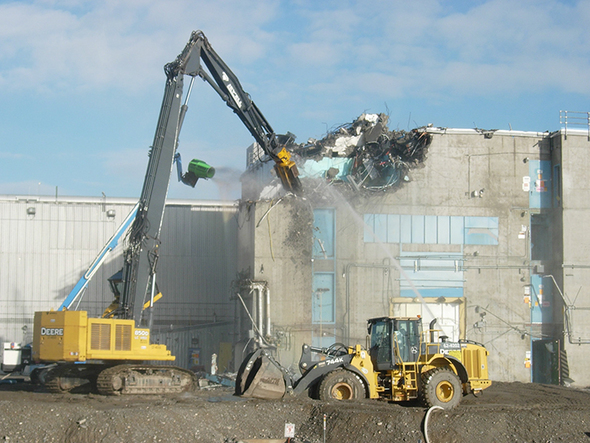
RICHLAND, Wash. – As demolition work continues at the Plutonium Finishing Plant at the Hanford Site, workers with EM contractor CH2M Plateau Remediation Company (CH2M) remove part of the fourth floor of the Plutonium Reclamation Facility (PRF). This time-lapse video shows removal of a portion of the building's fourth floor. The PRF, the first of four main structures set for demolition, is expected to be gone in spring 2017.
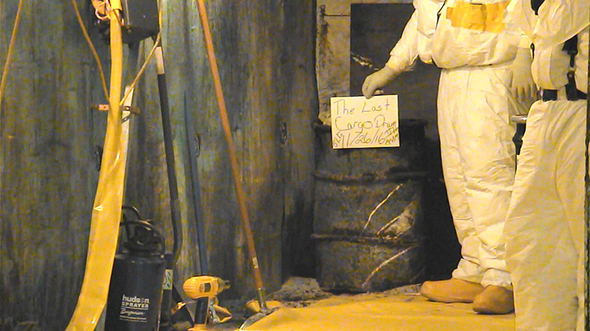
A worker holds a sign identifying the last of 14,500 drums to be removed in the cargo container extraction project.
IDAHO FALLS, Idaho – EM’s Idaho Site recently marked two significant cleanup accomplishments after workers retrieved the final drums of waste in two projects.
Crews removed the last of more than 14,500 drums in the cargo container extraction project inside the Transuranic Storage Area-Retrieval Enclosure, a more than seven-acre building at the Radioactive Waste Management Complex. Workers repackaged the drums in 85- and 110-gallon drums for characterization, treatment and eventual shipment out of state for permanent disposal.
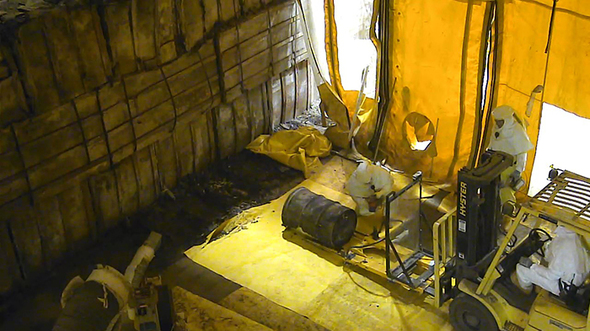
Crews prepare to pull out the last of more than 82,000 drums in a project at the Transuranic Storage Area-Retrieval Enclosure. At left are some of the 80 boxes of waste targeted for removal by May 2017.
The drums had been stored inside 209 cargo containers, which workers permanently disposed of in an onsite disposal facility.
In the second project in the building’s Retrieval Contamination Enclosure, crews cleared the last 55-gallon drum, adding to the more than 82,000 removed since 2003. The drums had been stored there since the early 1970s.
Crews are on track to meet a May 2017 deadline contained in Fluor Idaho’s contract for completion of safe, compliant and efficient retrieval work. About 80 boxes of waste remain. They contain the remnants of an estimated 250 cubic meters of the site’s original 65,000 cubic meters of stored waste.
An SRR employee follows a procedure during a recent scope for Salt Waste Processing Integration. A key part of conduct of operations is procedure compliance.
AIKEN, S.C. – EM’s Savannah River Site liquid waste contractor revamped its conduct of operations training with interactive modules to refocus the workforce on the importance of performing work in a deliberate, disciplined and structured manner.
Conduct of operations is more about the "why" rather than the "what," Savannah River Remediation (SRR) Operations Director James Harris said.
“Conduct of operations is a belief system,” Harris said. “Everyone knows what conduct of operations is and that we’re supposed to have it, but why? SRR is evaluating our current conduct of operations strategies, and we are now looking at ways to make the program even more effective.”
Conduct of operations is also important from the Department's perspective, DOE Waste Disposition Acting Assistant Manager Jean Ridley said.
“The Department of Energy is committed to the safe disposition of the legacy liquid waste at the Savannah River Site,” Ridley said. “A key part of that is worker safety. We appreciate SRR’s diligence in ensuring that safety is at the forefront of operations.”
Tom Foster, SRR president and project manager, said disciplined operations and conduct of operations are one and the same.
“At SRR, disciplined operations is one of our core values, and I couldn't be more pleased with this interactive conduct of operations training,” Foster said. “So why are we so serious about conduct of operations? Conduct of operations provides the structure and methods by which we keep nuclear safety as our overriding priority.”
Each training module is interactive, with a game show format or polling feature to keep participants engaged.
“The participants really enjoy the interactive aspects of this new training,” Harris said. “Our line managers, particularly second and third lines, say they value continued professional training. Senior management is committed to providing every opportunity for our managers to continuously develop their knowledge and leadership skills.”
The training include case studies of situations showing how good conduct of operations leads to excellent results, but also those where the opposite happened.
“When a facility lacks formality and discipline, events happen,” Harris said. “At SRR, we are not going to let ourselves get to that point. That’s what this conduct of operations revitalization training is all about.”
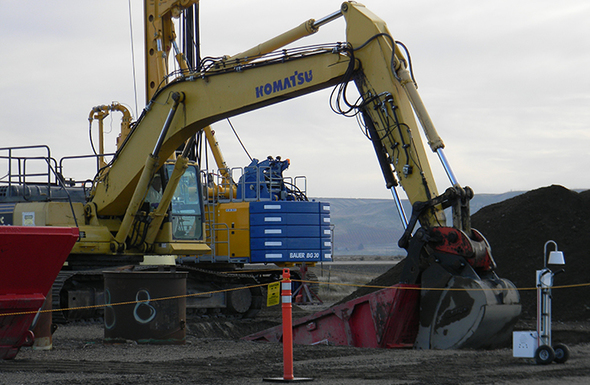
A worker uses an excavator to place a mixing box over the top of an exposed vertical pipe in mock testing.
RICHLAND, Wash. – Ingenuity has led EM’s Richland Operations Office (RL) to advance the challenging cleanup of highly contaminated underground vertical steel pipes containing radioactive waste.
RL and contractor CH2M HILL Plateau Remediation Company (CH2M) devised a plan to expose the top portion of the 14 pipes, lower mixing boxes on them and cover the boxes with grout. Hydraulic shears will reduce the size of the thick-walled pipes and mix the pieces with the surrounding grout. Workers will move that material into steel shielding containers for disposal at the site’s Environmental Restoration Disposal Facility (ERDF).
“Remarkable progress has been made on cleaning up the burial ground thanks to a committed team working safely and efficiently on this hazardous site,” EM River Corridor Closure Project Director Mark French said.
Workers finished mock-up testing to verify this remediation method and are on track to begin work this month.
The 7-5-acre site, known as the 618-10 Burial Ground, contains hazardous laboratory and other waste primarily generated at Hanford’s 300 Area, home to fuel manufacturing operations and experimental and laboratory facilities. The burial ground operated from 1954 to 1963.
The pipes are 14 to 15 feet high, requiring excavation in three 5-foot lifts to remove them. Once they’re taken out, workers can clean up the base soils.
Crews are remediating 80 other vertical pipes containing radioactive waste. Those pipes were constructed with welded-together 55-gallon drums or corrugated pipes. Their depth, unknown contamination levels, and difficult configurations make them challenging to treat and retrieve.
“We are making significant progress with our continued focus on safety and each other, our continued cooperation, our teamwork and our skillful approach to every task,” said Mike Jennings, CH2M’s 618-10 project manager.
Workers have removed 71 vertical pipes and disposed of them at ERDF. They also excavated a mass trench, pulling out more than 2,070 radioactive drums, with an estimated 180 drums remaining. The team is also remediating two adjacent waste sites, all expected to be completed in 2018.
Nuclear criticality safety engineers have worked to improve criticality safety. Back row, left to right, John Lint, Brittany Williamson and Austin Meredith; front row, left to right, Steve Kessler, Meagan Strachan, Tracy Stover, Michael Ratliff and Jim Baker (not pictured).
AIKEN, S.C. – The management and operations contractor for EM’s Savannah River Site cleanup is reducing attrition and improving workforce knowledge transfer by developing the next generation of criticality engineers.
The Savannah River Nuclear Solutions (SRNS) nuclear and criticality safety engineers work to prevent a nuclear criticality accident, which is an inadvertent, self-sustaining nuclear chain reaction. The engineers ensure compliance with DOE regulations by identifying, analyzing and documenting potential nuclear and criticality safety hazards and specifying controls to mitigate or prevent them.
With nearly half of its senior criticality engineers eligible to retire within the next five years, SRNS has hired nine engineers in its criticality safety program since 2012.
“An important part of the development process is to have the new hires work with our senior engineers to improve their site experience and to transfer knowledge,” SRNS Nuclear and Criticality Safety Engineering Criticality Safety Program Manager Mike Low said. “The new engineers come into the group with lots of energy and a great questioning attitude. Their fresh look can help the department see our existing processes in new and different ways and suggest improvements that have not been previously considered.”
The new hires work with senior engineers, helping identify criticality safety improvements and initiatives for implementation.
“It’s rewarding to come into a job like this and feel like you’re making an impact,” said Michael Ratliff, an engineer. “I’ve really benefited from the time I’ve been able to spend with the more senior engineers and I’m excited about my future here.”
Significant site resources support criticality limits and controls. With the newer engineers in tow, the criticality safety group reviewed criticality evaluations that use conservative assumptions and process conditions. The engineers left evaluations untouched if deemed acceptable. They changed others that didn’t reflect normal, credible conditions, or could lead to unnecessarily restrictive operational controls. The group now performs realistic — and still conservative — evaluations to identify limits and controls commensurate with hazard risk.
The engineers’ achievements include:
New analyses that redefine limits for plutonium solution transfers from HB Line to H Canyon using realistic process conditions. The analyses demonstrate that several credible criticality events are safe without credited controls, an approach that conserves site resources.
New HB Line studies that shows the amount of plutonium oxide can be tripled for packages shipped between HB Line and K Area storage. This efficiency also applies to disposition of legacy surplus plutonium.
A review of the chemistry and physics of the H Canyon dissolution process with High Flux Isotope Reactor fuel and the application of more realistic modeling has shown that dissolution can be performed safely without the need for credited controls to limit concentration or mass.
New analyses that demonstrate that spacing controls for side-by-side storage of waste containers and product shipping packages is safe in the site’s K Area, allowing for more efficient storage of containers.
“The approach to hiring and developing new criticality engineers is now starting to bear fruit,” Low said. “Most of the improvement initiatives have been worked over the last couple of years and are on the verge of being implemented.”
Third-generation glassblower Chandra Babbitt has been immersed in the craft, which she describes as “science mixed with glass and technology,” her entire life. She hopes her new position at SRNL shines light on scientific glassblowing rather than the more widely recognized creative side of the art form.
“Glassblowing is a skill that has to be perfect. In scientific glassblowing, there can be no flaws,” she said. “Someone is depending on you to make it right.”
A Kentucky native, Babbitt grew up attending American Scientific Glass Society meetings with her family, and her love for art and chemistry led to a career in scientific glass technology. While attending Salem Community College in Penns Grove, N.J., Babbitt learned about best safety practices, glass properties and innovative strategies for meeting customer needs.
Babbitt demonstrates her scientific glass technology skills.
Babbit said she is proud to be SRNL’s first female glassblower.
“As more women become interested in glassblowing, I’m confident the number of female scientific glassblowers will continue to grow,” she said.
As a scientific glassblower at SRNL’s Glass Apparatus Laboratory, Babbitt creates glassware for the laboratory setting, collaborating with other SRNL personnel to help solve customers’ challenges and ensure end products suit the laboratory’s needs. Babbitt has limited existing instructions because the glassware she crafts is unique.
Established in 1953 at SRS, the Glass Apparatus Laboratory designs, fabricates and repairs glass apparatus. It has supported projects involving H and F Canyons at SRS, other DOE entities and the University of South Carolina and Clemson University.
The Glass Apparatus Laboratory is creating small glass mockups for the Defense Waste Processing Facility (DWPF) at SRS. Mockups by Babbitt and her co-worker Gary Dobos, a 23-year veteran of this laboratory, provide a safe and cost-effective method for DWPF personnel to process high-activity waste in borosilicate glass, a stable storage form.
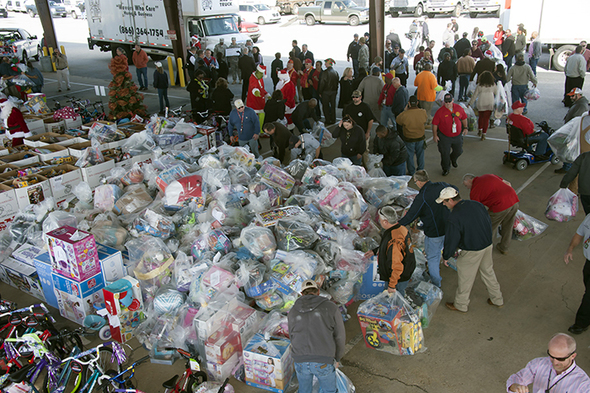
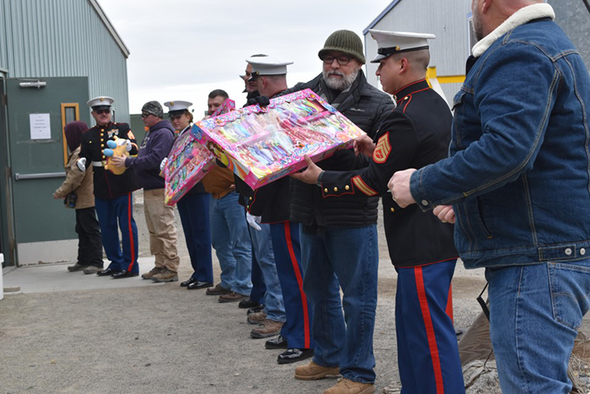
A view of the U.S. Marine Corps Reserve Toys for Tots Program. SRS employees collected more than 12,000 toys for this year’s drive.
EM federal and contractor employees across the complex pitched in to help people in need this holiday season, from collecting truckloads of toys for children to stocking pantries with thousands of pounds of food.
Here's a roundup of charitable giving across the DOE complex:
EM Headquarters
EM headquarters employees this week crossed the 54-percent mark toward their goal of donating $61,900 to the 2016 Combined Federal Campaign, the federal government’s workplace charitable giving drive.
Just over two weeks remain in the campaign. With a theme of “Show Some Love,” employees pledge to charities that support wounded warriors, provide medical care, feed the hungry, house the homeless and make a difference in many other ways for millions of people.
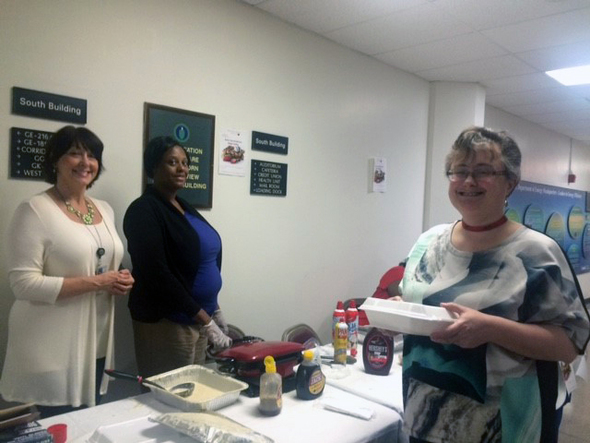
EM volunteers hosted “Taco Tuesday,” “Waffle Wednesday,” a miniature golf competition, pizza party, chili cook-off, bake sale and other events to raise donations. Employees can also give through payroll deductions and other methods.
Left to right, EM's Leslie Trevethan, Lakesha Morake and
Sara Boivin at a Combined Federal Campaign Waffle Wednesday event at EM headquarters in Washington, D.C.
EM and its contractors helped the WVDP annual food drive surpass its goal, delivering more than 110,380 pounds of food — including 379 turkeys — to nine food pantries in the West Valley area.
In its 27th year, the drive had a target of collecting 100,000 pounds of food for hundreds of families in need, just in time for the holidays. Participants helping beat that goal included cleanup contractor CH2M HILL BWXT West Valley and the New York State Energy Research and Development Authority.
Over eight days, the drive organizers watched the collection climb from an impressive 23,000 pounds on the first day to nearly 59,000 by the sixth day, and jumping by more than 50,000 pounds in the final two days.
The food pantries were thankful for the donations.
"With the turkeys and dry goods you donated, we were able to supply and help nearly 80 families, representing nearly 200 people. We are very grateful for your generosity," according to Valley View Food Pantry.
Volunteers with the West Valley Food Pantry, one of nine pantries that received food from the West Valley Demonstration Project food drive.
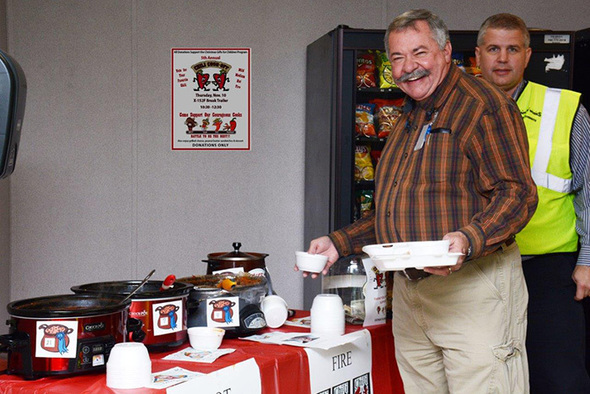
In November, 27 chefs battled for top chili cook-off honors at EM’s Portsmouth Site in southern Ohio while raising funds for Fluor-BWXT Portsmouth’s (FBP) Christmas Gifts for Children program.
First place went to FBP’s Cindy McBee, Cristy Renner and Beth Gilbert, who reprised “Venison Chili” in memory of their late friend and coworker Frank Thompson, a longtime supporter of the cook-off and gifts program.
Also supporting the program to benefit more than 3,000 children this year, the United Steel Workers Local 1-689 Women of Steel collected donations across the site. Some families signed up for children’s gifts will also receive donated hams and turkeys. Fifty lucky kids in the program will receive wooden “walking” bird toys made by FBP’s Ben Brier.
Bob Woods (left) and Jim Fleck of FBP lined up to sample chili cooked up by 27 chefs to support the Christmas Gifts for Children effort at the Portsmouth Site.
Jodi Jenkins of FBP was one of the United Steel Workers Local 1-689 Women of Steel who gathered at the Main Drive Gate collecting donations for the Christmas Gifts for Children program. During November, the group collected donations across the Portsmouth Site.
Hanford Site contractor Mission Support Alliance (MSA) found a new way to reward employees and support the community through its “30 Days of Caring” campaign.
A part of MSA Cares, an employee community outreach program, the campaign lets employees decide which charitable organizations receive MSA donations.
MSA and subcontractor employees submitted hundreds of nominations of nonprofit organizations, from the 2nd Harvest Food Bank to the Union Gospel Mission. Each day in November, a nomination was randomly chosen, and MSA donated in the employee’s name to the chosen non-profit.
Employee Kelly Profitt, with MSA Public Safety & Resource Protection, was a lucky winner. She chose to donate to the Columbia Basin Veterans Coalition.
“My son served in the Army in Afghanistan and was honorably discharged with a disability,” Profitt said. “He still suffers from night terrors seven years later. The local Veterans Coalition has done so much for him. They have helped him through some hard times and been very supportive. They deserve the donation and recognition for what they do to help our veterans."
By the end of November, MSA donated to more than 20 organizations, including Hospice at the Chaplaincy, the Alzheimer’s Association, Meals on Wheels, Wounded Warrior, Benton-Franklin Humane Society, Columbia Basin Veterans Coalition and others.
MSA employees gather with a display of a check for MSA’s donations to more than 20 non-profit organizations in November.
Hanford Waste Treatment and Immobilization Plant (WTP) employees and contractors Bechtel and AECOM donated thousands of toys and nearly $29,000 to the U.S. Marine Corps Reserve’s Toys for Tots campaign. It's the 10th year WTP employees have participated in the campaign.
“Toys for Tots is one of our favorite events of the year because it provides us with the opportunity to give back to the community and to honor the Marines as well as the many veterans who work at the Vit Plant,” said Danny Hydrick, construction manager for WTP, which is also known as the Vit Plant.
WTP employees and Bechtel designated $11,000 of the total donation to the Local 598 pipefitters’ annual Bikes for Tikes campaign. The pipefitters are purchasing and assembling 500 bicycles and helmets for Toys for Tots.
“We continue to be impressed by the consistent generosity of the Vit Plant employees and companies. Every year, they come together and help our local Toys for Tots organization meet our community’s needs and create brighter holidays for children in our area,” said Glen Carter, local Toys for Toys coordinator.
In 2016, WTP employees, Bechtel and AECOM donated nearly $570,000 to area community organizations and charities. Recipients included the United Way of Benton and Franklin Counties, Second Harvest, Junior Achievement, March of Dimes and others.
Local businesses Griggs/Ace Hardware and Vintners Logistics contributed to the WTP efforts. Griggs/Ace Hardware ensured the bicycle orders were fulfilled in time for Christmas delivery. Vintners Logistics will deliver the toys and bikes to Toys for Tots.
Marines accept toys, $29,000 for Toys for Tots at Hanford.
SRS employees collected more than 12,000 toys for the U.S. Marine Corps Reserve’s Toys for Tots and the Salvation Army’s Angel Tree program.
“This is the largest collection of toys I’ve been a part of since joining the Marine Corps in 1981,” Marine Corps Staff Sgt. Gregory Allen said. “SRS takes a lot of pressure off us. We don’t have to gather and organize the toys. They’re here, accepted and ready to go. All of this is inspiring.”
SRS employees supported 730 area children in the Angel Tree program, donating toys and clothing.
“The partnership we have with SRS and the Angel Tree Program is beyond anything I’ve ever experienced in my 15 years as an officer with the Salvation Army,” said Aiken Salvation Army Maj. David Phelps. “Because of events like this, last year we were able to provide over 21,000 toys to children in Aiken County.”
Contractors Savannah River Nuclear Solutions, Savannah River Remediation and Centerra provide monetary gifts to the program.
“When I wake up on Christmas morning, I stop and think about the number of children who are surprised with presents under the tree because of Toys for Tots and the Angel Tree Program,” said Julie Kirby, chair, SRS Toys for Tots Campaign. “At that moment, it’s more important than seeing what’s going on in my own house."
EM cleanup contractor Fluor Idaho and its employees contributed more than $209,000 to a United Way campaign.
“Like our employees, Fluor is committed to supporting United Way, and it’s more than just words,” Fluor Idaho Program Manager Fred Hughes said. “Fluor matched our employee contributions by 50 cents on the dollar that added nearly $50,000 more for our campaign. Fluor Idaho appreciates the warm welcome we have received and looks forward to demonstrating what it means to be a good corporate citizen involved in improving the quality of life in our communities.”
Fluor joined Battelle Energy Alliance, which operates Idaho National Laboratory, to donate a total of $615,000 to three regional United Way offices for the coming year. United Way organizations and nonprofit agencies throughout eastern Idaho will receive the donations.