EM Assistant Secretary Monica Regalbuto, third from left, toured the SPRU demolition project with, left to right, DOE SPRU Project Controls Lori Erbele; DOE SPRU Federal Project Director Steve Feinberg; AECOM Project Manager Jeff Selvey; EM Consolidated Business Center Director Ralph Holland; EM Consolidated Business Center Deputy Director Kash Grimes; and SPRU Deputy Site Manager Hugh Davis.
Regalbuto also observed demolition preparations for Building H2. The two primary SPRU buildings supported improvements in the chemical separation of plutonium for the nation’s Cold War defense.
With her SPRU visit, Regalbuto has now toured all 16 active EM sites in 11 states since her confirmation by the U.S. Senate to lead the DOE cleanup program in August 2015.
At SPRU, Regalbuto watched workers demolish the G2 superstructure and saw progress in removing steel-reinforced concrete process hot cell walls, several of which are 5 feet thick. She also observed the water spray and retention systems that ensure demolition dust remains within the project boundary.
“The work accomplished since the beginning of open-air demolition in July is truly impressive,” Regalbuto said. “Our DOE Field Office staff and AECOM have made significant progress, with an exceptional focus on protecting the workers, the environment and the public.”
Regalbuto also viewed crews within the H2 enclosure cutting a concrete slab to allow interior wall demolition and retrieval of three remaining large storage tanks for disposal. Demolition under the enclosure is expected to begin next month.
“AECOM and our DOE counterparts are working collaboratively and making great progress to safely demolish and eliminate the risk of these Cold War relics,” said Jeff Selvey, SPRU disposition project manager with EM contractor AECOM.
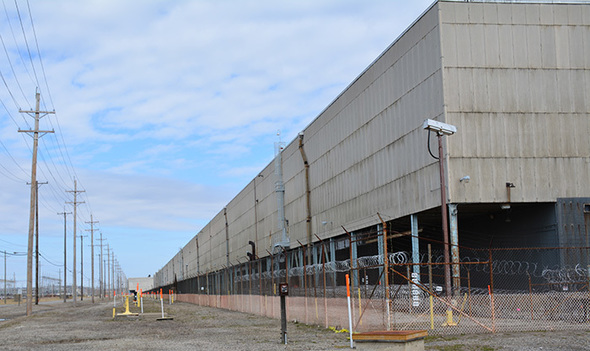
RICHLAND, Wash. – EM’s Richland Operations Office and contractor CH2M HILL Plateau Remediation Company are making final preparations to safely and compliantly demolish the Plutonium Reclamation Facility (PRF), the first of four main Plutonium Finishing Plant (PFP) buildings to be demolished at the Hanford Site. Demolition is expected to start within days.
This aerial photo shows the PFP demolition zone (upper left) around PRF, which is the tall concrete structure.
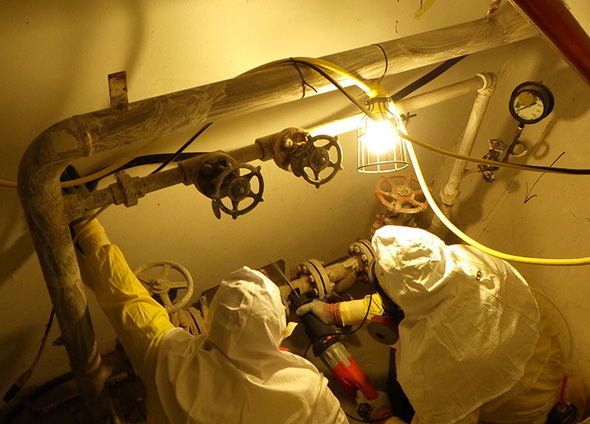
Crews cut deactivated steam lines that once serviced PRF to ensure they aren’t pressurized during demolition.
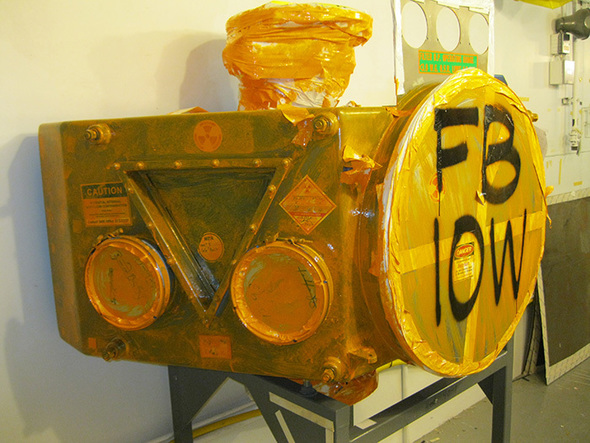
Crews packaged and marked this filter box for easy removal during demolition. Removing some large objects from the building is safer during demolition rather than before demolition.
PIKETON, Ohio – An alternative approach to determine how much remaining uranium is in piping and equipment should reduce time safely preparing the EMPortsmouth Gaseous Diffusion Plant’s three massive process buildings for demolition.
Original plans called for traditional quantitative nondestructive assay (NDA) measurements of all process equipment and piping. But Fluor-BWXT Portsmouth (FBP), EM’s D&D contractor, proposed the systematic monitoring approach, which provides the same level of assurance that the deactivation and decommissioning (D&D) can be safely completed, while saving considerable time.
Successfully deployed in D&D of the K-25 Building at Oak Ridge, the systematic monitoring approach uses gamma-ray scans to determine which piping contains uranium levels significantly below pre-determined conservative limits. Piping that falls below those limits may be left in the building for demolition, and quantitative NDA measurements will not be needed.
“Where appropriate to use, this new approach saves considerable project resources,” said FBP Nuclear Safety and Engineering Director Heatherly Dukes.
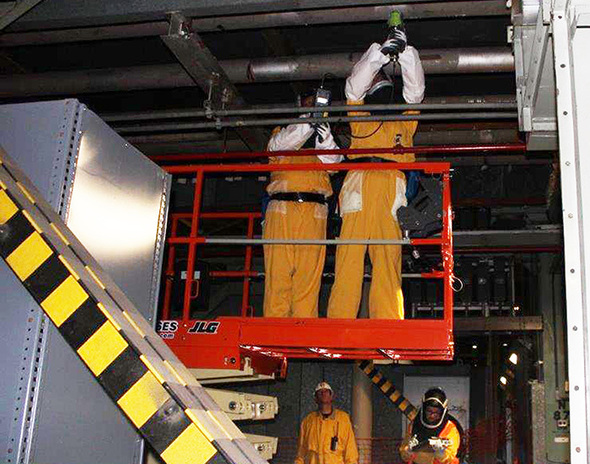
NDA technicians perform the systematic monitoring approach.
The 30-acre X-326 Process Building processed millions of pounds of uranium from the 1950s until 2001. Although equipment was cleaned, the process gas components that produced enriched uranium for national defense and commercial power generation still contain small amounts of residual uranium.
Almost all of the X-326 converters, compressors, and coolers have now been removed and shipped off site, but more than a hundred miles of process piping and thousands of pieces of support equipment remain in the building. The remaining items, along with surface contamination, will be characterized and surveyed before the building can be demolished to ensure nuclear criticality safety.
Testing showed the gamma-ray scans are effective in identifying uranium deposits in piping. More complex components, such as valves and expansion joints, will still be measured using traditional NDA measurement methods. To provide additional confidence, additional sections of piping are selected for traditional quantitative measurements. These measurements will be used to further verify the effectiveness of the scans.
Federal Project Director Jud Lilly said EM is encouraged by the alternative approach.
“FBP first got their arms around the NDA process and the quality requirements, then FBP developed, demonstrated, and verified a more efficient approach to performing some of this work while still meeting those same quality requirements,” he said.
Lilly added that the project hopes the systematic monitoring approach can be implemented in other areas to maintain quality requirements and improve efficiency.
Site contractor Parsons has so far completed six of 60 planned SWPF system tests and is on track to complete 14 more by the end of 2016. Over the next 16 months, Parsons will rigorously test the plant’s components and systems to ensure they meet DOE’s strict waste processing safety and design requirements.
“We are working hard to put the plant through its paces and it is really looking good so far,” said Frank Sheppard, Parsons senior vice president and project manager. “This facility is a key part of the tank waste mission and it’s important that we bring it online safely and on schedule.”
Parsons declared construction of the facility complete in April, eight months ahead of the target schedule and more than $60 million under the target cost for construction activities from Dec. 31, 2012 through the end of construction.
Once operational, SWPF will process the majority of the site’s salt waste inventory by treating highly radioactive salt solutions stored in SRS underground tanks. Removing salt waste, which accounts for over 90 percent of tank space in the SRS tank farms, is a major step toward emptying and closing the site’s remaining 43 high-level waste tanks.
“SWPF will allow us to process waste at 10 times the rate we are processing today, accelerating the cleanup of the Savannah River Site,” DOE Savannah River Operations Office Manager Jack Craig said.
The testing incorporates lessons learned from past DOE facility startups, including the Depleted Uranium Hexafluoride Conversion Facilities at EM’s Portsmouth and Paducah sites. Parsons conducts the tests from the plant’s control panel, using the facility’s software, rather than running the tests manually and incorporating the software later in startup.
“We are testing SWPF using the actual brains of the facility that we will use once we are in operation,” Sheppard said. “It’s been a very effective strategy to ensure that control system software was matured to support the test phase this early in the process.”
Operator training is going well, Sheppard said. Parsons will use a simulator that mimics the process control room operating stations and allows for procedure verification. It has the same software installed in the plant’s control systems.
An artist's rendering of the Low Activity Waste Pretreatment System.
RICHLAND, Wash. – EM’s Office of River Protection (ORP) is making progress on a planned phased approach to beginning treatment of Hanford’s tank waste as soon as 2022, with a key component set to reach a milestone this spring.
ORP expects to conduct a 60-percent design review for the Low Activity Waste Pretreatment System (LAWPS) in February 2017. This important step allows independent review of design choices to determine the final design path and guide future system testing plans. A 30-percent design review for this system was done earlier this year.
LAWPS is intended to separate the low-activity portion of the waste before feeding it to the Waste Treatment and Immobilization Plant’s (WTP) Low-Activity Waste (LAW) Facility for vitrification, which means immobilizing the waste in a stable glass form for long-term disposal. Using proven technology to separate the waste streams, LAWPS can also provide a backup for the WTP Pretreatment Facility.
EM’s phased approach to treat Hanford’s tank waste, known as Direct Feed LAW (DFLAW), is intended to use the portions of WTP closest to completion — the LAW Facility, Analytical Laboratory and balance of support facilities — while working to resolve technical issues at the High Level Waste and Pretreatment facilities.
“Using mature technologies and performing integrated system testing give the project a solid foundation to most quickly deliver this treatment capability,” said Steve Pfaff, federal project director for the LAWPS project. “We will also gain valuable operating experience that will help with the future completion of the larger WTP Pretreatment Facility.”
This summer, two of the three last major pieces of equipment for the LAW Facility were delivered and installed — the ammonia skid and thermal catalytic oxidizer. Later in 2016, the final piece — the caustic scrubber — will be received and installed. These pieces are part of the off-gas treatment system, designed to capture contaminants from the melter ventilation system so plant emissions meet regulatory requirements.
EM has committed significant resources to advancing the construction and design of the DFLAW components. Because of this program’s complex assortment of project activities, ORP has updated the One System organization.
Led by a board of ORP senior management, Hanford tank farms contractor Washington River Protection Solutions and WTP contractor Bechtel National, Inc., the One System organization includes other EM, laboratory and contractor teams to integrate schedules and resolve issues to prioritize DFLAW activities.
“LAWPS connects the tank farms and WTP, and we are using the One System program to ensure that interface is seamless,” ORP Manager Kevin Smith said. “Once completed, DFLAW will allow us to start immobilizing tank waste permanently in glass.”
Participants in the 10-year anniversary celebration of the Fernald Site cleanup completion.
HAMILTON, Ohio – DOE hosted an event Oct. 29 marking the 10th anniversary of the Fernald cleanup, drawing former site workers, neighbors, regulators, activist groups, contractors and others to celebrate the project’s successful completion a decade ago.
EM and contractor Fluor Fernald finished the project in 2006 at a cost of $4.4 billion — saving more than $8 billion — and 12 years ahead of the original estimated completion date. It was one of the largest environmental cleanups in U.S. history at the time.
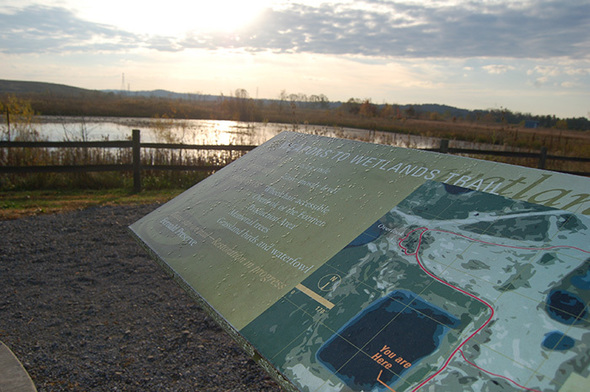
Close to 400 people attended activities for the celebration, “Weapons to Wetlands: A Decade of Difference” at the Fernald Preserve Visitors Center. Guests noted a spirit of pride and cooperation that helped make the cleanup a success. Building demolitions, soils mitigation and other work transformed the 1,050-acre former uranium production plant into the Fernald Preserve and its natural wetland, prairie and forest habitats.
“I’m proud to be part of the success of this project. This was the largest cleanup project in Ohio’s history and the largest waste shipping program in the Department of Energy,” said Dennis Carr, former deputy site manager with Fluor Fernald. “Our key to success is that no corners were cut and no rules were changed for us. It was all about the incredible people sitting in front of you and beside you that got this job done and we appreciate everything you did.”
Speakers included representatives from DOE, current and former stakeholder groups, site contractors, regulators involved in the cleanup and the Cold War Patriots. That group advocated for the creation of the National Day of Remembrance for nuclear weapons program workers, which takes place Oct. 30 every year.
Savannah River Site (SRS) Manager Jack Craig speaks at the celebration marking the 10-year anniversary of the Fernald Site cleanup completion. From 1995 to 2000, Craig was the director of Fernald Environmental Management Project, responsible for the management of all facilities decommissioning, radioactive materials management, environmental restoration, and public involvement.
“The Fernald Preserve is an amazing place. I see how this site has grown, changed, and healed itself and we did it all together,” said Lisa Crawford, a former Fernald Citizens Advisory Board member with Fernald Residents for Environmental Safety & Health (FRESH). “The Fernald Preserve has taken us back to our roots and has become a huge community asset that carries on the legacy of Fernald.”
Participants in the celebration toured the site by bus, viewed Cold War history exhibits at the visitors center and walked miles of trails now available to the public with scenic views of restored land.
“We’re here today to celebrate what is truly a unique cleanup project — a great partnership that involved a lot of creativity, perseverance, pragmatism, and, most importantly, a team that never lost focus on the end goal. The Fernald cleanup is the gold standard of the cleanup mission of this country,” said Tom Winston, who is retired from the Ohio Environmental Protection Agency (Ohio EPA). “In the ‘90s we set a tone that we had a focus on a timely and successful cleanup at Fernald and that is the message we sent to the Department of Energy. The Department of Energy responded that this was a site worth investing in and a site that could show a skeptical public that this was a program that was worth investing in.”
A view of the Fernald Preserve.
The environmental cleanup was carried out in accordance with legally binding agreements that directed site cleanup and established final remediation standards. The agreements were developed by the U.S. and Ohio EPAs, DOE and the public. DOE also worked closely with the Fernald Citizens Advisory Board, FRESH, local elected officials and plant neighbors to develop and execute cleanup plans.
Cleanup achievements by DOE and Fluor Fernald and its partner companies Jacobs Engineering, Nuclear Fuel Services and EnergySolutions, included:
Eliminating the world’s largest source of radon gas by safely removing and treating radioactive waste from three large concrete silos and shipping it offsite for disposal;
Dismantling 323 buildings, including 10 major uranium production complexes and administrative structures;
Excavating and shipping 1 million tons of waste from six waste pits;
Building an on-site disposal facility to hold 3 million cubic yards of contaminated dirt and debris from facility demolition;
Treating a 225-acre plume of uranium contamination in the underlying aquifer;
Removing over 100,000 drums of waste and 31 million pounds of uranium product from the site; and
Designing, building, operating and dismantling over $300 million in waste treatment and handling infrastructure.
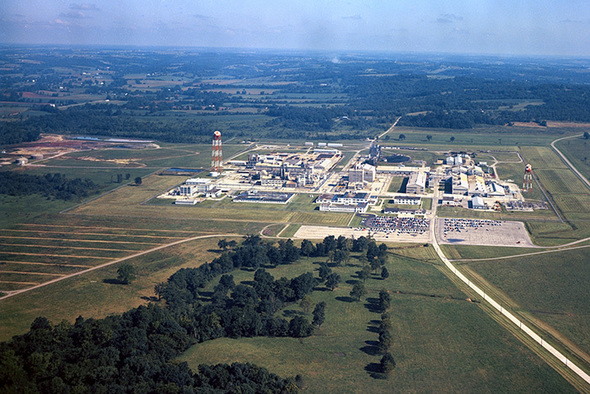
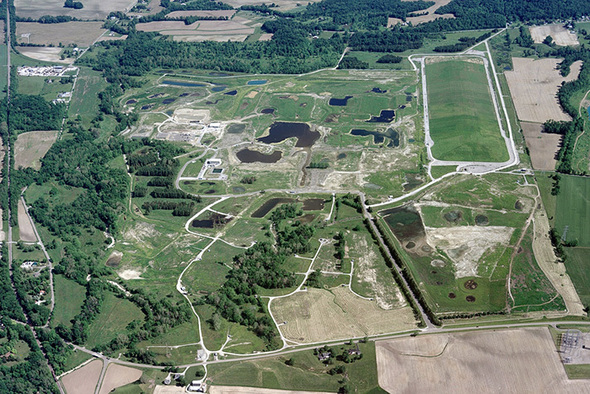
Before-and-after photos of the Fernald Site cleanup.
The Project Management Institute named the Fernald Closure Project its 2007 Project of the Year, citing superior project management and project controls employed in the safe cleanup and closure efforts by DOE and its contractors.
Fernald was transferred to DOE’s Office of Legacy Management in 2006, and the mission changed from environmental remediation to ongoing groundwater cleanup, maintenance of an onsite disposal facility, ecological restoration, environmental monitoring and public access.
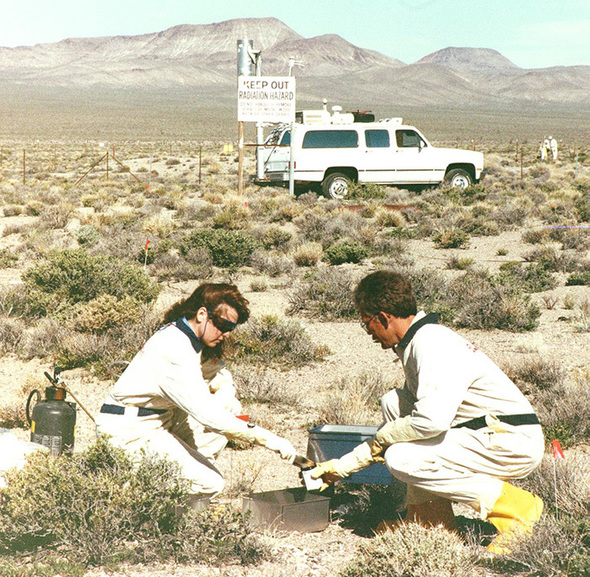
Workers conduct soil sampling at Double Tracks in 1995.
LAS VEGAS – EM recently completed cleanup of a 1963 plutonium dispersion test site just north of the Nevada National Security Site (NNSS), capping more than 20 years of hard work and cross-agency collaboration.
It was the first time EM completed environmental characterization and remediation of a plutonium dispersion site on the Nevada Test and Training Range (NTTR) as outlined in the Federal Facility Agreement and Consent Order (FFACO). The cleanup at the site known as Double Tracks also meets U.S. Air Force (USAF) land-use requirements (not releasable to or accessible by the public) and allows for less restrictive management of the sites.
“The completion of Double Tracks is a reflection of the success and value of collaboration that occurred at all stages to work through the process,” DOE Nevada Field Office (NFO) Environmental Management Operations Manager Rob Boehlecke said. “This decades-long effort was achieved through the collaborative efforts of NFO federal and contractor staff, State of Nevada Division of Environmental Protection, and the U.S. Air Force. And the benefits of this collaboration will continue as we work toward completion at other sites in the future.”
Completing the cleanup highlights the successful collaboration between DOE and its key stakeholders.
“This closure is an important step in continuing the cleanup efforts of the DOE EM program, but it couldn't happen without great working relationships with the Nevada Division of Environmental Protection and the U.S. Air Force,” said DOE NFO Soils Activity Lead Tiffany Lantow. “Those relationships make it possible to discuss options and information and work together towards a single goal.”
DOE is responsible for remediating sites with legacy contamination resulting from historic nuclear research and testing at the NNSS and NTTR, including the Tonopah Test Range. The completion of this environmental restoration mission is governed by the FFACO, a legally binding agreement between the DOE, State of Nevada, and Department of Defense (DoD) establishing a framework for identifying, prioritizing, investigating, remediating and monitoring the contaminated sites.
Operation Roller Coaster was a joint exercise between the DoD, Atomic Energy Commission and United Kingdom on USAF land at the NTTR in 1963. The project consisted of four conventional explosive detonations of nuclear devices designed to determine if nuclear weapons could be accidentally set off and produce a nuclear yield.
The devices were detonated at four sites: Double Tracks and Clean Slate I, II, and III, and proved that accidental yield-producing nuclear detonations would not occur. However, soil in the area was contaminated as a result of the experiments. For more information on Double Tracks and other historical plutonium dispersal tests, click here. For more information on the different NFO EM programs, click here.
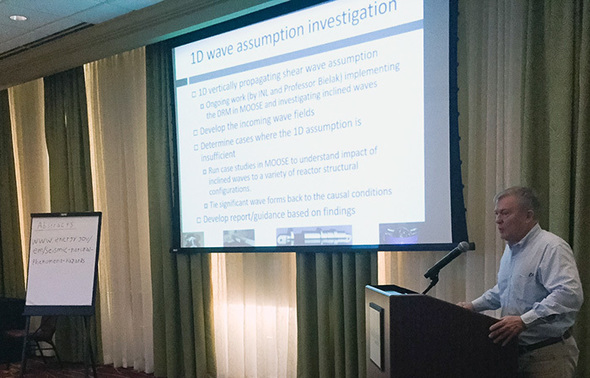
University at Buffalo Professor Andrew Whittaker presents his recent research on seismic isolation of nuclear facilities at the Natural Phenomena Hazards Meeting and Training Session technical meeting.
GERMANTOWN, Md. – There’s only one place to go to discuss natural phenomena hazards and their impact on nuclear facilities with experts from the federal government, national laboratories, academia, regulatory entities and private sector.
Dr. Stephen McDuffie, a seismic engineer with the CNS staff, led the meeting, which featured about 40 presentations on the latest developments in natural hazard characterization and mitigation.
It was the third time CNS held the biennial event but the first time it was named a training session.
“We added 'Training Session' to emphasize the meeting’s value as an educational, career-development experience for people interested in the sub-disciplines of natural hazard characterization and mitigation,” McDuffie said. “With its fairly small size and informal atmosphere, the meeting provided a great networking opportunity for more junior members of this community to get to know the leaders in the field.”
Natural phenomena are observable events that are not man-made, such as tornadoes, volcanic eruptions and earthquakes. EM is primarily concerned with earthquakes because of their severe consequences, which can also induce facility fires, according to McDuffie. He noted the importance of properly characterizing the hazards — such as conducting studies on earthquake faults — and designing facilities to mitigate their impact.
“How long is the fault, how big an earthquake might it produce, and how often? Some move frequently while others might move only once every 10,000 years or more. An important first step through field work is characterizing,” McDuffie said.
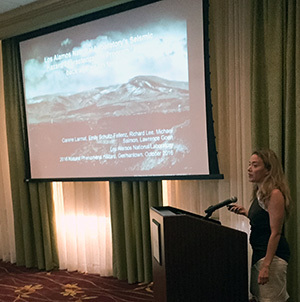
Dr. Carene Larmat of Los Alamos National Laboratory provides an update on the seismic hazard investigation program at Los Alamos.
EM sites at greatest risk for earthquakes include Savannah River, Oak Ridge and Hanford, McDuffie said. EM’s Office of River Protection is presently engaged in a study of volcanic ash fall hazard due to the active Mount St. Helens volcano in Washington state.
About 95 people attended the meeting from across the U.S, including representatives from EM and other DOE programs; Idaho and Los Alamos national laboratories; EM contractors such as Savannah River Remediation and Washington River Protection Solutions; the Defense Nuclear Facilities Safety Board and Nuclear Regulatory Commission; and entities such as the Electric Power Research Institute.
“It’s focused on a lot of different specialties. One cross-cutting theme that brings us all together is protecting nuclear facilities from natural hazards,” McDuffie said.
Participants reacted positively to the meeting’s offerings.
“It’s so useful to get this specialized community together in one place,” McDuffie said. “We got a lot of feedback that it’s a very well-organized event and so valuable.”
CNS is responsible for ensuring DOE nuclear safety regulations, standards, guides, and national and international technical standards are applied correctly in the conduct of DOE’s nuclear mission under the purview of the Under Secretary for Management and Performance.
DOE and Mound Site personnel view an emulsified oil injection, part of SRNL's enhanced attenuation groundwater treatment approach at Mound.
MIAMISBURG, Ohio – A novel approach to groundwater cleanup by EM’s Savannah River National Laboratory (SRNL) is expected to cut the timeline in half for treating a contaminated plume at the Mound Site and could save more than $6 million over the project life.
EM completed cleanup at Mound in 2010 and turned the site over to the DOEOffice of Legacy Management (LM). A pump-and-treat system remained active there to address a plume of chlorinated volatile organic compounds (VOCs) under the site of a former mixed-waste landfill, with plans to operate the system through 2040.
But researchers at SRNL believe an innovative technology could significantly reduce the time and cost to treat the plume through enhanced attenuation, an approach they developed and successfully used at several locations at the Savannah River Site.
After being approached by LM, SRNL tested the alternative system at Mound last year, turning off the pump-and-treat system and monitoring the effectiveness of enhanced attenuation.
A year later, the results are in and the plume has decreased in size and mass, and SRNL projects the concentrations of the VOCs will be below regulatory limits in five to 10 years.
SRNL met quarterly with the Ohio Environmental Protection Agency (EPA) to explain the alternative approach and achieve the agency’s concurrence. The Ohio EPA has approved moving forward with it, and pending further approval by the regulators, LM will remove the existing pump-and-treat system.
“The enhanced attenuation approach has significantly accelerated the progress in cleaning up this plume,” SRNL Director Terry Michalske said. “This is a great example of our core mission at SRNL, developing and deploying approaches like this one to work in the complex to solve problems, increase efficiency and save money.”
Enhanced attenuation uses two forms of oil — emulsified oil that goes into the water and neat oil that floats on top of the water — injected into the aquifer to help remove the contaminants from the water.
“As the water table goes up and down, it sequesters the VOCs because they would rather be in the oil than in the water,” said SRNL researcher Brian Looney. “The oil also stimulates the subsurface bacteria and accelerates contaminant degradation rates.”
SRNL researchers believe other EM sites where declining concentrations of VOCs reduce the effectiveness and efficiency of the active pump-and-treat system are good candidates for enhanced attenuation. The lab is continuing to work with DOE on future deployment.
“Enhanced attenuation can really be a bridge between the efforts to actively clean up the source of groundwater contamination and traditional monitored natural attenuation,” Looney said.
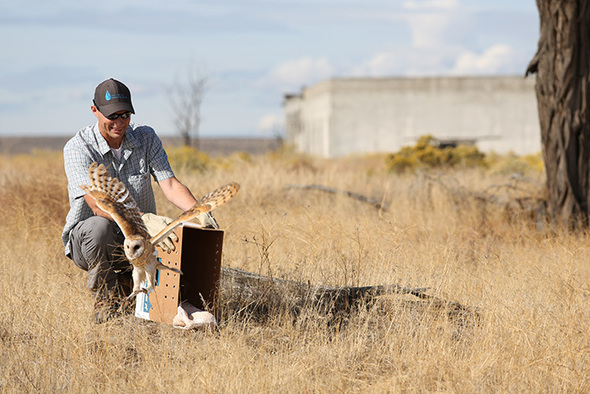
MSA wildlife biologists release the rehabilitated owl to the wild on the Hanford Site.
RICHLAND, Wash. – Wildlife biologists at the Hanford Site released a rehabilitated barn owl back into the wild this month after employees found the bird on the ground in apparent distress in late September.
The employees had called biological control specialists with EMRichland Operations Office contractor Mission Support Alliance (MSA), who were able to safely remove and transport the owl to the Blue Mountain Wildlife Rehabilitation & Education Center in Pendleton, Ore.
After less than a week of rehab, the owl was transferred to MSA’s ecological monitoring program and released on the site.
“We were very fortunate the volunteers at Blue Mountain Wildlife were able to fully rehabilitate the owl,” said Justin Wilde, an MSA wildlife biologist. “Releasing an animal back into its environment is a rare opportunity for us. Today was very exciting.”
MSA’s ecological monitoring program is responsible for monitoring, managing and determining potential impacts to habitats, plants, birds and animals on the site. Hanford is home to numerous species of animals such as elk, badgers, and over 200 different species of birds, including owls and bald eagles.
Blue Mountain Wildlife is a volunteer nonprofit organization focused on wildlife rehab and environmental education. To learn more about Blue Mountain, including how to volunteer, click here.
MSA provides cross-cutting services to EM and other site contractors to facilitate cleanup activities. MSA is responsible for areas such as site infrastructure, utilities, transportation, environmental integration, safety, emergency services and training, external affairs, information management and portfolio management.