Oak Ridge's EM program kicked off the K-27 Building demolition Feb. 8.
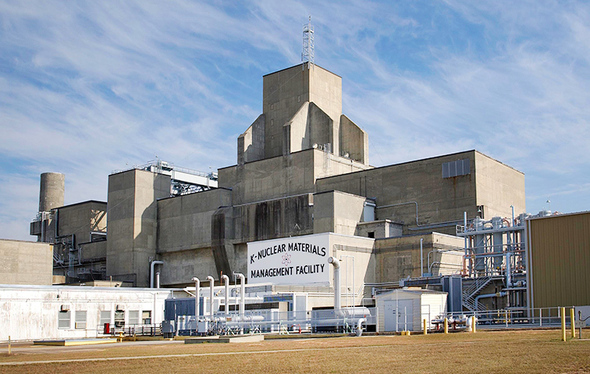
OAK RIDGE, Tenn. – The ceremonial “first bite” on Feb. 8 signaled the start of the K-27 Building demolition as URS|CH2M Oak Ridge, the EMOak Ridge program's lead cleanup contractor for the East Tennessee Technology Park (ETTP), moved closer to fulfilling Vision 2016 — removal of all gaseous diffusion buildings from the site by year’s end.
Watch a video of the start of the K-27 demolition.
K-27 is the last of five gaseous diffusion facilities to be torn down at ETTP. Demolition of the four-story, 383,000-square-foot building remains one of EM’s highest cleanup priorities.
Vision 2016 calls for the K-27 demolition to be completed by December. As the last uranium enrichment building falls, it will mark the first-ever demolition and cleanup of a gaseous diffusion complex anywhere.
Deactivation of K-27 — the process of placing the building in a “stable and known” condition — was completed in January. This included removal of hazardous and radioactive materials to ensure protection of workers, the public, and environment, and the isolation of utility systems and ensuring structural stability.
The K-27 tear-down follows successful demolition of four other uranium enrichment process buildings, including K-29, K-33, K-31, and the mile-long K-25 building. These facilities once produced highly enriched uranium for national defense and commercial energy production. At 44 acres, the U-shaped K-25 facility was once the world's largest building under one roof.
EM’s goal is to transform the former nuclear production site into an attractive private sector industrial park that will become home to new industries and create jobs.
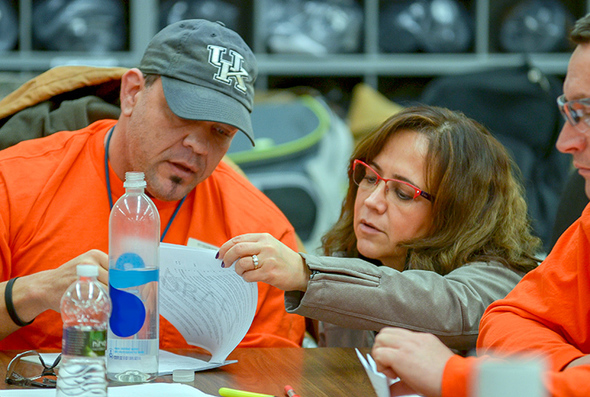
EM Assistant Secretary Dr. Monica Regalbuto sits in on a procedure review with facility operator Jim Burnett (left) of Fluor Paducah Deactivation Project at C-337, where a former uranium enrichment process building will be the first facility to undergo deposit removal by in-situ chemical treatment.
Regalbuto and senior headquarters officials toured the former gaseous diffusion plants and the two depleted uranium hexafluoride conversion facilities, and met with federal and contractor personnel, management, and union representatives to talk about the safe cleanup.
Regalbuto said EM is committed to the continued effective, efficient cleanup at the two sites, and that field visits give her invaluable insights about conditions across the complex.
“At both the Portsmouth and Paducah sites, I enjoyed hearing insights from the highly skilled workers who are making measurable cleanup progress,” she said.
Discussions with EM personnel and contractors largely focused on ensuring the right practices are in place to keep workers and the public safe.
On Jan. 27, Regalbuto toured the Portsmouth Site near Piketon in southern Ohio, including the future on-site waste disposal facility, X-326 former uranium enrichment process building currently undergoing preparations for demolition, and the X-333, which is slated to be the second process building to be demolished.
The next day and 400 miles away, Regalbuto’s group visited Portsmouth’s sister site near Paducah in western Kentucky. That stop included a look at ongoing groundwater remediation efforts and the new portable cell treatment system for removing material from the plant’s uranium enrichment process piping systems. The group also observed the efforts to remove polychlorinated biphenyls (PCBs), lube oil, and refrigerant. An important part of the tours detailed efforts to reduce maintenance costs to maximize taxpayer dollars that can be better spent on cleanup.
Portsmouth/Paducah Project Office Acting Manager Robert Edwards said field managers are fortunate to have EM’s top leader take time to see cleanup work firsthand. He said one group with whom Regalbuto met at Portsmouth and Paducah — the EM facility representatives — has already seen good follow-up from headquarters on some of their ideas.
“She personally led the discussions, and we’re already seeing benefits from the interaction,” Edwards said.
The evaluations determine the portion of annual contractor fees to be paid based on performance. The cost-plus-award-fee contracts under which work is performed include this category of fees as an incentive for excellent performance. In determining the awards, EM considers overall performance along with completion of specific EM mission objectives in accordance with annual award fee plans.
Scorecards summarizing the evaluations and award fee plans associated with these reviews can be accessed here.
For the contractor executing the overall decontamination and decommissioning project at the Portsmouth Site, Fluor-BWXT Portsmouth (FBP), EM awarded $10.5 million for the fiscal year 2015 award fee period from October 2014 to September 2015, amounting to 73.6 percent of the available fee.
According to EM's evaluation, FBP provided “good” contract performance and project management — in some areas exceeding significant award fee criteria — and met overall cost, schedule, and technical requirements with some specific highly significant accomplishments. The contractor performed “very well” in the areas of waste shipping and disposal, supporting EM’s development of an on-site waste disposal facility, and nuclear operations to support uranium transfer. The quality and effectiveness of its environmental, safety and health, and regulatory activities performance was deemed “satisfactory.” EM noted that FBP provided valuable support in finalizing the two strategic environmental records of decision for the project and excelled in particular nuclear safety and material accountability, radiological safety, and stakeholder outreach areas.
The Portsmouth infrastructure support services contractor Wastren-EnergX Mission Support received “excellent” marks in all areas of performance, earning $1.4 million, or 98 percent of the amount available. Areas evaluated include mission support services, security and maintenance, safety, computer services, and property management.
The Portsmouth environmental technical support services contractor Restoration Services (RSI) earned $360,725, or 92 percent of the fee available, for providing excellent management, environmental, safety and health, quality assurance, and field support, and “very good” project and administrative support.
For the contractor executing the deactivation and environmental remediation of the former Paducah Gaseous Diffusion Plant, Fluor Federal Services (FFS), DOE awarded approximately $4.26 million, which amounts to 69 percent of the amount available for the fiscal year. The contractor’s environmental safety and health, quality assurance, project, documents, and associated support performance was determined to be “satisfactory,” while its program and project management was deemed “unsatisfactory.” The contractor missed deadlines for submission of some documents and fell short of meeting some contract requirements, but effectively implemented corrective actions. The contractor achieved 81.9 percent of its performance-based incentive fee tasks, and EM credited FFS for identifying cost-saving opportunities and performing well in security and community outreach.
During the performance period, EM successfully transitioned Paducah Site cleanup activities to FFS, demolished its largest building to date, optimized and repaired infrastructure, and began to deactivate the gaseous diffusion plant facilities recently returned to EM.
EM’s Portsmouth/Paducah Project Office, located in Lexington, Kentucky, oversees cleanup activities at the Portsmouth and Paducah Sites. The gaseous diffusion plants were constructed during the early 1950s for the purpose of enriching uranium for national defense applications, and later for commercial nuclear fuel until 2001 and 2013, respectively. Since 1988, more than $5 billion has been invested in the cleanup mission at the two sites, including deactivation of plant facilities, decontamination and decommissioning of inactive facilities, conversion of depleted uranium hexafluoride, removal of hazardous materials, waste management, and remediation of soil and groundwater.
Savannah River Site Liquid Waste Contractor Earns Excellent Performance Rating
SRR workers oversaw placement of nearly 6,100 cubic yards of grout into Tank 16 from June to September 2015, achieving operational closure ahead of the October 2015 scheduled deadline, and making it the seventh tank closed at SRS.
AIKEN, S.C. – EM’s Savannah River Site (SRS) liquid waste contractor earned nearly a 96 percent award fee rating for exceeding most performance goals in key cleanup and risk reduction activities in fiscal year 2015.
Assessing Savannah River Remediation’s (SRR) continued excellent management and execution of the liquid waste program, EM highlighted several areas of noteworthy performance in its award fee determination scorecard. The contractor provided excellent regulatory support to the site’s tank closure program; worked closely with EM and regulators to bring about significant recovery of the Tank 16 closure schedule; and, ultimately, closed Tank 16 ahead of its milestone date, while also completing required activities to support Tank 12 closure, the next, or eighth, SRS tank scheduled for closure.
EM specifically cited SRR’s appropriate and conservative determinations in identifying and resolving several significant emergent technical issues prior to proceeding with operations. These issues centered on unanticipated mercury levels and other associated drivers potentially impacting flammability concerns in the liquid waste system.
“It is recognized that SRR did the right thing by appropriately addressing these technical uncertainties resulting in temporary limited operations,” DOE Savannah River Operations Office Manager Jack Craig said. “This philosophy to stop, evaluate, and proceed when appropriate is clearly evident of a management team dedicated to safe long-term operation of liquid waste facilities.”
EM commended SRR for providing excellent support on key deliverables directly tied to the startup and integration of the Salt Waste Processing Facility into the site’s liquid waste program.
Another area of notable performance was the contractor’s enhanced management engagement within SRS liquid waste facilities and operations. EM acknowledged SRR management’s responsiveness to identify value-added engagement opportunities, like instituting a Senior Supervisory Watch to correct operational concerns prior to becoming a more significant issue. Another result of the engagement was increased willingness and timeliness of occurrence reporting across the liquid waste system.
SRR President and Project Manager Stuart MacVean praised employees whose performance netted the outstanding score.
“We are confident that our performance and our efforts to find and implement efficiencies in our operations put us on the right path to reduce the state’s single largest environmental risk in South Carolina, the liquid waste in SRS tanks,” MacVean said. “We will continue to safely and efficiently disposition the tank waste and operationally close waste tanks as we work with DOE, regulators and stakeholders to ensure we are meeting expectations.”
Operational Pause at Savannah River Site Benefits Safety Culture, Operations
The K Area Complex exited deliberate operations on Jan. 25 this year.
AIKEN, S.C. – EM and the Savannah River Site (SRS) management and operations contractor are seeing positive impacts on safety culture as the site works to restore operations following last year’s operational pause.
Savannah River Nuclear Solutions (SRNS) instituted the company-wide pause for work not essential to safety and security in September after finding procedural non-compliances in operations in HB Line. As work gradually resumed, EM and SRNS examined all operations, making changes in how procedures are developed and followed, training, and other areas.
An overarching benefit of the pause is that the workforce can see that EM and its contractors are willing to “walk the walk” when it comes to safety, SRNS says.
“The real benefit has been the workforce seeing that when you realize there are problems, you take proactive and positive action,” SRNS President Carol Johnson said. “They see we’re willing to do this and we’re willing to sacrifice production too if that’s what it takes. We always say that but when you actually do it, the workforce really sees you’re really serious and that has a profound impact on the culture.”
DOE Savannah River Operations Office Manager Jack Craig agreed.
“Culture centers on shared beliefs and values,” Craig said. “We say we value safety above production but when you do it, it sends a very clear message of commitment. The safety of our workforce is the most important thing.”
In assessing its operations during the pause, SRNS concluded that its process for revising and validating procedures was cumbersome. The company established a team to identify improvements to help personnel performing field work, and provided additional training. Additionally:
An analysis concluded that industry comparisons show more personnel are needed for training and procedures at some SRS facilities. Efforts are underway to increase staffing levels where needed;
Management will spotlight positive actions by personnel who model excellence and deliver results;
Personnel have been coached on expectations regarding completion of rounds and awareness of surroundings to improve facility conditions; and
Routine meeting schedules have been revised to allow for more management time in the field.
“We are really focusing on asking and answering questions such as, ‘What do we expect first-line managers to be and do? How well do we train them to prioritize and resolve issues?” SRNS Chief Operating Officer Dave Eyler said. “It’s really important that we not only validate that our procedures work, but that we are coaching and mentoring our first-line managers.”
SRNS is building new assessment tools to ensure workers follow procedures, and procedures match work performed. SRNS will continue conducting sessions held during the pause in which eight to 12 workers discuss the procedures with first-line supervisors and other managers. SRNS also will hold periodic half-day pauses to examine operations.
“We are finding that these small groups that discuss how the actual work is conducted are very effective as an assessment tool and often more efficient than going out and watching the work,” Eyler said. “We’ve created a system where we are going to go through a cycle where we assess our procedures and operations in a more deliberate way. We’ve built in these preventive pauses going forward versus having to do company-wide or business unit corrective pauses.”
EM and SRNS are working to share lessons learned from the pause with similar projects across the DOE complex to help other projects maintain safe operations.
“SRNS has emerged from the pause as a significantly stronger company,” Johnson said. "With the changes we are incorporating we are well positioned for success in 2016 at Savannah River.”
Hanford Disposal Facility Expands Vertically to Make Room for More Waste
This photo illustration of the conceptual view shows the vertical expansion of the Environmental Restoration Disposal Facility. The large area on the right includes the uppermost surface of the vertical expansion, which will be shaped to form a crown and will be covered with a 2 percent grade and side slopes at 12 percent.
Enlarging the 107-acre landfill vertically instead of horizontally would save taxpayers $30 million.
ERDF began operations in 1996 and was expanded horizontally to accommodate waste as Hanford cleanup progressed. The first eight disposal cells were built in pairs with each cell being 500 feet wide, 1,000 feet long, and 70 feet deep. In 2011, ERDF completed construction of super cells 9 and 10, each similar in size and capacity to a pair of cells, but built using efficiencies gained from previous cell construction.
Cells 1 through 4 have been filled and are protected with an interim cover, which will be penetrated to ensure leachate — a liquid generated from waste in the vertical expansion — infiltrates the underlying leachate collection system. Cells 5 and 6 are also full and will be the starting point for the vertical expansion.
ERDF contains about 17.5 million tons of waste material, is less than 1 million tons from reaching its current capacity, and would be filled by 2017 without the expansion. Plans call for increasing the top of the waste grade by 20 feet.
Expanding ERDF vertically, instead of using the traditional approach of building new disposal cells, will save $30 million, according to Owen Robertson, EM project engineer for ERDF.
“Vertical expansion is a safe, efficient way to keep the landfill operating and allow Hanford cleanup activities to continue without delay,” Robertson said.
The uppermost surface of the landfill will be shaped to form a crown, covered with a 2 percent grade and side slopes at 12 percent. Surface water runoff will continue to be controlled to minimize contact with waste. Fixatives, vegetative cover, aggregate surfacing, berms, and surface grading will continue to be used to minimize erosion.
Bill Borlaug, WCH lead engineer for ERDF, said vertical expansion will provide space for an additional 3.6 million tons of waste, roughly equal to a super cell.
“We’ve also demonstrated that the existing ERDF liner and liquid waste collection systems have sufficient strength to accommodate the expansion,” Borlaug said.
Borlaug began working at ERDF in 2005. He has seen tremendous progress in safety and efficiency at the landfill.
“I’ve been amazed how well we engage our workforce in finding safe, efficient and compliant ways of doing our work better,” said Borlaug, who spent 15 years in the commercial disposal industry before joining the ERDF team. “Vertical expansion provides a safe, optimum way to minimize the environmental footprint while saving taxpayers money for other cleanup projects.”
EM Headquarters Employees Give More than $51,000 to 2015 Combined Federal Campaign
WASHINGTON, D.C. – Final results of the 2015 Combined Federal Campaign (CFC) show EM headquarters employees donated more than $51,000 to people in need through the federal government’s workplace charitable giving drive.
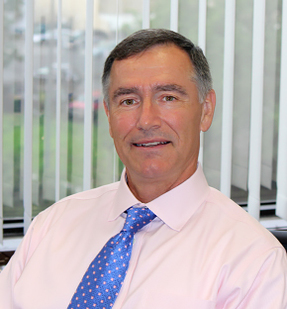
“In addition to the many individual contributions to CFC, EM employees rallied together to support several fundraiser events. Thanks to everyone who contributed their time, food, and/or supplies,” said EM Deputy Assistant Secretary for Program Planning and Budget Bart Barnhart, who served as senior coordinator for EM’s CFC campaign.
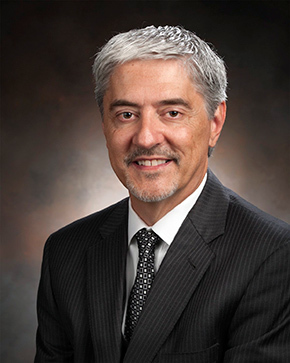
EM Deputy Assistant Secretary for Program Planning and Budget Bart Barnhart served as senior coordinator for EM's CFC campaign.
EM’s successful CFC fundraisers brought in more than $7,000 and included a chili cook-off, hot dog lunch, miniature golf challenge, white elephant sale, and silent auction.
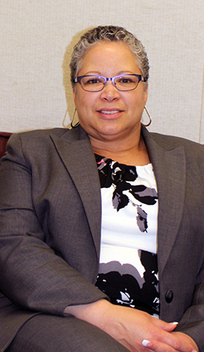
“I think EM did a great job in the campaign,” said Collaso-Talbert, who described EM employees as helpful and responsive to CFC. “Raising money allowed us to help so many charities around the D.C. metropolitan area.”
EM Program Analyst Judy Collaso-Talbert served as the CFC deputy campaign manager for DOE.
As one of three DOE employees running the campaign, Collaso-Talbert juggled many different tasks and jumped in where needed to keep the campaign running smoothly.
“You pick up the balls and run with them for everything,” she said. “You use a lot of coordination skills and patience.”
Collaso-Talbert also supported the public affairs and special events functions of the DOE CFC in 2005 as an employee of DOE’s National Nuclear Security Administration.
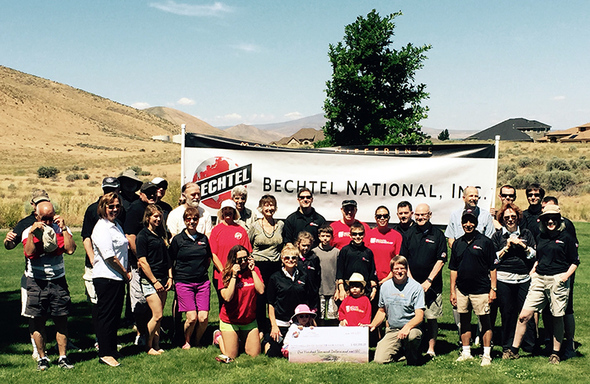
Bechtel employees celebrate a $100,000 gift to Friends of Badger Mountain at Trailhead Park in Richland.
RICHLAND, Wash. – EM’s prime contractor for the Waste Treatment and Immobilization Plant (WTP), Bechtel National Inc., and its employees donated more than $590,000 to community organizations in 2015.
“Bechtel has a corporate commitment to enhancing the communities in which it works through charitable contributions and personal stewardship, and we encourage our employees to do the same,” said Project Director Peggy McCullough.
“However, the generosity of employees on this project exceeds anything I’ve seen on other projects and in other communities,” she said.
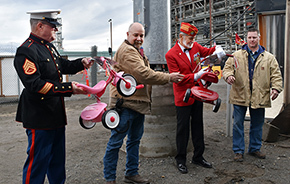
Most recently, the employees donated thousands of toys and more than $35,000 to the U.S. Marine Corps Reserve’s Toys for Tots campaign.
Toys from WTP’s 2015 U.S. Marine Corps Reserve's Toys for Tots campaign are loaded into a trailer to prepare them for delivery to needy families in the community. Pictured left to right are Glen Carter, Toys for Tots coordinator; Andrew Lacey, Bechtel superintendent; Anthony Tonda, Marine Corps League representative; and Casey Short, Bechtel superintendent.
The largest single contribution was to Friends of Badger Mountain. In June, Bechtel donated $100,000 to help create a preserve on Candy Mountain in Richland.
The Candy Mountain gift is the most recent in a number of legacy projects Bechtel has supported in the Tri-Cities over the last 20 years. Other legacy projects include the Hanford REACH Interpretive Center, Bechtel Planetarium at Columbia Basin College, Family Fishing Pond, and Playground of Dreams.
Bechtel, a contractor to EM’s Office of River Protection, is designing, constructing and commissioning WTP, the world’s largest radioactive waste treatment plant for DOE. When complete, WTP will process and stabilize 56 million gallons of radioactive and chemical waste currently stored at the Hanford Site.
Portsmouth Training Exercise Helps Radiological Trainees Spot Mistakes Safely
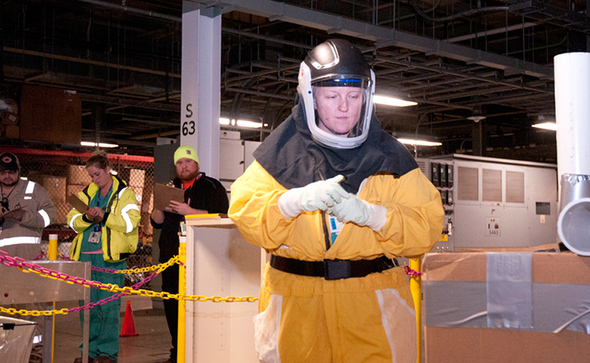
Connie Martin performs work inside the Error Lab while trainees observe her actions for mistakes.
PIKETON, Ohio – A new training exercise aims to enhance worker safety at EM’s Portsmouth Gaseous Diffusion Plant site as a decontamination and decommissioning project removes thousands of components from a 30-acre former uranium enrichment process building.
At hand is a challenging task by EM contractor Fluor-BWXT Portsmouth’s (FBP) Non-Destructive Assay (NDA) crew to measure the extensive piping and tubing systems in the X-326 building. The systems that meet conservative limits will remain until its demolition, but items that exceed the limits will be removed. To increase efficiency and expediency, the team brought on more than 77 new technicians and specialists working three shifts.
Combine an aggressive schedule, hazardous material, and new personnel, and the need for hazard controls becomes even more important.
To help achieve this, team members Connie Martin, Lorrie Graham, and Bill Potters created the “NDA Error Lab,” a training environment where employees identify mistakes in radiological work without being exposed to hazards.
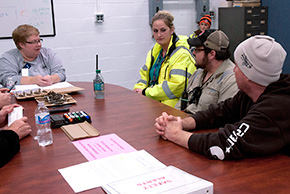
Lorrie Graham (left) talks with trainees in a classroom setting before observing the Error Lab.
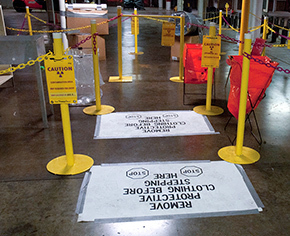
The Error Lab is a simulated radiological area typical of the X-326 building, complete with fake radiological materials. Employees observe the area and record discrepancies. An individual enters the area dressed in radiological protective gear and purposely makes procedural mistakes to see if the trainees identify them. The individual then removes the radiological protective gear. Students must identify at least 15 errors to pass the course, and the answers are shared to ensure employees understand the correct techniques.
“The NDA Error Lab helps add to the current radiological worker training by presenting real-life implementation,” Martin explained.
“The Error Lab steps in where the radiological worker II training program leaves off,” Graham said. “The goal is to keep up with the changes in the work scope of the X-326 deactivation project.”
Effective, realistic training programs are part of the core hazard controls function of the Integrated Safety Management System (ISMS), said Dewintus Powell, a DOE Facility Representative at the Portsmouth Site. ISMS is a five-step method for performing work safely. It calls for defining the work, identifying and analyzing hazards, developing and implementing hazard controls, performing the work within those controls, and providing feedback for continued improvement.
The Error Lab is a mockup of an actual radiological area in the X-326 facility.
“The FBP team was wise to recognize that newly hired NDA employees could benefit from additional radiological training to ensure their safety in performing this work,” Powell said.
"It’s great how Health Physics partnered with NDA to provide this training opportunity and work with them as they perform their work in the cells to help reinforce good radiological practices,” said FBP Facility Stabilization and Deactivation Director Ken Whittle. “We’ve seen a positive trend in performance as a result.”
More than 100 employees have received Error Lab training. FBP workers at the Portsmouth Site on Jan. 25 reached 2 million hours without a work-related, lost-time injury or illness.
Chamber of Commerce Recognizes Portsmouth Site Specific Advisory Board
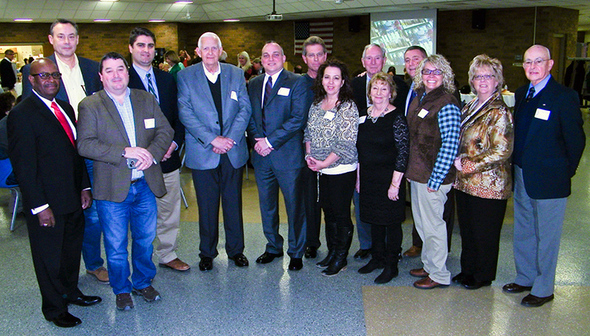
The Portsmouth Site Specific Advisory Board was honored at the chamber’s annual dinner in January. Pictured, left to right, are Carlton Cave (Portsmouth SSAB member), Joel Bradburne (Portsmouth SSAB deputy designated federal official), Greg Simonton (Portsmouth SSAB federal coordinator), Paul Price (chamber treasurer), Gary Cooper (chamber president), Will Henderson (Portsmouth SSAB chair), Val Francis (former Portsmouth SSAB chair), Cristy Renner (Portsmouth SSAB member), Richard Snyder (former Portsmouth SSAB Chair), Sharon Manson (former Portsmouth SSAB member), Neil Leist (Portsmouth SSAB member), Julie Galloway (Portsmouth SSAB support staff), Shirley Bandy (chamber executive director and former Portsmouth SSAB member), and Gene Brushart (former Portsmouth SSAB member).
PIKETON, Ohio – The Pike County Chamber of Commerce recently recognized the Portsmouth Site Specific Advisory Board (SSAB) as its 2015 Organization of the Year.
Established in 2008, the board provides community input and recommendations to EM. It has weighed in on numerous site issues, including budget, waste management and disposition, decontamination and decommissioning activities, environmental restoration, future land use, historic preservation, and community engagement.
“The Portsmouth SSAB has been a leader in the community and routinely provides advice that is relevant and objective, and we have taken that advice to heart in our decision-making processes,” said Joel Bradburne, EM Portsmouth Site lead for the Portsmouth/Paducah Project Office. Bradburne is the board’s deputy designated federal official. “These volunteers work hard and dedicate their time to make sure EM has a good understanding of what’s important to the community.”
In 2015, the board passed four recommendations dealing with community investment provisions for site contracts, support for asset recovery and recycling programs, project planning, and waste disposition.
“Our board has worked very hard and we’re humbled to be recognized by the Pike County Chamber of Commerce for our efforts,” said board chair Will Henderson. “We’d also like to thank DOE for providing the resources necessary to keep the community engaged in these complex topics. We believe this is important work and we’re appreciative that other members of our community recognize what we do.”
The board’s leaders participate in meetings of the EM SSAB, a national board with members of local boards from across the nation.
David Borak, the designated federal official for the SSAB program at EM’s headquarters in Washington, D.C., said Portsmouth’s representatives play an integral role at the national level and have been at the forefront of EM SSAB initiatives.
“DOE would like to congratulate the members of the Portsmouth SSAB for this recognition,” Borak said. “The goal of our program is to involve stakeholders more directly in DOE cleanup decisions and this award indicates the board has garnered the respect of the community.”
Shirley Bandy, the chamber’s executive director, said the board’s leadership on EM activities was worthy of recognition.
“The members of this board bring a range of valuable skills and experience and that diversity has been beneficial to DOE and beneficial to the citizens of Pike County,” Bandy said. “The chamber believed their dedication to providing DOE a community voice was worthy of this honor.”
EM Laboratory Meteorologist to Lead American Meteorological Society
AIKEN, S.C. – In a first for DOE, a Department-affiliated meteorologist has been named president-elect of the American Meteorological Society (AMS).
Matthew J. Parker, a meteorologist with EM’s Savannah River National Laboratory (SRNL) who specializes in meteorological measurements and instrumentation, will help guide AMS outreach and policy.
“Weather and climate information have been utilized effectively by the traditional energy industries for decades. Today, there is increasing need for improved wind and solar forecasts to support the burgeoning renewable energy sector. DOE has a huge role to play, and it is fitting that this is reflected within the leadership of the AMS,” Parker said.
Representing the society’s 13,000 members, Parker will lead the organization’s governing body and enhance partnerships with other countries to share measurement and forecast model data. He also plans to provide outreach to industry, academia, and the public.
“The AMS covers an incredible breadth of activities in what we call the weather, water, and climate enterprise,” he said.
Matthew J. Parker has been named president-elect of the American Meteorological Society.
Communicating accurate forecasts effectively to the emergency management community, businesses, and the general public is an invaluable service, according to Parker.
“Our nation must continue to develop a national infrastructure that is resilient to the climate of the future. The demand for such information to make these critical long-term decisions is extremely high right now,” he added.
A graduate of North Carolina State University, Parker has been a meteorologist with SRNL’s Atmospheric Technologies Group (ATG) since 1989. ATG specializes in weather forecasting, meteorological measurements, atmospheric modeling of airborne contaminants, and emergency response support for government and industry clients.
Founded in 1919, AMS is the nation’s premier scientific and professional organization promoting and disseminating information about the atmospheric, oceanic and hydrologic sciences. The membership includes scientists, researchers, educators, broadcast meteorologists, students, and other professionals in the fields of weather, water, and climate.
A multi-program applied research and development laboratory, SRNL applies state-of-the-art science and engineering to provide practical, high-value, cost-effective solutions for the nation’s environmental cleanup, nuclear security, and clean energy challenges.