EM and National Science Foundation Partner for Nuclearized Robotics
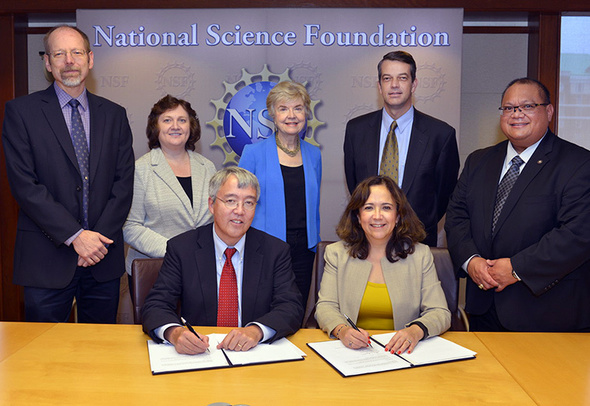
Officials with EM and NSF are pictured. Standing, left to right: Jeff Trinkle, NSF Program Director, NRI, and Robust Intelligence Information and Intelligent Systems Division; Lynne Parker, NSF Program Manager, NRI; Fay Cook, NSF Assistant Director, Social, Behavioral, and Economic Sciences; EM Principal Deputy Assistant Secretary Mark Whitney; and EM Senior Technical Advisor Rodrigo Rimando. Seated, left to right: James Kurose, NSF Assistant Director, Computer and Information Science and Engineering; and EM Assistant Secretary Monica Regalbuto.
WASHINGTON, D.C. – EM recently signed a memorandum of understanding with the National Science Foundation (NSF) for the National Robotics Initiative (NRI), which was originally chartered by President Obama in 2011 to accelerate the development and use of robots in the U.S. that work beside and in cooperation with people.
EM joins other federal agencies in the collaborative effort to advance robotics through university-led projects. The cleanup program infuses a new, unique focus of research to the NRI: the use of robotics in nuclear and radiological applications. This nuclear niche demands robotics that are radiation-hardened or radiation-tolerant.
EM’s mission and diverse problem-set crosscut almost all operating domains of robotics, including underwater, under or below ground, terrestrial, aerial, as well as the internal areas and spaces of facilities, systems, structures, and components. This provides opportunities for user-inspired technology development projects.
“EM stands to greatly benefit from the use of robotics, especially when it improves the health and safety of our nuclear workforce. Also, as an enabling technology, we will smartly deploy robotics to help reduce our lifecycle baseline costs,” EM Assistant Secretary Monica Regalbuto said. “Our active participation on the NRI gives EM direct access to expert roboticists and leading-edge technologies.”
The NRI is supported by multiple agencies of the federal government, including the NSF, National Aeronautics and Space Administration, National Institutes of Health, and the departments of Agriculture and Defense. Each agency provides funding for mission-relevant and mutually beneficial areas of investigations and technological maturation. NSF is an independent federal agency created by Congress in 1950 to promote the progress of science, advance the national health, prosperity, and welfare, and secure the national defense.
“Leveraging and pooling the expertise, assets and resources of other federal agencies makes plain sense, particularly when American taxpayer funds are being used for common technology interests,” EM Principal Deputy Assistant Secretary Mark Whitney said.
Collaboration among academic institutions, industry, and non-profit organizations, and other roboticists is a key feature of the NRI. By next month, the NSF expects to issue its next competitive solicitation for research and technology development projects, which will include nuclearized robotics. The memorandum of understanding is effective through fiscal year 2020.
EM Senior Technical Advisor Rodrigo Rimando championed the effort to partner with the NSF and with the Office of Science and Technology Policy, which is part of the Executive Office of the President. He will represent DOE on the NRI interagency working group.
Chinese Delegation Meets with EM Officials in its First Visit to Savannah River Site
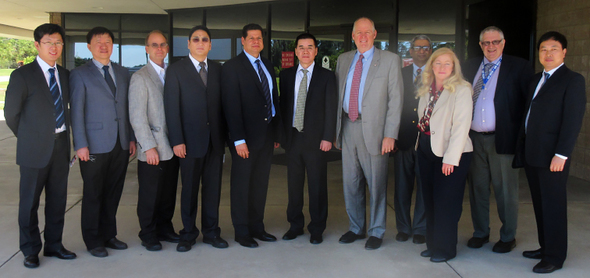
The Chinese delegation is pictured with EM officials at SRS, left to right: Liang Chen (CNNC), Zhao Zhou (CNNC), Lee Fox (SRS), Riu Su (CNNC), Ben Rivera (EM Headquarters), Liuyi Duan (CAEA), Jack Craig, (SRS), Vijay Jain (SRS), Pat Suggs (SRS), James R. Giusti (SRS), and Xuebing Song (CNNC).
AIKEN, S.C. – A delegation from two nuclear-related entities in China visited the Savannah River Site (SRS) for the first time last month, and its members agreed with EM officials to discuss potential areas of collaboration in waste treatment and disposal and to establish collaborative technology projects.
The delegation was from the China Atomic Energy Authority (CAEA) and China National Nuclear Corporation (CNNC). CAEA is a regulatory agency that oversees the development of nuclear energy in China, and CNNC is a large, state-owned enterprise and main body of the national nuclear technology industry. CAEA Deputy Director-General Liuyi Duan headed the delegation.
The delegation’s visit supports EM’s International Program work with CAEA under the U.S.-China Peaceful Uses of Nuclear Technology (PUNT) Agreement. Signed in 1998, the agreement is a legally binding mechanism between the U.S. and China that allows for bilateral technical cooperation in civil nuclear energy and nonproliferation. Over the years, this cooperation has covered a wide variety of areas, including nuclear technology and export controls, nuclear emergency management and safety, and high-level waste management.
During the visit, the delegates met with SRS Manager Jack R. Craig and other site representatives to exchange information on radioactive waste treatment and disposal, project management, contracting practices, and budget processes.
The delegation also toured the Defense Waste Processing Facility, where liquid nuclear waste is converted to a glass form suitable for long-term storage and disposal. The delegates also viewed the H-Canyon, which is the only hardened nuclear chemical separations plant still in operation in the U.S.; the R Reactor, which is in an in-situ, or in place, state after it was deactivated, decommissioned, and sealed with grout; the Low-Level Radioactive Waste Disposal Facility; the Saltstone facilities, which stabilize and dispose of low-level radioactive liquid salt wastes; and a tank farm with underground waste tanks.
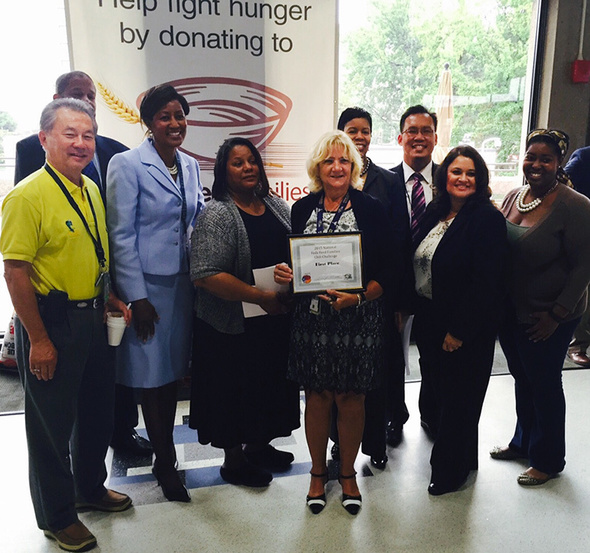
EM’s Carol Ward, center, holds a certificate honoring her first-place finish in the 2015 Feds Feed Families Chili Cookoff as she stands with the competition’s judges and organizer. Also pictured are EM employees John Lee, far left, and Marlenia Murray, right of Lee, who were recognized for donating 250 pounds of nonperishables to the Feds Feed Families drive.
WASHINGTON, D.C. – EM made a strong showing in this year’s Feds Feed Families drive, contributing 46,493 pounds of food across the DOE complex and topping it off by winning top prize in a government-wide chili cookoff held at the Department’s headquarters.
EM headquarters collected 6,992 pounds over two weeks for the food drive, with EM’s Office of Acquisition and Project Management alone topping 3,000 lbs. of donated nonperishables. Besides gathering canned goods from associates, EM employees made numerous trips to a warehouse store, returning with giant bags of rice and other bulk items bought with cash donations.
The Office of Acquisition and Project Management earned special recognition for the amount of food donated by staff. Recognition also was given to individual EM employees who donated 250 pounds or more, including Marlenia Murray, Dave Erdman, John Lee, Crandell McDonald, and Deputy Assistant Secretary for Acquisition and Project Management Jack Surash.
Government-wide, the 2015 Feds Feed Families Campaign collected 17.7 million pounds of food — 2.9 million more than last year.
“I want to personally thank the EM community for your generous support of DOE Feds Feed Families as we seek to eradicate hunger in our communities,” said Surash, EM’s headquarters champion for the campaign. “Your donations of nonperishable food will have a direct impact on the lives of many across our communities and the surrounding counties.”
EM’s achievement was capped when employee Carol Ward took first place in the 2015 Feds Feed Families Chili Cookoff held in the DOE cafeteria. The competition pitted chili maestros from a dozen Washington-area departments including Energy, Housing and Urban Development, Homeland Security, and Agriculture.
The win took Ward by surprise. She thought she was contributing chili to a fundraiser, not a contest. In fact, she missed the judging as she was attending the Office of Acquisition and Project Management Business Opportunities Forum in the DOE auditorium. She made it to the cafeteria as winners were announced.
“I was shocked because it was nothing fancy,” said Ward, who had followed a recipe passed down from her mother.
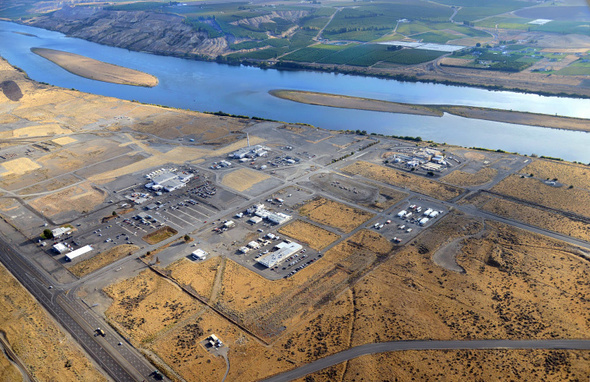
RICHLAND, Wash. – EM’s Richland Operations Office and its contractor Washington Closure Hanford (WCH) have made tremendous progress in cleaning up areas along the Columbia River at the Hanford Site in the past 10 years. The progress is especially visible in the 300 Area, a former industrial area that covered 1,700 acres at the site’s southern edge.
The 300 Area was built on the western shore of the river and is about a mile and a half from Richland. During World War II and the Cold War, the U.S. government and its contractors produced approximately 20 million pieces of metal fuel for Hanford’s plutonium production reactors in the 300 Area. The area was also the center of Hanford’s radiological research. More than 40 years of operations created a legacy of buildings, waste sites, and groundwater contaminated with radiological and hazardous materials. That contamination is being cleaned up as part of a larger remediation effort on the 586-square-mile site.
To date, EM and its contractors have demolished 209 facilities and remediated 312 waste sites in the 300 Area. Structures demolished include six research reactors, fuel fabrication facilities, and research laboratories. WCH has demolished 173 facilities and remediated 108 waste sites since 2005. The contaminated buildings and soil from the waste sites have all been moved away from the area near the river and transported to a permitted landfill near the site’s center. The landfill — the Environmental Restoration Disposal Facility — is lined with multiple layers of engineered materials to contain waste.
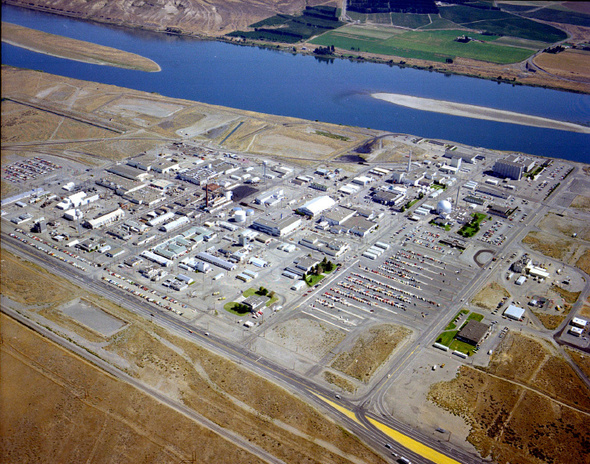
Photos of the Hanford Site’s 300 Area from 1982 (above) and 2015 (below) show dramatic changes visible after cleanup of more than 200 facilities and 300 waste sites. One facility, the 324 Building, remains for remediation, and a few buildings will continue to be used by the Pacific Northwest National Laboratory, which is part of DOE’s network of national laboratories.
“The progress in the 300 Area has been incredible, with the amount of work that has been done to eliminate hazards close to the Columbia River and the city of Richland,” said Stacy Charboneau, manager of the Richland Operations Office.
In September, 51 acres of cleaned-up sites in the 300 Area were backfilled and revegetated with native seeds, marking the on-time completion of a major regulatory milestone.
“We all can take pride in the tremendous progress by our River Corridor team, which includes both regulators and DOE,” said Scott Sax, president of WCH. “By working together, we have seen safe and efficient progress at the 300 Area and along the entire Hanford River Corridor.”
Two significant cleanup challenges lie ahead in cleanup of the 300 Area in the coming years. A former laboratory, called the 324 Building or the Chemical Materials Engineering Laboratory, is the last excess building that remains to be demolished. High levels of contamination under the facility must be remediated before the building can be torn down. Processing operations throughout the 300 Area contaminated the groundwater with uranium, which will be remediated through a sequestration process, immobilizing the uranium to reduce further risk to the groundwater.
Ancient Glass in Swedish Hillforts May Shed Light on Immobilizing Nuclear Waste
RICHLAND, Wash. – EM’s Office of River Protection (ORP) is looking to the past to help with its future by studying how ancient glass has fared through the centuries and how it compares to the results of accelerated aging tests on various types of low-activity waste (LAW) glass.
The waste will be immobilized in glass through vitrification. In this process, radiological liquid waste is mixed with glass-forming materials heated to 2,100-degrees Fahrenheit. That mixture is poured into stainless steel containers where it cools to a sturdy glass form for eventual final disposition.
This project is funded by EM’s International Program as part of a broader initiative to engage in mission-relevant research with countries having common interests. EM Lead Foreign Affairs Specialist Ana Han and EM International Programs Technical Advisor Rosa Elmetti manage EM’s International Program.
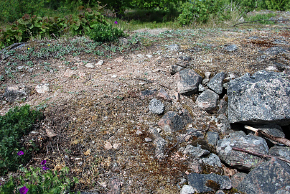
The ruins of a Swedish hillfort site are shown here.
The ancient glass, which has many of the same metal oxides that will be used in the glass formula for ORP’s vitrified LAW, is found in hillforts in Sweden and elsewhere in Europe. Hillforts are defensive structures located on natural earthen highpoints.
Professor Rolf Sjöblom, who is also affiliated with Uppsala University as a faculty member in structural chemistry, will work with ORP to obtain the hillfort glass samples for testing. The Smithsonian will help with handling and analyzing these culturally- and historically-significant samples. Other analytical methods will be employed at PNNL.
Smithsonian research scientist Dr. Edward Vicenzi also has experience with natural and experimental glasses, and has characterized a set of archeological reference glasses to help with the study.
Knowing how the hillfort glass have weathered the elements will allow a better understanding of how the vitrified LAW and its similar glass formula will stand up in hundreds or thousands of years. Various tests will be done on ORP’s vitrified waste form (glass), including the one which will be developed by ORP, University of Sheffield, and Vanderbilt University to simulate accelerated aging of the glass.
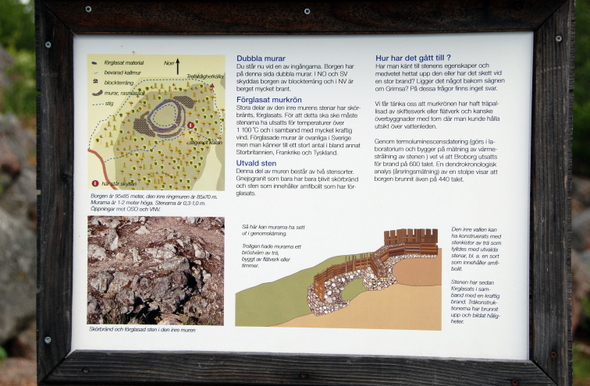
A sign at a hillfort site explains, in the Swedish language, how the hillfort was constructed and how glass material was made at the site.
“The hillfort glass allows us to observe at ambient conditions how glass deteriorates over time and we can compare it to our accelerated test,” explained Albert Kruger, ORP’s glass scientist. “The accelerated aging test we hope to develop will be based upon an Environmental Protection Agency’s (EPA) SW-846 validated method for RCRA applications.”
RCRA stands for the Resource Conservation and Recovery Act of 1976, which is the principal federal law in the U.S. governing the disposal of solid waste and hazardous waste. SW-846 is an EPA test method.
“This will provide the Environmental Protection Agency and Washington State Department of Ecology, which provides regulatory oversight of the project, greater confidence in the test results,” said Kruger. “Ultimately we will apply the tests to glasses produced with nuclear materials of greatest interest and finally from glasses produced from tank waste samples.”
Not only will the work done by ORP help with its mission of vitrifying LAW, but it will also further research on the Swedish hillforts. This testing could provide insight into the long-term preservation and historical interpretation of the vitrified hillforts material, much of which is still under debate among archaeologists.
Idaho Site Workers Continue to Finish D&D Cleanup Projects Under Budget
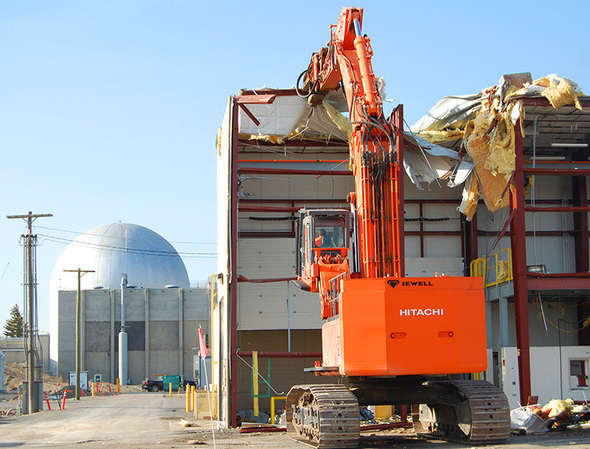
Workers demolish a sodium processing facility just north of the Experimental Breeder Reactor-II’s silver dome at the Idaho Site.
IDAHO FALLS, Idaho – CH2M-WG Idaho, LLC, (CWI) the main cleanup contractor for the EM program at the Idaho Site, took on additional work scope at the site’s Materials and Fuels Complex (MFC) after completing grouting work at the decommissioned Experimental Breeder Reactor-II (EBF-II) three months ahead of schedule and $110,000 under budget this year.
In a matter of weeks, deactivation and decommissioning (D&D) workers recently completed the intricate process of demolishing MFC-799, a sodium processing facility, a short distance north of EBR-II’s landmark silver dome, effectively using two large excavators equipped with heavy jaws to demolish and remove the structure. Crews also completed this work scope on time and nearly $289,000 under budget.
Skillfully attacking the building from two angles, operators Clay Haddon and Ryan Pimentel carefully maneuvered and synchronized the specialized heavy equipment to safely dismantle the building, reducing it to a large pile of insulation, wiring, and other debris. The debris was then loaded into large dump trucks and hauled to the landfill.
“The level of progress this crew can achieve in a short period of time is astounding,” said CWI D&D director Troy Donahue. “The D&D crew’s record of safety and demonstrated skill and resourcefulness in completing this important work is well recognized by our leadership team and our client.”
Through attention to safety and teamwork, MFC D&D crew members have overcome numerous challenges. They moved from the task of performing standard demolition of buildings located throughout the Idaho Cleanup Project to developing a patented sodium treatment as an essential component of D&D activities.
The D&D team’s future work will include the 766 boiler building demolition and preparation for demolition of the dome for the EBR-II, which was used for testing materials and design concepts to improve reactor safety.
“I am very proud of the accomplishments of this D&D team,” CWI Vice President Hoss Brown said. “I really believe this group can tackle any challenge they are presented with a level of pride and professionalism second to none.”
Savannah River Site Basin Cleanup Comes Full Circle to Los Angeles Project
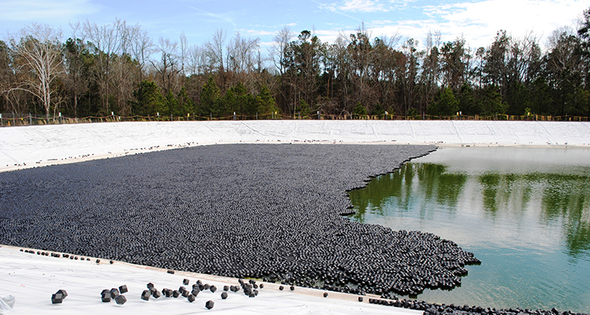
The rhombus-shaped balls fill the tank farm water basin at the SRS.
AIKEN, S.C. – Several news headlines referred to 96 million shade balls covering a Los Angeles reservoir, and they seemed oddly familiar to Savannah River Site (SRS) employees.
In Los Angeles, the small, black shade balls costing 36 cents each were added to a reservoir to protect water quality, prevent algae growth, and slow water evaporation.
About 2,340 miles away, in Aiken, 700,000, similarly small, rhombus-shaped balls costing 29 cents each were poured on top of the water in an SRS tank farm water basin. A rhombus has a four-sided flat shape with straight sides.
Employing the rhombus-shaped balls is aimed at lowering the basin’s pH levels, which had risen due to algae growth. The basin water discharges to a state outfall. Decreasing the basin water pH levels is required to meet state regulatory discharge requirements.
The Los Angeles and SRS reservoirs have a commonality in the bobbing, black solar covers. The black color prevents sunlight from reaching the water below the cover.
The shade balls were added to the Los Angeles reservoir to reduce the impact of a severe drought. According to a press release issued by the Los Angeles Department of Water and Power (LADWP), the recent water infrastructure investment represents $250 million in savings compared to the other options. Additionally, the LADWP estimates that the shade balls will prevent the annual loss of about 300 million gallons of water due to evaporation.
Last year, Savannah River Remediation (SRR), EM’s liquid waste contractor at SRS, was tasked with improving the estimated two-acre basin’s pH levels, which had increased due to algae growth. SRR evaluated methods to eliminate the algae growth, including ultrasonic devices, chemical and biological treatments, and other sun-blocking options. But the rhombus-shaped balls were the most cost effective and had a history of success in other water bodies in the U.S.
What is unique to the rhombus-shaped ball is its large, flat faces, which provide 99.9 percent of coverage of the water, as opposed to the 90-percent coverage by the spherical balls in Los Angeles. The interlocking design of the rhombus-shaped balls prevents them from going airborne because they are more difficult to roll. They also withstand winds up to 70 miles per hour.
SRR is the first federal contractor to deploy the rhombus-shaped balls in the DOE complex to improve water quality, and the LADWP is the first utility company to use this technology for water protection.
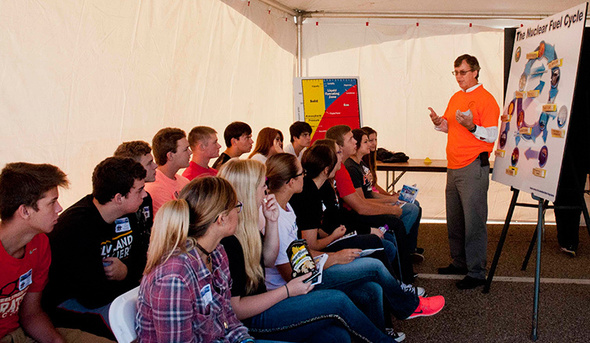
EM’s Jud Lilly explains the nuclear fuel cycle to a group of students participating in the recent Sixth Annual Science Alliance at the Portsmouth Gaseous Diffusion Plant site in southern Ohio. A record 1,255 high school juniors attended and participated in interactive demonstrations designed to match their interests with potential careers related to science, technology, engineering and math. Students also learned about post-secondary educational requirements for those careers and regional universities that offer the necessary curricula.