Dr. Monica Regalbuto Lays Out Vision for Tenure as EM’s New Assistant Secretary
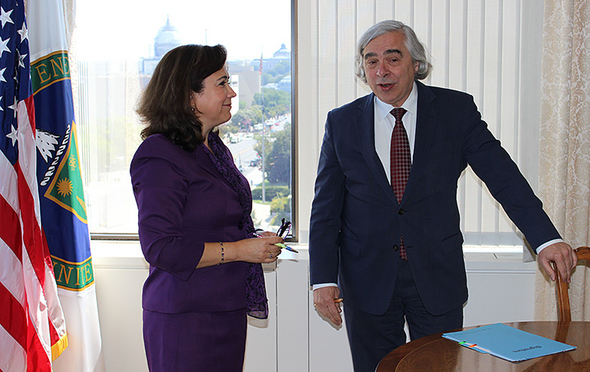
Dr. Monica Regalbuto talks with Energy Secretary Ernest Moniz after she was sworn in as Assistant Secretary for Environmental Management at DOE headquarters in August.
‘Chief Coach’ Describes Multidisciplinary Team Approach to Solving Cleanup Challenges
WASHINGTON, D.C. – Confirmed as EM’s Assistant Secretary in August, Dr. Monica Regalbuto provides the leadership necessary to continue EM’s safe cleanup of the environmental legacy of the Cold War and Manhattan Project. Dr. Regalbuto has held leadership positions in EM, the Office of Nuclear Energy, and Argonne National Laboratory. She recently spoke with EM Update about her new role as head of EM. The following are excerpts from her interview:
1. How would you describe your leadership style and approach for EM?
I’m a high-energy person who is passionate about the EM cleanup mission. I’m focused on working together to build on the accomplishments of the last 25 years while recognizing there is still significant work remaining. I’m also approachable, adaptive to the needs of the organization and mission, and data driven. It’s not uncommon to find me digging into the details of our projects, as data informs decisions.
My goal is to set the vision and direction for the organization and then work to ensure the organization has the tools and wherewithal for success. I see my role somewhat as chief coach for the organization because of my expertise and experience working on the kinds of complex technologies DOE designs, builds, and operates.
I take seriously my responsibility to make decisions that may last well beyond my tenure. The decisions involve how best to accomplish the cleanup mission, invest federal resources, and deal with challenges. In my experience in the petrochemical industry, as a researcher, a manager of researchers at a national laboratory, and as a federal manager in development of advanced nuclear energy systems, I have found that the best decisions are those informed by rigorous analysis and diversity of experience and perspective, in an open and respectful environment, and this is how I would like us to work together in EM.
2. How do you see EM headquarters helping the EM field sites to be successful in carrying out the cleanup mission?
The EM field managers have day-to-day line management responsibility for completion of the cleanup and for ensuring our federal and contractor workforce accomplishes work safely and effectively. The role of headquarters, as a strategic service organization, is to lead the planning, policy, budget formulation and execution processes, and to provide empowerment, support and oversight for accomplishing the EM mission. I would like to see decisions pushed to the level closest to the work being done as much as possible.
Organizational structure and communication are key to mission success in this large, complex organization with sites disbursed across the nation. I want to make sure our roles and responsibilities, authorities, and accountabilities are understood and in place at the right organizational levels to support our mission. We have great people at headquarters and the field, and we can do a lot to enable everyone’s success. I will continue to focus on how headquarters can support the field and work together to successfully realize accomplishments.
Establishing multidisciplinary teams to evaluate and solve these problems is effective, particularly when addressing some of our most difficult technical, policy or budget challenges. As chief coach, I believe in the blended team approach in a flat organization — not hierarchical. I rely on my players. I trust them, empower them, and want to see the best in them.
The team approach has served us well with our path today for the Integrated Waste Treatment Unit at the Idaho Site. It also serves us well as we tackle the tough job of preparing for resumption of waste emplacement operations at the Waste Isolation Pilot Plant (WIPP). I look forward to the reopening of WIPP.
3. What have you learned from trips to EM’s field sites and past experiences outside EM that will help you lead the EM program?
In my federal career, I have spent as much time in the field as I can, working with the field management on some of the key technical challenges. To fully understand the cleanup mission, we must go to the field sites to see firsthand the successes and the difficulties. I’ve done this at WIPP, at Idaho, Hanford, Oak Ridge, Savannah River, West Valley, and other sites.
I’ve spent considerable time in my career working at chemical or nuclear facilities. It’s given me a perspective of the challenges of building, commissioning, starting up, and operating complex chemical-nuclear facilities. I have the utmost respect for our federal and contractor workforce for what they do every day to support accomplishing this mission safely and securely.
Also, I believe it’s helpful for me to manage positions I have worked in myself, to the greatest extent possible. That experience goes a long way and enables me to appreciate and recognize the work that is being done in the field.
4. What does EM need to do differently in order to better develop new and innovative clean up technologies? What is the one new technology you wished EM had today?
I would like to better leverage technology development to reduce the time and life-cycle costs of our cleanup. For many of our sites, we have decades to go, and we have a modest amount of funding for technology development. I fully support the Secretary of Energy’s Advisory Board recommendation to invest more in it.
I will use every opportunity to leverage technologies. If NASA could put Rovers on Mars, we should be able to put robots into the WIPP facility. I wish we had that capability to support the investigation into the cause of the radiological release in February 2014, and our recovery efforts. They have proved invaluable in the removal of waste from our tank farms, too.
Robotics have an important role in monitoring and detecting abnormal conditions, and in conducting cleanup operations and reducing the potential for human exposure to hazardous conditions. Almost every mission area could benefit from greater access to robots. I’ve started an initiative to partner with the National Science Foundation and universities to accelerate our fundamental research in robotics science and technology. I think there is much enthusiasm across our complex to expand our capabilities in this area.
We are also developing a test bed concept where those who have technologies in development can test them in an environment that closely models their application. We offer unique capabilities for the test beds with our inventory of nuclear materials, expertise of our contractors, and valuable resources at DOE’s national laboratories, particularly EM’s Savannah River National Laboratory.
5.What is one of the big challenges you see facing EM?
We are responsible for making sure the people, the physical infrastructure, and the worker and facility safety management systems support the mission. I want to ensure we properly invest in operations and infrastructure to support safe mission accomplishment. Another priority is to continue to work closely with the National Nuclear Security Administration and the offices of Science and Nuclear Energy to ensure we maintain key capabilities that serve the Department’s broader needs.
We also need to continue developing our workforce. I was fortunate to have mentors who gave me opportunities to learn and to grow. EM needs to prepare, recruit and develop our next generation of scientists and engineers to carry this work forward in the years ahead.
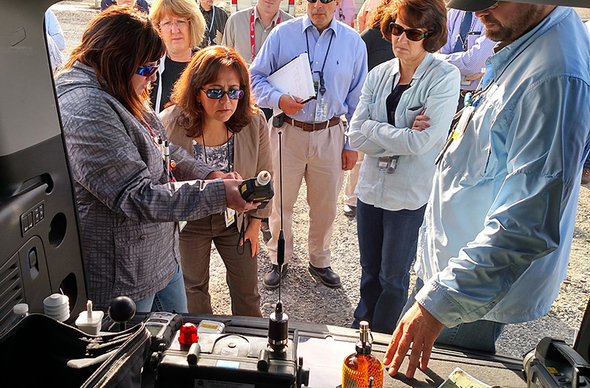
During a trip to the Hanford Site this month, Dr. Monica Regalbuto visited a number of project areas, including a tank farm, the 300 Area and River Corridor cleanup areas, and the B Reactor. During the Office of River Protection (ORP) portion of the visit, Dr. Regalbuto had lunch with about three dozen workers from the Waste Treatment Plant project. She stressed the importance of worker safety as well as improving facility safety. In this photo, an industrial hygienist, left, shows Dr. Regalbuto, second from left, technologies ORP is using or exploring for use in the tank farms.
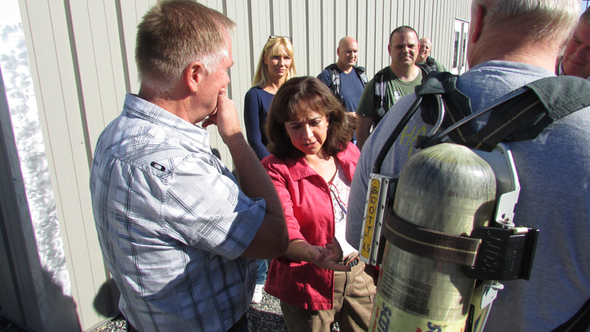
Dr. Monica Regalbuto, center, discusses personal respiratory tanks with worker-trainer Randy Coleman (left), during a visit to the Volpentest Hazardous Materials Management and Emergency Response (HAMMER) Federal Training Center on the Hanford Site.
3D Scanner to Help Boost Worker Safety in Hanford Tank Farms
RICHLAND, Wash. – A laser scanner is being tested in the Hanford tank farms as a mapping tool to help conduct virtual walk-downs.
The three-dimensional scanner — currently used to help determine post-retrieval volume in the underground tanks — is being tested for use in the first phase of a plan by EM’s Office of River Protection and contractor Washington River Protection Solutions (WRPS) that addresses a goal of identifying hazards in the tank farms to protect workers.
Roger Bauer, WRPS A/AX tank farm retrieval engineering manager, said the system test provides 3D representations of the farms complete with grade and elevation changes, obstacles and obstructions, all accurate to within a few millimeters.
The technology generates hundreds of thousands of point measurements every second, creating a “point cloud” that details the ground surface and contours of the infrastructure. The result is a highly-accurate 3D map that crews can use to plan and execute work by overlaying plans for retrieval systems along with photos from walk-downs to create a complete overview of a tank farm. This view gives planners the ability to virtually walk down transfer lines and across an entire tank farm from a computer.
The value of the laser scanner comes in the form of personnel safety, cost avoidance, and a better product, according to Chris Kemp, deputy federal project director for retrieval and closure.
“For a normal walk-down of a tank farm we’re looking at two full days with a team of about four people performing multiple tank farm entries each day,” Kemp said. “Using the laser mapping technology, we don’t need to have as many tank farm entries; and we’re able to have additional resources at the table when we review the 3D map.”
Those extra resources include design agent engineers and others who can review the 3D walk-down with team members in a conference room.
“The virtual walk-down provides in about two-and-a-half hours what would take us two days to accomplish in the field; and we get valuable input from the people responsible for putting together the design of the retrieval system,” Kemp said.
Kemp and Bauer believe the system could become a more regular feature helping to reduce entries and allowing for larger and more diverse review teams to participate in the virtual walk-downs. The platform, they said, will greatly enhance communication and understanding as well as improve the construction and operability of the retrieval system in A/AX farms.
EM's Richland Operations Office Completes Chromium Cleanup along Columbia River
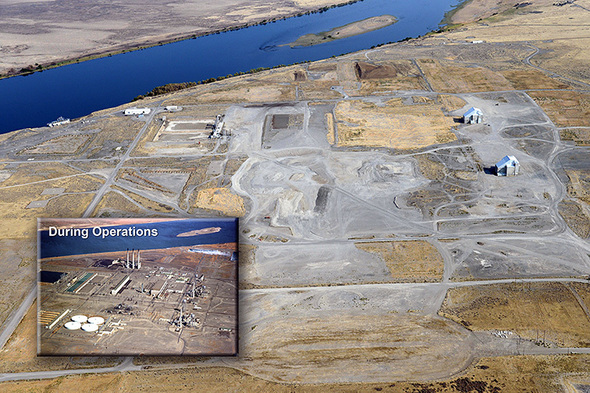
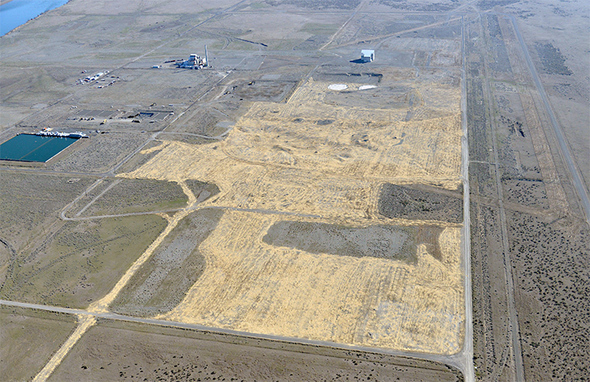
The inset photo shows Hanford's D and DR Reactor area during operations in the 1950s, and the larger photo shows how the site looked during final backfill activities earlier this year after a chromium contamination cleanup project.
RICHLAND, Wash. – EM’s Richland Operations Office and cleanup contractor Washington Closure Hanford have completed cleanup of chromium-contaminated soil along the Columbia River at the Hanford Site.
The work is part of the $2.7 billion River Corridor Closure Project. The 220-square-mile corridor was home to Hanford’s plutonium production reactors, fuel development facilities, and hundreds of support structures that operated during the Manhattan Project and Cold War.
In all, workers removed about 129 tons of chromium-contaminated soil from waste sites along the corridor. The waste was transported, treated as necessary, and disposed at the Environmental Restoration Disposal Facility, Hanford’s onsite landfill for low-level, radioactive, and hazardous mixed waste.
“Removing the source of chromium contamination is a critical step in restoring the quality of the groundwater and protecting the Columbia River,” said Mark French, the federal project director for the river corridor.
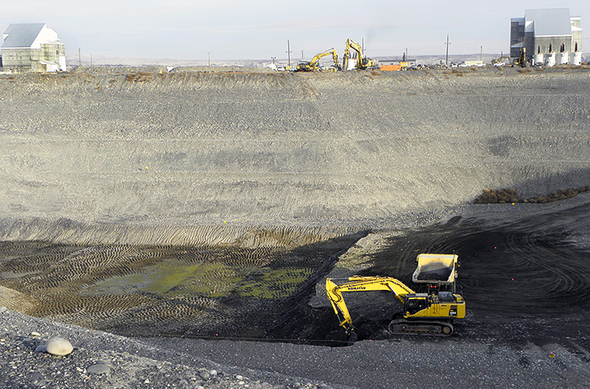
An excavator removes chromium-contaminated soil from a massive waste site near Hanford’s D and DR Reactors. Workers cleaned up chromium plumes at least 85-feet deep to remove the source of chromium-contaminated soil that had reached groundwater.
Workers recontoured the 85-foot-deep waste site near Hanford’s D and DR reactors, saved on backfill materials, and reduced costs after completing the revegetation with native plants.
The contaminant, sodium dichromate, was added as a corrosion inhibitor to river water used to cool Hanford reactors, which produced weapons-grade plutonium. Over the years, large quantities of the chemical compound were transported to the reactors by railcar or truck tanks and distributed by underground piping. Leaks from pipes or spills resulted in massive amounts of contaminated soil.
Recently, workers near Hanford’s D and DR reactors completed remediation of the largest source of chromium contamination near the Columbia River. The work involved digging 85 feet to groundwater at three waste sites. Two of the waste sites eventually merged, creating two dig sites.
Once workers hit groundwater at one waste site, they removed an additional 10 feet of sediments within the aquifer to access a layer of contamination that would have continued to contaminate groundwater.
“Eliminating more of the source term will greatly reduce life-cycle groundwater treatment costs,” French said.
The digs at D Area marked the second time that Washington Closure dug 85 feet to groundwater to remove chromium-contaminated soil. The approach was used successfully near Hanford’s C Reactor in two deep digs completed in 2012. Early this year, Washington Closure completed backfill of the cleaned sites and replanted there with native vegetation.
Hanford’s Groundwater Treatment System Expands Already Impressive Capabilities
RICHLAND, Wash. – Construction was completed earlier this month on an expansion of Hanford’s 200 West Pump and Treat Facility to remove uranium from groundwater.
EM’s Richland Operations Office and contractor CH2M HILL Plateau Remediation Company (CH2M) began construction earlier this year and expect the system to be fully operational by the end of this year.
“Adding this treatment capability will allow us to expand the areas that we’re treating, to include a much larger portion of central Hanford where plutonium production facilities once operated,” said Michael Cline, director of the soil and groundwater division, Richland Operations Office. “The goal of treatment is to prevent contaminated groundwater in the center of the site from moving toward the nearby Columbia River.”
Jhivaun Freeman-Pollard, CH2M’s director of project delivery, said construction was wrapped up safely.
"We're now turning it over for operational testing,” Freeman-Pollard said. “We added three new ion exchange columns to the facility, which are primarily designed to capture uranium, bonded, and tied in 14,000 linear feet of double-wall, high-density polyethylene pipe, and performed numerous electrical and mechanical infrastructure upgrades.”
Opened in 2012, the groundwater treatment facility already removes numerous contaminants. Biological treatment removes nitrates; air strippers remove carbon tetrachloride and volatile organic compounds; and ion exchange removes radiological contaminants.
“We were already removing more types of contaminants than any other water treatment system in the complex,” said Curt Wittreich, CH2M project manager. “However, this expansion allows us to go after additional areas of groundwater that are contaminated with higher concentrations of uranium.”
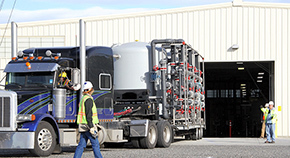
The uranium treatment ion exchange resin columns arrive at the 200 West Pump and Treat Facility, where they are offloaded before installation in the radiological building.
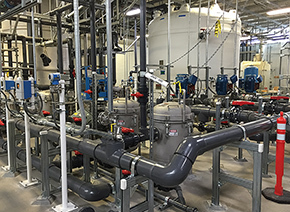
The expanded portion of the 200 West Pump and Treat Facility is shown here. Pumps, filters and piping surround a large, white inlet tank in the background.
The uranium in the groundwater targeted by this system primarily came from U Plant, a facility used to recover uranium from waste sludge stored in underground tanks. The discharge of liquids, some contaminated with chemicals and radionuclides, to soil disposal sites resulted in a plume of contaminated groundwater approximately 102 acres in area.
Additionally, the 200 West facility will treat about 2 million gallons of water that collected, or perched, in the soil above the water table. The uranium contamination is high and localized in the perched area and treating it before it can reach the groundwater aquifer is more efficient and protective of the environment. An 8-mile-long pipeline from Hanford’s 200 East area, where the perched water is, to the treatment facility is also nearly complete.
Contamination plumes at Hanford are already shrinking at accelerated rates, largely because of the size and flexibility of this facility, complemented by five smaller groundwater treatment plants along the Columbia River.
Reconfiguration of Paducah Site’s Electrical Distribution Provides Efficiency and Savings
PADUCAH, Ky. ‒ While EM’s Paducah Site is preparing its gaseous diffusion plant (GDP) facilities for future decontamination and decommissioning, optimization of the site’s utilities and other infrastructure to meet current and future needs will provide cost savings that can be invested back into the plant.
The GDP, which ceased production operations in May 2013, was built with four massive process buildings and supporting infrastructure facilities, including four electrical switchyards. The switchyards were supplied with enough electricity from three different sources to power a city the size of Memphis when the plant was in full production — about 2,000 megawatts.
When the plant was operating, the switchyards reduced power that ran GDP equipment and support facilities from an incoming 161,000 volts to 14,000 volts. By comparison, a residential outlet is 120 volts. Power was routed through more than 80 circuit breakers to 35 large transformers throughout the plant. Just one of those transformers could handle the total power load for the City of Paducah.
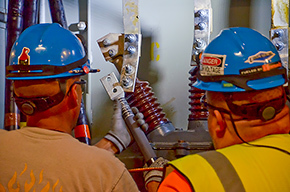
Electricians prepare to attach a new power cable to a transformer located inside the former Paducah Gaseous Diffusion Plant.
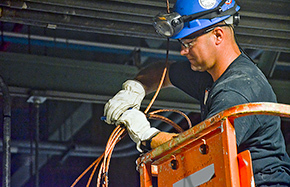
An electrician spools copper wire from a new power cable pulled into the former Paducah Gaseous Diffusion Plant.
Currently, electricity consumption at the site is only about 0.5 percent of what was used when the plant was fully operational — about 10 megawatts. The antiquated switchyards are expensive to maintain and require an enormous amount of electricity to operate.
To realign utilities to support the new deactivation mission, infrastructure services contractor Swift & Staley, Inc. began the work of consolidating the electrical distribution equipment in a more ideal configuration in July 2014. In May 2015, the Fluor Paducah Deactivation Project continued the work by reconfiguring the electrical substations, transformers, breakers, and relays and tying them into the main electrical grid. The project was safely completed in September 2015, ahead of schedule and under budget.
"Safely completing the consolidation of the switchyards was a major accomplishment made possible by the experienced workforce and contractor teamwork,” said Jennifer Woodard, the Paducah Site lead with EM’s Portsmouth/Paducah Project Office. “This ensures the site’s electrical facilities can support the new activities on site as well as future reindustrialization.”
EM Removes Radioactive Components from Former Reactor at Oak Ridge National Laboratory
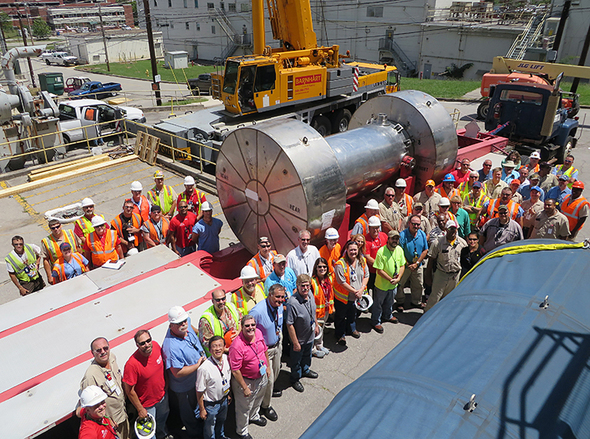
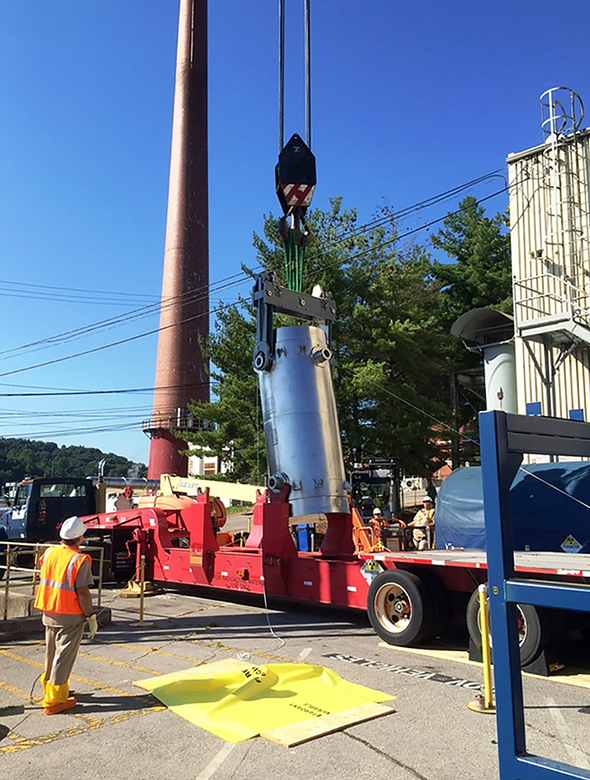
Federal and contractor employees who worked on the project to remove irradiated components from a reactor pool gather to watch the transport of the shipment offsite for disposition.
OAK RIDGE, Tenn. – Surveillance and maintenance — a process to monitor and maintain safe conditions in facilities awaiting demolition — is not a subject that often grabs headlines. But it’s an important part of EM’s portfolio.
In September 2014, employees conducting a routine inspection of the Oak Ridge Research Reactor discovered water seeping from the reactor pool. The facility, also known as Building 3042, is one of hundreds of Manhattan Project and Cold War-ear structures across the Oak Ridge Reservation monitored by the Oak Ridge Office of EM. Nuclear research had not been conducted at the facility since 1988, but it still contained the highly irradiated components from those operations. The leak was causing the pool to lose the water that served as a protective, shielding agent for the irradiated components.
The 125,000-gallon reactor pool remained under constant surveillance until workers could determine the extent of the situation and if conditions were stable. EM and contractor URS | CH2M Oak Ridge (UCOR) worked together to plan and conduct an $8 million project to address the issue and remove the most highly irradiated components from the reactor.
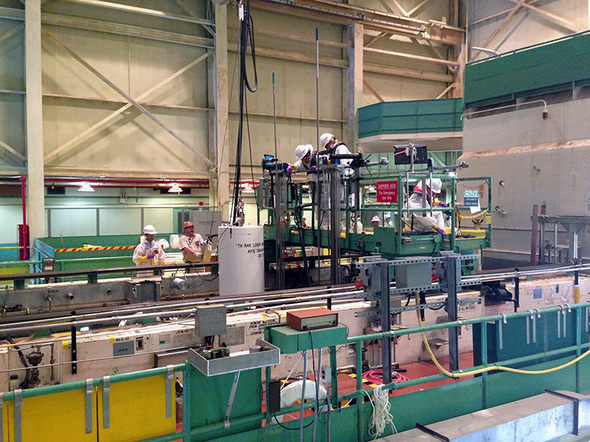
Employees use long-handled tools to move irradiated components into a container for retrieval.
Employees load an 80,000-pound shipping container with the irradiated components for disposition at the Waste Control Specialists facility in Texas.
Last month, employees made significant progress by removing four irradiated components, each weighing approximately 200 pounds, from the pool that were the source of 96 percent of the radiation. The items were moved by long-handled tools into a container that was placed in the pool. Then, the container was retrieved and moved by a crane into an 80,000-pound, heavily-shielded shipping cask.
UCOR subcontracted AREVA to load and transport the cask to the Waste Control Specialists facility in Texas for disposition.
“Overseeing aging, contaminated infrastructure often presents unexpected discoveries and challenges, but the response has been one of the highlights of our work this year,” said Sue Cange, manager of the Oak Ridge Office of EM. “I am very pleased with all of the people who contributed to this success — from the facility reps who diligently oversaw the facility and made the discovery to UCOR making adjustments to fund and accelerate cleanup of this facility in a safe and timely manner.”
The next step of the project involves placing a concrete cap over the pool that will act as a shield for the remaining items. Workers will then pump all of the water out of the pool and process it at an Oak Ridge National Laboratory water treatment facility. The project is expected to be complete in early 2016.
Operation Clean Desert Educates Hundreds of Students on EM Program in Nevada
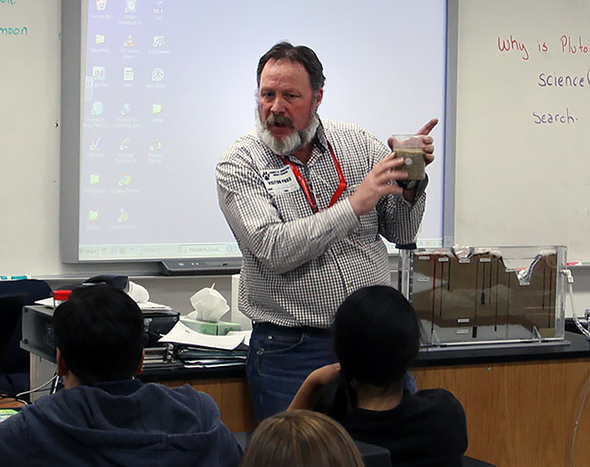
Jeff Wurtz, an NNSS groundwater specialist, uses an ant farm style model to show middle school students how an aquifer works.
LAS VEGAS – Operation Clean Desert — EM’s effort to educate students on the science of environmental cleanup and other missions at the Nevada National Security Site (NNSS) — kicked into gear with the start of the school year.
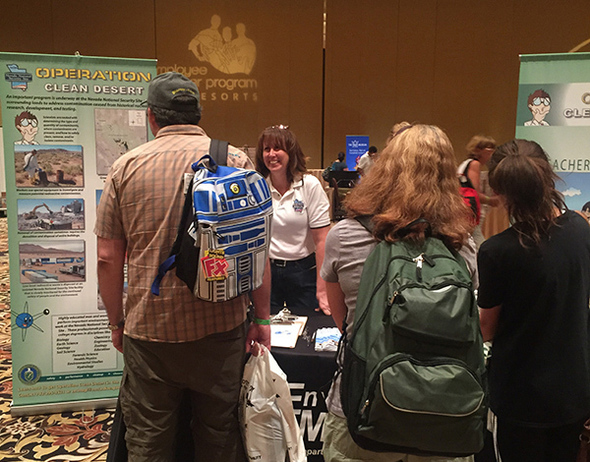
With more than 323,000 students, Clark County School District is the fifth-largest school district in the U.S., and nearby NNSS. The Operation Clean Desert team participated in two district events, New Teacher Kickoff and Educators Appreciation Day, providing hundreds of local teachers free learning materials to educate students.
At the events, educators swarmed the Operation Clean Desert booths to get their hands on samples of activity books and teacher’s guides. Within a week of the event, teachers requested hundreds of the activity books, which outline hands-on projects such as “Aquifer in a Cup” and “The Anatomy of an Atom” to reinforce learning.
Dr. Proton and Adam the Atom, stars of the Operation Clean Desert program, provide science education with a twist. Through the pages of the activity book, students are taken on a tour of NNSS to learn about the site’s history and develop an understanding of the cleanup activities and current missions. With several editions available, there are options for all grade levels.
Hundreds of teachers visited the Operation Clean Desert booths to learn more about educational materials and in-class demonstrations available for their students.
Exclusive to the teacher’s guide is a group activity showing students the relationship between decay and half-life.
“We are looking forward to using this material,” said Amanda Lee, a seventh-grade teacher.
Operation Clean Desert also offers popular in-class groundwater demonstrations conducted by NNSS scientists to reinforce what the students learn in the activity book.
“I was so excited when I heard about this program, I had to email you right away,” sixth-grade science teacher Samantha Parola told the team.
Another option for teachers with students 14 and older is an all-day tour of NNSS.
“The response from teachers has been amazing. We are glad to provide our support to assist these scholastic heroes with the education of children in our community,” DOE Public Affairs Specialist Kelly Snyder said.
To learn more about Operation Clean Desert, click here.
Cooling Vests Combat Heat, Improve Visibility at Savannah River Site
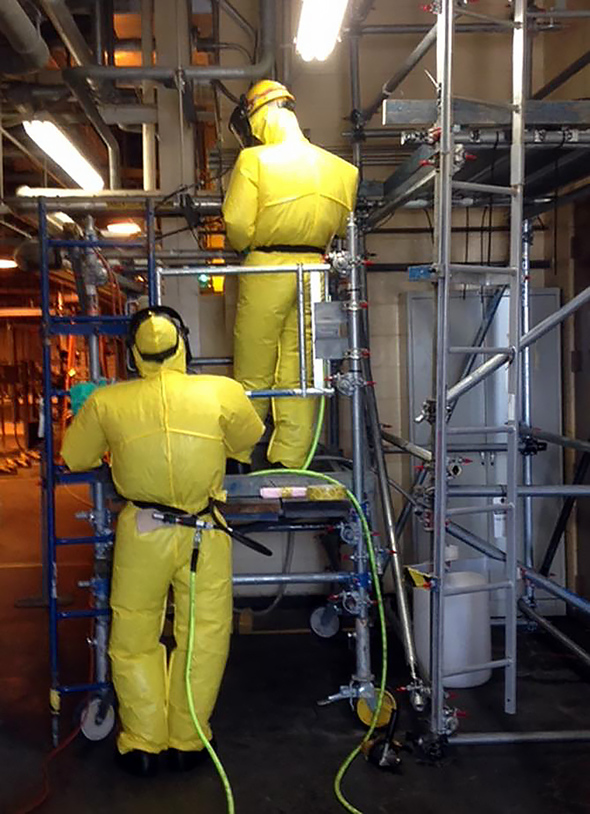
Pipefitters don cooling vests under protective suits in near 100-degree heat inside a building at SRS.
AIKEN, S.C. – Even though the temperature averaged 95 degrees, this was one of the coolest summers in the 25 years Grover Drawdy has worked as a pipefitter.
He is among the pipefitters at the Savannah River Site (SRS) who beat the heat with a cooling apparatus under his protective gear.
Above-average temperatures can be dangerous when paired with strenuous physical labor, but Savannah River Remediation (SRR), the liquid waste contractor at SRS, is working to keep its employees safe with the cooling vests.
“The facilities that we work in are like working outside — there is no air conditioning,” said Drawdy, who has been at SRR for a little over a year. “Wearing the cooling vests, though, really increases your stay-time on the job. You’re not as worn out at the end of the day from working in 100-degree heat.”
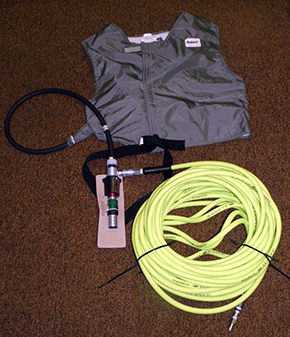
The cooling apparatuses used at SRS include a breathing air compressor, a belt-mounted climate control tube and light-weight vest.
The cooling apparatus includes a breathing air compressor, a belt-mounted climate control tube, and light-weight vest. The heart of the system is the climate-control vortex tube that can cool, or heat, incoming air by 30 degrees. So far, the cooling vests have been worn in non-radiological work environments at the Defense Waste Processing Facility at SRS to minimize the potential for heat-stress injuries. SRR is working to integrate use of the cooling vest into the personal protection equipment worn by workers in radiological environments as well.
“Working in high temperatures with an impermeable, chemical-resistant suit, face shield, and goggles is not an easy task,” SRR Construction Safety and Health Manager David Stavru said. “Trying new techniques or tools to reduce the risk of heat-related injuries is everyone’s objective.”
The cold air from the apparatus remedies another issue when workers wear protective suits: fogging of the face shields and goggles.
“The pipefitters are all for the vests because they eliminate both the over-heating issues and the visibility issues,” said Craig Adams, another SRR pipefitter.
Stavru said, “Our goal is to keep everyone at SRR safe, no matter what the work environment. And these cooling vests really help to do that.”