Sue Cange Provides Insight on Oak Ridge’s Cleanup Progress, Partnerships
OAK RIDGE, Tenn. – Sue Cange, manager for the Oak Ridge Office of Environmental Management, is responsible for safely executing the environmental cleanup of the Oak Ridge Reservation. With 24 years of experience within DOE, she has held leadership positions in the DOE offices of EM, Nuclear Energy, and Assets Utilization. Prior to coming to Oak Ridge, Cange worked for the U.S. Environmental Protection Agency (EPA), where she helped to develop much of the policy used to govern environmental cleanup under the Superfund Program.
Cange holds a bachelor’s and a master’s degree in environmental engineering from Vanderbilt University in Nashville. She recently talked with EM Update about her career experience and goals for the Oak Ridge EM program.
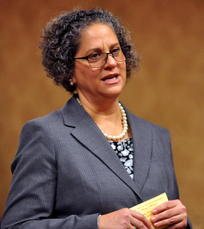
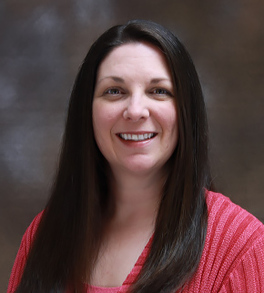
Sue Cange, manager for the Oak Ridge Office of Environmental Management
1. Early in your career, you worked with EPA. What lessons did you gain from your experience working there that you can apply to the advancement of EM’s cleanup mission at Oak Ridge?
I’ve gained a number of important lessons throughout my career. As an example, one lesson I learned early in my career was the importance of environmental stewardship. That remains an important focus of what I do each day working for EM. I also learned the value of partnerships with other organizations to achieve the best results. In addition, I think my time with EPA gave me greater insight into EPA’s perspective, and that helps me when discussing cleanup priorities and strategies with our regulators.
2.You spent a considerable amount of time working on Oak Ridge’s reindustrialization program. Having that external perspective and an internal perspective from working in EM, how have you seen EM’s cleanup advance new opportunities and growth for the region?
In the reindustrialization program, we take unneeded or underutilized assets like facilities, land or infrastructure, and we make them available for commercial use. I think that both reindustrialization and the environmental management program help to advance each other. EM makes land and facilities available for reuse. Reindustrialization highlights EM’s successes by reutilizing those assets, which helps to stimulate the economy. Our reindustrialization program here in Oak Ridge has a record of success. We’ve transferred land, buildings and infrastructure at the East Tennessee Technology Park (ETTP) to the Community Reuse Organization of East Tennessee and to the city of Oak Ridge. We’ve built sustainable energy projects and helped to locate a number of private sector companies on the site. We have a recent success that is noteworthy. CVMR Corp., a metals research and manufacturing company, announced it is relocating its headquarters to this area, on reindustrialized property. The company is investing over $300 million into its first phase of work and it is expected to add more than 600 jobs to the area.
3.Every portion of DOE’s portfolio and mission is represented at Oak Ridge. How has this unique aspect of the site provided opportunities?
We have roughly 13,000 employees on the Oak Ridge Reservation working on science and national security missions. Those are all within the areas where the environmental management program has its operations and projects. It can be challenging but it can also be gratifying to see how the cleanup work helps to transform and advance other mission work that the Department executes. For example, our cleanup work is allowing for economic development opportunities at ETTP and it will allow for the Y-12 National Security Complex (Y-12) and the Oak Ridge National Laboratory (ORNL) to continue with their modernization efforts.
4.The Oak Ridge EM program has partnerships with its contractors to conduct operations, and partnerships with the community for support and awareness about EM’s mission. How will these partnerships positively impact the EM program and its long-term goals?
This is a topic near and dear to my heart because I am a firm believer in partnerships. I believe that we will always accomplish more when we have strong partnerships with our contractors and with the community as well as other important stakeholders. We work hard to make sure we have collaborative relationships with our partners. With our contractors, we have a shared vision. We have a commitment to complete work safely and expeditiously, and in a fiscally responsible manner. We also work to foster and maintain a good relationship with our local labor unions because it’s an important element that contributes to our success here in Oak Ridge. We also have a great relationship with the greater Oak Ridge community. They’re advocates for our program. They understand the importance of the cleanup mission and how it enables the other missions in Oak Ridge. At the end of the day, our work is about improving both safety and the environment for the community. We also have a strong partnership with our state and federal legislators. They value the work we perform and they provide great support and leadership for our mission.
5.With completion of ETTP nearing, Oak Ridge is shifting to a new phase of cleanup. How do you feel about coming into leadership at such a special time?
I consider myself fortunate to be the manager at this time. I am committed to do my best to position Oak Ridge for this important transition. We have several challenges we need to overcome to transition our workforce from cleanup of ETTP to cleanup of Y-12 without interruption. I’m confident in our federal team as well as all the other stakeholders that support the cleanup program and as a result, I know that we will be successful.
6.To date, what do you think is EM’s greatest accomplishment at Oak Ridge?
EM in Oak Ridge has had a number of significant accomplishments over the years. If I have to pick one, it’s completing the demolition of the K-25 Building. That’s certainly been our greatest accomplishment in the past 10 years. In addition to performing that work safely, we completed the project more than one year ahead of schedule and approximately $300 million under the approved baseline. We are very proud of that accomplishment. The K-25 Building was the world’s largest building at one time, and its demolition was the first of its kind. We’ve learned a lot of lessons and gained a number of best practices by successfully completing that project. We’re applying those lessons and those best practices to other projects here in Oak Ridge, and are also sharing them with other cleanup sites in the DOE complex.
7.What are your expectations of Oak Ridge’s EM program in the next three to five years?
In three to five years, we plan to finish processing the legacy transuranic waste in storage at ORNL, and we plan to complete the U-233 direct disposition campaign. In addition, during that time period, we plan to be nearly complete with our cleanup of ETTP. With the completion of that project, we’ll be busy planning for our future. We will be moving from completion of cleanup of ETTP to initiating D&D work at Y-12. We have some important capital asset projects we are planning. They include constructing a new water treatment facility at Y-12 and siting and constructing a new onsite disposal facility for the cleanup debris generated at Y-12 and ORNL. We have a lot of work to do and are positioned to be successful. We will also be designing modifications to our TRU Waste Processing Center to process the transuranic-contaminated sludge that is in storage.
Agencies Move Closer to Creating Manhattan Project National Park
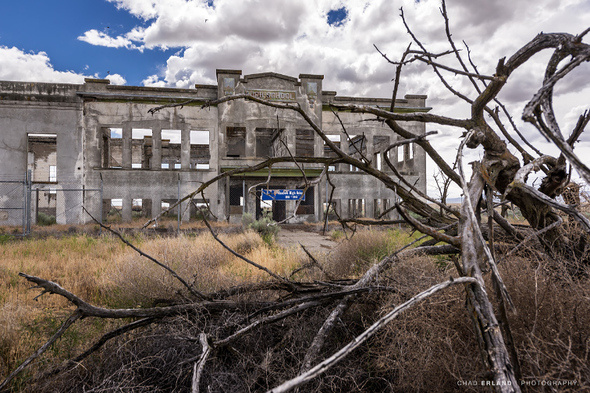
Shown here are the remains of Hanford High School, built in 1916 in the town of Hanford. It will be one of many pieces of the Manhattan Project National Historical Park.
WASHINGTON, D.C. – The establishment of a new national park commemorating the Manhattan Project is one step closer now that a draft Memorandum of Agreement (MOA) between the federal agencies that will be responsible for the park has been completed and released for public comment.
The MOA outlines the roles and responsibilities the DOE and U.S. Department of Interior will have in managing the Manhattan Project National Historical Park. The public comment period for the draft MOA ended Aug. 28; the document must be finalized by mid-December in accordance with the 2014 legislation that authorized the park.
“In the legislation creating the new park, DOE was given a substantial and perpetual role,” said Colleen French, the DOE program manager for the park at Hanford. “DOE will continue to own and operate all of our facilities included in the national park, maintain and preserve those sites, and provide safe public access to them. The National Park Service, meantime, will bring its unparalleled skill in interpretation and visitor services. It’s a perfect partnership, and we are proud to be a part of it.”
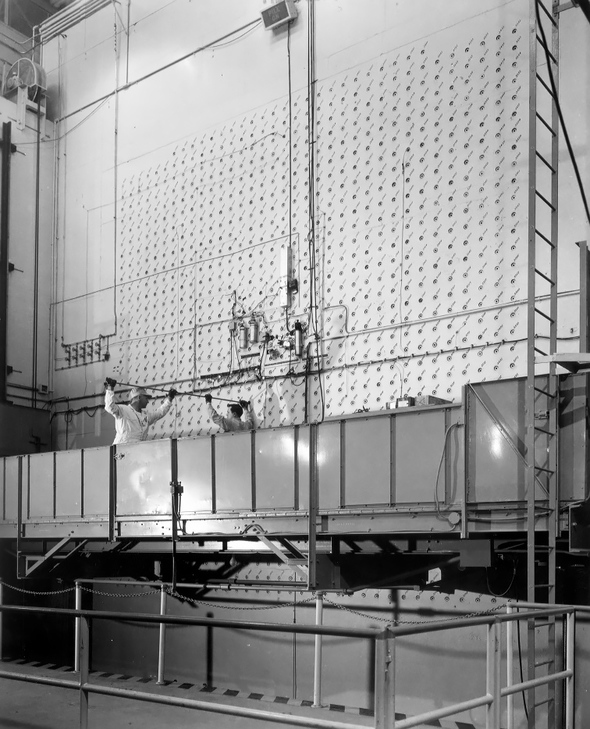
The Graphite Reactor at the Oak Ridge National Laboratory would be one of the featured stops for visitors of the Manhattan Project National Historical Park.
The park will consist of facilities at the three sites — Hanford, Oak Ridge and the Los Alamos National Laboratory — that played key roles in the creation of the atomic bomb during World War II. Each location will be interpreted and will increase the public’s access to the Manhattan Project story.
“Decisions about how to provide that access will be made over time and will be guided by the need to ensure public safety and continue meeting mission requirements,” French said.
Along with helping to educate visitors on the history of the Manhattan Project, the new park is expected to bring substantial benefits to the local communities near each site.
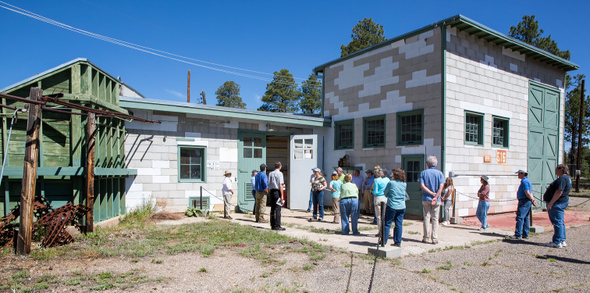
National Park Service staff responsible for initiating the Manhattan Project National Historical Park tour legacy sites at Los Alamos National Laboratory.
“Heritage tourism brings money, people, and jobs to gateway communities. At the Hanford Site, for example, where the B Reactor National Historic Landmark has been open for tours since 2009, the local Visitor and Convention Bureau estimates that B Reactor’s 10,000 visitors per year are bringing about $2 million dollars to the local economy. People stay in hotels, eat in local restaurants, and remain in town to do other things such as recreation on the river and wine tasting,” French said.
She added, “The communities surrounding the Manhattan Project sites have been passionate and effective advocates for the new park and are valuable partners as DOE plans for preservation of historic facilities and public access to the park sites. We will work closely with our communities, area Tribes, and others as we stand up the park and grow over time.”
DOE Recognizes EM Richland Operations Office Employees for Excellence in Safety, Cost Savings
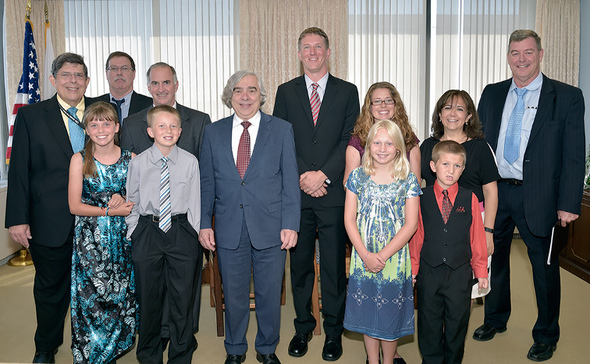
Energy Secretary Ernest Moniz and other DOE officials gather with award winner Joshua Allen and his family at DOE headquarters earlier this month. Front row, left to right, Makenna Allen, Noah Allen, Secretary Ernest Moniz, Aria Allen, and David Allen; back row, left right, DOE Facility Representative Program Manager Earl Hughes, EM Operational Safety Office Director Terrance Tracy, Environment, Health, Safety and Security Associate Under Secretary Matthew Moury, Richland Operations Office Operations and Oversight Division Facility Representative Joshua Allen, Tera Allen, EM Assistant Secretary Monica Regalbuto, and EM Nuclear Safety Chief Chip Lagdon.
WASHINGTON, D.C. – DOE has honored three EMRichland Operations Office (RL) employees with awards for their exemplary service, dedication to safety, and a cost-savings initiative.
Joshua Allen, who works in RL’s Operations and Oversight Division, was recognized as DOE’s Facility Representative of Year. Mark Hahn, a member of the engineering team in the RL Nuclear Safety Division (NSD) and a sought-after technical expert for confinement ventilation programs, was the recipient of the DOE Safety System Oversight Annual Award. RL’s Cheryl Arm was honored with the Secretary of Energy’s Excellence Honor Award for her work in a cost-savings initiative.
EM Principal Deputy Assistant Secretary Mark Whitney honored Allen and Hahn earlier this year at the DOE Facility Safety Programs Workshop at the Hanford Site in Washington state.
“They are models for all DOE and EM employees and are being deservedly recognized for their excellent work and their professionalism,” Whitney said to a gathering of RL employees earlier this year.
Richland Operations Office’s Mark Hahn was honored with the DOE Safety System Oversight Annual Award.
Cheryl Arm was recognized for her work while assigned to EM’s Office of River Protection.
Allen is responsible for oversight at the Central Waste Complex, the Waste Receiving and Processing Facility, and the low-level burial grounds at the Hanford Site. He was honored for his mentoring abilities, his initiative in developing a database improvement system, and leading substantial improvements that have been adopted across EM.
Hahn has performed above and beyond his duties in a number of ways, according to Whitney. He assisted with the accident investigation team at EM’s Waste Isolation Pilot Plant, participated in DOE and national convention standards, and served as a confined ventilation systems expert on the Waste Treatment and Immobilization Plant (WTP) engineering group.
Secretary Ernest Moniz also honored Arm, likewise a member of the RL NSD, for her work while assigned to EM’s Office of River Protection. She identified significant potential cost savings in material selection, product design, and process efficiency at the Low-Activity Waste facility. Her recommendations have led to the potential for an estimated life-cycle savings of $750 million for the WTP project.
“I am proud of Mark and Josh for their work and dedication to improving safety oversight at Hanford and throughout the EM complex,” RL Manager Stacy Charboneau said. “Cheryl has shown that the contributions of our safety personnel extend beyond engineering excellence to also include process and cost-saving initiatives.”
EM’s Minority Serving Institutions Partnership Program Issues Fiscal Year 2015 Research Contracts
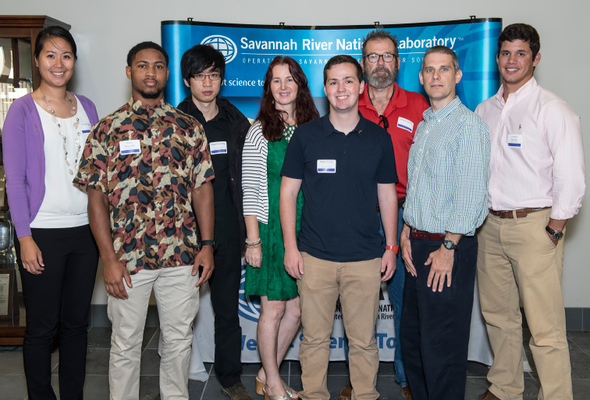
SRNL interns gather with their mentors at the laboratory, from left to right: Connie Yung, SRNL MSIPP program manager; Jamal Reynolds, intern, Mercer University; Guannian Zeng, intern, City College of New York; Anna Knox, SRNL scientist; Daniel Berry, intern, University of South Carolina-Aiken; Thomas Ansley, SRNL scientist; Tad Whiteside, SRNL scientist; and Charles Heindel, intern, Georgia Southern University.
WASHINGTON, D.C. – EM recently awarded contracts worth $3.3 million to support applied research and technology development projects at eight minority-serving institutions (MSIs).
The awards were made through EM’s Minority Serving Institution Partnership Program (MSIPP), and the selected research teams will perform state-of-the-art science and engineering to address EM’s technical challenges.
MSIPP supports science, technology, engineering, and mathematics (STEM) at MSIs, which include Historically Black Colleges and Universities, Hispanic-Serving Institutions, and Tribal Colleges and Universities.
“This program is helping us advance the community of minority students who understand EM’s mission. These students are technically-skilled, they’re excited about contributing to our work, and they’ll be the next generation at our labs and sites,” EM Site Restoration Deputy Assistant Secretary Mark Gilbertson said.
EM’s Savannah River National Laboratory (SRNL), part of the network of DOE national laboratories, administered MSIPP for EM for the first time in fiscal year 2015. The program included a laboratory internship component and a competitive research solicitation. SRNL and EM worked to place approximately 30 MSIPP summer interns in EM-relevant programs at SRNL and the Oak Ridge, Pacific Northwest, and Argonne national laboratories.
According to SRNL Mission Strategy Director Chuck Meyers, SRNL focused on opportunities to leverage existing EM research and development programs and projects when developing MSIPP’s competitive research solicitation.
“We worked very hard to match MSI researchers to national lab experts around the complex. This type of matching is critical to establish better familiarity with EM’s mission and to build relationships with national lab researchers,” he said.
SRNL also organized and led the proposal peer review process using subject-matter experts from various laboratories and incorporating a headquarters review of the proposals. Proposal selection criteria included technical quality, program priorities, MSI capabilities, and budget considerations.
Following the competitive selection process, funding was provided for a number of projects at eight colleges and universities. Research areas include soil and groundwater remediation, tank waste processing, and deactivation and decommissioning. Future research topics will continue to match EM’s needs for workforce expertise.
Following are the research topics and individual funding recipients:
Abiotic and Biotic Reactivity of Immobilized Mercury Species Formed After In Situ Treatment: Alabama State University;
Assessing Natural Attenuation vs. Biostimulation or Bioaugmentation for Groundwater Remediation of Chlorinated Solvents at the Savannah River Site: Benedict College;
Lactate Dehydrogenase as a Biomarker for Low-Dose Radiation Exposure in Medaka Fish: Benedict College;
Use of Whole Cell Bioreporters to Identify Hotspots of Bioavailability: Florida A&M University;
Development of an Alternative Solvent Extraction Technology for Combined Cesium and Actinide Separation for High-Level Waste Treatment: Florida International University;
Engaging Undergraduate Researchers in Molecular and Functional Characterization of the Culturable Microbiota Potentially Involved in Bioremediation at Hanford: Howard University;
Microbial Kinetics of Bacterial Isolates Capable of Iodate Reduction with Oxygen or Nitrate: Howard University;
Fouling Control Strategies for Crossflow Filtration of High Level Wastes: Howard University;
A Mechanistic Investigation of the Reduction and Volatilization of Mercury Contaminants in Soil at the Oak Ridge Y-12 National Security Complex: The City University of New York;
Determining Natural Attenuation Rates, Plume Movement and Source Reduction for the CMP Pits Volatile Organic Compound Plume at the Savannah River Site: South Carolina State University;
Chromium Contamination Remediation Using Activated Carbon Coated with Polysulfide Rubber and Zeolites Coated with Surfactants: University of Nevada, Las Vegas; and
Development of Plug-and-Play Interchangeable Components for Unmanned Aerial System with Mobile Manipulation Capability: University of Nevada, Las Vegas.
EM Discusses Job Opportunities with 140 Military Veterans at Hiring Event
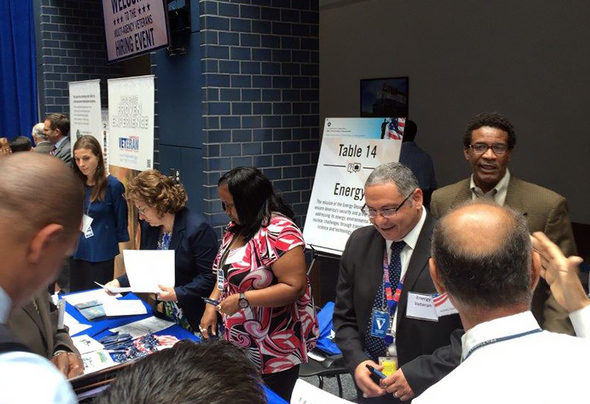
From right, EM’s Andre Fordham, Frank Moussa, and Vanessa Jenkins, and other DOE employees, talk with military veterans at DOE’s recruitment booth at the hiring event.
WASHINGTON, D.C. – EM recruiters discussed career opportunities with about 140 military veterans during a recent hiring event held by the U.S. Department of Transportation.
“It is very gratifying to honor our service veterans by assisting them in transitioning back into the civilian workforce,” EM Diversity and Inclusion Manager Andre Fordham said.
DOE’s Office of the Chief Human Capital Officer determined several of the veterans were well-qualified for positions in information technology, security, human capital, safety and occupational health, general engineering, management and procurement analysis, and emergency management.
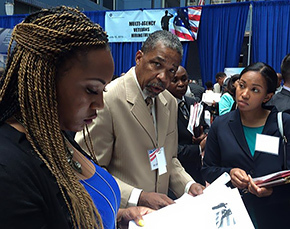
EM’s Nathan Spruill, center, assists veterans as they identify job opportunities at the event.
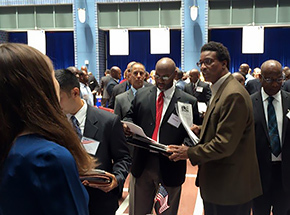
EM’s Andre Fordham, right, forefront, directs job seekers as they approach DOE’s recruitment booth at the event.
DOE’s offices of EM, Chief Human Capital Officer, and Loan Programs joined the U.S. Department of Treasury at the event, which provided space for hiring managers to conduct interviews with veterans.
EM is looking forward to participating in similar events in the future.
H Canyon’s 60th Anniversary Event Honors Past, Celebrates Future at Savannah River Site
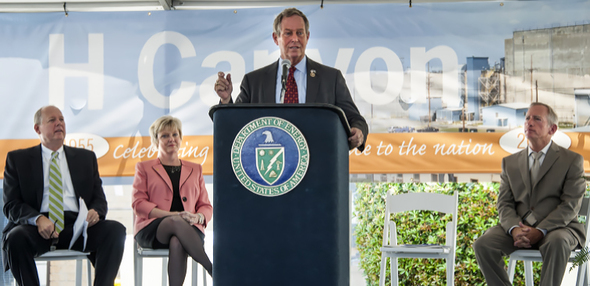
U.S. Congressman Joe Wilson addresses attendees at the H Canyon 60th anniversary event. In the background are, from left, Savannah River Site Manager Jack Craig, Savannah River Nuclear Solutions President and CEO Carol Johnson, and EM’s Tank Waste and Nuclear Material Deputy Assistant Secretary Ken Picha.
AIKEN, S.C. – U.S. Congressman Joe Wilson, EM’s Tank Waste and Nuclear Material Deputy Assistant Secretary Ken Picha, community stakeholders, and current and retired H Canyon employees recently came together to celebrate the Savannah River Site’s (SRS) H Canyon Facility’s 60 years of service to the United States.
The facility first produced nuclear materials to support the nation’s defense weapons programs. After the Cold War, it supported disposition and stabilization of nuclear materials and spent nuclear fuel from legacy cleanup, and foreign and domestic research reactors.
Wilson, Picha, Savannah River Site Manager Jack Craig, and Carol Johnson, president and CEO for Savannah River Nuclear Solutions, the SRS management and operations contractor, all spoke at the event. They conveyed gratitude to H Canyon employees for contributing to the national defense, and encouraged excellence in future operations.
“For 60 years, the canyon has supported this country’s nuclear material needs,” Wilson said. “There is no other place in the United States that has served our nation in this way. During the Cold War, it was involved with nuclear material production, significantly contributing to a victory for democracy. Today, H Canyon proves that it is a great asset to our nation by helping to keep nuclear materials in a safe and secure location, and I am grateful for their dedicated, capable employees.”
Picha said, “SRS has a set of capabilities that allow us to do work that simply has to be done. Without that capacity, our policy options are limited. That’s why we can say with confidence that we really are contributing to making the world safer.”
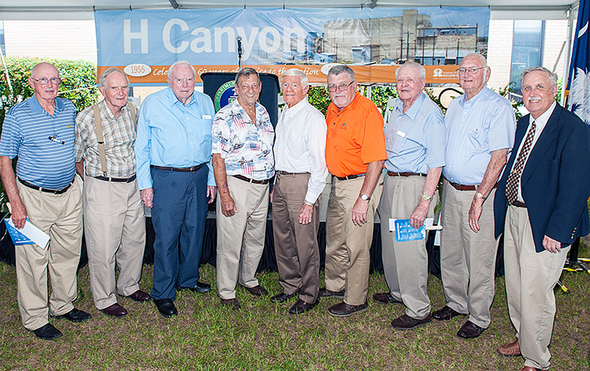
H Canyon retired employees, from left: Bill Whitlock, Jack Lowery, Bob Hanvey, George Blackburn, Jr., Zack Patrick, Alan Gregory, Frank Loudermilk, Jr., Bob Womack, and Don Johnson
H Canyon was originally constructed in the 1950s and began operations in 1955. For nearly 40 years, the facility separated and recovered plutonium, as well as uranium-235 and neptunium-237, from irradiated, aluminum-clad, enriched-uranium fuel assemblies from site weapons production reactors.
"H Canyon has served our nation well for 60 years and today it remains the only operating production-scale shielded chemical separations facility in the country,” said Energy Secretary Ernest Moniz. “Thanks to the hard work, creativity, and dedication of the men and women operating at H Canyon, the facility has stood the test of time as a national asset for large-scale nuclear materials processing. It is a global asset for nuclear nonproliferation cooperation. The Department commends the H Canyon community for the essential work they are doing to strengthen our national security, nonproliferation efforts, and the safe disposition of nuclear material."
H Canyon is preparing for a low-enriched uranium blend-down campaign. It recently restarted the second uranium cycle, the third process in purifying and decontaminating the uranium, for the first time in more than a year.
H Canyon is also being used as a test site for new technologies in the spent nuclear material field. Initially started for safeguards and nonproliferation purposes, the test site has expanded to include special nuclear material accountability, environmental monitoring and compliance, and improved process control.
DOE Idaho Operations Office’s STEM Partnership with Elementary School Grows
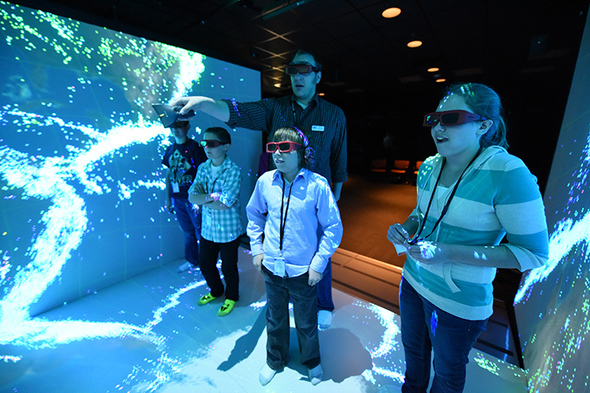
Students explore the inside of Idaho National Laboratory’s Computer Assisted Virtual Environment.
IDAHO FALLS, Idaho – The Idaho Operations Office continues to demonstrate DOE’s commitment to support science, technology, engineering, and mathematics (STEM) education through a partnership with A.H. Bush Elementary School in Idaho Falls.
The partnership with the STEM magnet school — which is supported by several EM employees of the Idaho Operations Office — began as an after-school tutoring program eight years ago. Each year, over 50 students receive tutoring from DOE engineers, administrative professionals, health physicists, human resource professionals, environmental scientists, and contracts professionals.
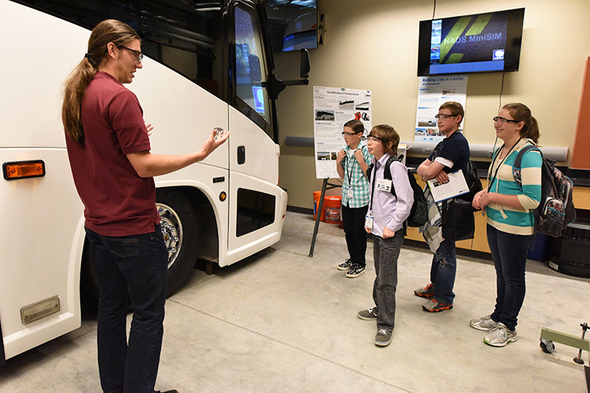
During the 2014-2015 school year, DOE-Idaho developed an intern program for promising sixth-grade students that DOE-Idaho and the school hope to expand next year. In the program, four interns spent time with computer scientists at Idaho National Laboratory’s (INL’s) Computer Assisted Virtual Environment (CAVE) and the INL passenger bus simulator. The students have been learning how to make their own CAVE. They said they enjoyed the bus simulator, which allowed them to virtually simulate driving an INL passenger bus. The students also met with a robotics scientist, and they were able to observe and operate various robots.
“Many of the students we tutored the first few years are now of college age and making decisions about their futures. Our goal is to introduce science to these kids early, expose them to past, present, and future scientific advances, and encourage them to consider careers in science when the time comes for them to make decisions about their future,” Idaho Operations Office STEM Education Coordinator Jan Ogilvie said.
Students learn about the Idaho National Laboratory’s bus simulator. The INL bus system transports about 2,500 people to and from the Idaho Site each day.
DOE-Idaho also sponsored a trip to the Experimental Breeder Reactor-1 (EBR-1) Atomic Museum for 42 sixth-grade students who were studying energy. Now a national historic landmark, EBR-1 was the first nuclear reactor to generate useable electricity. Trip activities included a nuclear energy presentation, museum tour, hands-on activities, and interactive engagement and activities inside of the recently added Experimental Breeder Reactor No. 2 (EBR-II) Reactor Operations Control Room Simulator. There, the students tried operating a simulated reactor and listened to stories from former EBR-II reactor operators and engineers.
The last activity for this year’s partnership was the planting of a tree at the school in memory of one of DOE-Idaho’s long-term tutors and nuclear engineer, Adolf Garcia, who died unexpectedly this spring. Garcia had been a tutor in the after-school program for six years. “Find something you love doing and you will never work a day in your life,” he told the students. Garcia routinely identified the interests of the students and purchased books for them.
This year, DOE-Idaho received an award plaque from Bush Elementary in recognition of eight years of STEM support to the school.
EM Completes Project to Maintain Water Quality of Spent Nuclear Fuel Basin at Idaho Site
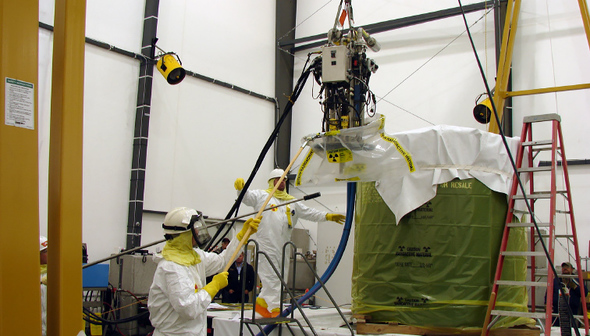
Workers train to prepare for the ion-exchange water treatment process.
IDAHO FALLS, Idaho – EM and its main cleanup contractor at DOE’s Idaho Site recently reached a major project milestone necessary to maintain water quality and continued, safe operations within the site’s spent nuclear fuel storage basin.
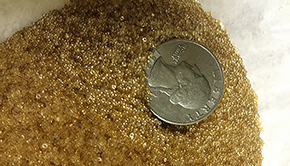
The resin replacement project by EM and CH2M-WG, Idaho (CWI) removed and replaced tiny, beaded media, called resin, used to filter millions of gallons of water necessary to cool and provide radiological shielding for the spent nuclear fuel. The specialized ion-exchange water treatment process, which operates similarly to a home water softener, is necessary to remove chlorides, heavy metals, and radionuclides from the water.
“This project was significant because maintaining the water quality in the fuel storage area is crucial to continued operations and storage of fuel,” CWI system engineer Kristen Mortensen said.
“This was a great achievement considering the many aspects of this complex project,” EM’s Idaho Manager Jack Zimmerman said.
It was 16 years ago that resin was last replaced in building CPP-666 at the site’s Idaho Nuclear Technology and Engineering Center. The used or “spent” resin was stored in on-site hold tanks.
The ion-exchange resin used to treat the storage pool water.
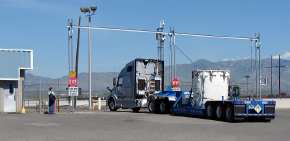
The last shipment of spent resin leaves the Idaho Nuclear Technology and Engineering Center for a disposal facility.
The overall scope of this project included removal of the used resin from the spent resin hold tanks and disposal by a subcontractor; transfer of resin from the ion-exchange resin beds to the spent resin hold tanks; inspection and recharging of the ion-exchange resin beds; and removal of the resin from the spent resin hold tanks and disposal by a subcontractor.
“The initial CWI proposal was to dispose of the old spent resin from 1999, and refill the columns with new resin before the end of September 2015,” CWI Project Director Randy Fadeley said. “However, DOE challenged us to dispose of all the spent resin — doubling the amount for disposal — and get it done three months sooner. At the time it seemed next to impossible, but this team pulled it off. This was an outstanding accomplishment.”
State Honors Hanford’s Tank Operations Contractor for Hiring Veterans
WRPS Compliance Programs Lead Lisa Bunch holds a plaque the company received from the Washington State Employment Security Department (ESD) for the company’s commitment to hiring veterans. Also pictured are, from left to right, Dave Olson, WRPS president and project manager; Jennie Weber, ESD’s eastern regional director; and Nick Erickson, the local veterans' employment representative.
RICHLAND, Wash. – Washington River Protection Solutions (WRPS), EM Office of River Protection’s prime contractor responsible for safely managing tank waste at the Hanford Site, was one of seven employers recently recognized by the Washington State Employment Security Department (ESD) for hiring veterans.
WRPS employs 221 veterans who make up about 11 percent of its workforce. ESD Commissioner Dale Peinecke praised WRPS for its sustained efforts to hire veterans.
“The men and women who serve in our military bring valuable skills and experience to civilian jobs after they’ve completed their active duty,” Peinecke said. “These seven employers have demonstrated their commitment to providing jobs for veterans in our state again and again.”
Dave Olson, WRPS president and project manager, said hiring veterans is a company priority.
“Veterans are professional, accountable, hard-working, and motivated,” he said. “They have a proven ability to learn new skills, which allows for a smooth transition to our project.”
WRPS works closely with veterans’ representatives by making them aware of job opportunities, supporting training services, and attending job fairs. Nick Erickson, a local veterans’ employment representative for WorkSource Columbia Basin, nominated WRPS for the honor.
“They have been a model employer for hiring veterans and supporting training services,” he said. “They regularly participate in mock interviews and resume-writing workshops, and speak to veterans on multiple occasions.”
WRPS representatives attended several local and regional job fairs for veterans. They also attended Service Academy Career Conference (SACC) events in San Diego and San Antonio. SACC is a national job fair for service academy alumni. To date, 17 veterans who interviewed at the SACC events accepted jobs with WRPS.
Robert Plemmons, who served 12 years in the Marines, joined WRPS last year as an accountant and is now a safety professional with the company. Plemmons said the military provides excellent training and skills that transfer to the civilian working world.
“We have a large number of experienced veterans who have helped WRPS grow and move forward with its mission,” he said.
Katie Sterling, an Army veteran, joined WRPS in 2008. She has been deployed four times, twice as a reservist while employed at WRPS. She currently works as a maintenance manager.
“I’m definitely a big fan of WRPS,” said Sterling, a graduate of the United States Military Academy. “The company has gone above and beyond to support me during my deployments and has provided me with many opportunities to advance my career. WRPS makes veterans feel like they are a part of a family.”
WASHINGTON, D.C. – Two EM employees were recently awarded Master of Science degrees from the National Defense University (NDU) as part of a DOE-sponsored professional development program.
Casey and Belton were able to complete a considerable portion of their coursework by participating in the Advanced Management Program (AMP) made available to DOE and its contractor employees twice a year. Now called the Chief Information Officer (CIO) Leadership Development Program, the 14-week graduate program is designed for middle- and senior-level managers and leaders responsible for promoting and attaining national and international security goals through the strategic use of information and information technology.
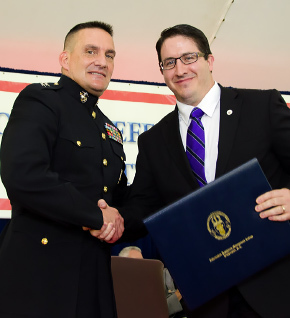
Stephen Casey of the Portsmouth/Paducah Project Office receives his degree from NDU President Maj. Gen. Frederick M. Padilla, U.S. Marine Corps, during the main campus graduation earlier this year at Fort Lesley J. McNair in Washington, D.C.
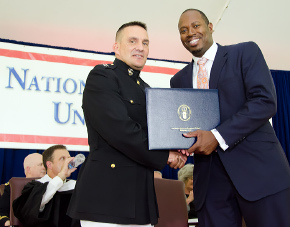
Lewann Belton of the Savannah River Operations Office receives his degree at the NDU graduation.
The NDU CIO Program is a leader in graduate education for federal leaders and agency personnel, aligning with the Federal CIO Council-defined competencies, the Clinger-Cohen Act, the Government Performance and Results Act, and other legislative mandates.
According to Casey, DOE’s partnership with the Department of Defense allows for a useful range of learning opportunities for DOE staff.
“DOE facilitated my access to NDU, which was a great resource for me with valuable applications in my work assignments,” he said.
For more information on the partnership between DOE and the NDU, including tuition reduction opportunities, contact DOE’s Office of Learning and Workforce Development, Career Development Programs.