Senior DOE Officials Visit Paducah Gaseous Diffusion Plant Site
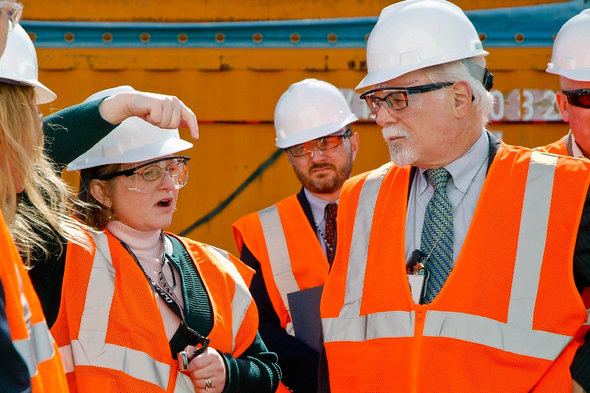
EM Paducah site lead Jennifer Woodard discusses electrical resistance heating as part of the trichloroethene remediation at the C-400 groundwater contamination source with David Klaus, DOE Deputy Under Secretary for Management and Performance (right).
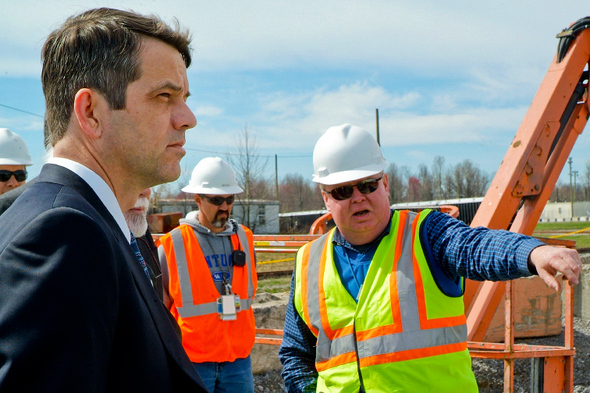
Brad Montgomery of LATA Environmental Services of Kentucky LLC (right) describes the deep-soil mixing process to EM Acting Assistant Secretary Mark Whitney (left).
The visitors also viewed the progress of some major projects from the ongoing environmental remediation program that began in the late 1980s. They observed the C-410/C-420 Feed Plant demolition, which is nearing completion, and groundwater remediation projects, including the southwest plume deep soil mixing project and the C-400 above-ground treatment system, which used electrical resistance heating technology. Both groundwater projects are focused on the removal of trichloroethene, a degreasing solvent used during production years to clean uranium enrichment process equipment. A steam injection treatability study is underway at C-400 to address contamination at lower depths.
The delegation also met with state, local, community, and union leaders.
Business Leaders Learn About Paducah Deactivation Project
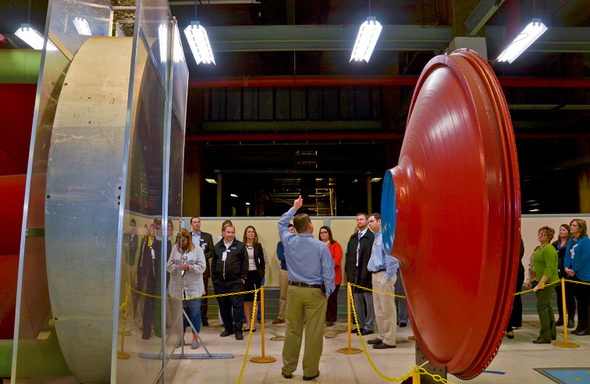
Scott Germain, Fluor Federal Services’ Paducah Deactivation Project support and integration manager, illustrates the magnitude of the display cell in one of the process facilities.
“For more than 60 years, this plant served a vital purpose of enriching uranium for nuclear defense and energy needs,” said Jennifer Woodard, Paducah site lead for the Portsmouth/Paducah Project Office (PPPO). “Now that the plant is no longer enriching uranium, the process of preparing the site for eventual decontamination and decommissioning has begun. I am pleased we had an opportunity to share the rich history of this site with the leadership class, and I look forward to working with them as they continue to advance into community leadership roles.”
The class toured many facilities on the site, including the C-300 Central Control Facility, which continues to monitor and control critical plant processes. The class also toured one of the site’s massive process buildings, which stands more than 80 feet high and has a footprint of 26 acres. It’s larger than 20 football fields and is one of four main process buildings that enriched uranium at Paducah.
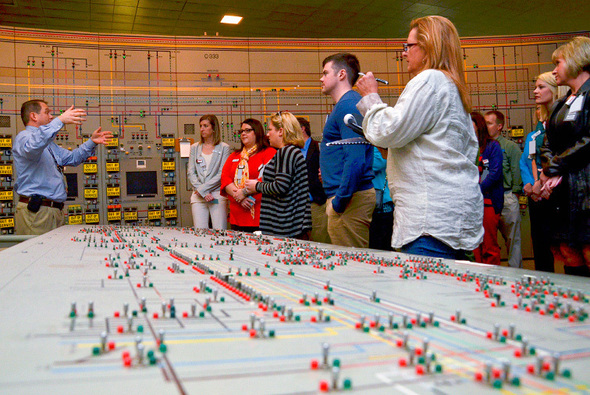
The class toured the C-300 Central Control Facility, the plant’s center for operations, which monitors, coordinates, and controls critical plant processes.
“Many people know that Fluor’s contract with EM includes tasks to begin to deactivate the gaseous diffusion plant and supporting buildings, but what does that mean?” Scott Germain, Fluor Federal Services’ Paducah Deactivation Project support and integration manager, told the group. “In a nutshell, deactivation is the deliberate process to safely idle the facility and enable preparations for safe demolition. This includes safely and compliantly removing nuclear materials inventories; shutting down unnecessary systems; removal of oils and fluids, such as refrigerant and lube oils; and right-sizing utilities, such as electrical, steam, and water. These efforts will generate savings that can be used for site remediation.”
Reflecting on the tour, Wendy Watts, a member of the leadership class, said, “The aerial pictures I have seen do not do justice to the vastness of the plant. I was pleased to have an opportunity to participate in this educational tour.”
EM Exceeds DOE Sustainability Goals and Reduces its Carbon Footprint
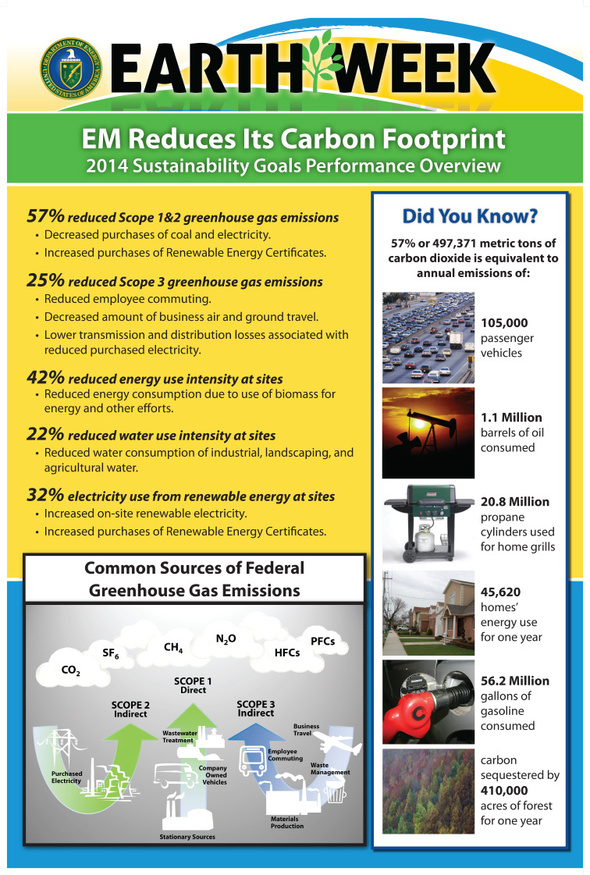
This graphic provides an overview of EM’s 2014 sustainability goals performance.
WASHINGTON, D.C. – EM continues to excel in its support of DOE’s aggressive initiative to cut greenhouse gas (GHG) emissions and energy intensity, which is a measure of building energy use per unit area.
EM again exceeded federal sustainability goals and reduced its carbon footprint in 2014. Since 2008, EM has cut two types of GHG emissions by 57 percent — well ahead of its target of a 28 percent reduction by 2020. The two kinds of emissions resulted from vehicles and equipment owned by EM or from the generation of electricity, heat or steam EM purchased.
EM’s 57-percent drop can be compared to the GHG emissions from 105,000 passenger vehicles over one year.
EM’s cutback was driven primarily by decreased emissions associated with coal and electricity, due in large part to the Savannah River Site biomass cogeneration plants. One of the largest of its kind in the U.S., the facility replaced a 1950s-era coal-fired plant, significantly reducing pollutant emissions. The biomass operation and other efforts also helped lower EM’s energy intensity at sites by 42 percent.
EM also continues to move ahead of the federal goal to cut emissions from related sources not owned or directly controlled by EM. Those emissions have declined by 25 percent since 2008, compared to a goal of a 13-percent reduction by 2020. EM achieved this drop by reducing employee commuting, decreasing the amount of business air and ground travel, and lowering transmission and distribution losses associated with reduced purchased electricity.
Federal sustainability goals are described in DOE’s annual Strategic Sustainability Performance Plan (SSPP) required by Executive Order 13514, Federal Leadership in Environmental, Energy, and Economic Performance, and developed by DOE’s Sustainability Performance Office. The plan establishes Departmental sustainability goals and targets for GHG emissions and energy intensity reductions.
EM’s sustainability efforts are a viable means to accomplish the EM mission in a more sustainable and cost-effective manner, driving EM to make optimum use of its limited resources, operate in a more highly efficient manner, and reduce its carbon footprint. EM’s efforts are part of a government-wide strategy to ensure federal agencies are leading by example in operating sustainably.
More Than 200 DOE Safety and Health Trainers Gather for Exchange
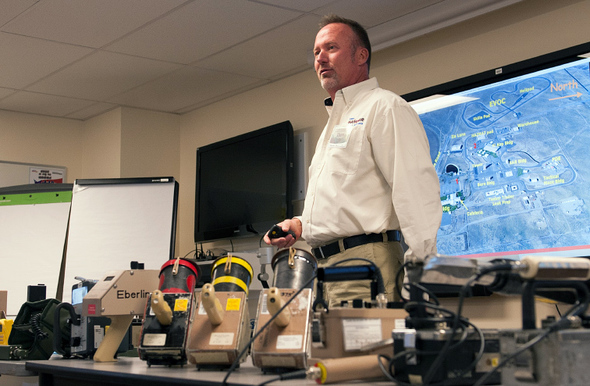
HAMMER Program Manager Thom Hogg discusses radiological monitoring during a National Training Center event and NIEHS Worker Trainer’s Exchange near the Hanford Site.
The trainers enhanced their relationships with counterparts at other DOE sites as they shared best practices, new information, and innovative techniques.
"The Environmental Management program recognizes the unique opportunity that the strong partnership between HAMMER and NIEHS represents, and values the benefits that this brings not only to our EM workforce but also to workers across the DOE complex," said Todd Lapointe, director of EM’s Office of Safety Management.
Participants attended diverse workshops that included hands-on training demonstrations, explanations of innovative adult learning strategies and skills, and presentations on using new instructional technology to enhance training. Topics included respiratory training, workplace violence, training for construction workers, and challenges associated with bridging communication gaps between generations.
The HAMMER staff was eager to host the program and welcomed the continued partnership with the NTC and support provided to other DOE sites.
“Many sites across the DOE complex look to Hanford as a model of successful training partnerships and cooperation,” said Ted Giltz, HAMMER manager of the HAMMER/NTC partnership and lead organizer of the event. “We strive to continue to share our experiences and expertise.”
This is the second time that the NIEHS Worker Training Program, in conjunction with NTC and HAMMER, conducted a trainers exchange specifically for health and safety trainers within the DOE complex. The first was in Knoxville, Tenn. in 2012.
Hanford Contractor Assumes Responsibility of Three Wastewater Facilities
RICHLAND, Wash. – EM’s Office of River Protection (ORP) gained a few more operations recently when the Effluent Treatment (ETF), Liquid Effluent Retention (LERF), and Treated Effluent Disposal (TEDF) facilities changed hands.
Washington River Protection Solutions (WRPS), ORP’s prime contractor for Hanford tank operations, assumed ownership of the three facilities and received 45 employees from CH2M HILL Plateau Remediation Company (CHPRC), the EM Richland Operations Office (RL) contractor.
The ownership change came as ORP’s demand for wastewater treatment facilities grows to support eventual operations of the Waste Treatment and Immobilization Plant (WTP) and ongoing 242-A Evaporator campaigns to support double-shell tank space management. WTP and the Evaporator are slated to become the primary wastewater generators at the site.
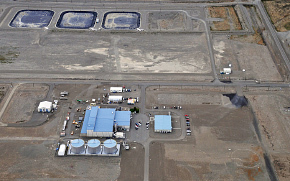
The Effluent Treatment Facility (foreground) and Liquid Effluent Treatment Facility holding basins.
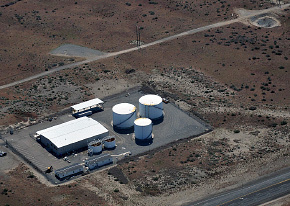
The Treated Effluent Disposal Facility is one of three facilities ORP recently gained.
The deal also means ORP can use existing facilities for wastewater retention and treatment rather than build new ones.
“This is a great example of how we are aligning operations at the Hanford Site between both the Richland Operations Office and ORP’s missions to ensure efficient use of facilities and good stewardship of taxpayer money,” said ORP Tank Farms Project Assistant Manager Tom Fletcher.
The ETF has been in operation for 20 years, removing radioactive and hazardous contaminants from wastewater generated by a variety of Hanford cleanup activities. The facility can treat up to 28 million gallons of water a year. The LERF consists of three holding ponds with a capacity of about 23 million gallons, and is where the contaminated water is stored before being treated in the ETF. The treated water is stored at the ETF, tested, and then discharged at the state-approved land disposal site.
The TEDF accepts treated non-radioactive, non-hazardous effluent collected from pump stations from a variety of locations on the site. The treated effluent is then discharged to two state-approved filtration basins.
Moab Site Installs Radar Unit to Monitor for Future Potential Rockfalls
MOAB, Utah – The Moab Uranium Mill Tailings Remedial Action Project continues to implement safety measures to protect its workers from a rockfall like the one that occurred on the hillside above the site last November.
No injuries resulted from that rockslide, which originated from 800 feet above a rail bench workers use for loading containers filled with uranium mill tailings for transport to the Crescent Junction disposal site, 30 miles north.
A safety measure already in place is a radar unit to monitor movement on the hillside. Other planned improvements include installing an engineered barrier along the rail bench haul road in the area considered to pose the highest risk from rockfalls and relocating the road further from the hillside.
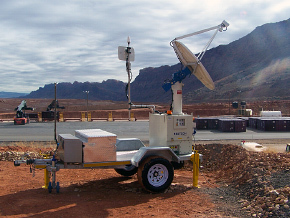
The radar unit is an early warning system for rockfalls on the hillside, which extends 2,000 feet along and 1,000 feet above the rail bench. The unit was manufactured by a firm that specializes in radar for monitoring slope stability in open-pit mines.
The radar monitoring unit is shown here installed at the Moab site in Utah.
The unit was installed at the Moab site on Jan. 19 in a location that maximizes the view of the hillside. The following week, eight project staff attended a weeklong operator training, which consisted of both classroom and practical instruction, provided by the manufacturer.
The unit detects and records rock movement, which accelerates just prior to a rockfall. The radar operates continuously and can be monitored remotely. The unit functions by sweeping the horizontal and lateral area of interest (the hillside) while emitting a radio signal and measuring the time for the signal return.
Several factors affect the size of rock the radar unit is able to detect movement in, including lateral and vertical distance of the rock from the unit, reflectivity of the material, and angle of the rock surface.
In the weeks following installation of the radar unit, project staff and subject-matter experts established thresholds of rock movement that, when exceeded, prompt the unit to issue an alarm indicating further evaluation is needed or evacuation of the work area, depending on the severity. The unit also issues system alerts if the power or signal is lost or the unit malfunctions.
“We are still adjusting alarm thresholds and areas of interest to hone in on movements detected by the unit that are true indicators of potential hillside instability,” said Federal Project Director Donald Metzler.
The project is in the design phase for the barrier on the rail bench to increase worker protectiveness.
EM Contractor Reaps Benefits of Continuous Improvement Culture
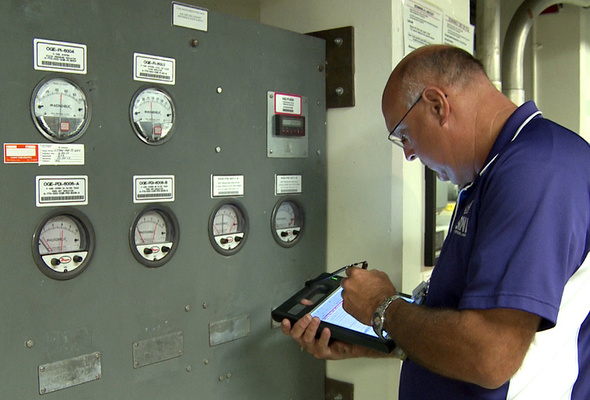
SRNS employee Matthew Gay uses critical electronic rounds to take a reading at the Savannah River National Laboratory. In one Continuous Improvement initiative, SRNS switched to recording required facility and equipment readings electronically. The move reduced operator readings from 326 to 26, freeing up as much as 3.5 employee hours per shift — 730 per year — for work on other facility needs. The annual cost savings are over $42,000.
AIKEN, S.C. – Continuous Improvement (CI) at Savannah River Nuclear Solutions (SRNS), EM’s management and operations contractor at the Savannah River Site (SRS), focuses on eliminating wasteful steps in processes, making little changes that result in significant savings.
In fiscal year 2014, SRNS achieved $45.7 million in cost savings by engaging in CI initiatives, exceeding its CI goal for the year by more than $30 million. Since SRNS assumed its contract at SRS in 2008, CI productivity and efficiency cost savings total over $200 million.
“Through cost avoidances, productivity and efficiency improvements, SRNS employees have returned significant value to their customers. The Continuous Improvement program at SRNS strives to improve our processes in a highly-regulated environment while saving taxpayer dollars,” SRNS CI Manager PK Hightower said.
An example of a CI initiative from fiscal year 2014 is the Corrective Action Program (CAP) Project, which will save 14,000 employee hours per year, or $1.24 million in productivity savings. A program required by DOE, CAP serves to correct and prevent recurrence of issues affecting personal safety, operational safety, and regulatory compliance.
More than 2,000 SRS employees use software called STAR (Site Tracking and Reporting) to track corrective actions. The CI initiative made usability improvements within the software and streamlined the corrective action process.
“I use STAR as part of my job as the Analytical Lab F Area Operations STAR and Assessment Coordinator. Since STAR was improved upon in early August, I’ve been able to save a lot of time and the interface is a lot easier to use,” said SRNS employee Janice Steadman Shipes.
SRNS hired Simpler Consulting, a proven leader in Lean Transformation, to help develop Lean experts within the company. Lean is a system that focuses on continuous efficiency and quality improvement. Simpler will help implement a Lean Business System to improve employee satisfaction, reduce costs, increase productive capacity, and improve quality and timeliness of product delivery.
“Simpler’s experience with implementing rapid improvement events throughout the DOE complex will help the Savannah River Site realize significant cost savings as well as streamline our processes and procedures to improve the way we work,” DOE-Savannah River Mission Planning Division Director Bill Clark said.
EM’s Liquid Waste Contractor Produces $21 Million in Savings with ‘Lean’ System
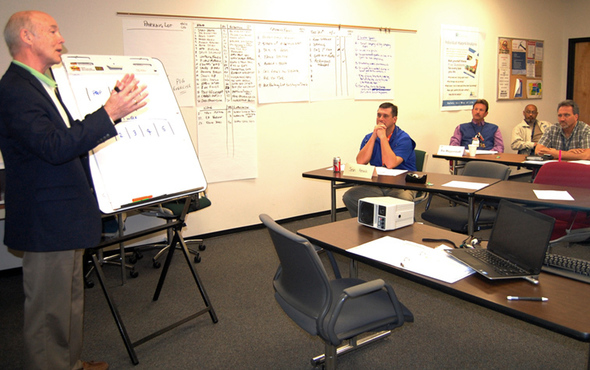
SRR employees work through the Lean process.
AIKEN, S.C. – EM’s liquid waste contractor at the Savannah River Site (SRS) achieved more than $21 million in savings in its first full year using a system that focuses on continuous efficiency and quality improvement.
The savings Savannah River Remediation (SRR) achieved through the Lean Business Management System were applied to priorities such as recovery from winter storms and steam outages, and new contract scope involving underground tank cleanup, including bulk waste removal and preparations for grouting the tanks, which is a step in the tank closure process.
A group of SRR employees were selected to gather for a week to identify and eliminate waste from work processes. They found savings by obtaining earlier authorizations for projects and changing the approval cycle and requirements for procedures. They also cut costs in work planning resources by creating a new surplus parts database.
SRR implemented the Lean process internally. The contractor also engaged EM employees, site regulatory agencies, such as the South Carolina Department of Health and Environmental Control and the U.S. Environmental Protection Agency, and personnel with AECOM, the parent company of SRR. The AECOM employees, who work at other EM sites, partnered with SRR to share information and perspectives.
Jim Folk, DOE-Savannah River Acting Assistant Manager for the Waste Disposition Project, said work accomplished by Lean so far has been well worth the effort.
“These Lean events have helped us gain greater efficiencies in a number of areas,” Folk said. “The work has also given us all a better understanding of the many challenges in various projects or issues.”
SRR President and Project Manager Stuart MacVean said employees have always been focused on finding ways to improve efficiencies. However, using the proven Lean approach has moved the company to a new level.
“Our employees have embraced the Lean system,” MacVean said. “So far, over 300 of our 2,200 employees participated in Lean events to determine how to systematically and efficiently maximize the use of taxpayers’ money. Their efforts are giving the Department of Energy even more value.”
The three core principles of Lean are:
Eliminate waste;
Design continuous flow; and
Respect the talent and knowledge of the worker.
Lean operates on the concept that the customer requirements drive what has value.
SRR began its Lean work in late 2013. Last year marked the first full year of Lean events, held to focus on various facets of SRR daily work.
“Lean is an outstanding tool that leads to a real return on investment,” MacVean said.
In other SRR news:
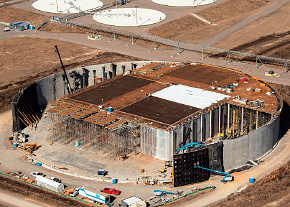
The contractor has passed the halfway mark in construction of the 30-million-gallon Saltstone Disposal Unit 6, the first mega-volume salt waste disposal unit being built at SRS. Construction of the unit began in October 2013. Current plans call for the structure to begin receiving decontaminated salt solution in May 2017, when two other units at the site are expected to reach capacity.
“At the end of the waste disposition path, these mega-facilities allow us to give the decontaminated salt solution a safe, final destination,” DOE-Savannah River Waste Disposition Acting Assistant Manager Jim Folk said of the Saltstone Disposal Unit 6.
SRR has processed 5 million gallons of salt waste through its Interim Salt Disposition Process, a milestone that continues to prove the effectiveness of salt waste processing at SRS, according to DOE-Savannah River Acting Waste Disposition Assistant Manager Jim Folk. “I congratulate SRR for reaching this high-water mark. Processing salt waste is essential for us and our mission to close tanks,” he said.