|
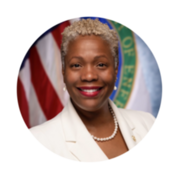
Message from Director (Acting) and Principal Deputy Director Tamia N. Gordon
For the last few months, EJE has been diligently working to advance President Biden’s equity mission. From releasing a new guide to understanding how Community Benefit Plans are evaluated to launching Federal Home Energy Rebate Programs that will lower some families’ bills, we have been hard at work. Yet, we also found time to enjoy mariachi music during DOE’s Hispanic Heritage Month event, all of which you are invited to read about below.
Still, there is much more on the horizon as we head into October. Not only are the temperatures dropping and the leaves getting ready to change colors, but DOE is getting ready to celebrate National Disability Employment Awareness Month, National Hydrogen Week, and to host two extraordinary events, DOE to the People and Justice Week 2024.
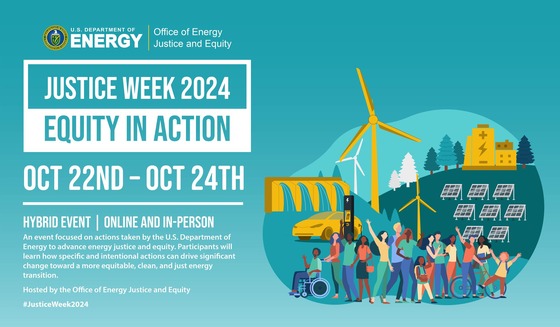
If you’re reading this, you have likely seen emails about Justice Week, our flagship event where the theme this year is Equity in Action. We will spotlight the day-to-day work DOE is doing in pursuit of energy justice, and we invite you to join us to be a part of it. This hybrid event is open to the public, both in-person at DOE headquarters in Washington, DC, and streaming online. In fact, registration is now open, so please sign-up and then forward the invitation to your family, friends, and colleagues, also sharing with them why energy justice and equity matters most to you.
Mark your calendars for DOE's Justice Week, scheduled from Tuesday, October 22nd to Thursday, October 24th, and we will see you later this month to learn how specific and intentional actions can drive significant change toward a more equitable, clean, and just energy transition.
In the meantime, keep watching for updates at the EJE website.
Tamia N. Gordon
Director (acting) and Principal Deputy Director
Office of Energy Justice and Equity
|
|
|
 |
|
We celebrate the contributions, culture, and rich history of Hispanic and Latino communities across the country.
|
|
We remember those we lost during — and in the aftermath of – 9/11, and we honor those who risked or gave their lives to save others.
In one of our nation's darkest moments, we saw the resilience and courage of the American spirit. We carry that with us today.
|
|
 |
 |
|
American workers are the backbone of our country and are shaping the very future of America’s energy sector.
Today, we honor their contributions — past and present — and look forward to a bright, #MadeInAmerica future.
|
 |
|
MSI Contract Readiness Prize – Office Hours with Ensemble
October 2024
During Office Hours, you can receive guidance on submission requirements for the MSI Contract Readiness Prize. Ensemble will answer questions about the Prize, offer personalized application support and feedback, and connect institutions to regional workshops, trainings, and federal centers focused on contract readiness. Register here.
|
 |
|
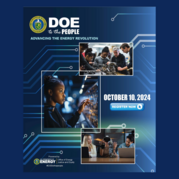
2024 DOE to the People
October 10, 2024 10:00 AM to 5:00 PM EDT
DOE to the People provides a platform for Historically Black College and University, Tribal College and University, and Minority-Serving Institution administrators, faculty, and students to build an awareness of opportunities that enable them to become active participants in programs, projects, and initiatives spearheaded by DOE, DOE National Laboratories, and the energy sector. Attendees are able to network and forge partnerships with key thought leaders within the federal government, industry, and academia. Register here.
|
 |
|
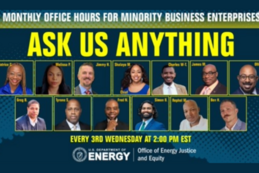
Ask Us Anything Series: USDA
October 16, 2024 02:00PM to 03:30PM EDT
The U.S. Department of Agriculture provides leadership on food, agriculture, natural resources, rural development, nutrition, and related issues based on public policy, the best available science, and effective management. Its vision is to provide economic opportunity through innovation, helping rural America to thrive; promoting agriculture production that better nourishes Americans while also helping feed others throughout the world; and preserving the Nation's natural resources through conservation, restored forests, improved watersheds, and healthy private working lands. Register here.
|
|
|
U.S. Department of Energy News
U.S. Department of the Treasury, IRS, and Department of Energy Announce Next Steps for 2024 Program Year of Inflation Reduction Act Program for Solar and Wind Energy in Low-Income Communities
The U.S. Department of the Treasury and Internal Revenue Service (IRS), in partnership with the Department of Energy, announced that they have received over 50,000 applications requesting over 6 gigawatts of capacity for clean energy projects across the country so far in the 2024 Program Year of the Inflation Reduction Act’s Low-Income Communities Bonus Credit Program under Section 48(e) of the Internal Revenue Code. DOE will accept applications for 2024 Program Year applications for projects located in a low-income community, qualified low-income residential building projects, and qualified low-income economic benefit projects (Categories 1, 3, and 4) on a rolling basis until October 10, 2024, at 11:59 PM ET. DOE will also accept applications on a rolling basis for projects located on Indian Lands (Category 2) until November 12, 2024 at 11:59 PM ET.
Biden-Harris Administration Launches Nationwide Environmental Justice Climate Corps
In commemoration of Climate Week NYC, the U.S. Environmental Protection Agency and AmeriCorps announced the Environmental Justice Climate Corps, a new partnership launched as part of President Biden’s American Climate Corps to open doors for people to serve in careers that benefit disadvantaged and other low-income communities.
This partnership will support more than 250 AmeriCorps VISTA members nationwide over three years, with each new participating member completing a one-year term of service. This historic initiative is the largest environmental partnership in AmeriCorps’ history and EPA’s first nationwide service effort. The Environmental Justice Climate Corps represents the Biden-Harris Administration’s ongoing commitment to tackling the climate crisis and advancing environmental justice. It also reaffirms the Administration’s commitment to creating pathways to middle class jobs and a step to implement the Biden-Harris Administration’s Executive Order to Promote Good Jobs by supporting workforce development through the American Climate Corps. Applications for the Environmental Justice Climate Corps will open in early 2025, with a goal for its first cohort to start later that year. To sign up for updates on the program, visit EPA’s Environmental Justice Climate Corps Program website.
New Proposed Rules Issued to Expand Clean Energy Investments in Underserved Communities, Open for Public Comment
The U.S. Department of the Treasury and the Internal Revenue Service invites comments on its Notice of Proposed Rulemaking for 48E(h), the Clean Electricity Low-Income Communities Bonus Credit Program, created by the Inflation Reduction Act. The program promotes cost-saving clean energy investments located in low-income communities, on Indian lands, within affordable housing, or directly benefitting low-income households.
The 48E(h) Clean Electricity Low-Income Communities Bonus Credit Program builds on the first-of-its-kind Low-Income Communities Bonus Credit Program, also known as 48(e). The transition from 48(e) to 48E(h) opens the program to additional clean energy technologies beyond wind and solar such as hydropower and geothermal.
Comments must be received by October 3, 2024.
New Report Highlighting $3.5 Billion in Clean Energy Investments in Low-Income Communities
The U.S. Department of the Treasury has released a report with new data on the success of the 2023 program year of the Inflation Reduction Act’s Low-Income Communities Bonus Credit Program. The report demonstrates how the program is lowering American families’ energy costs as part of the Biden-Harris Administration’s economic agenda.
More than 49,000 solar facilities were awarded bonus credits in the first year of the groundbreaking program; and investments are estimated to fund generation of nearly $270 million worth of clean energy annually in underserved communities. Learn more.
New Opportunity Funds Non-Profit Educational Organizations’ Efforts to Grow a Diverse Clean Energy Workforce
The Clean Energy Careers for All program will award nearly $3 million to non-profit science, technology, engineering and math organizations in support of their workforce development initiatives targeting K–12 and university students, alumni and academic professionals, veterans, and formerly incarcerated individuals. Register for the informational webinar on Oct. 16 and apply by Dec. 13
Hydrogen Week to Kick Off with a "Live Look-In" at a Public Forum on Clean Hydrogen
In recognition of Hydrogen Week (October 7–11), DOE's Hydrogen and Fuel Cell Technologies Office will host a special webinar on October 7, 2024, at 12 p.m. ET to offer a "live look-in" at a public forum on hydrogen. These new, innovative forums provide a template for helping communities engage in effective and beneficial discussions about clean hydrogen. This event will not be recorded. Read more here.
Apply Today for a DOE Peer-Learning Cohort on Distributed Wind, Clean Energy in Appalachia, or Microgrids
DOE’s Clean Energy to Communities (C2C) program is now accepting applications for a new round of peer-learning cohorts. Participants in C2C peer-learning cohorts receive strategic and technical assistance; access to training materials, tools, and best practices; and the chance to collaborate with peers across the country. The three peer-learning cohort topics in this round are: microgrids; distributed wind; and renewable energy and energy efficiency in Appalachia..
Each cohort starts in January 2025 and lasts six months. Participants should be available approximately four hours per month. Eligibility for each cohort depends on the cohort topic, but ideal participants may include local and regional governments, not-for-profit economic development districts, municipal and cooperative utilities, Tribes, and community-based organizations. Applications are due by October 31. Read more here.
Biden-Harris Administration Announces Maine’s Launch of First Phase of Federal Home Energy Rebate Programs to Help Lower Families’ Utility Bills
DOE announced that Maine has launched its first federal Home Energy Rebates program, supported by the Inflation Reduction Act. Maine is launching the Home Electrification and Appliance Rebates portion of the rebate program—enabling savings on energy efficiency improvements. Maine’s launch is part of the Biden-Harris Administration’s nationwide initiative to provide $8.8 billion in Federal funding for states, territories, and Tribes to lower energy costs and increase efficiency in American homes by making it cheaper to install cost-saving measures such as heat pumps, electrical panels, and insulation, which helps save money on housing costs. Read more here.
DOE Announces $18.9 Million Financial Assistance Grant Award Selections to 12 Disadvantaged Communities Across Country
DOE’s Office of Environmental Management announced competitive financial assistance grant selections for the Community Capacity Building Grant Program Funding Opportunity Announcement. The awards will focus on reinvestment in disadvantaged communities impacted by decades of nuclear defense and research missions, and currently hosting environmental cleanup sites. The awards will also focus on strengthening relationships with communities by supporting projects that serve community and economic development goals, promote revitalization efforts, and promote inclusive community engagement practices. Read more here.
Biden-Harris Administration Announces $31 Million for Transformative Clean Energy Projects Led by Tribal and Local Governments
DOE has selected 12 local governments and tribes to receive over $31 million in funding through the Communities Sparking Investments in Transformative Energy (C-SITE) funding opportunity. Under DOE’s new Local Government Energy Program, C-SITE supports the implementation of high-impact clean energy projects in disadvantaged communities, energy communities, and small- and medium-sized jurisdictions. Read more here.
|
|
|
|
|