Office of Indian Energy Updates
Indian Energy Staff Visits TCUs Across the Country
 To celebrate National Tribal Colleges and Universities Week, our Office of Indian Energy team and colleagues across the U.S. Department of Energy (DOE) and national labs visited several TCUs, including the Haskell Indian Nations University career fair pictured here.
Office of Indian Energy staff have been busy the last few months visiting TCUs to connect with faculty and students and learn how DOE can best support clean energy initiatives on their campuses and workforce development. So far, staff have visited the following TCUs:
- College of Muscogee Nation—Oct. 10, 2023
- Pawnee Nation College—Oct. 11, 2023
- Tohono O’odham Community College—Jan. 22, 2024
- Diné College—Jan. 24, 2024
- Navajo Technical University—Jan. 25, 2024
- Institute of American Indian Arts—Jan. 26, 2024
- Haskell Indian Nations University—Feb. 6–7, 2024
- Nebraska Indian Community College—Feb. 12, 2024.
Director Wahleah Johns Delivers Keynote Speech at Haskell
On Feb. 6, Office of Indian Energy Director Wahleah Johns delivered a keynote speech during the visit to Haskell Indian Nations University, before connecting with students at a career fair the next day. The Lawrence Journal-World newspaper summarized how Johns conveyed the importance of DOE’s nationwide campus tour:
"We do think that Haskell and Tribal Colleges and Universities, campuses are basically a 'mini-lab' of what you can actually produce in your community and see," Johns told the Journal-World. "…The beauty about TCUs is that they also carry a lot of Indigenous knowledge within the faculty, within the philosophy of Indigenous teachings, and I think when you pair those with science and STEM, there's a lot of creativity that can come out and a lot of innovation that can come out of utilizing our knowledge as Indigenous people, but also with the education that is there."
Johns also said she anticipates a surge of workforce opportunities that DOE can help students prepare for.
“More and more, we're going to see a number of opportunities—so many job opportunities—and we want these students to be ready and to be able to contribute to this energy ecosystem and clean energy,” Johns said. “And also, be the stewards of our lands and our communities and this great nation.”
Overall, we’ve had an incredible time visiting TCUs and learning how we can shape future funding opportunities.
REMINDER: DOE to Announce $25 Million Tribal Energy Funding Opportunity This Spring
Planned FOA Will Solicit Applications to Deploy Clean Energy Technology on Tribal Lands
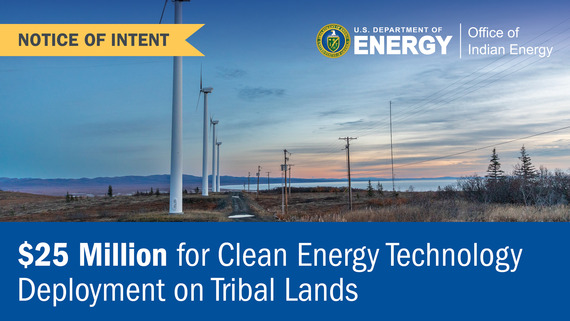 On Jan. 17, the Office of Indian Energy issued a Notice of Intent to release a $25 million Funding Opportunity Announcement (FOA) this spring to support clean energy technology deployment on Tribal lands.
Through this planned FOA, the Office of Indian Energy intends to solicit applications from Indian Tribes, which include Alaska Native Regional Corporations and Village Corporations, Intertribal Organizations, and Tribal Energy Development Organizations, to install clean energy technology on Tribal lands.
A Note on TCU Eligibility: TCUs are not directly eligible unless they are a subsidiary/instrumentality of the Tribe and obtain Tribal Council Resolution or have delegated authority.
Learn about TCUs that have successfully received funding under past Office of Indian Energy funding opportunities:
News and Resources
DOE Announces Winners of 2023 Geothermal Collegiate Competition
Both First-Place Teams Supporting Native Community Geothermal Projects
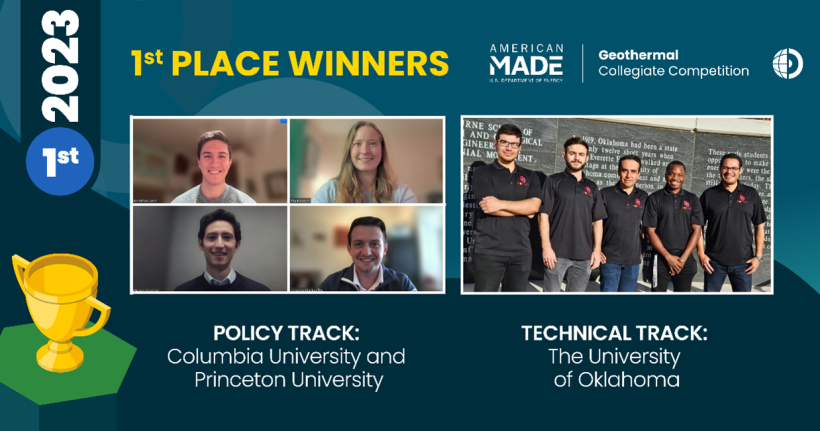 On Feb. 15, DOE announced the winners of the 2023 Geothermal Collegiate Competition, an annual challenge that offers college students experience in the renewable energy industry and the chance to win cash prizes for developing real-world geothermal solutions.
Each first-place team will receive a $10,000 cash prize plus funding to host a community event where they will present their projects and discuss geothermal.
Policy Track First Place: Columbia University and Princeton University
The team from Columbia and Princeton Universities partnered with the Native Village of Elim to explore geothermal options for the 330-person Alaskan town.
The team’s economic analysis of their proposed ocean-based closed-loop geothermal heating and cooling system found that system costs could be recouped in as little as 14 years, advancing clean energy in a manner consistent with the Inupiat way of living from the land and saving residents more than 2.3 million gallons of fuel oil and 70 million pounds of wood over 30 years.
Technical Track First Place: The University of Oklahoma
The University of Oklahoma team designed a system of geothermal wells to heat and cool the Osage Nation’s 40,000-square-foot greenhouse, supporting efforts for native food sovereignty in Pawhuska, Oklahoma.
The greenhouse was established during the COVID-19 pandemic when there was a breakdown in the Tribe’s food system. The proposed geothermal system design would help alleviate the challenge of maintaining a constant year-round growing temperature.
Learn more about the Geothermal Collegiate Competition and how to get involved.
Apply Today for DOE’s Faculty-Applied Clean Energy Sciences Program
DOE Invites STEM Faculty from TCUs to Apply for 10-week Summer Program
 DOE’s Faculty-Applied Clean Energy Sciences Program, a groundbreaking initiative designed for STEM faculty from Minority Serving Institutions, TCUs, Historically Black Colleges and Universities, and Historically Black Community Colleges aims to foster diversity and inclusion in the energy sector.
The collaborative effort between the National Renewable Energy Laboratory, in partnership with the Office of Energy Justice and Equity and the Office of Energy Efficiency and Renewable Energy, focuses on bridging the gap between DOE laboratories and the academic community, enhancing STEM education, and promoting clean energy careers. The 10-week program (June 3–August 9, 2024), set at National Renewable Energy Laboratory facilities in Golden, CO, encourages faculty to develop scalable education modules on various topics, offering a stipend and travel reimbursement.
Applications for the 2024 Faculty Cohort are now open until March 1, 2024. Faculty members interested in contributing to clean energy research and inspiring students are encouraged to apply.
BRIDGES Virtual Office Hours
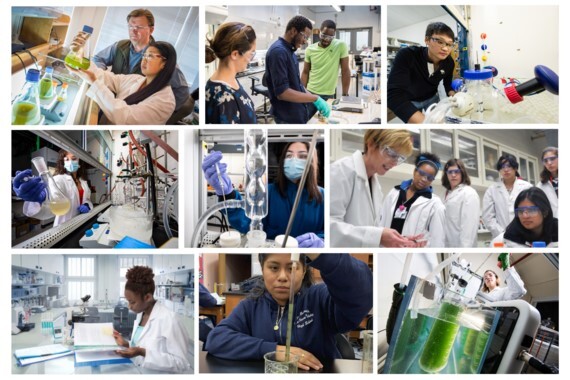 Office hours are available to help educators incorporate the Bioenergy Research and Education Bridge (BRIDGES) Program into classroom curricula. DOE’s Bioenergy Technologies Office, in collaboration with Argonne National Laboratory and Idaho National Laboratory, has developed free bioenergy national laboratory case study-based education toolkits geared toward high school, technical and community college, and university classroom settings. Bioenergy knowledge is not required.
BRIDGES office hours provide individualized help for educators and the opportunity to review the resources with program experts. Office hours are by registration only. Upcoming sessions will be held from 4–5 p.m. ET.
Funding Opportunities
Stay up to date on the latest clean energy funding opportunities for tribes and tribal entities on the Office of Indian Energy Current Funding Opportunities page and download our weekly funding flyer.
Career Skills Training Program
$10 million
Apply by Feb. 27.
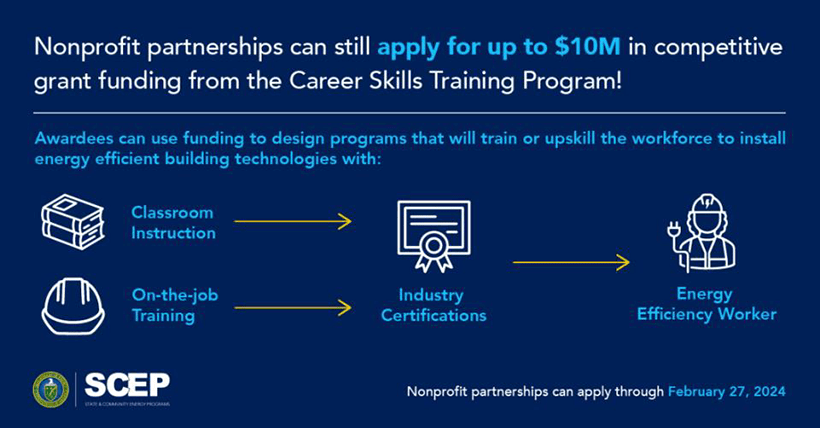
The Career Skills Training Program provides $10 million for nonprofit-led partnerships between industry and labor organizations to create programs where students concurrently receive classroom instruction and on-the-job training to obtain an industry-related certification to install energy efficiency buildings technologies.
Capacity Building for Repurposing Energy Assets with Expanded Eligibility
DOE Announces $2.7 Million to Provide Workforce Development Opportunities in Energy Communities. Community Colleges Now Eligible to Apply.
$2.7 million
Concept papers due April 18.
Has your local economy historically been supported by energy assets, such as coal, oil, and/or natural gas power facilities? This initiative will provide workforce development opportunities in energy communities, and eligibility has been expanded to include TCUs (among other community entities).
The program aims to help energy communities build technical capacity and develop a workforce necessary to help revitalize energy systems, address environmental impacts, and tackle challenges associated with energy assets that have been retired, or are slated for retirement (2009-2033).
Events
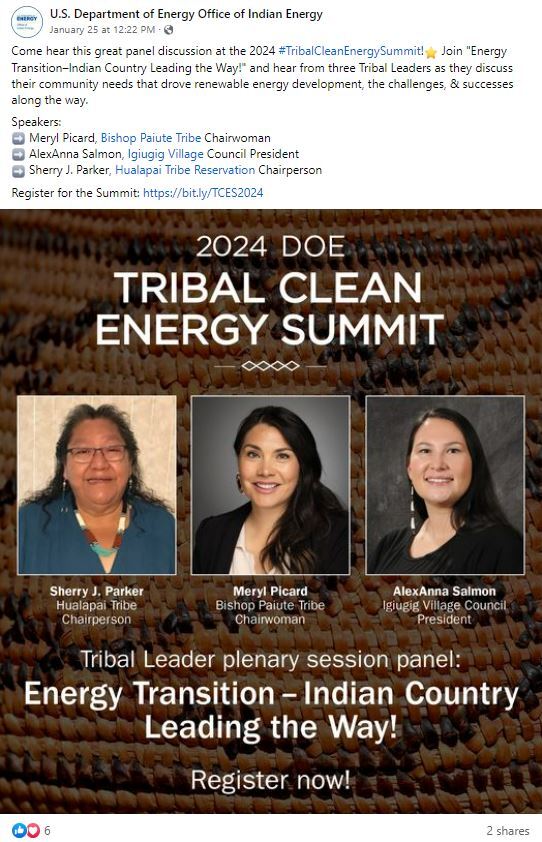
2024 DOE Tribal Clean Energy Summit
📅 Feb. 27–28 | Temecula, California, and Virtual
We invite Tribal Leaders, staff, and partners to come together to build networks, exchange ideas, and explore clean energy solutions that support Tribal energy sovereignty.
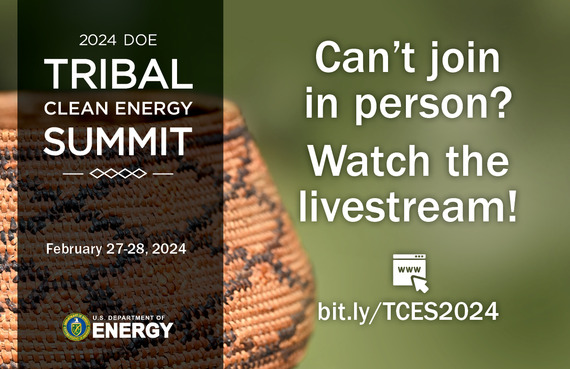
Can't join in person? Tune in to the livestream on the Summit event page to experience the plenary sessions virtually Tuesday and Wednesday from 8:30–11:30 a.m. PT.
BRIDGES Office Hours
📅 March 7 & 21 | 4–5 p.m. ET | Online
BRIDGES office hours are an opportunity to receive individualized help, review the BRIDGES resources, and learn how to implement each case study into your curriculum.
Here's what's catching attention on our social media pages. Follow us on Twitter and Facebook for the latest updates.
|