|

Ahead of Federal Energy Management Program (FEMP) Summer Courses Aligned with Mission Priorities (CAMP) later this summer, join us July 21–25, 2025 for an engaging week of virtual learning at the FEMP Summer Workshops. These virtual workshops are not only a gateway to enhancing your knowledge in key energy management areas but are also a unique opportunity to earn continuing education units (CEUs).
Led by FEMP leadership and staff, our workshops focus on your most pressing priorities. Key focus areas include:
- Cybersecurity
- Resilience Planning
- Partnerships and Procurement
- And much more!
Registration for this no-cost event will open soon. Visit the FEMP website to view the agenda and learn more about each workshop.
FEMP Summer CAMP – August 4–7, 2025
Get ready for an action-packed FEMP Summer CAMP, featuring a blend of in-person training events, virtual training, and special sessions designed for federal energy and water management professionals at all levels. Mark your calendars for this learning and networking opportunity that combines both world-class training and CEU accreditation!
Visit the FEMP website to view the schedule of hybrid and virtual events.

|
|
Puerto Rico's Power Shortage: How Federal Facilities Can Help and Save Money at the Same Time
June 24, 2025, 12:00 p.m.–1:00 p.m. ET
Federal facilities in Puerto Rico have a unique opportunity to reduce energy costs while supporting the island’s electric grid.
Join FEMP’s live webinar to learn how federal sites in the territory can enroll in LUMA Energy’s demand response programs, tap into available utility incentives, and contribute to grid reliability.
This event is not accredited but will provide valuable information on how FEMP supports federal agencies interested in demand response programs. These efforts align with federal energy statutes under 42 U.S.C. § 8253(i)(1)(C), (3)(A)(vii), and 42 U.S.C. § 8256.
Take this opportunity to understand how federal facilities can lower their energy costs and make a positive impact on Puerto Rico’s electric grid.
Sign up today.
|
|
Determining Price Reasonableness in Energy Performance Contracts
FEMP’s updated report provides recommendations and best practices concerning fair and reasonable price determination in federal energy performance contracts (EPCs), which include energy savings performance contracts and utility energy service contracts. It reflects the experiences, lessons learned, and best practices of agencies implementing EPCs, and is consistent with FEMP’s training on this subject.
This is an update to the 2015 revision. Download the report.
The Smart Labs Framework Shows Promising Results at Sandia National Laboratories
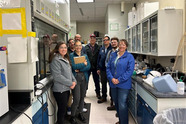
Sandia National Laboratories is a federally funded Department of Energy laboratory exploring a vast range of research topics. With safety and efficiency being high priorities for national laboratories, a multidisciplinary team launched a Smart Labs pilot program at Sandia in 2022.
The program focused on Building 897—a 30-year-old, multistory, multiuse research facility on Sandia’s Albuquerque campus in New Mexico. Using the Smart Labs process, Sandia optimized Building 897’s operations, enhanced lab safety, reduced energy costs, and created a framework for future projects. Learn more about the lessons learned and successes from this pilot program.
|
Know When To Bring in Cybersecurity Experts During Procurement
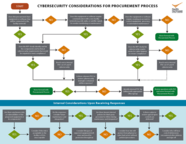
If you’re buying new equipment, systems, or services, at what point should you consult a cybersecurity expert? To help federal facility staff answer this question, FEMP has developed the Cybersecurity Considerations for Procurement Process decision tree to provide a high-level overview of key questions to consider.
Ensuring cybersecurity from the onset of the process is key to protecting federal facility assets, systems, and sites, and it can help reduce the number of weaknesses or vulnerabilities that must be remediated after the fact.
Read more about cybersecurity considerations during procurement.
|
|
|
The U.S. Department of Energy’s Federal Energy Management Program builds the capacity of the federal agency workforce to achieve efficient, secure and resilient energy use in facilities and fleets—saving taxpayers money. |
|
|
|