|
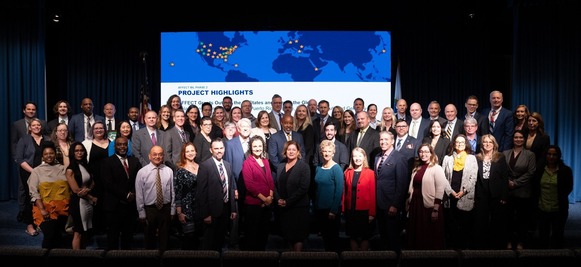 In 2024, FEMP strengthened its efforts to equip the Federal workforce with the tools and expertise needed to ensure efficient, clean, secure, and resilient energy use in facilities and fleets. These efforts enable agencies to lead by example while reducing energy use and saving taxpayer dollars.
It was a year of historic milestones. To name a few:
- FEMP selected 98 Federal projects to receive a record amount of funding to help agencies implement energy- and cost-efficient measures and make progress toward meeting Federal goals.
-
70 individuals, programs, and projects were honored through our recognition programs.
- More than 2,700 Federal energy management professionals joined FEMP in Pittsburgh, PA for Energy Exchange where more than 80 trainings were offered that covered topics spanning all phases of energy management.
|
|
DOE Scholar Alum Agustin Martinez Returns to Aerospace Roots

One of the best ways to understand the impact of the DOE Scholars Program is to hear from our past participants. We recently caught up with U.S. Army veteran Agustin Martinez who participated in a recent cohort.
Learn how his experience working for the U.S. Department of the Interior gave him the career boost he needed to excel in the military and the private sector.
|
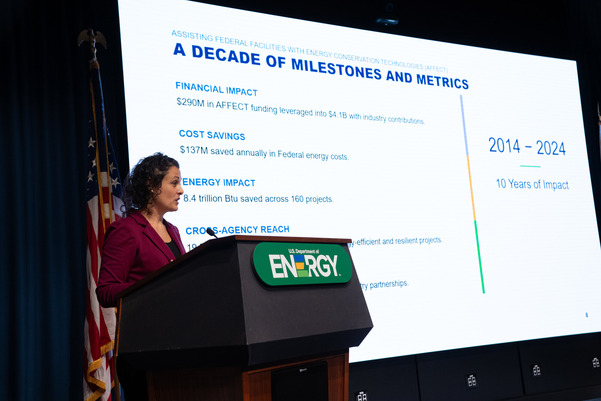
Federal Agency Leaders Celebrate Historic Funding Effort
On October 30, more than 75 agency leaders convened at DOE Headquarters to mark a milestone in Federal energy leadership. The announcement revealed the selection of a record 67 Federal facility projects under the AFFECT program.
The event featured distinguished speakers, including Federal Chief Sustainability Officer Andrew Mayock, Principal Deputy Under Secretary for Infrastructure Kathleen Hogan, FEMP Director Mary Sotos, and FEMP Deputy Director Anna Siefken.
Read more about the selected projects and why Federal leaders are celebrating this historic investment.
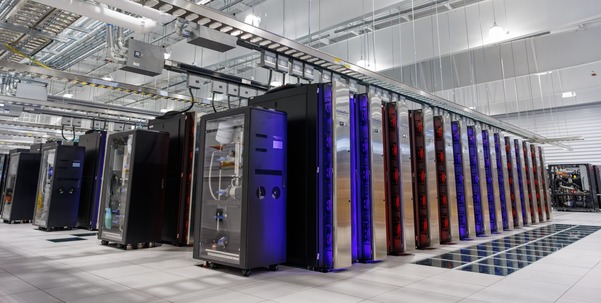
Technology Changes, but Energy-Efficiency Principles Remain Steadfast in Data Center Design
Data centers are the heartbeat that keep a flow of information pumping through our public and private sectors. To process mountains of data in mere seconds—and keep cool while doing it—data centers consume massive amounts of energy. FEMP and experts from the National Renewable Energy Laboratory (NREL) created the Best Practices Guide for Energy-Efficient Data Center Design to address concerns about data center efficiency. Read key takeaways from this guide.
|
|
Forrestal Fast-Tracks 24 EV Charging Ports With Charging as a Service
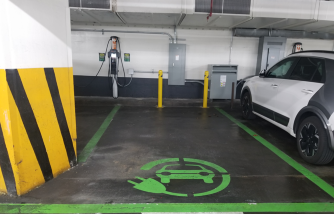
The 1.7-million-ft2 Forrestal building in Washington, D.C., houses hundreds of DOE staff. To support electric vehicle (EV) charging for the increasing number of zero emission vehicles (ZEVs) in its fleet and provide on-site charging for its employees, DOE wanted to expand the number of EV charging stations.
To better understand its options, DOE teamed up with an NREL team to conduct a thorough assessment. Based on this analysis, DOE opted to lease 24 new charging ports in the Forrestal parking garage. Learn more about the Forrestal assessment.
|
Energy-Efficient Product Purchasing Made Easy
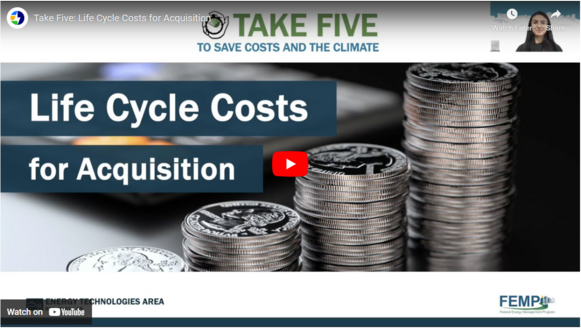
Are you in the process of purchasing new products? FEMP recently updated our energy-efficient product purchasing guidance. .
FEMP considers initial costs and operational costs when setting required efficiency levels. Federal purchasers can assume products that meet FEMP-designated efficiency requirements are life cycle cost-effective. FEMP's to ensure that products are cost effective. A product is considered cost-effective when the lifetime energy savings exceeds the additional up-front cost , if any, compared to a less efficient option.
New Updates to the Investment Grade Audit Tool
We have released a new version of the ESPC ENABLE Investment Grade Audit (IGA) tool. Compatible with the latest versions of Excel, Windows, and EnergyPlus; the updated ESPC ENABLE IGA tool enhances stability and restores the functionality of the original tool. For more information, visit the Federal Energy Management Program Investment Grade Audit Tool webpage.
Distributed Energy Resource Cybersecurity Framework Supports Power Sector Resilience in the Caribbean and Beyond
Island communities face unique energy security challenges due to their remote geographic locations and high energy costs. Over the past 3 years, the Caribbean Electric Utility Services Corporation and its partners have been leveraging the Distributed Energy Resource Cybersecurity Framework (DER-CF) tool to create roadmaps for improving their security posture against digital threats. Read more about how DER-CF is helping communities across Latin America and the Caribbean adopt new cybersecurity solutions.
|
|
The U. S. Department of Energy’s Federal Energy Management Program (FEMP) builds the capacity of the Federal agency workforce to achieve efficient, clean, secure and resilient energy use in facilities and fleets—saving taxpayer money and reducing environmental impact. |
|
|
|