|
|
|
|
|
|
|
 |
|
MESSAGE FROM THE DIRECTOR |
|
|
 |
|
|
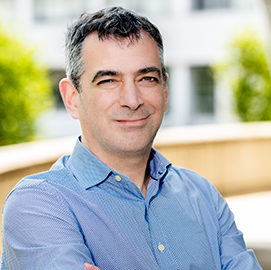
As we prepare to welcome 2025 in the next few weeks, it’s a good time to reflect on just how much the team at the Advanced Photon Source (APS) has accomplished together in a single year. Almost exactly 12 months ago, we were placing the final magnet module into the storage ring, and we were giving tunnel tours before closing the ring.
In the last 12 months, we inaugurated a new machine, bringing the upgraded APS up to 25 mA of current in just a month. Demonstrating successfully multi-bunch swap-out injection to replenish the electron beam in the ring, and measuring the world’s best horizontal beam emittance – the lowest – for any synchrotron light source to date, have been major achievements. As I write this message, we have been running for 10 weeks with an uptime of 97%, ramped up the current to 160mA and have been running in 48-bunch mode for the last 4 weeks. We met all our upgrade project objectives for the year, and, today, we have more than 42 beamlines in various stages of commissioning. We are all excited to see our users starting new experiments, including the early science using new capabilities of the APS-U feature beamlines. We are impatient to see the breakthroughs enabled by the upgraded APS and feel extremely privileged to be supporting U.S. scientific competitiveness with our new tools, thanks to the funding, continued support and guidance from Basic Energy Sciences of the U.S. Department of Energy.
Users are closing out their experiments at the end of this week ahead of the machine studies that precede our winter shutdown, but in running the first few experiments with the transformed APS, they – and we – have measured already the transformative impact that coherent and focused X-ray beams will have for decades to come. Researchers are putting the beamlines through their paces as commissioning proceeds. To track the impressive progress, remember to refer to the chart on the APS Upgrade home page.
In the new year, I look forward eagerly to the first user run of 2025, which picks up January 27 and runs through April 30. We’re also looking forward to an exciting user meeting coming up May 5-9 and will share more details about that in the months ahead.
In this darker and, hopefully for you, slower portion of the year, I hope you take time to reflect on how important your own professional contributions are to the science conducted here at the APS. When you pause to think about the collective impact of all that effort, you can connect once more with what brought you to this kind of a place to do science. In ways big and small, what you choose to study here may inspire a cadre of promising STEM students or postdocs, illuminate new approaches on a path toward answers to one of the grand scientific challenges, or forge a new path for you that opens up career discovery and discipline-spanning efforts. The APS at Argonne is a place for you to explore ideas in an environment of creative problem solving with superlative scientists, engineers and other staff who make use of the upgraded APS’s new capabilities. We are grateful for the collaboration.
I hope you return in 2025 refreshed and energized after a happy, healthy winter break. I wish you a wonderful holiday season.
Sincerely,
Laurent Chapon
Associate Laboratory Director, Photon Sciences
Director, Advanced Photon Source
Director, Advanced Photon Source Upgrade project
|
|
|
|
|
|
|
 |
|
NEWS |
|
|

The upgraded APS is now circulating its world-record-breaking electron beam, generating X-ray beams for its updated beamlines and beginning to welcome users for its new era of scientific discovery. This 21-minute documentary takes you inside the effort to complete the upgrade project.
|

The X-ray Photon Correlation Spectroscopy (XPCS) beamline at 8-ID is one of seven new feature beamlines being built as part of the APS Upgrade project. These beamlines are optimized to take advantage of the increased brightness and coherence of the upgraded APS X-ray beam and will make currently impossible X-ray techniques commonplace.
|

After a yearlong installation, light has returned to the world-leading Advanced Photon Source. Users across a gamut of disciplines, from materials to planetary science, are getting their research proposals ready.
|

Argonne has launched LabCab, an on-campus rideshare service designed to provide quick, convenient, and free rides around the Lemont campus. Get where you need to go, anywhere on campus.
|
|
|
|
|
|
|
|
|
NOTABLES |
|
|

David Baker of the University of Washington received the 2024 Nobel Prize in chemistry for his work on protein folding using artificial intelligence. His published work has made use of data collected at the APS for more than a decade, and he has used the resources of the Argonne Leadership Computing Facility as well.
|
|
|
|
|
|
|
|
|
PEOPLE |
|
|

Dennis Mills played a key role in planning, building and upgrading the APS, establishing it as a world-class scientific facility. He also brought together a team of experts in X-ray research, which has since flourished into the X-Ray Sciences Division at Argonne.
|

The American Physical Society has chosen Alexander Zholents, a senior physicist at the U.S. Department of Energy’s (DOE) Argonne National Laboratory, as the recipient of this year’s Robert R. Wilson Prize.
|
|
|
|
|
|
|
|
|
EVENTS |
|
|
-
Monday, May 5 – Friday, May 9, 2025: APS/CNM Users Meeting Argonne National Laboratory
-
Sunday, August 10 – Friday, August 15, 2025: North American Particle Accelerator Conference 2025 (NAPAC 25) Sacramento, California
-
Saturday, September 20 – Sunday, September 28, 2025: International Conference on Accelerator and Large Experimental Physics Control Systems (ICALEPCS2025) Chicago, Illinois
|
|
|
|
|
|
|
|
SCIENCE HIGHLIGHTS |
|
|

Learning how to manipulate eutectic materials’ microstructure and its evolution could provide ways to design materials that can withstand extreme environments, such as high temperatures.
|

A team of scientists has discovered a new class of enzymes from bacteria in our guts that could explain why some people respond well to certain drugs and other people don’t, leading the way to more personalized drug dosing based on genomic analysis of the patient and the microbes in their gut.
|

Researchers from the University of Toronto and Carnegie Mellon University turned to the artificial intelligence technique of machine learning to efficiently screen thousands of possible catalysts and identify some likely choices for alternative electrocatalysts.
|

Synchrotron X-ray measurements performed at the Advanced Photon Source (APS), a U.S. Department of Energy (DOE) Office of Science user facility at DOE’s Argonne National Laboratory, played a vital role in characterizing the hydrogenated compound, NdNiO3, post-hydrogenation.
|

A multidisciplinary team of structural biologists, cell biologists, and chemists has engineered a proteolysis targeting chimera molecule that degrades two proteins that promote cancer, without causing off-target side effects.
|
|
|
|
|
|
|
|
|
UEC CORNER |
|
|

As the upgraded Advanced Photon Source continues to bring up beamlines and welcome users back to the facility, the APS Users' Executive Committee (APS UEC) steering committee chair Mindga Li and vice chair Stuart Stock would like to remind users – or inform brand new users – about the work of the UEC.
The UEC is the advocacy group for the user community at the APS, elected by members of the user committee during the annual users meeting in the spring. The UEC provides advice to the Associate Laboratory Director on matters that affect the user community and ensures a good flow of communication between the APS user community and APS management.
If you have any questions, concerns, feedback, or ideas you'd like to discuss with the UEC, use the form on this page of the APS site to contact the APS UEC Steering Committee Chair and Vice Chair. Your communication can be completely anonymous if you wish. There’s more detail about the group on the APS UEC bylaws page.
|
|
|
|
|
|
|
|
|
CAREERS |
|
|
|
|
|
|
|
|
|
|
|
|
|
|
|