|
Last week, FEMA awarded more than $1.7 billion in federal funding to states, tribal nations, territories, local jurisdictions and operational partners across the country.
FEMA will award this money through its preparedness grant programs. Through these programs, FEMA enables communities across the country to strengthen their security and resilience against emergencies like fires, floods, hurricanes, tornadoes, cyber incidents and terrorist attacks. This funding aligns with President Donald J. Trump’s America First Resilience Strategy, which calls for empowering states, communities and industries to ensure their own resilience and ability to sustain key services. These investments will save lives, generate prosperity and reduce state dependence on the federal government.
Grant awards include:
- More than $580 million through the Urban Area Security Initiative, which is part of the Homeland Security Grant Program. These funds will be used to protect high-risk urban areas from terrorist attacks and other threats.
- Nearly $400 million through the State Homeland Security Program, which is part of the Homeland Security Grant Program. State, local, tribal and territorial governments will use this funding to strengthen their security and resilience from terrorist attacks and other threats.
- More than $335 million through the Emergency Management Performance Grant program. State, local, tribal and territorial governments will use these funds to hire and train emergency managers, develop disaster preparedness plans, and conduct disaster response training and exercises for emergency responders and other stakeholders.
- More than $95 million through the Port Security Grant Program. Port authorities and facility operators will use the money to strengthen port security, including conducting risk assessments, purchasing surveillance systems and upgrading cyber defenses.
- More than $88 million through the Transit Security Grant Program. Public transportation systems will use the money to strengthen security measures, including conducting risk assessments, providing additional staff training and acquiring new capabilities.
- $84 million to border states and communities through FEMA’s Operation Stonegarden, which is part of the Homeland Security Grant Program. Recipients will use this funding to combat threats like illegal immigration and illicit drug trafficking.
- $83 million through the Emergency Operations Center Grant Program. State and local governments will use this funding to improve their ability to coordinate disaster response.
- $48 million through the Next Generation Warning System Grant Program. States, tribal nations and territories will use this funding to improve their ability to send alerts and life-saving information to the public during an emergency.
- $14 million through the Tribal Homeland Security Grant Program. Eligible tribal nations will use this funding to strengthen their security and resilience from terrorist attacks and other threats.
- $9.5 million to Amtrak through the Intercity Passenger Rail program. Amtrak will use this funding to strengthen its security and keep the traveling public safe from acts of terrorism and other threats.
- $1.9 million through its Intercity Bus Security Grant Program. Owners and operators of eligible intercity bus systems will use this funding to strengthen security and keep the traveling public safe from acts of terrorism and other threats.
By investing federal funding back into American communities, FEMA empowers community leaders to prepare for emergencies, strengthen their resilience and stand ready to protect American citizens.
For more information on FEMA’s grant programs, visit FEMA.gov/Grants.
FEMA announced more than $781 million in federal funding for 493 projects and programs in communities recovering from past disasters, reducing future risk and strengthening critical infrastructure nationwide.
Under the leadership of President Donald J. Trump and Homeland Security Secretary Markwayne Mullin, FEMA continues to focus federal disaster resources on projects and programs that protect lives, safeguard property and deliver accountable results for the American people.
The funding comes from several FEMA programs that support state, local, tribal and territorial governments, eligible private nonprofits and individuals affected by disasters. The funded projects reduce risk and make communities safer and stronger.
Public Assistance
The largest share of this funding supports more than 400 Public Assistance projects for state, territorial and local governments and eligible private nonprofits. These awards allow communities to repair damaged facilities, restore essential services and cover eligible costs tied to prior disasters.
Public Assistance funding in this batch will support work such as debris removal, emergency protective measures, fire suppression activities, road and bridge repairs, utility restoration, public building repairs, parks and recreational facility repairs, and management costs associated with eligible disaster recovery work.
FEMA reviews claimed costs before obligation to ensure funding is used appropriately and in accordance with program requirements. These reviews support federal efforts to prevent fraud, waste and abuse.
Individual Assistance
This announcement also includes Individual Assistance funding for the Commonwealth of the Northern Mariana Islands (CNMI) following Super Typhoon Bavi.
The award provides Disaster Unemployment Assistance for eligible survivors who lost work or income as a direct result of the disaster. This assistance is part of FEMA’s broader mission to support individuals and households after disasters while ensuring assistance is delivered consistently with statutory and program requirements.
Hazard Mitigation Grant Program
FEMA is also supporting more than 80 Hazard Mitigation Grant Program projects in communities that are reducing long-term risk from future disasters.
These awards fund a wide range of mitigation activities, including flood-prone property acquisitions, structure elevations, mitigation reconstruction, drainage and stormwater improvements, generators and emergency power systems, safe rooms, warning systems, wildfire risk reduction, utility and infrastructure upgrades and hazard mitigation planning.
Projects span communities across the country, including New Hampshire, New York, Puerto Rico, Virginia, West Virginia, Florida, North Carolina, South Carolina, Tennessee, Illinois, Wisconsin, Arkansas, Texas, Iowa, Missouri, California, Hawaii, CNMI, Alaska, Oregon and Washington.
Building Resilient Infrastructure and Communities
FEMA is awarding funding for several Building Resilient Infrastructure and Communities (BRIC) projects in Louisiana, South Dakota, Alaska, Oregon and Washington.
These BRIC projects will advance community resilience through project scoping, engineering and design, transportation planning for emergency management, water infrastructure improvements, tsunami and earthquake resilience, hospital protection and building code feasibility work.
By investing in mitigation before the next disaster through BRIC, communities are reducing future losses, protecting critical facilities, supporting safer construction and lowering the long-term cost of disasters.
Strengthening Recovery Nationwide
Across all four programs, FEMA funding will support recovery and resilience work in every FEMA region. The awards reflect the agency’s commitment to support communities to rebuild, strengthen infrastructure and prepare for future hazards while maintaining accountability for federal disaster spending.
FEMA generally provides grant funding to states, territories and tribal nations, which then manage distribution to local subrecipients, where applicable. This approach supports FEMA’s principle that disaster recovery is locally led, state-managed and federally supported.
On Sept. 24, FEMA announced that it will deliver $18.8 million to states and territories across the country through two National Dam Safety Program grants. State and territorial leaders will use this funding to strengthen the resilience of dams, including by repairing, replacing or removing dams that put people and property at risk. This funding aligns with President Donald J. Trump’s America First Resilience Strategy, which calls for a new risk-informed approach that treats resilience as an investment opportunity.
The funding announced today is for two separate grants under the National Dam Safety Program:
- FEMA is awarding $11.4 million through the Fiscal Year 2026 Rehabilitation of High Hazard Potential Dams grant program. This program focuses funding on dams in the United States classified as high hazard potential, meaning their failure could result in loss of life. States and territories can use the funding to repair, replace, reconstruct or remove eligible dams that put people and property at risk.
- FEMA is awarding $7.4 million through the State Assistance grant program. Selected states and territories can use this funding to strengthen their dam safety programs through activities like training more dam safety personnel or conducting dam inspections.
For more information about these grant awards, visit the National Dam Safety Program webpage.
FEMA announced $51.7 million in funding and equipment through its BioWatch and Securing the Cities programs to support U.S. communities to detect and respond to biological, radiological and nuclear threats. This includes $33 million for more than 30 BioWatch jurisdictions and $18.7 million for more than 10 Securing the Cities jurisdictions. Both established programs transitioned to FEMA earlier this year from the Department of Homeland Security’s Countering Weapons of Mass Destruction Office, bringing specialized detection capabilities into FEMA’s broader preparedness work and empowering communities to better prepare for and respond to all types of emergencies.
BioWatch
Through BioWatch, FEMA and its federal partners work closely with specific local communities to establish and operate air monitoring systems. Those systems provide early warning of a biological incident, allowing first responders and government officials to respond quickly and effectively if needed. With its focus on local detection and response, BioWatch is a crucial piece of the United States’ defense against biological threats.
The funding announced is under Fiscal Year 2026 cooperative agreements with jurisdictions that participate in BioWatch. Recipients can use the money for activities, such as:
- Hiring and training field operators who collect samples and laboratory staff who analyze them.
- Conducting exercises to ensure they are prepared to carry out a robust response if a threat is detected.
- Purchasing equipment and establishing sampling sites.
- Enhancing biodetection operations during special events, like major sporting events.
Securing the Cities
Through Securing the Cities, FEMA assists participating high-risk urban areas strengthen their ability to detect and report radiological and nuclear threats. FEMA personnel work with participating law enforcement and public safety agencies to support coordinated operations focused on steady-state daily activities and special events. The Securing the Cities awards announced today include both equipment purchases and funding for participating jurisdictions. Together, these resources support activities such as:
- Acquiring equipment to detect radiological and nuclear material.
- Providing specialized training and conducting exercises to practice detection and coordinated response.
- Developing operating procedures and strengthening information sharing among participating agencies.
Together, these investments sustain biological threat monitoring and strengthen radiological and nuclear detection capabilities in participating communities. By supporting the personnel, equipment, and coordination these programs require, FEMA supports local partners to identify potential threats early and take action to protect lives.
FEMA will participate in the annual Big Build event on Saturday, Oct. 17, from 10 a.m. to 5 p.m. at the National Building Museum in Washington, D.C. The Big Build is a free, family-friendly event that gives visitors of all ages an interactive look at how homes, buildings and communities are designed and built through hands-on activities and demonstrations.
The event brings together professionals from across the building industry, including construction, engineering, architecture and skilled trades. FEMA will help visitors explore how natural hazards can affect homes and communities and show how building science can reduce damage and protect lives.
At FEMA’s exhibit, visitors can try the following interactive activities:
- A flood table to see how water moves through a community and learn how mitigation measures can reduce flood risk.
- A shake table to see how buildings respond during earthquakes and how stronger design and construction practices can improve building performance.
Families can also explore FEMA resources on:
- Earthquake safety.
- Wind and flood mitigation.
- Building codes.
- Steps people can take to make their homes safer before disasters strike.
Whether you have a future engineer at home, are a construction enthusiast or are looking for an engaging family activity, stop by the Big Build at the National Building Museum and learn how everyone can build a more resilient future.
Registration is required for the free Big Build event. To register and learn more, visit the National Building Museum’s website.
The world’s largest earthquake drill takes place each year at 10:15 a.m. (your local time) on Thursday, Oct. 15. Encourage your friends, family and colleagues to participate in the 2026 Great ShakeOut earthquake drill!
The recent devastating earthquakes in Colombia and Venezuela are tragic reminders that earthquakes can strike anywhere at any time, and you may have just a few seconds to protect yourself from injury.
Participation in the ShakeOut drill allows each of us to take proactive steps before an earthquake. Additionally, by encouraging others to do the same, we can all contribute to the safety, security and resilience of the nation.
When the clock strikes 10:15 a.m. (your local time), practice three simple actions: Drop, Cover and Hold One. DROP to the ground, take COVER by getting under a sturdy desk or table and HOLD ON as if there was a major earthquake occurring. Identify safe places such as under a sturdy piece of furniture or against an interior wall in your location.
Most earthquake-related injuries and deaths are caused by collapsing walls and roofs, flying glass and falling objects.
During an earthquake, immediately moving to a safe place can save your life. Your safe place should be easy to access to avoid injury from flying debris.
Take these actions to stand ready before an earthquake:
You can spread awareness of earthquakes by sharing your ShakeOut participation. Take a photo and mention ShakeOut and Earthquake Safety in your post.
To learn more about ShakeOut, visit ShakeOut.org. You can also text “shakeout” to 43362 to receive texts from FEMA about earthquake preparedness tips and safety information.
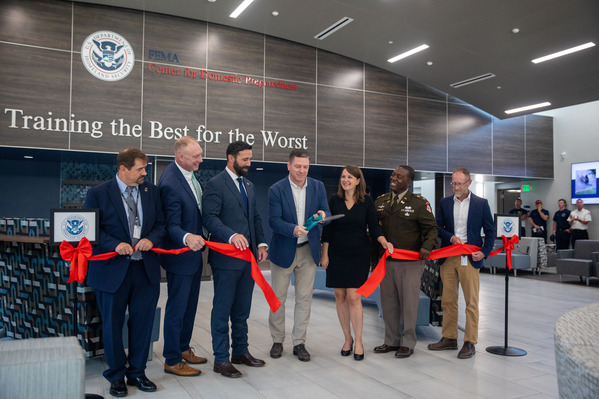
Anniston, Ala. (Sept. 21, 2026) – From left, Center for Domestic Preparedness Acting Superintendent Chris Chesney; FEMA’s National Preparedness Directorate Deputy Assistant Administrator Dr. Thom Layou; FEMA Administrator Cameron Hamilton; Department of Homeland Security Under Secretary for Management Brian Cavanaugh; Department of Homeland Security Deputy Undersecretary for Management Erin Hoffman; U.S. Army Corps of Engineers, Mobile District, Commander Col. Kelcey Shaw; and Center for Domestic Preparedness Business Operations Director Rodney Singleton.
On Sept. 21, FEMA’s Center for Domestic Preparedness (CDP) officially opened its new student training and in-processing center at its Advanced Responder Training Complex.
The new facility provides a place to equip state, local, tribal and territorial emergency responders with the information, skills and abilities required to react and respond to mass casualty incidents, including those involving chemical, biological, radiological, nuclear or explosive materials. The building includes classroom space and a large area where students can be in-processed before training and gather with fellow responders. It will also house CDP Training and Education staff as well as staff associated with training support and delivery functions.
Before, during and after a disaster, emergency management is best when it is locally led, state-managed and federally supported. By providing training on preparedness, protection and all-hazards response, CDP strengthens the local capacity of communities across the country. Each year, approximately 60,000 emergency responders from state, local, tribal and territorial governments participate in this training to hone the skills they need to keep people safe. Since it opened its doors in 1998, CDP has trained more than 1.5 million responders.
For more information about CDP training or to register for upcoming classes, visit CDP.DHS.gov.
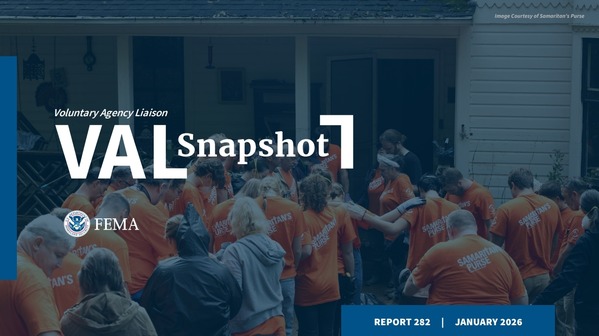
The September 2026 edition of the FEMA Voluntary Agency Liaison (VAL) Snapshot Report is now available. This monthly newsletter informs FEMA’s nongovernmental partners about current events, resource needs and opportunities to support disaster recovery efforts across the country.
FEMA VALs establish, build and maintain relationships among government, voluntary, faith-based and community partners. Through these relationships, they support the delivery of services and strengthen communities’ ability to address unmet needs caused by disasters.
FEMA and University of Maine System Launch Academic Disaster Collaborative
FEMA and the University of Maine System hosted the inaugural Academic Disaster Collaborative Symposium on September 9 in Orono, Maine, at one of the University of Maine’s seven universities.
The symposium brought together University of Maine System leaders; representatives from other colleges and universities; FEMA Public Assistance and Individual Assistance senior leaders; Maine Department of Defense, Veterans and Emergency Management; Maine Emergency Management Agency; and national, local faith-based and voluntary partners.
Panel discussions explored how universities can better integrate research, technology, facilities, students and faculty expertise to support emergency management and help solve real-world disaster challenges. Sessions also highlighted trauma-informed emergency management, coastal resilience through Maine Sea Grant, financial resilience and university-based emergency response capabilities, including the University Volunteer Ambulance Corps.
Following panel discussions, participants toured the University of Maine’s Advanced Structures and Composites Center, where they saw innovations including 3D-printed housing and advanced wind and wave simulation capabilities.
The first symposium concluded with the launch of the FEMA Academic Disaster Collaborative, a new effort to connect academia, emergency management, government and nonprofit partners to strengthen how research, innovation and university capabilities support disaster preparedness, response and recovery.
More Stories Inside the VAL Snapshot Report
The September VAL Snapshot Report features additional stories about FEMA's nongovernmental partners supporting disaster survivors and communities throughout the United States, tribal nations and territories. Read the full newsletter at: September VAL Snapshot Report.
FEMA Corps Team Leader Applications Close Today, September 30; Member Applications Due October 19
The FEMA Corps program is accepting applications for its 2027 class of future emergency managers. Following a review and refocus to align with FEMA’s core mission and the Trump Administration's priorities, the program will select about 80 members and 10 team leaders to serve from February 2027 to November 2027.
Apply to be a FEMA Corps Team Leader:
Apply to be a FEMA Corps Member:
- Ages 18 to 24.
- Application Deadline: Saturday, Monday, Oct. 19.
- Application Link: AmeriCorps NCCC 2027.
FEMA Corps graduates may receive an education award upon completion, which can be used for tuition or student loans, and relocation expenses. Additionally, FEMA Corps members receive paid housing and a weekly stipend for food and living expenses, all while being deployed to serve communities in need across the country. To learn more, visit AmeriCorps NCCC.
....................................................................................................................................................
Apply by October 15 for the 2027 Vanguard Crisis Leaders Fellowship
Senior executives and experienced crisis leaders are invited to apply to FEMA's 2027 Vanguard Executive Crisis Leaders Fellowship by Thursday, Oct. 15. FEMA’s National Disaster and Emergency Management University will offer a two-week, senior-level leadership program to support leaders from government, academia, non-governmental, philanthropic and private-sector organizations to strengthen the skills needed to lead through complex, uncertain and rapidly changing crises.
The fellowship is designed for executive-level leaders with substantive crisis leadership or emergency management experience, particularly those responsible for operational and strategic decision-making during crises or those who have guided organizations through crises. Selected applicants will be notified Nov. 30.
2027 Vanguard Fellowship Schedule:
Week one will be held at a rotating, offsite location. Week two will be held in Washington, D.C. and typically includes visits with elected officials and Department of Homeland Security and FEMA leadership.
-
Cohort 13:
-
Week One: Feb.1-5, 2027, in Nashville, Tennessee.
-
Week Two: Feb. 22-26, 2027, in Washington, D.C.
-
Cohort 14:
-
Week One: March 15-19, 2027, in Charlotte, North Carolina.
-
Week Two: April 12-16, 2027, in Washington, D.C.
-
Cohort 15:
-
Week One: May 10-14, 2027, in Denver, Colorado.
-
Week Two: June 21-25, 2027, in Washington, D.C.
For more information and application instructions, visit the Vanguard Executive Crisis Leaders Fellowship webpage.
....................................................................................................................................................
FEMA, Federal Communications Commission Schedule 2026 Emergency Alert System Test Nationwide for November 17
FEMA, in coordination with the Federal Communications Commission, will conduct a nationwide test of the Emergency Alert System at approximately 2:20 p.m. ET, Tuesday, Nov. 17. Through this test, FEMA will assess how participating broadcasters and other communications providers receive and relay a national test message to the public.
FEMA is required by law to conduct a nationwide test of the public alert and warning system at least once every three years. These tests evaluate the operational readiness and effectiveness of external Emergency Alert System participants and the infrastructure they use to relay national emergency messages to the public. Emergency Alert System participants include thousands of radio and television broadcasters, cable systems, satellite radio and television providers and wireline video providers.
The test message will state, “This is a nationwide test of the Emergency Alert System, issued by the Federal Emergency Management Agency, covering the United States from 2:20 to 2:50 hours ET. This is only a test. No action is required by the public.” The test message may be delivered as audio, on-screen text or both, depending on the provider. After the test concludes, normal programming will resume.
In the coming weeks, FEMA will host webinars for broadcasters and radio operators participating in the test. Additional details will be posted on the FEMA.gov Events Page.
....................................................................................................................................................
|


