|
FEMA released an updated report about earthquake hazards in the United States. The report will help communities prepare for the devasting effects of earthquakes.
The agency partnered with the U.S. Geological Survey (USGS) to update the P-366: Hazus Estimated Average Annualized Earthquake Losses for the United States and its Territories report, detailing the latest average annualized loss from damage earthquakes cause across the nation. For the first time, the report includes seismic data for American Samoa, the Commonwealth of the Northern Mariana Islands and Guam. The report may be viewed on the FEMA Hazus webpage.
With this report, state, local, tribal and territorial emergency managers can easily find the latest seismic data. This information can help them understand their risks, so they can make informed decisions on planning, mitigation strategies and building code updates to enhance readiness in their community.
FEMA and USGS also published an interactive version of the report’s data, allowing officials to easily visualize findings for their area, including average annualized earthquake losses for buildings at the state, county, metropolitan and U.S. Census tract levels.
To learn more about this report and other ways FEMA helps communities prepare for disasters, visit the FEMA Hazus webpage.
On Wednesday, August 12, the U.S. Fire Administration (USFA) launched an app that allows the public to view near real-time data about fires from fire departments across the country. The National Emergency Response Information System (NERIS) Public: Incident Basics app, gives local responders more information to plan for fires in their communities.
A modern approach to fire data transparency
For decades, fire incident data was released in annual batches — often a year or more after the fire. While invaluable for retrospective analysis, this process limited the data’s ability to inform current decisions or provide timely insight to the public.
With the transition to NERIS, USFA is transforming how fire incident data is shared. NERIS Public: Incident Basics, offers a curated, flattened release of incident-level data, refreshed several times per week. This new resource includes the most essential fields for analysis — such as incident type, date, location and actions taken — while carefully excluding sensitive information.
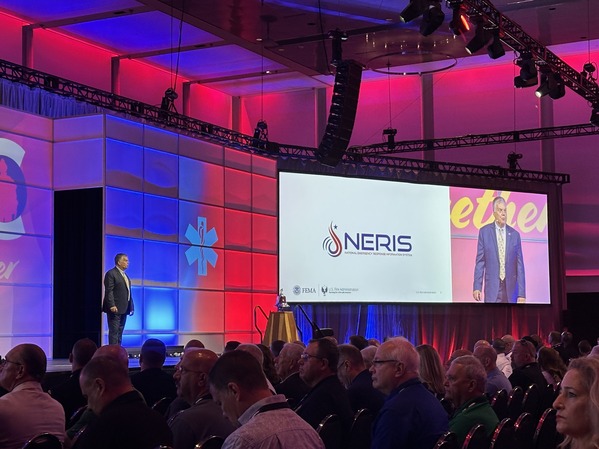 Caption: Eriks Gabliks, Superintendent, National Fire Academy, announces the release of NERIS Public at Fire Rescue International in Kansas City, Missouri, on August 12.
Key features of NERIS Public: Incident Basics
-
Structure: Each record represents a single incident reported through NERIS, with status of approved or pending approval.
-
Coverage: Nationwide, from departments reporting through NERIS.
-
Refresh rate: Updated multiple times per week for timely insight.
-
Availability: Open to the public — no login or request required.
-
Contents: Approximately 40 data fields, covering incident identifiers, cause, damage, number of people displaced, responding departments, emerging hazards and actions taken.
-
Excluded data: Casualty and rescue details, medical specifics, detailed unit response and operational data.
-
Intended use: Ideal for call type and frequency analysis, high-level policy and strategic planning, code enforcement, planning and community risk reduction.
A commitment to public ownership and accountability
USFA believes that data collected through publicly funded efforts should be accessible to all. By making NERIS Public: Incident Basics available in a user-friendly format, USFA is reinforcing its commitment to transparency, accountability and empowering communities with the information they need to enhance fire safety and prevention. Learn more about NERIS public.
FEMA will host the September Business and Industry Call through the agency’s Office of Business, Industry and Infrastructure Integration. The virtual event will be at 3 p.m. ET on September 1, 2026. Please register in advance through Zoom for government.
National Business Emergency Operations Center members, business and industry organizations, and FEMA partners will receive updates on the initiatives and tools available during all stages of the disaster lifecycle. Each month features different topics presented by experts from FEMA and other stakeholders.
The call spotlights key tools to help business and industry leaders better understand, plan for, and reduce disaster risk. The next session will focus on the consideration of artificial intelligence adoption into business processes and will discuss recently released analyses and readily available resources. The session will provide an emphasis on enhancing decision-making in emergency and crisis management while ensuring humans maintain control.
Presenters will also share practitioners’ perspectives on building organizational capacity and using artificial intelligence to better serve individuals and communities. If you have questions or want additional information, send an email to OB3I@fema.dhs.gov.
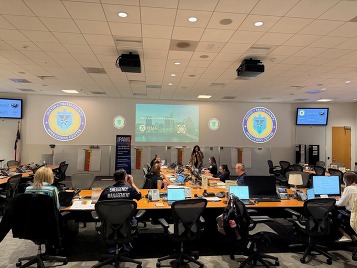
One year after devastating floods highlighted the importance of timely and coordinated public alerts, FEMA conducted five emergency communications trainings in the Austin region, bringing together 57 emergency management and public safety professionals to plan how they’d use the Integrated Public Alert and Warning System to protect their communities during disasters.
Participants studied the system, reviewed alert procedures and shared strategies to send accurate and actionable information. They discussed how to reach people during different types of weather, at any time. Trainers also scheduled a late session so dispatchers and overnight personnel could participate. The strong turnout– from organizations including Austin-Travis County Emergency Medical Services, the Austin Fire Department, Austin Police Department, Travis County Emergency Management, Travis County Sheriff's Office and Williamson County Office of Emergency Management – and cross-jurisdictional collaboration during the training demonstrated participants’ commitment to enhance public warning capabilities across Central Texas.
Through efforts like this, FEMA continues supporting state, local, tribal and territorial leaders as they strengthen emergency communications and get their communities ready for disasters.
Learn More:
|
The latest issue of the FEMA Voluntary Agency Liaison (VAL) Snapshot is now available. The snapshot provides FEMA’s non-governmental partners with updates on current disaster activity, recovery operations and partner-led efforts supporting survivors and communities nationwide. Each issue highlights examples of collaboration among voluntary, faith-based, community-based, philanthropic and private sector organizations working alongside emergency management partners before, during and after disasters.
This report is intended to help partners better understand current needs, ongoing recovery efforts and opportunities to coordinate resources in support of disaster-impacted communities. This report spotlights collaboration in action; here are three examples;
- In July, 23 high-impact non-governmental organizations (NGOs) from across the nation gathered at FEMA Headquarters for the inaugural NGO Leadership Information Exchange meeting. This new forum organized is a step forward in strengthening partnerships among FEMA and voluntary, faith-based, academic, philanthropic and private sector organizations.
-
Friends of Disabled Adults and Children (FODAC), who donated 44 pallets of Durable Medical Equipment to survivors in the Commonwealth of the Northern Mariana Islands following back-to-back typhoons. The equipment was requested by the Government of CNMI following Super Typhoon Bavi, activating the cost-share between FEMA and the CNMI government. The shipment was picked up by FEMA from the FODAC warehouse in Atlanta, GA and shipped to Saipan, CNMI.
-
EmergencyRV teamed up with the Florida State Disaster Case Management team and the FEMA Direct Housing Mission, as the direct housing program came to a close in Florida. EmergencyRV provided 22 units to support FEMA housing applicants, including 15 loaner units and seven units donated directly to applicants. Their willingness to assist, combined with the exceptional efforts of our DCM partners, has helped applicants overcome housing barriers and continue progressing toward their permanent housing goals.
“Our partners are indispensable to the nation’s disaster response and recovery efforts. The expertise, commitment, and compassion they bring to their service, helps ensure survivors and communities receive the support they need when it matters most,” said Cameron Hamilton, FEMA Administrator.
The August VAL Snapshot Report features additional stories of FEMA's non-governmental partners supporting disaster survivors and communities throughout the United States, Tribal Nations and territories. Read the full newsletter on the VAL Snapshot Library. To receive the monthly VAL newsletter, subscribe via GovDelivery.
FEMA Corps Resumes, Application Period Open for 2027 Class
The FEMA Corps program has resumed and is now accepting applications for its next class of future emergency managers. The FEMA Corps program is restarting after being carefully reviewed and refocused to align with FEMA’s core mission and the Trump Administration's priorities. About 80 members and 10 team leaders will be selected to serve from February 2027 to November 2027.
Apply to be a FEMA Corps Team Leader:
Apply to be a FEMA Corps Member:
FEMA Corps graduates may receive an education award upon completion, which can be used for tuition or student loans, and relocation expenses. Additionally, FEMA Corps members receive paid housing and a weekly stipend for food and living expenses all while being deployed to serve communities in need across the country. To learn more, visit AmeriCorps NCCC.
....................................................................................................................................................
|


