|
On June 15, FEMA announced more than $420 million in two funding opportunities, helping ensure Americans are protected in times of greatest need. This funding will support state, local, tribal and territorial governments strengthen their emergency response capabilities and build resilience from potential catastrophic incidents. The agency is disbursing money through two grant programs:
-
Emergency Management Grant Program: FEMA is providing $337.3 million to state, local, tribal and territorial emergency management organizations to bolster their emergency management organizations. In years past, recipients have used these funds to hire and train more staff, buy critical equipment such as generators and mobile command vehicles and establish interoperable communications systems to help first responders connect during disasters.
-
Emergency Operations Center Grant Program: FEMA is providing $83 million for states and local governments to construct, upgrade or equip secure, interoperable Emergency Operations Centers. During a crisis, Emergency Operations Centers serve as a centralized hub where representatives from various agencies and multiple jurisdictions coordinate with each other. This prevents breakdowns of communication, eliminates duplicate efforts and ensures a rapid, unified response to safeguard communities.
The application period for both grant programs will close on Wednesday, July 15.
Eligible applicants can review the full funding opportunities for both programs on Grants.gov.
On June 10, FEMA announced the approval of more than $1.1 billion in post-disaster funding for Public Assistance and Hazard Mitigation Grant Program projects across the nation. These programs empower states, local communities, tribes and territories to recover and rebuild more resilient, safer communities and protect infrastructure from future events. With this funding, President Donald J. Trump is keeping his promise to reform federal disaster support and ensure that taxpayer money is spent only on projects that deliver safety and security to the American people.
The funding includes more than $1 billion from FEMA’s Public Assistance Program. States will use this money for 427 recovery projects related to past disasters, including 44 COVID-19 projects, totaling more than $323 million. In alignment with President Trump’s executive order establishing the Task Force to Eliminate Fraud, FEMA conducted thorough reviews of all claimed costs for COVID-19 Public Assistance funds to remove any fraud, waste and abuse.
The 383 non-COVID Public Assistance projects include repairs to critical infrastructure, restoration of public buildings, road repairs and reimbursement for costs incurred to ensure public health and safety after a disaster.
In addition, FEMA is awarding more than $54 million for 25 projects across 13 states that will prevent, eliminate or reduce future disaster-related damage. This money is being distributed through FEMA’s Hazard Mitigation Grant Program.
Through this program, state, local, tribal and territorial governments take mitigation measures such as acquiring hazard-prone homes and businesses, adopting and enforcing building codes and standards, protecting against floods through elevations and drainage improvement projects, building safe rooms and upgrading utilities and infrastructure.
FEMA coordinates directly with the state, tribe or territory on all hazard mitigation projects. This aligns with FEMA’s principles of ensuring that disaster recovery and mitigation is state-led and federally supported. These projects are the latest examples of billions of dollars in disaster recovery provided by FEMA to support state and local communities as they work to rebuild from recent natural disasters.
FEMA continues its renewed commitment to help communities recover from disasters like hurricanes, severe storms, tornadoes and wildfires while making them more resilient from future disasters.
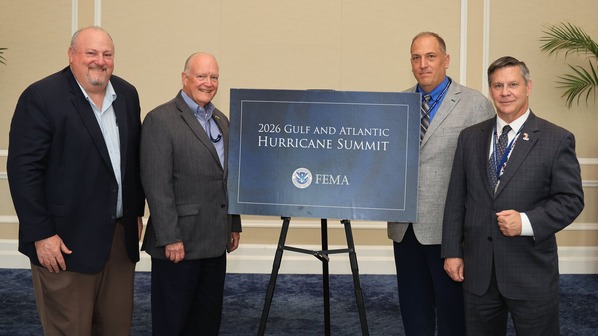 New Orleans (June 9, 2026) - From left to right: Senior Official Performing the Duties of Administrator Robert J. Fenton Jr., Maryland Department of Emergency Management Secretary Russell Strickland, Delaware Department of Emergency Management Director A.J. Schall Jr., and FEMA Region 3 Regional Administrator Andre McCoy.
Last week, FEMA convened emergency management leaders from across the Gulf and Atlantic coasts to strengthen coordination and readiness at the start of hurricane season. During the 2026 Gulf and Atlantic Hurricane Summit, state officials identified challenges, aligned response plans and shared best practices with one another.
Senior Official Performing the Duties of the FEMA Administrator Robert J. Fenton led the summit, which was attended by FEMA Regional Administrators and officials from Delaware, Maryland, South Carolina, Georgia, Florida, Mississippi, Alabama, Louisiana, New York and Texas. Over the course of the summit, these leaders worked through practical challenges and identified opportunities to improve coordination across state lines.
FEMA officials and state leaders discussed ways to make the disaster declaration process more efficient, improve information and data sharing between partners, and ensure that survivors understand what programs and resources are available to them. National Emergency Management Association Executive Director Trina Sheets outlined how states can support one another through the Emergency Management Assistance Compact, a nationwide mutual aid agreement that allows states and territories to share resources with each other during disasters and emergencies. As the summit ended, participants reflected on the importance of partnerships and strengthening the nation’s resilience by ensuring every American community is prepared.
FEMA entered this hurricane season with one of the strongest readiness postures in recent years. The agency has nearly 20,000 trained and deployable personnel ready to support communities—and more than 5,500 of those personnel are available to deploy immediately. This includes 28 Urban Search and Rescue teams and six Mobile Emergency Response Support units. FEMA also has the lowest number of incident management personnel currently deployed and the second-highest number available for deployment in the past five years, ensuring capacity to surge wherever needed. Together, these capabilities position FEMA to rapidly support state, local, tribal and territorial partners.
Learn more about FEMA’s hurricane readiness at FEMA.gov.
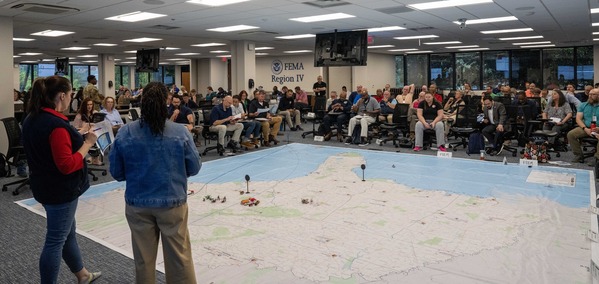
FEMA Region 4 took proactive steps to build readiness across the Southeast during its annual Hurricane Readiness Week in Atlanta.
Emergency management leaders from Alabama, Florida, Georgia, Mississippi, North Carolina and South Carolina joined federal partners from the Department of War, U.S. Army Corps of Engineers, and regional response and recovery teams to sharpen their plans for the season ahead.
The group tackled a two-storm hurricane scenario hitting multiple states, working together to coordinate response strategies, improve communication and validate readiness plans. Experts in operations and logistics shared their capabilities and discussed what their states need most. To visualize how resources would be deployed, the team used a large floor map featuring all Region 4 states, allowing everyone to see a force laydown and plan more effectively.
Throughout the week, participants exchanged lessons learned from past disasters and best practices for managing the complex challenges of hurricane response and recovery. They explored how federal resources are deployed, how critical information flows between agencies and how to keep operations running during an emergency.
FEMA is absorbing several chemical, biological, radiological and nuclear readiness and detection programs from the Department of Homeland Security’s Countering Weapons of Mass Destruction Office. These programs are designed to help communities prepare for and respond to potential chemical, biological, radiological and nuclear threats by providing intelligence, equipment, training, exercises and support. The transition strengthens FEMA’s all-hazards readiness and resilience mission in support of state, local, tribal and territorial partners nationwide.
The programs and capabilities transitioning to FEMA include:
- The Threat Intelligence Team analyzes chemical, biological, radiological and nuclear intelligence and provides strategic and operational guidance to help federal, state, local, tribal and territorial law enforcement officials plan for, detect and protect against threats.
- The BioWatch Program provides 24/7 biodetection operations, monitoring the air for the presence of biological agents, in more than 30 major metropolitan areas across the country. BioWatch also provides training and exercises to help state and local officials learn how to respond if a threat is detected.
- The Securing the Cities Program provides equipment, technical and exercise support, training and planning guidance to 14 high-risk designated urban areas to enhance their ability to detect and prevent terrorist attacks using radiological or nuclear materials.
- The Mobile Detection Deployment Program deploys detection and monitoring capabilities across the country to ensure state and local law enforcement agencies have what they need to address chemical, radiological and nuclear threats. Deployments are typically requested to help secure special events such as concerts, marathons, parades, festivals, and college and professional sports.
- The ChemPREP Program helps state, local, tribal and territorial partners prepare to respond to a chemical incident by providing tailored training and exercises relevant to each local jurisdiction’s unique chemical risks and vulnerabilities.
- The Training and Exercises Team develops and supports exercises, including national-level exercises with interagency partners, as well as state and local exercises. They also conduct robust training on chemical, biological, radiological and nuclear detection and response for law enforcement officers.
- The Test and Evaluation Team conduct independent assessments of detection technologies to verify and validate their technical and operational capabilities. This ensures technologies are effective, reliable and mission ready.
FEMA’s priority is continuity for partners, personnel and ongoing operations. Existing coordination and operational support will continue as FEMA works to integrate these programs into the agency. FEMA remains committed to ensuring state, local, tribal and territorial partners have access to the resources, expertise and support needed to prepare for and respond to evolving threats.
In coordination with the Small Business Administration’s Disaster Recovery and Resilience Office, FEMA presents the Small Business Disaster Preparedness Series. Small businesses are invited to attend the webinar session, "Stay Ready and Resilient with Help from your Local Small Business Development Center," from 1-2:30 p.m. ET, Tuesday, June 23.
This series is aimed at sharing critical information and resources for small businesses to successfully navigate disaster recovery situations and build resiliency. The upcoming session will focus on how small businesses can utilize the Small Business Administration’s Small Business Development Centers to enhance business operations throughout a disaster. Presenters will showcase how your local development centers help businesses stay ready, navigate disruptions and recover stronger.
During this series, the centers’ advisors provide small business resources and tools aimed at strengthening funding, planning, technology and operations. This support helps businesses address unexpected challenges, recover with confidence and remain resilient in any situation.
Register for the call at FEMA Zoom Webinar. If you have questions for the presenters, email OB3I@fema.dhs.gov.
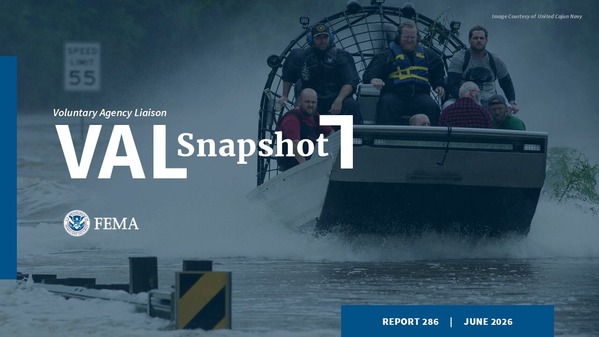
The June 2026 edition of the FEMA Voluntary Agency Liaison (VAL) Snapshot Report is now available. This monthly newsletter helps inform FEMA’s non-governmental partners about current events, resource needs and opportunities to support disaster recovery efforts across the country.
Building Strong Partnerships for Community Recovery
The mission of FEMA VALs is to establish, foster and maintain relationships among government, voluntary, faith-based and community partners. Through these relationships, VALs support the delivery of services and empower and strengthen capabilities of communities to address disaster-caused unmet needs.
Partner Success Story: United Cajun Navy and Delivery Good in North Carolina
This month's report highlight's the United Cajun Navy's ongoing support for Lake Lure, Chimney Rock and Bat Cave communities in western North Carolina as they recover from Hurricane Helene. In collaboration with Delivery Good, United Cajun Navy organized the Rural Communities Resource Giveaway at Lake Lure Classical Academy.
The event provided students and families with 26 pallets of furnishings, home decor, clothing and other essentials. Local agencies supporting food insecurity, utility support, homelessness and family services were also provided with essential supplies. Local nurses serving the community's youngest patients were provided with essential items to continue their healthcare services.
Founded in the aftermath of Hurricane Katrina in 2005, United Cajun Navy continues to demonstrate the positive impact of volunteer service. The organization continues to rely on its volunteers to expand its reach and help strengthen communities during times of need across the country.
More Stories Inside the VAL Snapshot Report
The June VAL Snapshot Report features additional stories of FEMA's non-governmental partners supporting disaster survivors and communities throughout the United States, Tribal Nations and territories. Read the full newsletter: June 2026 Voluntary Agency Liaison (VAL) Snapshot Report.
Stay Connected
To receive the monthly VAL newsletter, subscribe at GovDelivery.
Apply for FEMA's FY24-25 Building Resilient Infrastructure and Communities Grants by July 23
FEMA is currently accepting applications for the Fiscal Years 2024 and 2025 Building Resilient Infrastructure and Communities (BRIC) funding opportunities. Through this program, FEMA is making $1 billion in federal funding available to state, local, tribal and territorial governments, empowering them to take decisive, proactive steps to protect their communities from disasters like fires, floods, earthquakes and hurricanes.
FEMA held two national webinars to provide an overview of the funding opportunity. These sessions covered eligibility requirements and application guidance for states, local communities, tribal and territorial governments.
Watch the Fiscal Year 2024 and 2025 BRIC webinars at the links below:
The deadline to submit applications is Thursday, July 23.
Interested applicants and subapplicants may review the funding opportunity on Grants.gov. A fact sheet is available online summarizing the eligible projects and available funding.
For more information on the BRIC program, applicants should contact their FEMA Regional Office or visit the Building Resilient Infrastructure and Communities webpage.
....................................................................................................................................................
Apply for FEMA's FY2024 Flood Mitigation Assistance Grant Program by August 6
FEMA recently hosted a webinar on eligibility and application requirements for the current funding opportunity for the Fiscal Year (FY) 2024 Flood Mitigation Assistance Program. Through this program, FEMA is making $600 million available to state, local, tribal and territorial governments, empowering them to take decisive, proactive steps to protect their communities from flood disasters.
Visit FEMA’s website to watch the FY2024 Flood Mitigation Assistance funding opportunity webinar. It provides an overview, including recent amendments and important changes as of April 30.
Topics covered include:
- Tips for preparing and submitting high-quality subapplications and applications.
- Eligibility requirements for applicants, including states, territories and federally recognized Tribal Nations.
- A recorded question-and-answer session.
Applicants have until 3 p.m. ET, Thursday, August 6, to revise and re-submit their application to FEMA. States, territories and Tribal Nations may have an earlier deadline for subapplications. All applications must be submitted using FEMA Grants Outcomes (FEMA GO). Applications received after this deadline will not be considered.
Learn more about this funding opportunity and its recent amendments.
....................................................................................................................................................
|


