|
As peak hurricane season approaches it’s a good time to review or update your preparedness plan.
Knowing when and how to protect yourself, your loved ones and your property can make all the difference during a disaster. While you may have several days advance warning that a hurricane is on the way, storms can intensify quickly and even a small change in the storm’s track can leave little time for additional preparation.
Know Your Risk
The first step of preparing for hurricanes is to know your risk.
- Coastal areas are most at risk for extreme winds, power outages and flooding from rain and storm surge.
- Inland areas could experience wind, thunderstorms, flooding and power outages.
- You may live in a state with designated evacuation zones. Visit your state and county emergency management websites to learn about their plans.
- Identify your home’s structural risks. Mobile homes and homes with basements can be especially vulnerable to hurricane hazards.
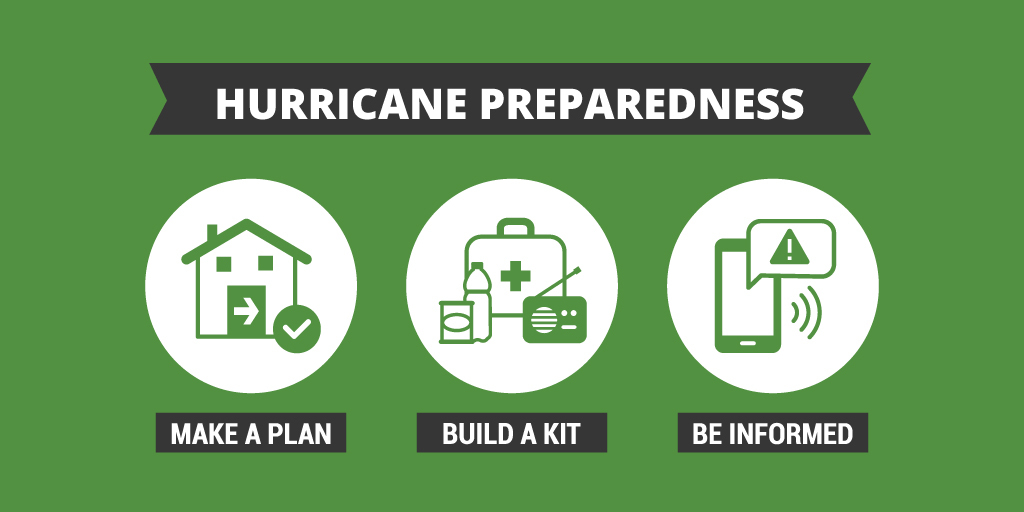
Know How to Stay Informed
The most important information about disasters and emergency management comes from your local officials and community leaders. Local governments plan, prepare for and respond to disasters.
- Some counties use email or web updates, while others may use a telephone notification system. Contact your local Emergency Management Agency to find out how to get local warnings. You should also sign up for community alerts in your area.
- Have several ways to receive alerts. Download the free FEMA app and receive real-time National Weather Service weather alerts for up to five locations nationwide, safety tips and reminders on how to be ready for the unexpected.
Learn more about the Emergency Alert System and make sure your phone can receive
Wireless Emergency Alerts.
Have a Communication Plan
Knowing when and how to protect yourself, your loved ones and your property can make all the difference during a disaster. Your family may not be together if a hurricane strikes, so it is important to know what to do and where you’ll go – and to practice your plan before any incident occurs.
- Talk to your family about where to meet if you’re separated. Include an out-of-town location in case there is an evacuation.
- Write down a list of emergency contacts on paper, and make sure to include utilities and other critical services. Keep this information in a waterproof container.
- Practice your plan with your family/household.
Consider the needs of those you care for, whether they are children, older adults, loved ones who have a disability or pets, and help neighbors who might need help getting prepared.
Build an Emergency Kit
Make sure you have what you need to survive, well in advance of a hurricane.
Items in your kit should include:
- Medicine.
- Flashlights (and extra batteries).
- Several days’ supply of food and water for all people and pets in your household.
- First aid kit.
- Hand-crank or battery-powered radio (with more extra batteries, if needed).
Generators can be helpful if the power goes out. However, there are many risks from incorrect generator use so it’s important to learn how to use one safely. Never use a generator indoors and keep it outside away from homes, windows and garages. Learn more by visiting Ready.gov | Generator Safety.
Find more items you may want to include in your kit on Ready.gov | Build a Kit.
Strengthen Your Home
Take time now to make sure your home can withstand the hazards hurricanes can bring. Actions include:
- Trimming trees and shrubs near your home.
- Checking your roof’s shingles, decking, secondary water barrier, roof to wall connections, wall to foundation connections and gables.
- Reinforcing soffits. A soffit is a horizontal surface outside on the underside of the eaves (the area of the roof that overhangs the exterior walls).
- If your windows, exterior doors and garage doors are not impact resistant, know how you will protect them. You can visit the Federal Alliance for Safe Homes (FLASH) webpage for
customizable plans for how to prepare your home based on your location.
Find additional tips on low and no cost preparedness by visiting Ready.gov.
Have an Evacuation Plan
Do not ignore evacuation orders before a storm. Even sturdy, well-built houses may not hold up against a hurricane. Staying home to protect your property is not worth risking your health and safety. For more information, visit Ready.gov | Evacuation.
Even if you feel ready, there may be additional things you could do or learn. Visit Ready.gov to learn more about how you can prepare for hurricanes today!
On May 21, President Donald J. Trump approved five major disaster declarations for individuals who sustained losses in designated areas of Mississippi (DR-4874-MS), Missouri (DR-4867-MO), Arkansas (DR-4873-AR), Oklahoma (DR-4866-OK) and Texas (DR-4871-TX).
Affected individuals should first file claims with their insurance providers, then apply for assistance today, July 22.
The fastest way to apply is online at DisasterAssistance.gov or the Spanish language site DisasterAssistance.gov/es.
If you need more information or additional help:
- Download the FEMA App.
- Call the FEMA Helpline at 1-800-621-3362 for assistance in multiple languages. If you use a relay service, such as video relay service (VRS), captioned telephone service or others, provide FEMA the number for that service.
- Find in-person FEMA support at fema.gov/drc.
When applying for FEMA assistance, specify the damage and the date it occurred to ensure you are applying under the correct declaration number.
For more information, visit Current Disasters | FEMA.gov.
Individuals who sustained losses in the designated areas of Kentucky (DR-4875-KY) and were affected by severe storms, straight-line winds and tornadoes from May 16-17, should apply for federal disaster assistance by tomorrow, July 23.
Affected individuals should first file claims with their insurance providers, then apply for assistance.
The fastest way to apply is online at DisasterAssistance.gov or the Spanish language site DisasterAssistance.gov/es.
If you need more information or additional help:
- Download the FEMA App.
- Call the FEMA Helpline at 1-800-621-3362 for assistance in multiple languages. If you use a relay service, such as video relay service (VRS), captioned telephone service or others, provide FEMA the number for that service.
- Find in-person FEMA support at fema.gov/drc.
When applying for FEMA assistance, specify the damage and the date it occurred to ensure you are applying under the correct declaration number.
For more information, visit fema.gov/disaster/4875.
Local communities within 10 miles of Michigan’s Palisades Nuclear Plant are finalizing more than a year of preparations for the plant’s restart this fall. To ensure the health and safety of people living near the plant, FEMA worked closely with local officials throughout the process.
These efforts are part of FEMA’s Radiological Emergency Preparedness Program. This program helps protect communities near commercial nuclear power plants by educating residents, providing guidance to local officials and evaluating overall preparedness.
For months, FEMA staff has worked daily with the three counties surrounding the Palisades Nuclear Plant to help them develop updated preparedness plans. Recently, these communities conducted various drills and exercises to prepare for the plant’s restart. The drills and exercises involved many parts of the local community, including first responders, schools, local hospitals and government officials.
More preparedness drills will continue through a final series of exercises on July 29, to test safety systems and validate capabilities.
FEMA and the U.S. Nuclear Regulatory Commission have also held many public meetings since the plant’s closure and decommissioning in 2022. As the plant prepares to reopen under new ownership, a final public meeting will be held on Aug. 5 to discuss public safety and seek feedback on the restart of the plant. Comments may also be submitted by emailing FEMA-PublicComment-Palisades@fema.dhs.gov.
This project is an example of how communities near nuclear plants across the nation can prepare for potential radiological incidents. By ensuring these communities are well-equipped to handle emergencies, we can protect public health and safety nationwide.
Kentucky Survivors Affected by Spring Severe Storms, Straight-line Winds, Tornadoes and Mudslides Can Apply for FEMA Assistance Until July 25
Individuals who sustained losses in the designated areas of Kentucky (DR-4864-KY) and were affected by severe storms, straight-line winds, tornadoes and mudslides from April 2-May 16, should apply for federal disaster assistance by Friday, July 25.
Affected individuals should first file claims with their insurance providers, then apply for assistance.
The fastest way to apply is online at DisasterAssistance.gov or the Spanish language site DisasterAssistance.gov/es.
If you need more information or additional help:
- Download the FEMA App.
- Call the FEMA Helpline at 1-800-621-3362 for assistance in multiple languages. If you use a relay service, such as video relay service (VRS), captioned telephone service or others, provide FEMA the number for that service.
- Find in-person FEMA support at fema.gov/drc.
When applying for FEMA assistance, specify the damage and the date it occurred to ensure you are applying under the correct declaration number.
For more information, visit fema.gov/disaster/4864.
....................................................................................................................................................
Join the 2025 HURREVAC Webinar Series: Essential Training for Emergency Managers
The National Hurricane Program, a federal partnership between FEMA, the National Oceanic and Atmospheric Administration’s National Hurricane Center and the U.S. Army Corps of Engineers, is proud to sponsor the 2025 HURREVAC Webinar Series. HURREVAC is a free web-based decision-support tool that assists emergency managers by providing information and tools to inform hurricane response decisions in advance of a threatening storm.
To sign up for any of the trainings, select the links below.
Day 1 | Intro to HURREVAC: An introduction to the program's purpose, basic operation and customization.
Date and Time: Monday, July 28, from 2-4 p.m.ET.
Day 2 | Wind Forecast Features: Tools to understand wind timing and intensity.
Date and Time: Tuesday, July 29, from 2-4 p.m. ET.
Day 3 | Storm Surge and Flooding Hazards: Tools to understand storm surge and flooding hazards.
Date and Time: Wednesday, July 30, from 2-4 p.m. ET.
Day 4 | Evacuation Timing Features: Tools to support evacuation decisions and response timelines.
Date and Time: Thursday, July 31, from 2-4 p.m. ET.
Please contact support@hurrevac.com with any questions.
....................................................................................................................................................
FEMA Offers Trainings on the Updated Preliminary Damage Assessment Process
FEMA published an updated Preliminary Damage Assessment Guide, which defines how state, local, tribal and territorial government officials and FEMA staff collect, validate, quantify and document damage following a disaster.
To help states, local governments, tribal nations, territories and the emergency management community better understand the Preliminary Damage Assessment process, FEMA is offering virtual training sessions on the following dates:
- July 29, 10-11 a.m. ET.
- Aug. 7, 10-11 a.m. ET.
The course will prepare participants to conduct joint preliminary damage assessments with FEMA and is open to all interested personnel.
To participate in one of the training sessions, visit the FEMA Zoom link to attend and use the codes below:
- Meeting ID: 161 5791 3048
- Passcode: 2025
....................................................................................................................................................
FEMA Begins Process to Update the Radiological Emergency Preparedness Manual
In preparation for the next update of the manual in 2027, FEMA is requesting public comments on the current 2023 edition of the Radiological Emergency Preparedness Manual.
The public comment period will be open until Sept. 30.
To submit a comment:
- Access the 2023 manual on FEMA.gov.
- Complete a Comment Matrix form to capture relevant details, such as page number, background information and recommended solution language.
- Email a copy of the completed Comment Matrix to FEMATHDPolicy@fema.dhs.gov, with the subject line “2023 RPM Public Comment.”
Please note, if you participated in FEMA’s recent Radiological Emergency Preparedness Program Scenario Guidance Listening Sessions, FEMA has captured your feedback, and you do not need submit a comment.
....................................................................................................................................................
|


