|
FEMA announced that federal disaster assistance is available to the state of New Mexico to supplement response efforts due to emergency conditions resulting from severe storms, flooding and landslides beginning on June 23 and continuing.
The president’s action authorizes FEMA to coordinate all federal disaster relief efforts to alleviate the hardship and suffering caused by the emergency on the local population and to provide appropriate assistance to save lives, to protect property, public health and safety and to lessen or avert the threat of a catastrophe.
The assistance is for Chaves, Lincoln, Otero and Valencia counties.
Specifically, FEMA is authorized to identify, mobilize and provide, at its discretion, equipment and resources necessary to alleviate the impacts of the emergency. Emergency protective measures, limited to direct federal assistance under the public assistance program, will be provided at 75% federal funding.
More counties may be designated at a later date if requested by the state and warranted by the results of further damage assessments.
For more information, visit fema.gov/disaster/3628.
Homeowners and renters in Kerr, Burnet, San Saba, Tom Green, Travis and Williamson counties are now eligible for FEMA disaster assistance after the severe storms, straight-line winds and flooding that began July 2.
Federal disaster assistance can include grants for temporary housing and home repairs, low-cost loans to cover uninsured property losses and other programs to help individuals recover from the effects of the disaster.
Federal funding is also available to state and eligible local governments and certain private nonprofit organizations in Kendall, Kerr, Kimble, Menard and San Saba counties on a cost-sharing basis for emergency work and the repair or replacement of facilities damaged by the severe storms, straight-line winds in the designated areas.
Affected individuals should first file claims with their insurance providers, then apply for assistance.
The fastest way to apply is online at DisasterAssistance.gov or the Spanish language site DisasterAssistance.gov/es.
If you need more information or additional help:
- Download the FEMA App.
- Call the FEMA Helpline at 1-800-621-3362 for assistance in multiple languages. If you use a relay service, such as video relay service (VRS), captioned telephone service or others, provide FEMA the number for that service.
- Find in-person FEMA support at fema.gov/drc.
To view an accessible video on how to apply, visit What to Expect Before Applying for FEMA Assistance.
When applying for FEMA assistance, specify the damage and the date it occurred to ensure you are applying under the correct declaration number.
For more information, visit fema.gov/disaster/4879.
The National Hurricane Program, a federal partnership between FEMA, the National Oceanic and Atmospheric Administration’s National Hurricane Center, and the U.S. Army Corps of Engineers is proud to sponsor the 2025 HURREVAC Webinar Series. The series, scheduled for July 28–31, is intended for emergency managers from all levels of government within the United States, with new HURREVAC users encouraged to participate.
HURREVAC is a free web-based decision-support tool that assists emergency managers by providing information and tools to inform hurricane response decisions in advance of a threatening storm.
This annual webinar series will consist of four training sessions. Each session features guest speakers from FEMA, the National Hurricane Center and the U.S. Army Corps of Engineers. Attendees must register for each day they plan to attend. For more details and to register, please select the links below.
Day 1 | Intro to HURREVAC: An introduction to the program's purpose, basic operation and customization.
Date and Time: Monday, July 28, from 2-4 p.m. ET.
Day 2 | Wind Forecast Features: Tools to understand wind timing and intensity.
Date and Time: Tuesday, July 29, from 2-4 p.m. ET.
Day 3 | Storm Surge and Flooding Hazards: Tools to understand storm surge and flooding hazards.
Date and Time: Wednesday, July 30, from 2-4 p.m. ET.
Day 4 | Evacuation Timing Features: Tools to support evacuation decisions and response timelines.
Date and Time: Thursday, July 31, from 2-4 p.m. ET.
Please contact support@hurrevac.com with any questions.
FEMA’s Radiological Emergency Preparedness Program Manual is updated every four years. It provides planning standards and guidance for communities and offsite response organizations near commercial nuclear plants to prepare for radiological disasters.
In preparation for the next update of the manual in 2027, FEMA is requesting public comments on the current 2023 edition of the Radiological Emergency Preparedness Manual.
The public comment period will be open until Sept. 30.
During this time, Radiological Emergency Preparedness partners and stakeholders, including state, local, tribal and territorial governments, are encouraged to review and comment on the current 2023 edition.
To submit a comment:
- Access the 2023 manual on FEMA.gov.
- Complete a Comment Matrix form to capture relevant details, such as page number, background information and recommended solution language.
- Email a copy of the completed Comment Matrix to FEMATHDPolicy@fema.dhs.gov, with the subject line “2023 RPM Public Comment.”
Please note, if you participated in FEMA’s recent Radiological Emergency Preparedness Program Scenario Guidance Listening Sessions, FEMA has captured your feedback, and you do not need submit a comment.
Members of the public will also have an opportunity to comment on the draft of the 2027 manual before it is published. The comment period for the draft of the 2027 manual is targeted for the summer of 2027, with a final publication date of December 2027.
.
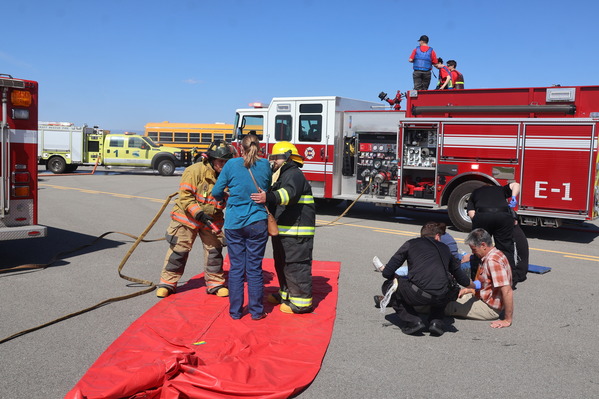
Firefighters perform response and recovery activities during the 2024 Alamosa Regional Airport Full-Scale Exercise.
FEMA's U.S. Fire Administration and National Exercise Division partnered to create a series of multi-phased, progressive wildfire preparedness tabletop exercises.
In July 2024, phase one kicked off with the delivery of tabletop exercises in Marin County, California; Klickitat County, Washington; and Gunnison County, Colorado. The exercises focused on wildfire evacuation and data gathering for the development of the U.S. Fire Administration’s National Wildfire Evacuation Guidance.
The team also worked diligently to develop a wildfire exercise starter kit to further reach communities in the Wildland Urban Interface areas not already participating in the exercises. Combined, the exercises and exercise starter kit allowed participating organizations to plan their approach and coordinate with stakeholders they would work with in a wildfire evacuation, strengthening local communities' disaster preparedness beyond what a standalone exercise could accomplish.
Phase two continues the momentum into 2025, with a partnership between FEMA's U.S. Fire Administration, National Exercise Division, and the non-profit Gordon and Betty Moore Foundation to deliver six additional tabletop exercises. These exercises, in FEMA Regions 4, 8, 9 and 10, will drive continuous improvement and help further refine the National Wildfire Evacuation Guidance.
For more information on what communities should consider for wildfire evacuation and to download Wildfire Evacuation Exercise Starter Kits, visit FEMA's Wildfire Evacuation Prep Toolkit.
FEMA published an updated Preliminary Damage Assessment Guide, which defines how state, local, tribal and territorial government officials and FEMA staff collect, validate, quantify and document damage following a disaster.
To help states, local governments, tribal nations, territories and the emergency management community better understand the Preliminary Damage Assessment process, FEMA is offering virtual training sessions on the following dates:
- July 22, 10-11 a.m. ET.
- July 29, 10-11 a.m. ET.
- Aug. 7, 10-11 a.m. ET.
The course will prepare participants to conduct joint preliminary damage assessments with FEMA and is open to all interested personnel.
To participate in one of the training sessions, visit FEMA Zoom and use the codes below:
- Meeting ID: 161 5791 3048
- Passcode: 2025
Survivors in Designated Areas in Mississippi, Missouri, Arkansas, Oklahoma and Texas Can Apply for FEMA Assistance Until July 22
On May 21, President Donald J. Trump approved five major disaster declarations for individuals who sustained losses in designated areas of Mississippi (DR-4874-MS), Missouri (DR-4867-MO), Arkansas (DR-4873-AR), Oklahoma (DR-4866-OK) and Texas (DR-4871-TX).
Affected individuals should first file claims with their insurance providers, then apply for assistance by Tuesday, July 22.
The fastest way to apply is online at DisasterAssistance.gov or the Spanish language site DisasterAssistance.gov/es.
If you need more information or additional help:
- Download the FEMA App.
- Call the FEMA Helpline at 1-800-621-3362 for assistance in multiple languages. If you use a relay service, such as video relay service (VRS), captioned telephone service or others, provide FEMA the number for that service.
- Find in-person FEMA support at fema.gov/drc.
When applying for FEMA assistance, specify the damage and the date it occurred to ensure you are applying under the correct declaration number.
For more information, visit Current Disasters | FEMA.gov.
....................................................................................................................................................
Kentucky Survivors Affected by May Severe Storms, Straight-line Winds and Tornadoes Can Apply for FEMA Assistance Until July 23
Individuals who sustained losses in the designated areas of Kentucky (DR-4875-KY) and were affected by severe storms, straight-line winds and tornadoes from May 16-17, should apply for federal disaster assistance by Wednesday, July 23.
Affected individuals should first file claims with their insurance providers, then apply for assistance.
The fastest way to apply is online at DisasterAssistance.gov or the Spanish language site DisasterAssistance.gov/es.
If you need more information or additional help:
- Download the FEMA App.
- Call the FEMA Helpline at 1-800-621-3362 for assistance in multiple languages. If you use a relay service, such as video relay service (VRS), captioned telephone service or others, provide FEMA the number for that service.
- Find in-person FEMA support at fema.gov/drc.
When applying for FEMA assistance, specify the damage and the date it occurred to ensure you are applying under the correct declaration number.
For more information, visit fema.gov/disaster/4875.
....................................................................................................................................................
Kentucky Survivors Affected by Spring Severe Storms, Straight-line Winds, Tornadoes and Mudslides Can Apply for FEMA Assistance Until July 25
Individuals who sustained losses in the designated areas of Kentucky (DR-4864-KY) and were affected by severe storms, straight-line winds, tornadoes and mudslides from April 2-May 16, should apply for federal disaster assistance by Friday, July 25.
Affected individuals should first file claims with their insurance providers, then apply for assistance.
The fastest way to apply is online at DisasterAssistance.gov or the Spanish language site DisasterAssistance.gov/es.
If you need more information or additional help:
- Download the FEMA App.
- Call the FEMA Helpline at 1-800-621-3362 for assistance in multiple languages. If you use a relay service, such as video relay service (VRS), captioned telephone service or others, provide FEMA the number for that service.
- Find in-person FEMA support at fema.gov/drc.
When applying for FEMA assistance, specify the damage and the date it occurred to ensure you are applying under the correct declaration number.
For more information, visit fema.gov/disaster/4864.
....................................................................................................................................................
|


