|
FEMA announced that federal disaster assistance is available to the state of Tennessee to supplement recovery efforts in the areas affected by severe storms, straight-line winds, tornadoes and flooding from April 2-24.
The president's action makes federal funding available to affected individuals in Cheatham, Davidson, Dickson, Dyer, Hardeman, McNairy, Montgomery, Obion and Wilson counties. Assistance can include money for temporary housing and home repairs, low-cost loans to cover uninsured property losses and other programs to help individuals and business owners recover from the effects of the disaster.
Federal funding is also available to state and eligible local governments and certain private nonprofit organizations on a cost-sharing basis for emergency work and the repair or replacement of facilities damaged in Cheatham, Davidson, Decatur, Dyer, Fayette, Gibson, Grundy, Hardeman, Hardin, Haywood, Henry, Hickman, Lauderdale, Madison, McNairy, Obion, Perry, Stewart and Tipton counties.
Individuals who sustained losses in the designated areas should first file claims with their insurance providers and then apply for assistance.
The fastest way to apply is online at DisasterAssistance.gov or in the Spanish language at DisasterAssistance.gov/es.
If you need more information or additional help:
- Download the FEMA App.
- Call the FEMA Helpline at 1-800-621-3362 for assistance in multiple languages. If you use a relay service, such as video relay service (VRS), captioned telephone service or others, provide FEMA the number for that service.
- Visit a FEMA Mobile Disaster Recovery Center (DRC). To find one in your area, visit the DRC Locator or text DRC along with your ZIP code to 43362 (Example: “DRC 29169”).
To view an accessible video on how to apply, visit What to Expect Before Applying for FEMA Assistance.
When applying for FEMA assistance, specify the damage and the date it occurred to ensure you are applying under the correct declaration number.
For more information, visit fema.gov/disaster/4878.
Senior Official Performing the Duties of the Administrator David Richardson announced that President Donald J. Trump made additional disaster assistance available to the state of West Virginia to supplement recovery efforts in the areas affected by severe storms, straight-line winds, flooding, landslides and mudslides from Feb. 15-18.
The president authorized the federal cost-share to be increased from 75% to 90% for applicable categories of Public Assistance. The major disaster declaration approved on Feb. 26, made federal funding available for Public Assistance, hazard mitigation and other needs assistance for total eligible costs.
The Benefit-Cost Analysis discount rate has been adjusted from 3.1% to 7% following recent action by the Office of Management and Budget. On April 8, the Office of Management and Budget revoked a recent update to Circular No. A-94, “Guidelines and Discount Rates for Benefit-Cost Analysis of Federal Programs,” to return the discount rate to the original amount set in October 1992.
FEMA uses the federal discount rate—an estimate of how the value of benefits and costs decreases over time—to calculate the net present value of proposed hazard mitigation projects.
The agency is working to ensure all aspects of the Benefit-Cost Analysis aligns with this new guidance, at the Department of Homeland Security and administration’s direction. The Benefit-Cost Analysis web page is updated to include the 7% discount rate.
A cost-effectiveness determination is required for all mitigation projects as a basic eligibility requirement. In many cases, this means performing a Benefit-Cost Analysis. To learn how to streamline a Benefit-Cost Analysis, visit FEMA.gov.
Hazard Mitigation Assistance projects that have not been awarded by FEMA as of April 8 must use the 7% discount rate when performing a Benefit-Cost Analysis to calculate cost effectiveness. This applies to all projects, including those that require review for additional federal funding or phased projects.
Public Assistance projects that have not been awarded by FEMA as of April 8 should also use the 7% discount rate when performing a Benefit-Cost Analysis to demonstrate cost effectiveness.
FEMA will continue to update the Benefit-Cost Analysis Toolkit and will release additional guidance on applicability, timing and content. The toolkit provides guidance and instructions for the entire process of performing a full Benefit-Cost Analysis.
FEMA’s Center for Domestic Preparedness will host its 10th annual Tribal Nations Training Week, Sept. 20-27 on the Center for Domestic Preparedness campus in Anniston, Alabama.
The weeklong event is for responders affiliated with a tribal nation or the Indian Health Service who work in an emergency response capacity.
The theme for this year’s training is “Protecting Traditions by Building Capabilities Through Partnerships.”
Information on the week’s planned courses and the participating training partners will be released in the coming weeks.
For more information on this training week or to register, email FEMA-tribalnationscdp@fema.dhs.gov.
Center for Domestic Preparedness training for state, local, tribal and territorial emergency responders is fully funded, including round-trip transportation, meals and lodging.
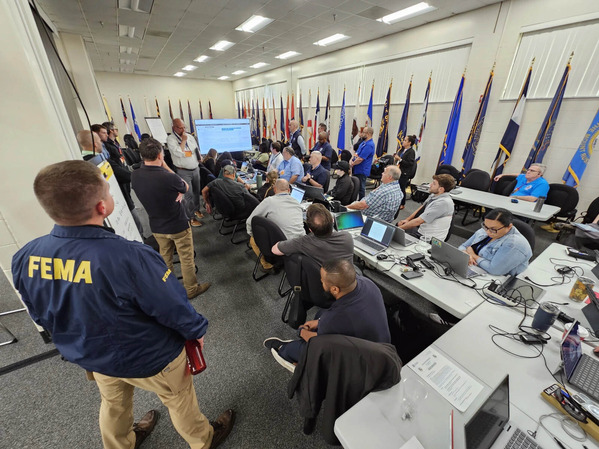 Anniston, Ala. (June 2025) - FEMA Incident Management Assistance Teams practice response scenarios to prepare for the 2025 hurricane season at a bootcamp training.
Throughout a disaster, FEMA partners with local, state, tribal and territorial leaders to support their response and recovery efforts. One way we do this is through the agency’s 18 Incident Management Assistance Teams. These quick response teams are able to deploy anywhere in the U.S. within 24 hours, allowing them to help local areas meet immediate needs for information, expertise and coordination during a disaster response.
This year, these teams attend a bootcamp in June that helps them make any final preparations ahead of the peak months of hurricane season. More than 450 attendees are taking part in the bootcamp, from both the regional and national teams.
Learn more by reading the full blog at FEMA.gov.
FEMA Updates Free Tool to Help Local Emergency Managers Assess Hazards
For the sixth consecutive year, FEMA has updated its free, easy-to-use geographic information systems (GIS) tool that helps emergency managers and local partners assess threats and hazards that may challenge their community’s resilience. This tool is part of FEMA’s work to empower states and localities across the country to prepare for and respond to disasters.
The 2025 update of the Resilience Analysis and Planning Tool includes new census data from the American Community Survey Five-Year Estimate (2019-2023) and the updated Community Resilience Challenges Indices for counties and census tracts. The tool includes over 100 pre-loaded data layers, and its functionality allows users to visualize combinations of these data layers for a specific location.
FEMA will host three interactive webinars on the Resilience Analysis and Planning Tool. Each webinar will cover the same content.
Please register for the two remaining 60-minute Zoom sessions below:
Visit the Resilience Analysis and Planning Tool Resource Center to access supporting materials, learn more about the tool's functionality and see how it can improve resilience planning in your community.
....................................................................................................................................................
Application Period Open for $360M in Grants to Boost Number of Firefighters and $36M in Grants to Strengthen Fire Prevention and Safety Until July 3
FEMA opened the Fiscal Year (FY) 2024 Staffing for Adequate Fire and Emergency Response (SAFER) application period for $360 million. In addition, FEMA also opened the Fire Prevention and Safety application period for $36 million. The application period for both the FY24 SAFER and Fire Prevention and Safety programs will close on Thursday, July 3, at 5 p.m. ET.
The SAFER grant program awards these funds directly to fire departments and volunteer firefighter interest organizations across the nation to help them increase or maintain the number of trained firefighters available in their community.
The Fire Prevention and Safety grant program helps strengthen community fire prevention programs and support scientific research on innovations that improve firefighter safety, health and well-being.
Since 2005, the SAFER program has awarded approximately $5.2 billion in grant funding. The Fire Prevention and Safety program has also awarded nearly $900 million since its inception in 2002.
The FY24 SAFER and Fire Prevention and Safety Notices of Funding opportunity and technical assistance documents for both programs are available at Grants.gov and on the FEMA websites at SAFER and Fire Prevention and Safety. Additional information about upcoming webinars to assist applicants is also available on the FEMA website.
....................................................................................................................................................
Arkansans Affected by March Severe Storms and Tornadoes Can Apply for FEMA Assistance Until July 14
Individuals who sustained losses in the designated areas of Arkansas who were affected by severe storms and tornadoes from March 14-15 can apply for federal disaster assistance by July 14.
Affected individuals should first file claims with their insurance providers and then apply for assistance. The fastest way to apply is online at DisasterAssistance.gov or the Spanish language DisasterAssistance.gov/es.
If you need more information or additional help:
- Download the FEMA App.
- Call the FEMA Helpline at 1-800-621-3362 for assistance in multiple languages.
- Visit a FEMA Mobile Disaster Recovery Center (DRC). To find one in your area, visit the DRC Locator or text DRC along with your ZIP code to 43362 (Example: “DRC 29169”).
For more information, visit fema.gov/disaster/4865.
....................................................................................................................................................
|


