|
FEMA is actively working together with state, local, federal and nonprofit partners to support the California wildfire response. Teams are actively on the ground coordinating lifesaving and life-sustaining activities to support the state-led disaster response.
It is crucial for individuals to remain aware of ongoing wildfire hazards, which can be life-threatening. People should continue to listen to instructions from local officials and evacuate immediately if told to do so. Do not return home until you are told it is safe. Residents should remain vigilant as there is a Particularly Dangerous Situation Red Flag Warning in effect until 3 a.m. PT, Wednesday, Jan. 22.
The Los Angeles County Department of Public Health issued a Windblown Dust and Ash Advisory following strong Santa Ana winds. If possible, wear a face covering to protect against smoke inhalation. For a detailed air quality map specific to Los Angeles County, visit South Coast AQMD’s website or download their mobile app.
If you were affected by the wildfires in Los Angeles County, you may be eligible for FEMA financial assistance. After filing a claim with your insurance company, you can apply for FEMA assistance by phone at 1-800-621-3362 or by visiting DisasterAssistance.gov. If you use a relay service such as VRS, give FEMA your number for that service. The phone line is open daily from 7 a.m. to midnight PT, and help is available in most languages.
If you need additional support or would like help uploading documents, you should visit a Disaster Recovery Center (DRC) to apply for assistance and learn about resources from FEMA and other state organizations to aid you in your recovery. There are two Disaster Recovery Centers in Los Angeles and Pasadena for people to get in-person help with FEMA assistance. To find the nearest DRC, text “DRC” along with your ZIP Code to 43362.
Los Angeles residents displaced by the wildfires may be eligible to stay temporarily in a hotel or motel paid for by FEMA while they work on their long-term housing plan. FEMA Displacement Assistance helps survivors who can’t return to their home following a disaster by giving them up-front money to help with immediate housing needs. Survivors may be eligible for additional rental assistance for short-term housing.
To request Rental Assistance, homeowners and renters need to contact FEMA and let them know. This can be done by:
- Visiting a Disaster Recovery Center.
- Download the FEMA App.
- Calling the FEMA Helpline at 1-800-621-3362.
- Sending your request in writing to FEMA: P.O. Box 10055, Hyattsville, MD 20782-8055.
The deadline to apply for assistance for the wildfires is March 10, 2025.
Some Californians impacted by the Los Angeles County wildfires may be targeted with scams and fraudulent schemes. If you suspect fraud, call the FEMA Helpline immediately at 800-621-3362 or speak to a FEMA representative at a Disaster Recovery Center. If you did not apply for assistance but received a letter from FEMA about your application, call the FEMA Helpline to stop further processing of the application and investigate the apparent fraud. Visit IdentityTheft.gov for more information and steps you can take if you suspect you're the victim of identity theft.
The Disaster Distress Helpline is available anytime to provide support. Survivors and responders feeling overwhelmed can call or text 1-800-985-5990 to receive free, confidential support in any language.
FEMA is working with state and local officials on debris removal plans for areas affected by
the wildfires. Residents should pay attention to local safety guidance and instructions
related to debris removal in their area
For more information, visit Press Releases | FEMA.gov.
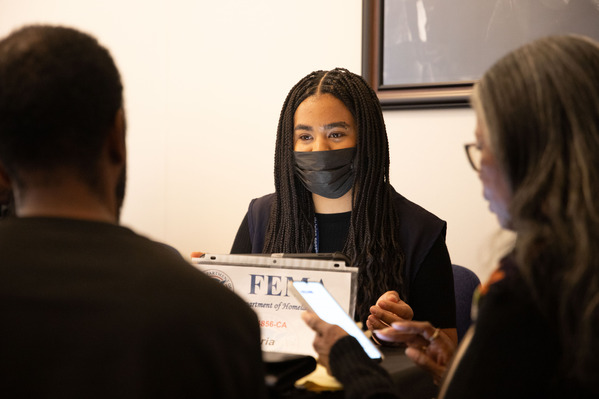
Pasadena, Calif. (Jan. 20, 2025) – FEMA’s Disaster Survivor Assistance staff help register wildfire survivors for FEMA assistance and discuss services available to them at the Pasadena Church East Campus.
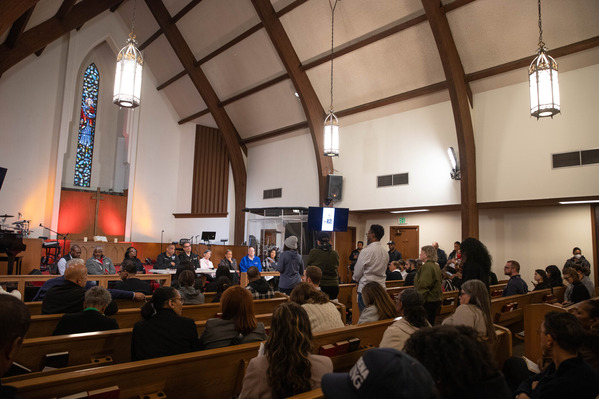
Pasadena, Calif. (Jan. 20, 2025) - FEMA and partners attend the Altadena listening session to discuss wildfire recovery at the Pasadena Church East Campus.
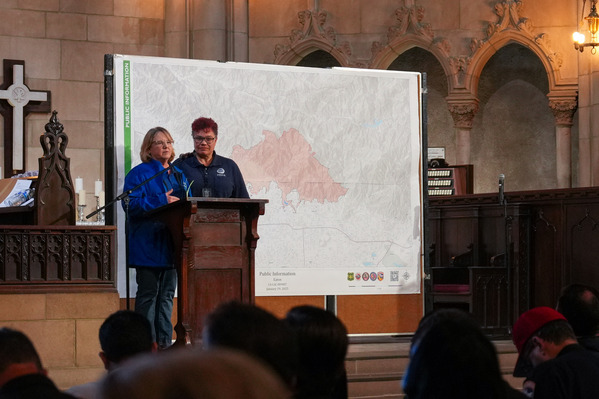
Pasadena, Calif. (Jan. 19, 2025) - FEMA, the U.S. Small Business Administration, and California Fire speak about the Southern California wildfire response and recovery at the Westminster Presbyterian Church Community event.
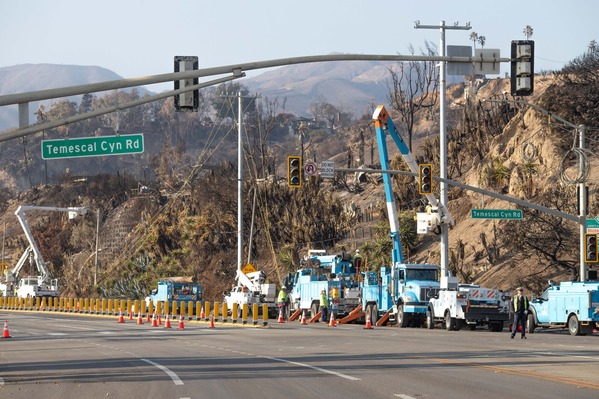
Pacific Palisades, Calif. (Jan.19, 2025) - Utility workers inspect power lines affected by wildfires in the Pacific Palisades .
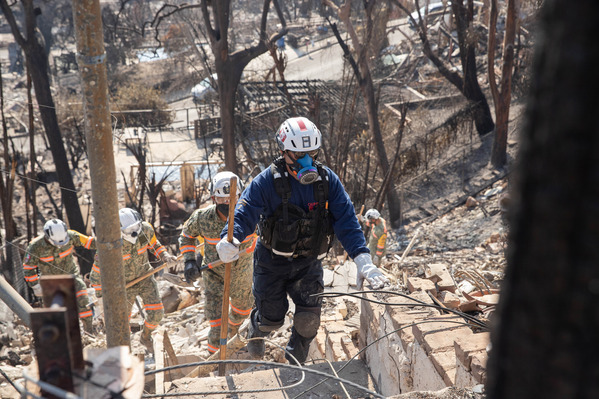
Pacific Palisades, Calif. (Jan. 19, 2025) - California Regional Task Force 5, California Task Force 3, California Fire and Ejercito Mexicano perform search and rescue missions in the Pacific Palisades, California.
FEMA is announcing the third funding opportunity for the Safeguarding Tomorrow Revolving Loan Fund grant program to make communities safer from natural hazards. This program, funded by the Bipartisan Infrastructure Law, provides capitalization grants to eligible applicants nationwide.
States, territories, eligible Tribal Nations and the District of Columbia are eligible for a total of $178 million, the largest amount available in a single fiscal year for the program. Funding enables these entities to administer revolving loan funds that will help local governments carry out hazard mitigation projects and build community climate resilience.
Current participants are using funding in diverse ways, from addressing earthquakes, heat, floods and several other hazards. FEMA also designed the program to assist residents of communities who are at increased risk to these hazards.
Through this program, states can direct loans to local governments to mitigate the effects of events such as drought, intense heat, wildfires, floods and earthquakes. It is one of several Hazard Mitigation Assistance grant programs that fund improvements to make communities more resilient to natural hazards.
The Bipartisan Infrastructure Law provides $500 million to fund the Safeguarding Tomorrow Revolving Loan Fund Program through fiscal year 2026, providing low-interest loans to local governments to reduce their vulnerability to disasters, foster greater resilience and reduce disaster impacts.
Eligible projects include construction or modification of natural or built infrastructure to increase resilience, building code adoption and enforcement, local zoning, land use planning changes and developing local hazard mitigation plans. Deferred maintenance of mitigation infrastructure and paying the non-federal cost share of other FEMA hazard mitigation projects are also eligible.
Emphasis on Local Communities, Tribal Nations
Entities that participate in the program may set loan terms for local communities that are more flexible, with up to 20 years for repayment. This provides a more accessible funding source for the construction of resilience infrastructure than traditional financing options.
Revolving loans are intended to reach local governments most in need of financing assistance, such as low-income geographic areas. These areas have more flexible loan terms with up to 30 years for repayment. FEMA encourages governments to take full advantage of the broad range of activities and projects eligible through this program and include mitigation measures that are not typically submitted under other programs.
Also, $15 million has been set aside exclusively for Tribal Nations to ensure they can receive funds from the program.
The Safeguarding Tomorrow Revolving Loan Fund funding notice is available at Grants.gov. Eligible entities must apply for funding using the FEMA Grants Outcome (FEMA GO) system. Applications may be submitted on a rolling basis through Sept. 30.
FEMA has completed its 2025 placement of reinsurance to continue the National Flood Insurance Program’s (NFIP) support of resiliency and protection against flood losses. The agency transferred $757.8 million of the NFIP’s financial risk to the private reinsurance market throughout the calendar year.
For this placement, 27 reinsurance companies agreed to indemnify FEMA for flood losses from individual flood events or a named storm. FEMA paid a total premium of $139.9 million for the coverage. The agreement is structured to cover:
- 0334% of losses between $7 billion and $9 billion.
- 8584% of losses between $9 billion and $11 billion.
FEMA will receive qualifying payments only if a named storm event is large enough to trigger the traditional and/or capital market reinsurance coverage. As of Jan. 1, 2025, should a named storm event result in flood insurance claims exceeding $11 billion, FEMA will receive the full $2.058 billion of reinsurance coverage from the private markets. FEMA’s 2022 Insurance-Linked Securities reinsurance coverage from the capital markets of $450 million is scheduled to terminate in March 2025, leaving a remaining capacity of $1.608 billion across both traditional and capital markets placements.
The agency contracted with Guy Carpenter and Company, a subsidiary of Marsh & McLennan Companies, to provide broker services to assist in securing the reinsurance placement.
Reinsurance is an important risk management tool used by insurance companies to protect themselves from large financial losses. Public entities also secure reinsurance. Examples of other reinsurance programs include the Citizens Property Insurance Corporation of Florida, the California Earthquake Authority and the Texas Windstorm Insurance Association.
For more information, visit the NFIP Reinsurance Program webpage on FEMA.gov.
.
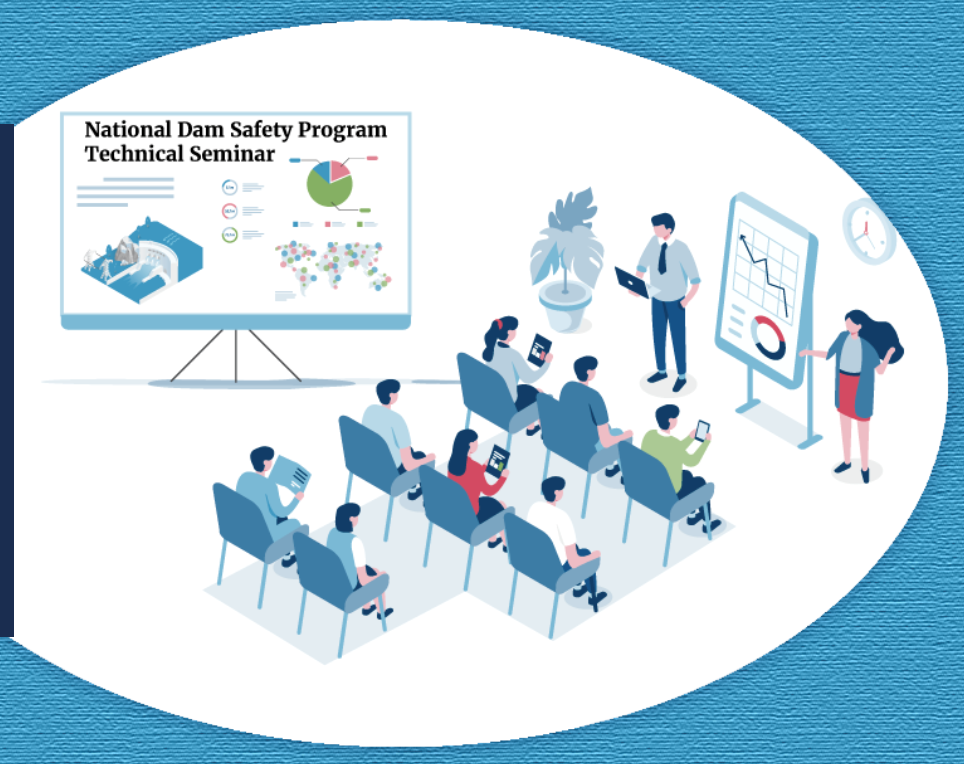
The 32nd FEMA National Dam Safety Program Technical Seminar is scheduled for Feb. 19-20 at the National Disaster and Emergency Management University in Emmitsburg, Maryland. This year’s theme is “Innovations in Dam Safety: Collaborative State and Federal Efforts."
This seminar will provide a comprehensive platform for state and federal agencies to collaborate on dam safety by featuring specialized sessions on dam modeling tools, updated resources, and grant requirements for state dam safety programs. Participants will also review evolving dam safety strategies, provide feedback on FEMA publications, and engage in a panel discussion on cross-sector collaborative efforts. The goal is to enhance decision-making, problem-solving and resilience in dam infrastructure through shared expertise and resources.
Don't miss your chance to register! Visit the National Dam Safety Program Technical Seminar webpage to apply.
Each year, the National Dam Safety Program Seminar unites professional dam safety practitioners to explore emerging challenges, research, technologies and regulations vital for the effective operation of our national dam infrastructure. This year's seminar emphasizes the crucial collaboration between state and federal agencies, highlighting joint efforts to address diverse challenges and enhance dam safety through shared expertise and resources.
Experience the excitement and breakthroughs of the 2025 National Dam Safety Program Seminar—watch the highlight video to learn how collaboration is shaping the future of dam safety!
Two new resources developed by FEMA in partnership with tribal emergency managers will help build, sustain, and improve emergency management capacity and resilience.
FEMA’s National Tribal Strategy redefines how the agency can better meet the needs of Tribal Nations and tribal community members by developing tribal-specific resources that support readiness, hazard mitigation, disaster response and recovery. Disaster preparedness and planning are critical to ensuring the safety and welfare of Tribal Nation communities. With natural disasters becoming more frequent and intense, now, more than ever, is the time to develop and build emergency management programs to reduce the impacts of disasters that can affect your Tribal Nation.
FEMA’s Quick Tip Guide for Starting a Tribal Emergency Management Program or Department and Having an Emergency Management Program Benefits Tribal Community Safety fact sheet were created in response to tribal partners’ request for products that better explain how to get started in tribal emergency management and the importance of disaster preparedness.
For additional tribal emergency management resources, visit FEMA’s Tribal Affairs Hub and Ready.gov.
FEMA has launched a user-friendly online dashboard showing the obligations of hazard mitigation investments across the nation.
The Building Resilient Infrastructure and Communities (BRIC) and Flood Mitigation Assistance Obligations Dashboard provides greater transparency on the agency’s two competitive grant programs. BRIC and Flood Mitigation Assistance help reduce disaster risk to natural hazards through community-driven resilience and hazard mitigation planning and projects. Viewers may access the dashboard here.
The dashboard shows agency data visually and geographically to better communicate progress and allow external stakeholders to get more information on when and where these federal investments are being spent.
It includes summary statistics, a dynamic explorer map, data visualizations, and detailed tables for users to gain a comprehensive understanding of hazard mitigation funding across the nation.
The dashboard is hosted on FEMA’s Geographic Information System (GIS) online platform and is built from the OpenFEMA data sets already available on FEMA.gov.
This effort underscores our dedication to equipping communities, policymakers and stakeholders with the tools they need to build resilience against natural disasters. It also aligns with FEMA’s “people first” approach to be more transparent on the obligations for grants selected for funding through BRIC and the Flood Mitigation Assistance annual grant programs.
Visit FEMA.gov for more information on the agency’s Hazard Mitigation Assistance programs.
FEMA announced the release of the Office of the Flood Insurance Advocate Fiscal Year (FY) 2023 in Review. The Office of Flood Insurance received the largest number of customer inquiries to date in FY23, with over 1,000 cases. Many were complex and required extensive research and collaboration across several components within the National Flood Insurance Program.
The Office of Flood Insurance advocates for the fair treatment of policyholders and property owners under the National Flood Insurance Program. The Office of Flood Insurance's FY23 Year in Review report provides insight into the inquiries they received in 2023 and “Advocate’s Advice” for navigating FEMA’s National Flood Insurance Program.
The Office of Flood Insurance fields inquiries from frustrated and confused customers, identifies trends in the issues these customers face and makes recommendations for program improvement based on these findings. The trends and recommendations are published yearly in annual reports.
The report is retrospective, providing a deeper analysis of the recent trends in the Office of Flood Insurance casework. It is organized into various sections, including insurance claims, mandatory purchase requirements and flood mapping.
A copy of the report can be found on FEMA.gov.
FEMA is hosting two webinars on the Response Inventory System (RIS) on Feb. 4, from 1-2 p.m. ET, and on Feb. 6, from 1-2 p.m. ET.
The webinar will cover the basic capabilities and functions of RIS and provide a live demonstration of using the tool. Resource management is the cornerstone of preparing for and responding to incidents that require mutual aid among agencies and jurisdictions.
The webinar will explain RIS’s role in the resource management process. This webinar will show participants how to use RIS to type, inventory, and prepare resources ahead of a disaster and provide a demo of using RIS when responding to a disaster. Participants will receive insights on the benefits of using RIS before, during and after a disaster. Participants will also be able to ask questions at the end of the presentation.
Please register in advance to attend the webinar at the links below:
For more information, visit the National Resource Hub.
.
FEMA is hosting the January Business and Industry Call on Tuesday, Jan. 28, from 3-4 p.m. ET.
The webinar will feature an expert panel discussion focused on public-private partnerships during disaster response. Esteemed panelists include North Carolina’s Business Emergency Operation Center, FEMA’s Region 4 External Affairs team, the Private Sector Emergency Management Association and Target. Panelists will discuss lessons learned, key opportunities and other highlights from recent response work and collaboration accomplished during the 2024 hurricane season. To register today, please visit FEMA January Business and Industry Call | FEMA.gov.
FEMA hosts monthly Business and Industry Calls to update National Business Emergency Operation Center members, business and industry organizations, and FEMA partners on the tools available during all stages of the disaster lifecycle. Each month features different topics presented by experts from FEMA, other interagency partners, and business and industry organizations. For organizations interested in joining the National Business Emergency Operation Center, please visit fema.gov/NBEOC.
Leaders of FEMA and the Cherokee Nation signed an agreement on Jan. 15 that will enable the Tribal Nation to deploy in support of FEMA’s operations during disasters, the first such agreement ever signed.
The Intergovernmental Service Agreement is a formal, binding contract. Under the agreement, FEMA’s Supplemental Response Team program is able to deploy to the Cherokee Nation’s Incident Management Team, giving it the opportunity to integrate with the federal response. The partnership will also create new opportunities for tribal emergency managers to increase their capacity and capabilities to respond on the federal level, which allows them to bring those skills back to their own communities.
The Supplemental Response Team program’s mission is to expand FEMA’s ability to respond to disasters by mobilizing our country’s best while building the capability and capacity of state, local, Tribal Nation and territorial incident management teams.
FEMA currently works with two other Supplemental Response Teams, New York and New Jersey. However, those two teams are activated through mission assignments. New Jersey plans to also sign a more formal Intergovernmental Service Agreement with FEMA in the near future, along with other teams across the country.
Read the full press release at FEMA.gov.
FEMA and the Disaster Recovery Coalition of America signed a memorandum of agreement on Tuesday, Jan. 14, that will enhance both organizations’ ability to carry out their emergency management missions.
The agreement describes the ways in which FEMA and the Disaster Recovery Coalition of America will cooperate to carry out their respective responsibilities regarding emergency declaration communications, disaster mitigation, disaster preparedness, operational readiness, response and recovery operations in the event of a disaster or emergency under the Stafford Act. This cooperation will help people and communities prepare for and recover from disasters.
The Disaster Recovery Coalition of America is a nonprofit trade association representing the top contractors, emergency management experts and industry leaders from over 15 industries. The Disaster Recovery Coalition of America mobilizes and guides a national network of America’s foremost private sector organizations specializing in resilience, disaster response, recovery and mitigation. The Disaster Recovery Coalition of America empowers its members to develop and implement cutting-edge strategies, operational frameworks and crisis management tools that reduce disaster risks and vulnerabilities, supporting local, state and national partners in achieving sustainable and equitable disaster recovery outcomes.
FEMA partners with a number of organizations like the Disaster Recovery Coalition of America to ensure recovery efforts encompass the whole community—which includes the private enterprise—to help people before, during and after disasters.
Read the full press release at FEMA.gov.
FEMA Requests Feedback on Two Draft Environmental Assessments by Jan. 21
FEMA published two Draft Supplemental Programmatic Environmental Assessments in the Federal Register for public comment. These items are required for review in accordance with the statute and implementing regulations for the National Environmental Policy Act.
The public comment period deadline for both assessments is 5 p.m. ET, Tuesday, Jan. 21.
The Safe Room Construction Supplemental Programmatic Environmental Assessment includes a reevaluation of the environmental analysis and underlying assumptions of the 2011 Programmatic Environmental Assessment. The proposed action includes the nationwide construction, retrofit or renovation of safe rooms eligible for FEMA grant funding.
The Grant Programs Directorate Programs Supplemental Programmatic Environmental Assessment includes a reevaluation of the environmental analysis and underlying assumptions of the 2010 Programmatic Environmental Assessment. The proposed action is the implementation of FEMA’s Grants Programs for security and response measures to improve preparedness.
....................................................................................................................................................
Annual FEMA Offer for Exercise Support Now Open
FEMA's National Exercise Program provides state, local, Tribal Nation and territorial jurisdictions with no-cost technical assistance for exercises designed to enhance preparedness and response capabilities. The 2025 exercise support requests can be submitted through March 3. New applicants are strongly encouraged to apply, especially those from underserved jurisdictions.
To learn more, including how to request this technical assistance for exercises, attend one of the webinars or office hours FEMA is hosting. All webinars will offer the same content. Register in advance by selecting the links below:
-
Session 2: Thursday, Jan. 23, at 11 a.m. ET: Session #2 Registration
- Office Hours: Friday, Jan. 24 at 2 p.m. ET: Office Hours Registration #2
-
Session 3: Wednesday, Jan. 29 at 4 p.m. ET: Session #3 Registration
- Office Hours: Thursday, Jan. 30 at 2 p.m. ET: Office Hours Registration #3
-
Session 4: Monday, Feb. 3 at 11 a.m. ET: Session #4 Registration
- Office Hours: Wednesday, Feb. 5 at 11 a.m. ET: Office Hours Registration #4
-
Session 5: Tuesday, Feb. 11 at 2 p.m. ET: Session #5 Registration
- Office Hours: Thursday, Feb. 13 at 4 p.m. ET: Office Hours Registration #5
-
Session 6: Thursday, Feb. 20 at 11 a.m. ET: Session #6 Registration
- Office Hours: Friday, Feb. 21 at 11 a.m. ET: Office Hours Registration #6
To learn more about the National Exercise Program, visit FEMA.gov. For specific questions, please email the program staff at NEP@fema.dhs.gov and include "2025 Exercise Support Question" in your subject line.
....................................................................................................................................................
Attend FEMA’s Webinar on Planning for Your Incident After-Action Review
FEMA will host a webinar on how to plan for data collection and analysis for real-world incident after-action reports from 1-2 p.m. ET on Thursday, Jan. 23. This webinar will emphasize approaches for planning incident after-action reviews outlined in FEMA’s National Continuous Improvement Guidance.
After-action reviews are critical for emergency managers to identify strengths, potential best practices, areas for improvement and mission critical issues during and following real-world incidents. During this webinar, FEMA will equip participants with a systematic approach to successfully collect and analyze data to inform real-world incident after-action review products. The webinar will also review resources focused on developing data collection and analysis plans that are available on the Continuous Improvement Technical Assistance Program’s website in the FEMA Preparedness Toolkit.
The webinar is designed to support the development of state, local, Tribal Nation and territorial partners’, non-governmental organizations’, the private sector’s continuous improvement capabilities in emergency management.
To attend the webinar, register in advance by visiting the event page on FEMA.gov and click the "Register Online" button. If an issue arises while registering or logging in, please contact the FEMA CITAP Team at FEMA-CITAP@fema.dhs.gov.
....................................................................................................................................................
Register for the 2025 Radiological Emergency Preparedness Scenario Guidance Listening Sessions
FEMA will host a series of listening sessions through the agency's Radiological Emergency Preparedness Program. The session will gather feedback on existing exercise scenario guidance found in the 2023 Radiological Emergency Preparedness (REP) Program Manual. The sessions will allow state, local, Tribal Nations, territorial, industry and federal stakeholders the opportunity to provide feedback on the challenges presented in implementing REP exercise scenarios.
FEMA will seek feedback on potential improvements to REP scenario guidance. Registration links are listed below. You can also find these sessions listed on the FEMA Events page. Once registered, you will receive a meeting invitation with the link to join.
REP Scenario Guidance Listening Session #2
-
Date: Thursday, Jan. 23.
-
Time: 1-2 p.m. ET.
-
Location: MS Teams Register Here.
REP Scenario Guidance Listening Session #3
-
Date: Thursday, Jan. 30.
- Time: 1-2 p.m. ET.
- Location: Zoom Register Here
REP Scenario Guidance Listening Session #4
-
Date: Thursday, Feb. 6.
-
Time: 1-2 p.m. ET.
-
Location: MS Teams Register Here.
....................................................................................................................................................
$210M in Additional Funds Available to Protect Faith-based and Nonprofit Organizations
The Department of Homeland Security (DHS), through FEMA, is accepting applications for $210 million in Nonprofit Security Grant Program (NSGP) funds as the second tranche of additional funding that the Biden-Harris Administration secured to protect faith-based institutions and nonprofit organizations against targeted attacks.
The Notice of Funding Opportunity was published on Oct. 28, 2024. Completed applications must be submitted in the FEMA Grants Outcome (GO) system no later than 5 p.m. ET on Jan. 24.
Supporting materials for stakeholders are available on the Nonprofit Security Grant Program | FEMA.gov. All application materials are also posted on Grants.gov. Eligible applicants should submit their application through FEMA GO. Applicants needing technical support with the FEMA GO system should contact FEMAGO@fema.dhs.gov or (877) 585-3242, Monday-Friday from 9 a.m. - 6 p.m. ET.
....................................................................................................................................................
FEMA is Accepting Youth Preparedness Council Applications
FEMA is accepting applications for the Youth Preparedness Council. Students must complete their applications by March 3.
Register for the Youth Preparedness Council Webinar to Learn More
Teens in grades eight through 11 who are interested in applying for the Youth Preparedness Council can learn more about the process and have their questions answered in a webinar at 8 p.m. ET, Thursday, Jan. 30. The webinar will walk students through the application process and give applicants a glimpse of what it’s like to be on the council. Please register for this webinar in advance at this Zoom link.
During their one-year term, council members collaborate virtually with each other to develop projects that promote preparedness on a local and national scale. Members will also have the chance to engage with top leaders within FEMA, the federal government, and national nonprofit organizations.
If you know a teen interested in preparedness and community service, encourage them to apply.
To learn more about the Youth Preparedness Council, visit Youth Preparedness Council | FEMA.gov.
....................................................................................................................................................
FEMA Announces $1.35B to Increase Resilience to Extreme Weather Events Nationwide
FEMA has announced that the agency is making $1.35 billion available for two grant programs designed to help communities enhance their resilience to the impacts of increasingly frequent and extreme weather events. The Building Resilient Infrastructure and Communities (BRIC) annual grant program is making $750 million available for projects that protect people and infrastructure from natural hazards and the effects of extreme weather events. The Flood Mitigation Assistance program is making $600 million available for projects that mitigate flood risks facing homes and communities across the nation.
The funding opportunities for BRIC and Flood Mitigation Assistance grants will be available on Grants.gov.
The application period opened on Jan. 6. Eligible applicants must apply for funding using FEMA Grants Outcomes, FEMA’s grants management system. Applications must be submitted in the portal no later than 3 p.m. ET on April 18. FEMA will not consider applications after this deadline. The application deadlines are for applicants only. Local governments should consult with their state, tribal or territorial agencies to confirm deadlines to submit subapplications.
FEMA plans to host several webinars to educate state, local, Tribal Nation and territorial governments on the programmatic changes. More information will be shared as it becomes available on FEMA.gov.
....................................................................................................................................................
|


