
FEMA is hosting a virtual event at 1 p.m. ET, Friday, Aug. 23, titled "A National Conversation on Resilience in America.” This event is part of FEMA’s Year of Resilience campaign as an opportunity for experts across the federal family, state, local and private sectors to convene and share stories, funding opportunities and strategies for building resilience nationwide.
August is National Resilience Month at FEMA, and this event promises to be an enlightening and empowering experience for all attendees. The agenda includes engaging in conversations on resilience and the critical need to invest in resilience today to prepare for an uncertain tomorrow. Attendees will have the unique opportunity to hear from influential speakers who will share inspiring examples of resilience-building efforts in their diverse communities.
Register today and join Department of Homeland Security Secretary Alejandro Mayorkas, FEMA Administrator Deanne Criswell and our partners in this crucial discussion at 1 p.m. ET, Friday, Aug. 23. You can also watch the video, FEMA Administrator Announces National Resilience Month and Virtual Event on YouTube to learn more.
The Integrated Public Alert and Warning System (IPAWS) is FEMA's national system for local alerting that provides authenticated emergency and life-saving information to the public through mobile phones. To assist with this, the new Integrated Public Alert and Warning System Assistive Tool Platform (ATP) offers a unified login to access the Message Design Dashboard, the Message Viewer and future tools to help Alerting Authorities gain confidence and proficiency in sending public alerts. An Alerting Authority is a jurisdiction with the designated authority to use IPAWS to alert and warn the public when there is an impending natural or human-made disaster, threat or dangerous or missing person.
The Message Design Dashboard can be used to quickly generate alerts based on cutting-edge best practices in crisis psychology and social science research. The Message Viewer can view messages sent to the IPAWS non-public demonstration environment.
IPAWS is FEMA's national system for local alerting. It provides authenticated emergency and life-saving information to the public through mobile phones using Wireless Emergency Alerts, to radio and television via the Emergency Alert System and on the National Oceanic and Atmospheric Administration's Weather Radio.
Benefits of ATP includes:
- Availability to current IPAWS Alerting Authorities and the public.
- Unified account login for current and future IPAWS utilities.
- Access to the Message Design Dashboard and Message Viewer.
- Current IPAWS Alerting Authorities can set their preferred ID so that utilities automatically load related profile information.
- Messages created in the Message Design Dashboard are saved to users’ profiles and can be quickly reloaded or edited at any time.
The Message Design Dashboard (MDD) allows Alerting Authorities to rapidly draft effective messages that are complete, clear, certain and consistent, with the power to motivate action. Alerting Authorities input pertinent information about their emergency into the MDD, and it will automatically produce draft 90- and 360-character alerts based on cutting-edge best practices in crisis psychology and social science research. A database informs the MDD of content for more than 50 hazards across a range of domains. It includes hazard impact statements and protective action guidance that have been vetted with subject matter experts and reviewed by communication scholars.
We encourage first-time users to complete training on the dashboard and effective message writing. On the MDD Training Page, you can take self-paced introductory training and register for instructor-led courses.
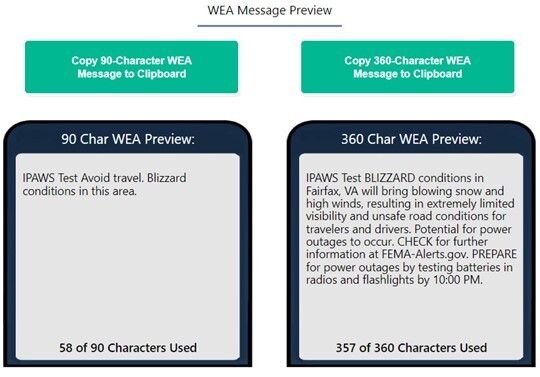
The IPAWS Message Viewer is a verification tool designed to assist Alerting Authorities with alert tests and exercises within the IPAWS demonstration environment. The user-friendly interface returns the alert status to the tester through visual confirmation and status codes. The IPAWS Message Viewer assures Alerting Authorities that they are using their alert origination tool properly before posting an IPAWS alert to the live environment.
IPAWS will continue adding testing and training resources to the ATP to help Alerting Authorities develop the most effective emergency communications with the public. The IPAWS Office is currently investigating language translation applications for inclusion in the ATP and adding an IPAWS-OPEN Status Indicator and a Proficiency Demonstration Scenario Builder.
For first-time access, the IPAWS user must create an account. We recommend following the IPAWS Alerting Authority ATP User Guide to complete the sign-up process. It explains how to navigate the platform and access the applications.
Please note that the Integrated Public Alert and Warning System Assistive Tool Platform is not a replacement for the IPAWS User Portal.
FEMA's Continuous Improvement Technical Assistance Program (CITAP) is hosting a webinar on Common Data Collection Methods for Incident After-Action Reviews to help organizations learn how to collect data to support real-world incident after-action reviews. The webinar is from 10-11 a.m. ET, Tuesday, Aug. 20, and will focus on the data collection methods outlined in FEMA’s National Continuous Improvement Guidance.
During this webinar, FEMA aims to equip participants with an understanding of common after-action review data collection methods (e.g., surveys, interviews, hotwashes), learning the pros and cons of these methods and when to use each method. Data collection after an incident is key to identifying best practices, strengths and areas for improvement. The webinar will also review data collection-related resources available on the FEMA Preparedness Toolkit webpage.
The webinar is designed to support the development of state, local, Tribal Nation and territorial partners, non-governmental organizations and private sector organizations with continuous improvement capabilities in emergency management.
Register in advance by visiting the webinar’s event page on FEMA.gov and clicking the "Register" button. If an issue arises while registering or logging in, please contact the FEMA CITAP Team at FEMA-CITAP@fema.dhs.gov.
.
FEMA’s Office of Business, Industry and Infrastructure Integration is hosting the August Business and Industry Call. The virtual event will be held from 3-4 p.m. ET on Tuesday, Aug. 27.
The webinar will focus on the critical aspects of emergency risk analysis for business owners and communities. Panelists will highlight various of tools, resources and best practices for effectively identifying, assessing and mitigating risks. To register, visit August Business and Industry Call.
FEMA hosts monthly Business and Industry Calls to update National Business Emergency Operations Center members, business and industry organizations, and FEMA partners on the tools available during all stages of the disaster lifecycle. Each month, experts from FEMA, other interagency partners, and business and industry organizations present different topics. For organizations interested in joining, please visit fema.gov/NBEOC.
FEMA is releasing two new Federal Continuity Directives (FCDs), Federal Executive Branch Essential Functions Risk Identification and Management and Federal Executive Branch Continuity Program Management Requirements.
Federal Continuity Directive: Federal Executive Branch Essential Functions Risk Identification and Management provides:
- Federal Executive Branch organizations with guidance to identify essential functions and supporting activities.
- Account for the resources and processes needed to perform them.
- Identify vulnerabilities and resultant essential function risks.
- Implement continuity options to mitigate risk.
It enables organizations to identify opportunities to close gaps, address vulnerabilities and prioritize investments that improve their essential function resilience and achieve National Continuity, including Federal Mission Resilience.
Federal Continuity Directive: Federal Executive Branch Continuity Program Management Requirements establish the minimum requirements for organizations to build and maintain a viable continuity program and increase the U.S. government's overall resilience. It includes program management guidance and a comprehensive continuity planning process to responsibly guide the activities that ensure the performance of essential functions and promote National Continuity, including Federal Mission Resilience.
For assistance or questions concerning the Continuity Planning Framework for the Federal Executive Branch, please contact FEMA's Office of National Continuity Programs Associate Administrator by emailing FEMA-NationalContinuity@fema.dhs.gov.
In late 2023, FEMA’s Resource Typing Library Tool on PrepToolKit was updated to host all National Qualification System job titles, position qualifications, position task books and emergency operations center skillsets.
In a series of final updates this month, numerous individual resource PDFs were removed from FEMA.gov and moved to a new, centralized platform on the Resource Typing Library Tool. The Resource Tool, which is an easy-to-navigate format, allows user to view the posted documents online or download any one as an individual PDF.
Users of this content can still find quick links to the Library Tool resources they need from the National Incident Management System page on FEMA.gov. Web buttons take visitors directly to National Qualification System job titles and position qualifications, position task books and emergency operations skillsets.
.
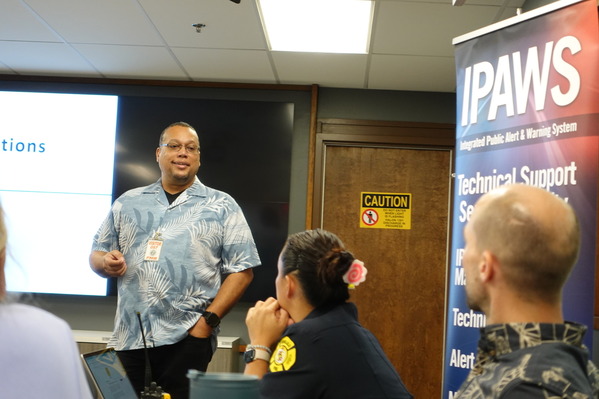 IPAWS Director Manny Centeno discusses the importance of emergency communications with the public during IPAWS-designed Alerter Training at the city and county of Honolulu Emergency Operations Center on July 31, 2024.
FEMA’s Integrated Public Alert and Warning System (IPAWS) team spent a week delivering the IPAWS Training Series in Honolulu, Hawaii. The July 29 through Aug. 2 visit started with executive training for Honolulu Mayor Rick Blangiardi and senior staff on the importance of developing and strengthening governance and policy and procedures for public warning and emergency communications with the public.
Director Manny Centeno and the IPAWS team led a series of training and demonstrations throughout the week to bolster resilience and preparedness of emergency alerting officials in Hawaii. The IPAWS training series sees FEMA collaborate with executive leaders, alert originators and emergency communications professionals.
The IPAWS team met with local alerting authorities at the Honolulu Dispatch Center to discuss the future of emergency communications and the utility of IPAWS. IPAWS hosted two types of training sessions covering the Common Alerting Protocol and a demonstration at the new National Public Warning System radio station in Honolulu, KHKA. In addition, IPAWS took part in the Monthly Siren Demonstration at KHKA. This was a unique opportunity for IPAWS and Honolulu’s local alerting authority to practice and ensure effective emergency communications to the public.
IPAWS is FEMA’s national system for local emergency alerts and is committed to supporting Hawaii in strengthening its alert and warning ecosystem, allowing for more reliable and resilient public safety information across all islands and communities.
…………………………………………………………………………………………………………..
FEMA Hosts Resume Writing Workshops for Interested Applicants
FEMA will host a recurring virtual resume writing workshop on the second Tuesday of the month from 5-6:30 p.m. ET to help interested applicants tailor their resumes for federal employment at FEMA. The next workshop will be held Tuesday, Aug. 13.
Attending a resume writing workshop can help you to take your resume to the next level. By joining a workshop, you will receive expert guidance from professionals who understand the challenging requirements of federal resumes and will provide you with the tools needed to ensure your resume complies with federal resume requirements. Specific topics to be covered will include, an overview of FEMA, federal resume writing tips, navigating USAJobs and additional resources.
To register, visit Webinar Registration - Zoom (zoomgov.com) or FEMA Resume Writing Workshop | FEMA.gov. For questions and to request reasonable accommodations, email FEMA-Recruiting-Assistance@fema.dhs.gov.
…………………………………………………………………………………………………………..
Attend the Radiological Emergency Preparedness Lunch and Learn Series
The FEMA Radiological Emergency Preparedness Program (REPP) will host Lunch and Learn opportunities every Thursday in August. Each session will focus on a different topic, covering updates to the 2023 REP Program Manual (RPM).
The list of topics covered each week are below:
- Aug. 15 - Part 2: REPP Planning Guidance.
- Aug. 22 - Part 3: REPP Alert and Notification System Guidance.
- Aug. 29 - Part 4: REPP Assessment Policies and Guidance.
After registration, you will receive a meeting invitation with the link to attend. For more information about REPP sessions and registration, visit (RPM) August Webinars on FEMA.gov.
To learn more about the REP program, trainings and additional resources, including the REPP's standard operating guide, reference library, final after-action reports and national public information map, visit Radiological Emergency Preparedness on FEMA.gov.
…………………………………………………………………………………………………………..
FEMA Releases Updated Guide to Help Communities with Resilience Grants Process
Following valuable feedback from grant applicants, FEMA updated the Hazard Mitigation Assistance Guide to make it more user-friendly.
The update consolidates information and eligibility requirements for Hazard Mitigation Assistance projects addressing air quality, drought, extreme temperatures, wildfire and wind. It also reflects recent policy changes to simplify program delivery through streamlined cost effectiveness methods and a lower benefit-cost analysis discount rate.
This edition builds on the last year’s update which incorporated climate change and future conditions, equity, building codes, capability and capacity building, nature-based solutions and community lifelines as key principles for its grant programs. The Hazard Mitigation Assistance update was also the first guide to cover Building Resilient Infrastructure and Communities (BRIC).
FEMA is offering two office-hour sessions to provide an overview of recent updates. Registration is now open for the following sessions:
Visit FEMA.gov to access the guide.
…………………………………………………………………………………………………………..
FEMA Announces $5.4M Available in Competitive Training Grants for Rural and Tribal Preparedness
FEMA has made $5.4 million available for the Fiscal Year 2024 Competitive Training Grants to focus on “Rural and Tribal Preparedness for Equitable Outcomes." These funds are provided through the Homeland Security National Training Program’s Continuing Training Grants. This program helps develop and deliver FEMA-certified training solutions to help the emergency management and first responder communities. Funding through the grants is provided as a cooperative agreement and awarded directly to the recipients.
The delivery and development of these innovative training programs play an important role in implementing the National Preparedness System and support the core capabilities essential to achieving the National Preparedness Goal for a secure and resilient nation.
The Notice of Funding Opportunity was posted on Grants.gov, Monday, July 8. Eligible Homeland Security National Training Program applicants must submit their application no later than 11:59 p.m. ET, Friday, Aug. 16.
…………………………………………………………………………………………………………..
FEMA Seeks Social Scientist to Improve Community Preparedness
FEMA is searching nationwide for an experienced social scientist to assist the agency in integrating social and behavioral science best practices to improve the equitable, people-centered delivery of our products and programs. Applications for this unique opportunity are being accepted until Sunday, Aug. 18.
The Social Scientist Partner will work with programs across the agency, advising on implementing data-informed decision making. Candidates should have an advanced degree in sociology, anthropology, psychology or a related social science discipline, proven experience in conducting social science research, strong written and verbal skills and the ability to work independently and as part of a team.
More information, including application instructions, can be found at Social Scientist Partnership on FEMA.gov.
…………………………………………………………………………………………………………..
FEMA Requests Public Comment on Latest Public Assistance Program and Policy Guide
FEMA is requesting public comments on its latest Public Assistance Program and Policy Guide, which focuses on plain language and increased eligibility for assistance. The 60-day public comment period opened June 18, and written comments may be submitted on the Federal Register Portal and FEMA.gov through 5 p.m. ET, Monday, Aug. 19.
With this updated guide, Public Assistance applicants will be able to maximize the program’s authorities by submitting cost summaries for their projects rather than detailed, itemized cost information. Likewise, applicants will experience reduced documentation with the ability to group projects with similar damage together rather than undergo individual inspections to help keep recovery moving forward.
To ensure equitable outcomes, applicants can help FEMA prioritize projects that benefit vulnerable populations by submitting information to determine whether disaster impacts affect any underserved communities. In addition, houses of worship and their role in communities pre- and post-disasters are now specifically mentioned in the guide to ensure these types of nonprofits have access to assistance. To promote resiliency when building back, version 5 includes a section on nature-based solutions, which incorporates natural features or processes into the project design and construction phase.
The guide offers an overview of Public Assistance program and policy and how to apply to all disasters declared on or after its publication date.
…………………………………………………………………………………………………………..
New Campaign Features Civil Rights Training for FEMA Grant Recipients
In August, FEMA will launch the Recipients’ Awareness Campaign. The purpose of the campaign is to educate and inform FEMA grant recipients and sub-recipients about compliance with civil rights laws and their responsibilities to administer programs and activities without discrimination. The campaign will help recipients and their communities develop effective, efficient, inclusive disaster preparedness and recovery strategies.
During the trainings, FEMA’s Office of Civil Rights will directly engage a large audience of recipients and sub-recipients with information about relevant civil rights laws and executive orders that affect how they provide services to their beneficiaries. Participants will have the opportunity to ask questions about compliance with civil rights laws as they create or review their policies and programs.
The first training session will be held on Wednesday, Aug. 21, from noon to 4 p.m. ET, with others to follow throughout the year.
If you know a recipient or sub-recipient of FEMA’s financial assistance, please send them a message and encourage them to register to attend. For more information, they can contact FEMA-RecipientsAwarenessCampaign@fema.dhs.gov.
…………………………………………………………………………………………………………..
FEMA Seeks Public Comment on the Community Rating System
FEMA has published a notice in the Federal Register seeking public comment on the National Flood Insurance Program’s Community Rating System. The public can provide comments on the suggested alternative program features to the Community Rating System by submitting a response to the Federal Register Notice Request for Information on Regulations.gov. In addition, FEMA is offering public meetings in August and individuals can register for a session.
FEMA is seeking input on the suggestions and approaches for a redesigned Community Rating System. This is based on public input from the August 2021 request for information (Docket ID “FEMA-2021-0021”) and recommendations from the July 2023 Government Accountability Office report, FEMA's New Rate Setting Methodology Improves Actuarial Soundness but Highlights Need for Broader Program Reform (GAO-23-105977).
FEMA will host three 90-minute public meetings to explain the suggested alternative program features and how to provide information for public comment. Participants must register in advance and will be confirmed on a first-come, first-served basis.
Anyone interested may register online and attend a public meeting on:
Written comments must be submitted by Sept. 9 on the Federal eRulemaking Portal, Docket ID: FEMA-2024-0022. Please follow the instructions on the page for submitting comments and contact the Regulations.gov Help Desk if you have technical issues. Visit FEMA.gov for more information about the Community Rating System.
…………………………………………………………………………………………………………..
FEMA Requests Public Comment on Updated Preliminary Damage Assessment Guide
FEMA is requesting public comments on its updated Preliminary Damage Assessment (PDA) Guide, which includes clarifications for conducting joint preliminary damage assessments, adjustments on eligibility requirements and reviews on exceptions or special considerations for Tribal Nations. The 30-day public comment period opened July 22 and written comments may be submitted on FEMA.gov through Thursday, Aug. 22.
The guide helps emergency management officials at all levels of government efficiently complete accurate and consistent preliminary damage assessments that align with the Stafford Act Presidential disaster declaration request requirements.
Any remarks received during the comment period will be reviewed and considered for the final version of the PDA Guide.
…………………………………………………………………………………………………………..
FEMA Seeks Input on its Disaster Case Management Program
FEMA published a Request for Information notice on SAM.gov, seeking input from post-trauma case management and emergency management professionals to help remove barriers, identify best practices and find innovative solutions related to its Disaster Case Management program.
Insights and expertise from professionals in these fields can help inform future changes to the program, ensuring that it effectively connects survivors to the wide range of disaster assistance available.
This Request for Information is a continuation of FEMA’s recent updates to its Individual Assistance program, which focused on establishing new and flexible forms of assistance, cutting through red tape and simplifying the application process for survivors. Enhancing the Disaster Case Management program is vital to simplifying processes for survivors so they can find and access help when they need it most.
FEMA encourages all professionals in post-trauma case management and emergency management to provide their valuable feedback.
To participate, please visit the Request for Information notice on SAM.gov and submit your comments by Sunday, Aug. 25.
Please note that responses to these notices are not offers and cannot be accepted by the government to form a binding contract.
…………………………………………………………………………………………………………..
National Floodplain Administrator Requests Assessment Survey by Aug. 30
FEMA manages the National Flood Insurance Program, which includes more than 22,600 participating communities. This year, FEMA is conducting a National Floodplain Administrator Needs Assessment survey of the nation’s floodplain administrators who manage local floodplains for these jurisdictions. This is the first nationwide survey since 2009.
FEMA wants to hear from local governments and their staff about how training can be improved to help them protect their communities and retain existing floodplain administrators. The survey is available in English and Spanish. The survey will close Friday, Aug. 30.
…………………………………………………………………………………………………………..
Register for the Great ShakeOut!
Earthquakes can happen anywhere with little to no warning. Do you know how to keep your family, employees or stakeholders safe? Knowing what to do before a big earthquake can determine how well you survive and recover. Join FEMA in the world's largest earthquake drill on Oct. 17!
Register today so that you or your organization will:
- Be counted in the largest-ever earthquake drill in the world!
- Be listed with other participants in your area, if desired.
- Set an example that motivates others to participate and prepare.
- Get updates with ShakeOut news and preparedness tips.
- Have peace of mind that you, your family, your co-workers and millions of others will be better prepared to survive and recover quickly from the next big earthquake!
Get ready to DROP, COVER and HOLD ON. Spread the word! Please ask friends and family to text SHAKEOUT to 43362. Visit Earthquakes | Ready.gov to learn more about how to stay safe before, during and after an earthquake.
…………………………………………………………………………………………………………..
FEMA Announces $300M to Strengthen Community Resilience to Flooding
The third round of Swift Current funding is now available to help National Flood Insurance Program policyholders across the nation become more resilient to flooding. FEMA is using $660 million from President Biden’s Bipartisan Infrastructure Law for the Flood Mitigation Assistance Program’s Swift Current opportunity.
For the first Swift Current announcement in 2022, FEMA made available a total of $60 million. The second announcement in 2023 made $300 million available and expanded criteria to benefit more places, which as of May 30, includes 19 states and one Tribal Nation.
The application window opened on June 1, 2024, and the last eligible disaster declaration date is May 31, 2025. The funding opportunity is available on Grants.gov. Potential applicants who have questions may contact their FEMA regional office.
All applications must be submitted in FEMA Grants Outcomes (FEMA GO) and will be reviewed on a rolling basis. The application deadline date will be provided to the applicant. Applications received by FEMA after the deadline will not be considered for funding. For more information, interested NFIP policyholders should contact their state or territory hazard mitigation officer.
…………………………………………………………………………………………………………..
|


