|
For 50 years, the United States Fire Administration (USFA) has been working for a fire-safe America. Early this month, President Biden signed a bill extending the USFA authorization through Sept. 30, 2028.
The USFA, FEMA's fire prevention and control branch, was established in 1974 when Congress passed the Federal Fire Prevention and Control Act. Since its inception, USFA has helped to reduce the occurrence of fire and the number of fire deaths and make our nation’s communities and residents safer.
The USFA works with federal, state, local, Tribal Nation and territorial partners and nongovernmental stakeholders to improve public safety, including:
- Collecting and analyzing data.
- Administering national fire and emergency medical service programs.
- Increasing public awareness about fire safety.
- Reducing community risks and delivering specialized training through the National Fire Academy.
While residential fires are of major concern, so are extreme weather-driven wildfires in suburban communities. They are becoming more frequent and more destructive in more places. The fire that devastated the Hawaiian island of Maui last summer was the deadliest our country has faced in over 100 years.
This May, the USFA held its first-ever World Fire Congress in Washington, D.C. The inaugural event brought together fire service leaders representing 56 countries, the United Nations Office for Disaster Risk Reduction and the Directorate-General for European Civil Protection and Humanitarian Aid Operations. This meeting was critical to sharing best practices and wildfire strategies strengthening all participants' ability to respond.
In October 2024, the USFA will host its annual signature event – the U.S. Fire Administrator’s Summit on Fire Prevention and Control – assembling the leaders of national fire service organizations to discuss fire problems across the country along with the challenges facing America’s fire service and collaborate on solutions.
These collaborations strengthen our partnerships and demonstrate our continuing commitment to address the universal issues affecting all firefighters and heighten our readiness as we head into peak wildfire season.
Support to our Nation’s Firefighters
With a focus in 2024 on the Year of Resilience, FEMA is increasing efforts to enhance response capabilities at all levels. In January, FEMA Administrator Deanne Criswell announced the opening of the latest application period for the Fiscal Year 2023 Assistance to Firefighters Grant (AFG) program, which awards $324 million to enhance the safety of the public and firefighters nationwide against fire-related deaths and hazards. Since fiscal year 2001, the AFG has awarded approximately $8.4 billion in grants to provide critically needed resources to help keep firefighters and the public safe from fires and fire-related hazards. The Fire Prevention and Safety Grants are part of the AFG and support projects that enhance the safety of the public and firefighters from fire and related hazards.
The Staffing for Adequate Fire and Emergency Response (SAFER) Grant program was created to provide funding directly to fire departments and volunteer firefighter interest organizations to help them increase or maintain the number of trained, "front line" firefighters available in their communities.
As we look to the future, USFA’s reauthorization and the reauthorization of the AFG and SAFER grants give us the opportunity to continue our steadfast and ever-growing commitment to keeping America fire safe.
For the fifth consecutive year, FEMA is announcing updates to a free, easy-to-use geographic information systems (GIS) tool that helps emergency managers and community partners visualize, prioritize and implement strategies to build resilience. This tool assesses potential challenges to community resilience to help make strategic decisions for mitigation, response and recovery.
The 2024 update of the Resilience Analysis and Planning Tool (RAPT) includes new census data from the American Community Survey five-year estimate (2018-2022) and updated Community Resilience Challenges Indices (CRCI) for counties and census tracts. The web map allows users of all GIS skill levels to combine layers of community resilience indicators, infrastructure locations and hazard data. The 2024 update also includes a preview of Future RAPT built with ArcGIS Experience Builder, Esri’s new web app tool.
The announcement aligns with the 2024 FEMA Year of Resilience theme to build capacity to withstand tomorrow’s hazards. FEMA defines resilience as the ability to prepare for threats and hazards, adapt to changing conditions and withstand and recover rapidly from disruptions.
RAPT includes more than 100 pre-loaded data layers and the tool’s functionality allows users to visualize combinations of these data layers for a specific location. This update of RAPT includes:
- Updated U.S. Census data: Latest American Community Survey five-year estimates (2018-2022) with refreshed pop-ups.
-
Take a Tour: New walkthrough of the site built right into the tool.
-
County Overview: This dashboard provides at-a-glance information at the county level.
FEMA will host three interactive webinars on RAPT. Each webinar will cover the same content. Please register for one of these 60-minute sessions:
Visit the RAPT Resource Center to access supporting materials, learn more about RAPT functionality and see how it can improve resilience planning in your community.
FEMA is requesting public comments on its updated Preliminary Damage Assessment (PDA) Guide, which includes clarifications for conducting joint preliminary damage assessments, adjustments on eligibility requirements and reviews on exceptions or special considerations for Tribal Nations. The 30-day public comment period opened July 22 and written comments may be submitted on FEMA.gov through Aug. 22.
The guide helps emergency management officials at all levels of government efficiently complete accurate and consistent preliminary damage assessments that align with the Stafford Act Presidential disaster declaration request requirements.
The 30-day public comment period opened July 22, and written comments may be submitted on FEMA.gov through Aug. 22. Any remarks received during the comment period will be reviewed and considered for the final version of the PDA Guide.
FEMA is currently working to update the Tribal Mitigation Planning Policy. A key part of this effort has been Nation-to-Nation engagement. From June 2023 to March 2024, FEMA’s National Mitigation Planning Program engaged with Tribal Nations through in-person and virtual consultations, feedback sessions and regional outreach.
Through this effort, FEMA gathered feedback on the current policy and priorities for its update. Now, FEMA is releasing a summary of this input in the Tribal Mitigation Planning Policy Update: Summary of Feedback Report.
Tribal Nations create hazard mitigation plans to reduce the risk and impact of natural hazards. When they have FEMA-approved plans, they can also access additional disaster assistance and funding.
The current Tribal Mitigation Planning Policy was released in 2017. The policy update will affect Tribal Nations across the country. It is expected to be released in 2025. The release date is subject to change and there will be a one-year period before the policy becomes effective.
FEMA collected 70 unique comments through the tribal engagement process. Key themes from tribal representatives’ feedback included:
- General comments about tribal mitigation planning.
- Challenges accessing grants.
- Limited capacity and staff turnover.
- Commenters also noted difficulties with the grants process, concerns about climate change and the need to recognize Tribal knowledge and sovereignty.
The National Mitigation Planning Program is working closely with FEMA Tribal Affairs to review and address these comments.
To view the Summary of Feedback Report and learn more about the policy update, visit FEMA’s Tribal Mitigation Planning Policy Updates page.
FEMA is searching nationwide for an experienced social scientist to assist the agency in integrating social and behavioral science best practices to improve the equitable, people-centered delivery of our products and programs. Applications for this unique opportunity are being accepted until Aug. 18.
The Social Scientist Partner will work with programs across the agency, advising on implementing data informed decision making. Possible duties may include:
- Determining effective risk communication methods for diverse people and communities, including guidance on issuing alerts, warnings or other public information related to preparedness, mitigation, response and recovery.
- Understanding of barriers people face in taking recommended protective actions (e.g., investing in safe rooms, preparing for disaster, evacuating, purchasing flood insurance, etc.) and developing recommended program solutions to address those barriers and drive behavior change.
- Guiding analysis of data from the National Household Survey, which FEMA conducts to understand the public’s preparedness actions, attitudes and motivations and proposing programmatic changes to address survey findings to increase preparedness of households across the nation.
- Recommending effective, research-based methods for youth education and communication to drive life-long effective risk reduction behavior through FEMA-developed curriculum.
Candidates should have an advanced degree in sociology, anthropology, psychology or a related social science discipline, proven experience in conducting social science research, strong written and verbal skills and the ability to work independently and as part of a team.
More information, including application instructions, can be found at Social Scientist Partnership on FEMA.gov.
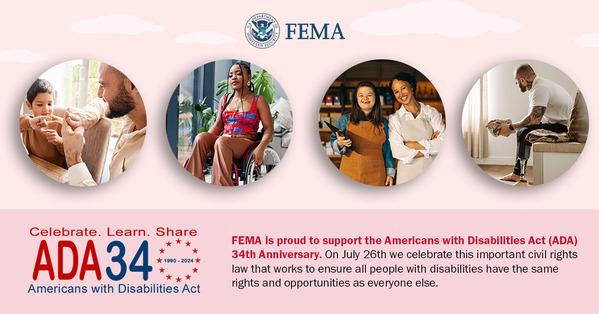
After a disaster, FEMA works not only to help as many people as possible but also provides help tailored to meet the unique needs of all survivors. The Americans with Disabilities Act (ADA) is a guiding force for equality and accommodation for these efforts. One major way the ADA has shaped the agency is through recent changes to FEMA’s Individual Assistance program.
Earlier this year, FEMA updated the program to make it easier for people with disabilities and others with access and functional needs to participate in the program to ensure all survivors can navigate their disaster recovery successfully.
Learn more about these updates and how they align with the principles of ADA at FEMA.gov.
 .
…………………………………………………………………………………………………………..
Apply for Regional Catastrophic Preparedness Grants by July 25
FEMA released the funding notice for the Fiscal Year (FY) 2024 Regional Catastrophic Preparedness Grant Program. The program provides $10.8 million to eligible states and local governments to close known preparedness capability gaps, encourage innovative regional solutions to issues related to catastrophic incidents and build on existing regional preparedness efforts.
Awards will be made on a competitive basis to applicants who present an ability to successfully meet the requirements described in the funding notice.
The application period will close at 5 p.m. ET on July 25. Submissions must be made through FEMA Grants Outcomes (GO). The Notice of Funding Opportunity is available on Grants.gov (Assistance Listings Number 97.111), as well as on the FEMA website at www.fema.gov/grants.
…………………………………………………………………………………………………………..
Fiscal Year 2024 Spring Dam Safety State Assistance Grant Application Period Closes July 26
The application period for FEMA’s Fiscal Year 2024 Spring Dam Safety State Assistance Grant Program opened on June 24 and will close on Friday, July 26. This year’s funding opportunity is for $7.5 million. The State Assistance grant program provides financial assistance to states and territories to help strengthen the administration of their dam safety programs. Eligible activities include training for state dam safety personnel, dam inspections, public awareness campaigns, emergency action plans and similar activities.
To be eligible for the grant, applicants must have a state dam safety program authorized by state legislation and be working toward meeting specific criteria and budgeting requirements. Each state or territory will submit one application to FEMA on behalf of its respective dam safety program.
All applications must be submitted through FEMA Grant Outcomes. Applicants can find more detailed information on applicant eligibility and the application process on this fact sheet. The Dam Safety webpage on FEMA.gov will be periodically updated with timeline and award information.
…………………………………………………………………………………………………………..
FEMA Announces $5.4M Available in Competitive Training Grants for Rural and Tribal Preparedness
FEMA has made $5.4 million available for the Fiscal Year 2024 Competitive Training Grants to focus on “Rural and Tribal Preparedness for Equitable Outcomes." These funds are provided through the Homeland Security National Training Program’s Continuing Training Grants. This program helps develop and deliver FEMA-certified training solutions to help the emergency management and first responder communities. Funding through the grants is provided as a cooperative agreement and awarded directly to the recipients.
The delivery and development of these innovative training programs play an important role in implementing the National Preparedness System and support the core capabilities essential to achieving the National Preparedness Goal for a secure and resilient nation.
The Notice of Funding Opportunity was posted on Grants.gov, Monday, July 8. Eligible Homeland Security National Training Program applicants must submit their application no later than 11:59 p.m. ET, Friday, Aug. 16.
…………………………………………………………………………………………………………..
FEMA Requests Public Comment on Latest Public Assistance Program and Policy Guide
FEMA is requesting public comments on its latest Public Assistance Program and Policy Guide, which focuses on plain language and increased eligibility for assistance. The 60-day public comment period opened June 18, and written comments may be submitted on the Federal Register Portal and FEMA.gov through Aug. 19.
With this updated guide, Public Assistance applicants will be able to maximize the program’s authorities by submitting cost summaries for their projects rather than detailed, itemized cost information. Likewise, applicants will experience reduced documentation with the ability to group projects with similar damage together rather than undergo individual inspections to help keep recovery moving forward.
To ensure equitable outcomes, applicants can help FEMA prioritize projects that benefit vulnerable populations by submitting information to determine whether disaster impacts affect any underserved communities. In addition, Houses of Worship and their role in communities pre and post-disasters are now specifically mentioned in the guide to ensure these types of nonprofits have access to assistance. To promote resiliency when building back, version 5 includes a section on nature-based solutions, which incorporates natural features or processes into the project design and construction phase.
The guide offers an overview of Public Assistance program and policy and how to apply to all disasters declared on or after its publication date.
…………………………………………………………………………………………………………..
FEMA Seeks Public Comment on the Community Rating System
FEMA has published a notice in the Federal Register seeking public comment on the National Flood Insurance Program’s Community Rating System. The public can provide comments on the suggested alternative program features to the Community Rating System by submitting a response to the Federal Register Notice Request for Information on Regulations.gov. In addition, FEMA is offering public meetings in August and individuals can register for a session.
FEMA is seeking input on the suggestions and approaches for a redesigned Community Rating System. This is based on public input from the August 2021 request for information (Docket ID “FEMA-2021-0021”) and recommendations from the July 2023 Government Accountability Office report, FEMA's New Rate Setting Methodology Improves Actuarial Soundness but Highlights Need for Broader Program Reform (GAO-23-105977).
FEMA will host three 90-minute public meetings to explain the suggested alternative program features and how to provide information for public comment. Participants must register in advance and will be confirmed on a first-come, first-served basis.
Anyone interested may register online and attend a public meeting on:
Written comments must be submitted by Sept. 9 on the Federal eRulemaking Portal, Docket ID: FEMA-2024-0022. Please follow the instructions on the page for submitting comments and contact the Regulations.gov Help Desk if you have technical issues. Visit FEMA.gov for more information about the Community Rating System.
…………………………………………………………………………………………………………..
FEMA Seeks Input on its Disaster Case Management Program
FEMA published a Request for Information notice on SAM.gov, seeking input from post-trauma case management and emergency management professionals to help remove barriers, identify best practices and find innovative solutions related to its Disaster Case Management program.
Insights and expertise from professionals in these fields can help inform future changes to the program, ensuring that it effectively connects survivors to the wide range of disaster assistance available.
This Request for Information is a continuation of FEMA’s recent updates to its Individual Assistance program, which focused on establishing new and flexible forms of assistance, cutting through red tape and simplifying the application process for survivors. Enhancing the Disaster Case Management program is vital to simplifying processes for survivors so they can find and access help when they need it most.
FEMA encourages all professionals in post-trauma case management and emergency management to provide their valuable feedback.
To participate, please visit the Request for Information notice on SAM.gov and submit your comments by Sunday, Aug. 25.
Please note that responses to these notices are not offers and cannot be accepted by the government to form a binding contract.
…………………………………………………………………………………………………………..
National Floodplain Administrator Requests Assessment Survey by Aug. 30
FEMA manages the National Flood Insurance Program which includes more than 22,600 participating communities. This year, FEMA is conducting a National Floodplain Administrator Needs Assessment survey of the nation’s floodplain administrators who manage local floodplains for these jurisdictions. This is the first nationwide survey since 2009.
FEMA wants to hear from local governments and their staff about how training can be improved to help them protect their communities and retain existing floodplain administrators. The survey is available in English and Spanish. The survey will close Friday, Aug. 30.
…………………………………………………………………………………………………………..
FEMA Announces $300M to Strengthen Community Resilience to Flooding
The third round of Swift Current funding is now available to help National Flood Insurance Program policyholders across the nation become more resilient to flooding. This funding makes $660 million, which FEMA is using from President Biden’s Bipartisan Infrastructure Law for the Flood Mitigation Assistance Program’s Swift Current opportunity.
For the first Swift Current announcement in 2022, FEMA made available a total of $60 million. The second announcement in 2023 made $300 million available and expanded criteria to benefit more places, which as of May 30, includes 19 states and one Tribal Nation.
The application window opened on June 1, 2024, and the last eligible disaster declaration date is May 31, 2025. The funding opportunity is available on Grants.gov. Potential applicants who have questions may contact their FEMA regional office.
All applications must be submitted in FEMA Grants Outcomes (FEMA GO) and will be reviewed on a rolling basis. The application deadline date will be provided to the applicant. Applications received by FEMA after the deadline will not be considered for funding. For more information, interested NFIP policyholders should contact their state or territory hazard mitigation officer.
…………………………………………………………………………………………………………..
|


