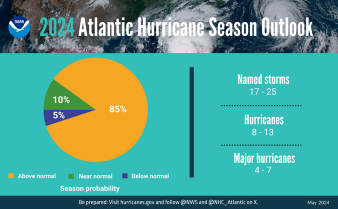
 A summary infographic showing hurricane season probability and numbers of named storms predicted from NOAA's 2024 Atlantic Hurricane Season Outlook. (Image credit: NOAA)
On May 23, FEMA Deputy Administrator Erik A. Hooks joined National Oceanic and Atmospheric Administration (NOAA) Administrator Dr. Rick Spinrad and National Weather Service (NWS) Director Ken Graham to issue the 2024 Atlantic Hurricane Season outlook ahead of the official start of the season, which begins on June 1.
To prepare for any potential storms or emergencies, FEMA opened a new, larger distribution center in Greencastle, Pennsylvania, earlier this year that will ensure critical supplies can be deployed quicker along the Mid-Atlantic and Northeast. This center joins six other facilities strategically located across the country and the Caribbean. FEMA is also updating its standing contingency contracts to support rapid disaster response and recovery operations.
NOAA Administrator Rick Spinrad announced heightened storm activity with forecasts of up to 25 named storms, including up to 13 hurricanes. Roughly four to seven of these potential hurricanes are expected to be “major hurricanes,” with winds of 111 mph or higher.
Deputy Administrator Hooks, Dr. Rick Spinrad and Director Ken Graham briefed media on preparedness actions to take in preparation for hurricane season.
To learn more about how to prepare for this year’s hurricane season, visit fema.gov and Ready.gov.
To read the full press release, visit FEMA.gov.
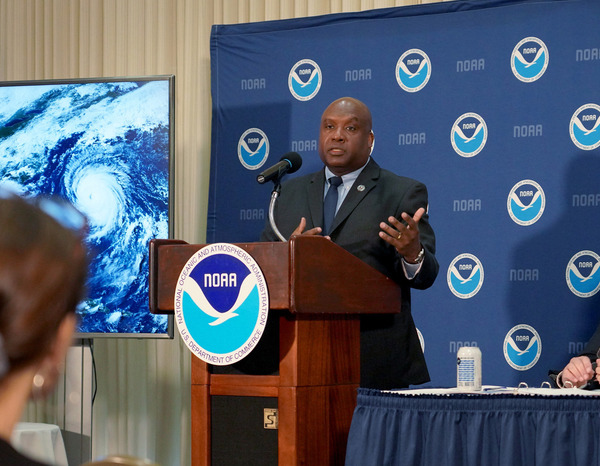 WASHINGTON -- FEMA Deputy Administrator Erik A. Hooks delivers remarks during the NOAA 2024 Atlantic Hurricane Season Outlook press conference. (FEMA photo)
.
FEMA published the Fiscal Year 2024 funding opportunity making approximately $191 million available to support 110 mitigation projects nationwide.
These projects were congressionally authorized through the Further Consolidated Appropriations Act, 2024. The funding for these projects will be made available through FEMA’s Pre-Disaster Mitigation grant program for 35 states, the District of Columbia and one Tribal Nation.
The resilience funding complements FEMA’s other Hazard Mitigation Assistance programs that help communities meet the growing need to make their infrastructure, homes and businesses more resilient to increasingly severe weather events.
These efforts highlight the importance of FEMA’s continued commitment to “people first” and helping communities, families and businesses build climate resilience. It also aligns with the 2024 FEMA Year of Resilience theme to build capacity to withstand tomorrow’s hazards.
These funds are available to specific state, local, Tribal Nation and territorial governments to plan for and implement sustainable cost-effective mitigation measures to reduce the risk to individuals and property from future natural hazards while also reducing reliance on federal funding from future disasters.
Many of the projects focus on infrastructure improvements to stormwater, drainage, sewer systems and levee systems to build community resilience against future flooding. Other projects focus on addressing other hazard types such as seismic activity and wildfire. Approximately 15 identified projects will leverage nature-based solutions addressing greenways, open space, climate resilience and shoreline preservation.
Communities with projects identified for funding must submit an application by June 28. The agency will only disburse funding after all program eligibility criteria, such as Environmental and Historic Preservation requirements, are met.
FEMA continues to reduce barriers to ensure timely review and awards, including streamlining Benefit-Cost Analysis by reducing the discount rate from 7% to 3.1%. They may use the Benefit Cost Analysis toolkit on FEMA.gov to take advantage of this effort that makes it easier to demonstrate cost effectiveness.
For general questions about Pre-Disaster Mitigation congressional community projects, please contact the appropriate State Hazard Mitigation Officer or FEMA regional office. The Hazard Mitigation Assistance Helpline is also available at 866-222-3580.
FEMA will offer a webinar series for applicants. For more information and list of the projects, visit FEMA.gov.
If you require further assistance after navigating the resources listed above, email FEMA-Ask-PDM@fema.dhs.gov.
FEMA released the funding notice for the Fiscal Year (FY) 2024 Regional Catastrophic Preparedness Grant Program. The program provides $10.8 million to eligible states and local governments to close known preparedness capability gaps, encourage innovative regional solutions to issues related to catastrophic incidents and build on existing regional preparedness efforts.
The purpose of the Regional Catastrophic Preparedness Grant Program (RCPGP) is to build regional capacity to manage catastrophic incidents by improving and expanding collaboration for catastrophic incident preparedness. The National Response Framework (4th edition, 2019) defines a catastrophic incident as any natural or manmade incident, including terrorism, that results in extraordinary levels of mass casualties, damage or disruption severely affecting the population, infrastructure, environment, economy, national morale or government functions.
For FY 2024, to reduce the complexity of developing an RCPGP application, proposals are permitted to select just one of the three focus areas (housing, community resilience or long-term vulnerability reduction) on which to concentrate their project. Additionally, applicants are encouraged to consider the needs of Community Disaster Resilience Zones (CDRZ) when developing their project proposals.
Awards will be made on a competitive basis to applicants who present an ability to successfully meet the requirements described in the funding notice.
The application period will close at 5 p.m. ET on July 25. Submissions must be made through FEMA Grants Outcomes (GO). The Notice of Funding Opportunity is available on Grants.gov (Assistance Listings Number 97.111), as well as on the FEMA website at www.fema.gov/grants.
FEMA is hosting a webinar on how to assess the success of completed actions from real-world incident after-action reports (AARs) with the agency’s Continuous Improvement Technical Assistance Program (CITAP). The webinar is from 1-2 p.m. ET on Wednesday, June 12, and will focus on approaches for evaluating completed recommended actions as outlined in FEMA’s National Continuous Improvement Guidance.
During this webinar, FEMA will ask attendees to consider two common approaches for evaluating the success of completed actions and when to use them. The webinar will also review best practices for assessing the effect of completed actions and resources available on the FEMA Preparedness Toolkit.
The webinar is designed to support the development of state, local, Tribal Nation and territorial partners, non-governmental organizations, the private sector continuous improvement capabilities in emergency management.
Register in advance to attend the by visiting the event page on FEMA.gov and clicking the "Register" button. If an issue arises while registering or logging in, contact the FEMA CITAP Team at FEMA-CITAP@fema.dhs.gov.
Together, FEMA and the International Code Council (ICC) are raising awareness about building safety throughout the month of May with the 44th Annual Building Safety Month campaign. The 2024 campaign theme is “Mission Possible” and includes special weekly themes throughout the month.
Week Four’s theme, “Engaging Your Community,” points to the tips and tools you need to engage and advocate for building safety in your community. Building Safety Month is a great opportunity to speak up and let your voice be heard. We all have a role in making sure the places where we live, work and play are safe for not only ourselves but our family, friends and neighbors, too.
Local and state emergency managers, building code officials and others share responsibility for reducing their communities’ risk in dealing with natural hazards and other events – before, during and after a disaster. As a result, these positions must engage in comprehensive conversations about topics central to mitigation (i.e., land use and building codes). From homeowners to elected officials, everyone has a part to play and help ensure that their local community is up to or above code.
By advocating for building safety, we see even the smallest action can ultimately save lives. Take action by:
- Share building safety information or concerns with your city manager or mayor and other local officials.
- Contact the code officials in your area to make sure they’re aware of FEMA’s Building Code Playbook. The Playbook is intended for officials interested in increasing community resilience and reducing loss from natural hazards. The Playbook outlines general steps to help navigate the code adoption process and informs about FEMA grants available to support building code adoption and enforcement activities.
- You can engage younger community members with FEMA’s "Building Codes Activity Sheet: Winter Edition" to educate children about the importance of building codes in protecting communities. Through a fun fort-building activity children can be empowered with knowledge to understand building codes in real-world scenarios.
Additional Guidance:
- This Building Codes Toolkit for Homeowners and Occupants helps readers better understand building codes. The toolkit can be read as one publication or can be read as separate documents to give readers information specific to their needs.
-
Visit Inspect to Protect, which is a web-based resource to determine the building codes used in your community today and get innovative ideas for retrofitting your home to increase resilience or contact your local government for information about building codes used in the past.
Get involved and stay in the know by using and following the hashtag #BuildingSafetyMonth2024 on social media.
For additional information on 2024 National Building Safety Month, visit the International Code Council.
For additional information on FEMA’s Building Science, please visit this FEMA webpage or contact your local regional building science point of contact.
First proclaimed in 1983 by President Ronald Reagan, National Missing Children’s Day falls on May 25 each year. The day honors the efforts of those protecting children and highlights the issue of missing and abducted children.
FEMA’s Integrated Public Alert and Warning System (IPAWS) plays a crucial role helping locate missing children through distributing America’s Missing: Broadcast Emergency Response (AMBER) Alerts.
Read the full blog on FEMA.gov to learn how the quick broadcasting of AMBER Alerts through IPAWS have helped authorities safely recover 180 missing children.
 .
…………………………………………………………………………………………………………..
Public Comment Period Open for Federal Flood Standard Website and Support Tool
Flooding is the most common and costly natural hazard in the United States. According to NOAA’s Billion-Dollar Weather and Climate Disasters from 1980-2023, flood-related losses have cost the nation an average of $4.3 billion per year.
The White House Office of Science and Technology Policy (OSTP) published a Notice of Availability for public comment on two draft resources. The public can review a beta version of the Federal Flood Standard Support website and the Federal Flood Standard Support Tool. These digital resources can assist federal agencies and applicants or recipients of federal financial assistance in the implementation of the Federal Flood Risk Management Standard. The deadline to submit comments is May 28.
…………………………………………………………………………………………………………..
FEMA Seeking Feedback on Draft “Engaging Faith-Based and Community Organizations: Planning Considerations for Emergency Managers”
FEMA and the DHS Center for Faith-Based and Neighborhood Partnerships are seeking feedback on the draft, “Engaging Faith-Based and Community Organizations: Planning Considerations for Emergency Managers.”
A line-numbered version of the draft guide is provided to help identify specific areas or topics for potential updates. The feedback form can be used to capture any recommendations. Email feedback or questions to NPD-Planning@fema.dhs.gov. The feedback period will conclude at the close of business on June 21.
You can register for the sessions below and on FEMA.gov.
To learn more about the update effort and listening sessions, please visit the FEMA website at Planning Guides on FEMA.gov.
…………………………………………………………………………………………………………..
Biden-Harris Administration Announces $150 Million to Help Underserved Communities Fund Resilience Projects
FEMA announced the second funding opportunity for the Safeguarding Tomorrow Revolving Loan Fund grant program to make communities safer from natural hazards. Funded by the Bipartisan Infrastructure Law, this program provides capitalization grants to eligible applicants nationwide. Applicants then offer low-interest loans directly to local communities to reduce their vulnerability to disasters, promote equity, foster greater community resilience and reduce disaster impacts.
The Safeguarding Tomorrow funding notice is available on Grants.gov. Eligible entities must apply for funding using the Non-Disaster Grants Management System on the FEMA website. Applications must be received by 3 p.m. ET. by Thursday, May 30.
…………………………………………………………………………………………………………..
Application Period Open for Repetitive Flood Mitigation Funding
An additional $300 million in Swift Current funding is available to help property owners across the nation become more resilient to flooding. This funding opportunity is the second time that FEMA is using assets from President Biden’s Bipartisan Infrastructure Law for Swift Current, part of the Flood Mitigation Assistance program. Buildings must be insured through the National Flood Insurance Program to be eligible.
FEMA will work with states and Tribal Nations to explore their participation during this cycle. Potential applicants who have questions may contact their FEMA regional office through the FEMA website, while interested sub-applicants should contact their state or territory hazard mitigation officer through the FEMA website. All eligible applicants must submit their FY 2023 Swift Current grant applications to FEMA via the Mitigation eGrants webpage. Upon Swift Current activation, FEMA will provide the application deadline to the applicant.
The application period opened on Nov. 15, 2023, and the last eligible disaster declaration date is May 31, 2024. Full details are available on Grants.gov.
…………………………………………………………………………………………………………..
FEMA Announces More Than $103M Available to Assist Emergency Operations Centers Nationwide
FEMA released the Notice of Funding Opportunity (NOFO) for the Fiscal Year 2024 Emergency Operations Center (EOC) Grant Program on April 25. The program provides more than $103 million in funds eligible for state and local governments, as well as Tribal Nations, for equipping, upgrading or constructing emergency operations center projects determined by Congress.
Only State Administrative Agencies (on behalf of state and local units of government) and federally recognized Tribes with projects identified in Appendix A of the funding notice are eligible to apply. The EOC Grant Program is congressionally directed spending with Congress determining the funded projects.
The application period will remain open until 5 p.m. ET on Friday, June 7. Application submissions must be made through FEMA Grants Outcomes (GO). The NOFO is available on Grants.gov (Assistance Listings Number 97.052) and www.fema.gov/grants.
…………………………………………………………………………………………………………..
National Hurricane Program Hosts HURREVAC Webinar Series for Emergency Managers
The National Hurricane Program is a partnership between FEMA, the U.S. Army Corps of Engineers and the NOAA National Hurricane Center. From June 10 – 14, FEMA's National Hurricane Program will host a five-day HURREVAC training for emergency managers. Each session will start at 2 p.m. ET and run 60–90 minutes.
HURREVAC is a free, web-based decision-support tool that assists emergency managers by providing information and tools to inform hurricane response decisions in advance of a threatening storm. Interested emergency managers can register now for this annual HURREVAC webinar series.
…………………………………………………………………………………………………………..
FY24 FEMA National Earthquake Hazards Reduction Program State Assistance Grant Applications Available this Month
The Fiscal Year 2024 Notice of Funding Opportunity (NOFO) for the FEMA National Earthquake Hazards Reduction program (NEHRP) Multi-State and National Earthquake Assistance funding opportunity was made available May 8 on grants.gov/search-results-detail/354079. The Fiscal Year 2024 FEMA National Earthquake Hazards Reduction Program Individual State Earthquake Assistance Program Notice of Funding Opportunity opened May 17.
The application period for each funding opportunity is as follows:
- Fiscal Year 2024 Multi-State and National Earthquake Assistance Notice of Funding Opportunity will close at 5 p.m. ET on June 14. All applications must be submitted in FEMA GO.
- Fiscal Year 2024 Individual State Earthquake Assistance Notice of Funding Opportunity will close at 5 p.m. ET on June 24. All applications must be submitted in FEMA GO.
For more information on FEMA GO please visit FEMA.gov.
FEMA invites stakeholders to visit the National Earthquake Hazards Reduction program page to view and register for upcoming training for applicants specific to the 2024 funding opportunities. Additional information on these funding opportunities and FEMA NEHRP is available at FEMA.gov.
…………………………………………………………………………………………………………..
|


