|
FEMA published its first Office of Response and Recovery Year in Review report, highlighting the office’s 2023 accomplishments, challenges and innovative solutions as it continues to face increasingly unique disasters.
Some of FEMA's top 2023 highlights included:
- Streamlining the disaster assistance process with the goal of reducing application time by approximately 15% for survivors.
- Collaborating with Tribal Nations to help them connect with grants, improve planning and provide support for declarations.
- Dedicating nearly $3 billion to fund critical resilient infrastructure and flood mitigation projects to build climate resilience.
- Responding to more than 100 disasters, including wildfires in Maui, Typhoon Mawar in Guam, Hurricane Idalia and tornadoes in Mississippi and Arkansas.
- Providing $1.3 billion in direct assistance to disaster survivors.
- FEMA's Ready Campaign in support of Older Adults and their caregivers to help them stay safe and better prepared for disasters.
- FEMA's Summer and Winter Ready Campaigns gave extreme weather safety tips to help individuals and emergency managers stay safe.
Watch the FEMA Strategic Plan Two Year Anniversary video to learn more.

This month marks the 30th anniversary of an executive order addressing environmental justice across the federal government.
Executive Order 12898, signed by President Bill Clinton on Feb. 11, 1994, has influenced FEMA’s role in disaster recovery and preparedness through its Office of Environmental Planning and Historic Preservation (OEHP). The law ensures FEMA actions do not disproportionately or adversely affect minority and low-income populations.
The order requires federal agencies to achieve environmental justice by “identifying and addressing, as appropriate, disproportionately high and adverse human health or environmental effects of its programs, policies and activities on minority populations and low-income populations.”
FEMA works with applicants and sub-applicants during all disaster cycle phases to meet the needs of all communities.
For example, FEMA advises states, Tribal Nations and local governments on debris activities to minimize adverse effects on minority and low-income communities. FEMA also advises these entities during the disaster recovery process to ensure there’s equal access for the relocation of public facilities like schools and fire stations.
The Biden-Harris Administration has taken several steps to advance the executive order policies and guidelines through the creation of new executive orders, 13985, 14008 and 14096. FEMA is working with the Council on Environmental Quality to ensure that consideration of all environmental justice executive orders is incorporated into FEMA policies and guidance.
To learn more about Executive Order 12898, visit FEMA.gov.
FEMA announced that the agency will expand funding to tackle the climate crisis, improve resilience and cut energy costs through net-zero projects.
For the first time, FEMA will fund net-zero energy projects, including solar, heat pumps and efficient appliances, through its largest grant program—Public Assistance, which covers the rebuilding of schools, hospitals, fire stations and other community infrastructure investments post-disasters. FEMA is also funding net-zero energy projects for its Hazard Mitigation Grant Program (HMGP), HMGP Post-Fire and PDM programs and now offers incentives through its Building Resilient Infrastructure and Communities (BRIC) annual grant program to encourage more communities to use net-zero projects that increase community resilience.
These activities are enabled by President Biden’s Inflation Reduction Act, the largest investment in clean energy and climate action in the history of the nation.
This follows the March 2023 announcement that FEMA will fund low-carbon construction materials for three programs as part of its work through the Federal Buy Clean Initiative.
FEMA funding net-zero projects will cut utility costs, increase energy reliability and reduce disaster-related costs for communities. Net-zero infrastructure and buildings are more resilient and can maintain comfort and safety in emergencies such as brown-outs, black-outs and extreme temperatures.
Examples of eligible net-zero projects are solar microgrids, heat pumps, certified high-performance appliances and passive heating or cooling. States and Tribal Nations can now submit expenses for these activities for FEMA reimbursement.
For any federal disaster declared after Aug. 16, 2022, applicants may now use FEMA financial assistance for unobligated projects under these programs to take advantage of this opportunity through Public Assistance and Hazard Mitigation Grant Program funding. As of Jan. 30, more than 80 disasters have been declared across all 10 FEMA regions during this time.
In the BRIC 2023 Notice of Funding Opportunity, applicants receive additional points towards their overall score when taking advantage of these climate-friendly materials and cleaner energy opportunities.
The built environment contributes to nearly 40% of greenhouse gas emissions. In 2023 alone, FEMA spent over $10 billion on rebuilding and hazard mitigation construction. The federal government is the single largest purchaser of construction materials in the United States.
Any community interested in introducing low-carbon materials or implementing net-zero energy projects can work directly with their point of contact at their FEMA region or reach out at FEMA-IRA-Implementation@fema.dhs.gov or fema-climate@fema.dhs.gov.
For more information on the Inflation Reduction Act and the agency’s efforts to make a more resilient, cleaner nation, visit FEMA.gov.
FEMA published its first Office of Response and Recovery (ORR) Year in Review report, highlighting the significant accomplishments, innovative solutions and challenges faced by FEMA in 2023. The report focuses on the ways that ORR is working to support communities in alignment with FEMA’s 2022-2026 Strategic Plan: instilling equity as a foundation of emergency management, leading the whole of community in climate resilience and promoting and sustaining a Ready FEMA and prepared nation.
With the persistent rise in the frequency, severity and complexity of disasters, FEMA continues to lean forward to meet the mission. In addition to supporting dozens of complex recovery missions from years past, FEMA responded to 84 Presidentially declared disasters in 2023 that crossed the continental United States, Caribbean, Western Pacific and Alaska.
For example, during the Hawaii wildfire response in August 2023, search and rescue resources on the ground searched more than 2,000 structures. In the ongoing recovery, the agency is focused on delivering technical assistance and coordinating recovery efforts across the federal family. Through its Interagency Recovery Coordination mission, FEMA is working with trusted local community leaders on the ground and faith-based organizations who understand the unique history and culture of Maui.
The report also contains interviews with three members of FEMA’s Office of Response and Recovery: Reservist Jane Norton, Federal Coordinating Officer (FCO) John Brogan and FEMA Liaison to the National Hurricane Center Michael Spagnolo. The interviews highlight the diversity of roles within the Office of Response and Recovery that all work together to meet FEMA’s mission of helping people before, during and after disasters.
FEMA also implemented new approaches to put people first and remove barriers for disaster assistance. In 19 recovery missions, FEMA utilized a process that identifies and assists a targeted population of applicants who need proactive assistance navigating the agency’s programs. This initiative led to over $60 million in additional funds for survivors. Other enhancements to improve the survivor experience in 2023 included simplified letters to survivors who apply for assistance and the formation of the first Pre-Disaster Housing initiative to help provide reliable, affordable and safe housing for disaster survivors.
To read the Office of Response and Recovery's 2023 Year in Review, click here.
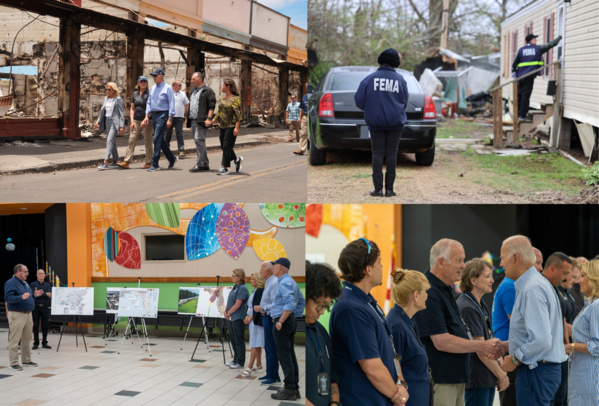
FEMA held its first public engagement with external partners on the sweeping changes to the FEMA’s Individual Assistance Program. It aimed at cutting red tape, providing funds faster and giving people more flexibility, expanding eligibility for repairs and a simplified application process.
Nearly 2,700 partners, including non-governmental agencies, community and faith-based organizations, private sector and state emergency management agencies, joined FEMA leadership during the webinar co-hosted by FEMA’s Voluntary Agency Liaisons and DHS Center for Faith-Based and Neighborhood Partnerships on Jan. 25 to discuss the reforms to help survivors recover faster.
The following FEMA leaders participated in the discussions:
These leaders reviewed at length what will be the most significant update to survivor assistance in the last 20 years, helping to reach more survivors and deliver assistance faster.
“FEMA has heard for decades that our programs don’t go far enough to help and are too difficult to navigate,” Hagmaier said. “Based on feedback from disaster survivors, communities, stakeholders, recovery partners and public comments FEMA solicited in 2021 on how to improve the Individual Assistance program, we are taking action that will help us to do more. State and congressional partners have echoed these concerns and pressed for simpler, more straightforward programs to help people. Administrator Deanne Criswell has championed these improvements and fast-tracked their approval. We’re doing everything we can within our authorities to help people recover faster and more fully from disasters, and in doing so, helping them to rebuild their lives and communities in more resilient ways.”
The changes will go into effect beginning with the first disaster declared for Individual Assistance on or after March 22.
“We are laser focused on making sure these changes fundamentally transform how survivors recover,” Matranga said. “Teams across FEMA, and our other partners are focused on the implementation of these changes. These efforts include updating communication materials, guidance, training and technology systems. We will gather public comment for the next six months and are committed to getting this right.”
To learn more, follow the links below:
In November 2023, FEMA selected counties in New York for the 2024 Planning for Dam Emergencies Collaborative Technical Assistance Program (CTA) through the National Dam Safety Program’s annual competitive process.
These communities will receive coaching, tools and technical expertise in support of local efforts to increase understanding of flood risk and prepare for dam-related emergencies. The CTA, funded in part by the Bipartisan Infrastructure Law, is an interactive year-long process requiring the dedicated involvement of participating communities and their dam safety stakeholders.
The first kickoff meeting will be held in Chemung County, New York, on Feb. 7–8 with local, state and federal representatives to plan further dam safety collaboration. In support of the Justice40 Initiative, these benefiting communities are within Census tracts identified as overburdened and underserved in the Climate and Economic Justice Screening Tool.
Working together through formal scoping calls, FEMA and Chemung County officials determined this CTA would be tailored to address the preparedness of jurisdictions downstream of high-hazard potential dams within the watershed, requiring cross-state coordination in two counties in Pennsylvania.
In addition to federal and state officials, the kickoff meeting will include local emergency managers, dam owners and operators, hydrologists, engineers and dam safety stakeholders from Chemung and Steuben counties in New York and Bradford and Tioga counties in Pennsylvania.
Whole community preparedness for dam-related hazards will increase by developing emergency action plans, building relationships between dam operators and emergency managers and collaborating with dam safety stakeholders throughout the CTA.
FEMA's Integrated Public Alert and Warning System to Host Tabletop Exercises for Emergency Alerts
The Integrated Public Alert and Warning System (IPAWS) Office will host its next Tabletop Exercise on Feb. 27–29, with virtual and in-person options.
IPAWS is FEMA's national system for local alerting that lets state, local, tribal and territorial authorities send authenticated emergency and life-saving information to the public through mobile phones using Wireless Emergency Alerts, to radio and television via the Emergency Alert System, and on the National Oceanic and Atmospheric Administration's Weather Radio.
As part of FEMA’s ongoing support to its emergency alerting partners, staff from the IPAWS Technical Support Services Facility conduct these exercises four times each year. The event in February enables Alert Originators to practice, review and exercise their alert, warning and notification capabilities for winter weather emergencies. Facilitated group discussions will promote peer-to-peer learning.
-
Virtual Tabletop Exercise: Feb. 27, 11 a.m.–1 p.m. ET
-
Virtual Tabletop Exercise: Feb. 28, 1 p.m.–3 p.m. ET
-
In-Person Tabletop Exercise: Feb. 29, 11 a.m.–1 p.m. ET
This training is available to attend virtually. However, FEMA encourages in-person attendance at the TSSF in National Harbor, Maryland, for participants to take full advantage of our hands-on learning facility. Seating is limited to provide an efficient exercise for all involved.
The same exercise will be conducted each day. Register for the virtual exercises using these links:
To attend in-person on Thursday, Feb. 29, please send an email to the IPAWS Technical Support Services Facility Training and Exercise Staff stating your request to participate, a primary point of contact for your organization, agency name and the number of expected participants.
For general IPAWS questions, send an email to fema-ipaws-lab@fema.dhs.gov.
Learn more about IPAWS Tabletop Exercises in this FEMA video.
FEMA released a Fact Sheet on Art and Culture: Helping People Before, During and After Disasters as part of its Year of Resilience campaign. The fact sheet provides an overview of the role of emergency managers, art and cultural organizations, and artists in utilizing the strength of the arts to fortify communities, promote equity and build local community resilience.
FEMA and the National Endowment for the Arts (NEA) recently hosted a webinar on Disaster Mitigation, Preparedness, Response and Recovery Resources for Artists and Art and Cultural Organizations, and the resources from the webinar can now be found in the newly published fact sheet.
FEMA and NEA also co-hosted a summit that focused on the impact of arts and culture in shaping our lives, communities and nation. The Healing, Bridging, Thriving: A Summit on Arts and Culture in our Communities event took place on Tuesday, Jan. 30, and a live stream of the event is available on NEA’s YouTube page.
Emergency Management Exchange Program Application Period Closing Soon
The Emergency Manager Exchange program (EMX) application deadline is Friday, Feb. 9. FEMA encourages Emergency Managers to apply for EMX by submitting their resume and a nomination letter from their home office. Requirement details and submission information can be found online at Emergency Manager Exchange | FEMA.gov.
During the exchange, non-federal emergency managers will work for six months in FEMA offices engaging with decision makers. FEMA staff will be sent to the emergency manager’s home office to help fill in gaps and learn about the participant’s emergency management work.
…………………………………………………………………………………………………………..
FEMA Seeks Feedback on the “Climate Adaptation Planning for Emergency Managers” Draft Guide
FEMA is seeking feedback on the draft guide, “Climate Adaptation Planning for Emergency Managers,” until Feb. 9. The guide will help emergency managers incorporate climate adaptation into emergency management planning efforts.
The guide is designed to walk state, local, tribal and territorial partners through the Six Step Planning Process identified in the “Comprehensive Preparedness Guide 101: Developing and Maintaining Emergency Operations Plans,” highlighting existing climate mapping tools and potential funding resources. FEMA is seeking feedback that can be incorporated into the guide, particularly real-world case studies.
To review the document, visit the "Climate Adaptation Planning for Emergency Managers" on FEMA.gov.
…………………………………………………………………………………………………………..
Attend FEMA’s Webinar on How to Use the National Continuous Improvement Guidance
FEMA's Continuous Improvement Technical Assistance Program (CITAP) will host a webinar that explores the structure and content of the National Continuous Improvement Guidance on Monday, Feb. 12, from 12:30 - 1:30 p.m. ET.
The webinar is designed for state, local, Tribal Nation and territorial partners, non-governmental organizations, the private sector and other entities involved in emergency management functions engaged in continuous improvement efforts.
To attend the webinar, register in advance by visiting the event page on FEMA.gov and clicking the "Register Here" button. For registration or login issues, email FEMA-CITAP@fema.dhs.gov.
…………………………………………………………………………………………………………..
FEMA Hosts Webinars on New Exercise Starter Kits
FEMA developed 10 new Exercise Starter Kits for the 2023-2026 National Exercise Program Principals’ Exercise Priorities. The new kits are now available in the Emergency Management Toolkit section of the Preparedness Toolkit. This online portal provides the whole community with tools for implementing the National Preparedness System.
FEMA will host webinars to discuss the new kits. All webinars will offer the same content. There is no registration required to attend one of the webinars. Join during one of the times listed below using this Adobe Connect link.
- Session 3: Tuesday, Feb. 13, at 9 a.m. ET.
If you are unable to attend one of the webinars listed above, a recorded version of the webinar will be available on the Preparedness Toolkit HSEEP Webinars page starting Feb. 1.
If you have any questions, email NEP@fema.dhs.gov.
…………………………………………………………………………………………………………..
FEMA Seeks Volunteers for Virtual BRIC National Review Panels
FEMA seeks volunteers from state, local, tribal and territorial governments and other federal agencies to participate in the Building Resilient Infrastructure and Communities (BRIC) virtual national review panels.
The agency is accepting Expression of Interest forms through Feb. 15. These volunteers will leverage their mitigation experience and expertise to determine how sub-applications meet BRIC qualitative evaluation criteria. The virtual panels will run from April 8 to May 3 on Zoom. Panelists will serve 30 hours on one weekly panel from 10 a.m. to 5 p.m. ET, plus a three-hour training.
For more information, visit the BRIC webpage on FEMA.gov.
…………………………………………………………………………………………………………..
Public Comment Period Open for DHS Environmental Justice Program
The Department of Homeland Security (DHS) issued a Request for Information (RFI) on Dec. 18, 2023, for public feedback on barriers, challenges, suggestions and ideas to help improve the agency’s Environmental Justice Program. The public comment period closes on Friday, Feb. 16.
DHS is committed to addressing communities’ environmental justice challenges related to DHS programs and activities. To achieve this, the agency is seeking meaningful public engagement for inclusive decision-making in the DHS Environmental Justice Strategy for Fiscal Years 2021-2025.
On April 21, 2023, Executive Order 14096 was signed to revitalize the nation’s commitment to environmental justice. The order defines environmental justice as "the just treatment and meaningful involvement of all people, regardless of income, race, color, national origin, Tribal affiliation, or disability, in agency decision-making and other Federal activities that affect human health and the environment.”
To view translations of the RFI, visit DHS Environmental Justice Request for Information | Homeland Security. For free language services, including written translation or oral interpretation of this document, or to request this document in alternate formats such as Braille or large print, contact crcl@hq.dhs.gov.
For more information about the agency’s Environmental Justice Program, visit DHS and Environmental Justice | Homeland Security. In addition, for any questions or concerns, contact dhsenvironmentaljustice@hq.dhs.gov.
…………………………………………………………………………………………………………..
Youth Preparedness Council Application Period is Open Until March 4
The FEMA Individual and Community Preparedness Division is accepting applications for the Youth Preparedness Council. The online application process is open to students in grades eight through 11. Students must apply by March 4.
Students interested in applying for the Council can learn more about the process and have their questions answered in the following webinar:
If you know a teen interested in preparedness and community service, encourage them to apply.
To learn more, visit the Youth Preparedness Council webpage.
…………………………………………………………………………………………………………..
Request Free FEMA Help for Mitigation Planning and Project Support by February 29
If your community or Tribal Nation lacks resources to start climate resilience or project design, FEMA provides free help with hazard mitigation planning and Building Resilient Infrastructure and Communities (BRIC) project support. The deadline to apply is Thursday, Feb. 29.
To be considered for selection, applicants do not need a previous BRIC grant sub-application, award or a FEMA-approved Hazard Mitigation Plan. Interested communities and Tribal Nations can apply to this program by submitting a BRIC Direct Technical Assistance Request Form to fema-bric-dta-submission@fema.dhs.gov for this cycle of selections. FEMA will select up to 80 communities and Tribal Nations to receive direct technical assistance, which will be announced later this summer. For FEMA’s fiscal year, 2023 BRIC Notice of Funding Opportunity, communities and Tribal Nations requesting BRIC Direct Technical Assistance must identify at least two ongoing or potential community partners in the request form.
To learn more about BRIC Direct Technical Assistance, visit FEMA.gov.
…………………………………………………………………………………………………………..
FEMA Publishes Resources for Developing BRIC and FMA Grant Applications
On Oct. 12, 2023, FEMA announced $1.8 billion available in funding for the Fiscal Year 2023 Building Infrastructure and Communities (BRIC) and Flood Mitigation Assistance grant programs. The BRIC funding level will be $1 billion, and the Flood Mitigation Assistance funding level will be $800 million.
The application period for both programs closes on Feb. 29.
Information about the Building Resilient Infrastructure and Communities and Flood Mitigation Assistance Funding Opportunities Webinar Series is available online and includes an opportunity to watch the video or download the presentation. This webinar provides an overview of and guidance on how to request Building Resilient Infrastructure and Communities Direct Technical Assistance in fiscal year 2023. More information about this opportunity is available on the BRIC Direct Technical Assistance webpage.
Please complete this form by Feb. 29. Once completed, email the form to fema-bric-dta-submission@fema.dhs.gov.
…………………………………………………………………………………………………………..
Application Period Open for $211M to Fund Dam Safety Grants
FEMA will commit more than $211 million in funding to enhance dam safety efforts across the nation to ensure that communities have the critical infrastructure needed to protect against disasters and prevent flooding.
The National Dam Safety State Assistance Grant Program is available for any state or territory with an enacted dam safety program. The state administrative agency or an equivalent state agency is eligible to apply. Each eligible state or territory may submit only one grant application. The funding opportunities are open now and will close on Feb. 29. Available opportunities may be found on Grants.gov.
…………………………………………………………………………………………………………..
Request FEMA National Exercise Support by March 1
FEMA provides exercise support to state, local, tribal and territorial jurisdictions at no cost through the agency’s National Exercise Program. Exercise support can include assistance with exercise planning, design, scenario development, conduct and evaluation.
Applications for 2024 exercise support will be accepted through March 1. Support requests are open to all state, local, tribal and territorial governments. New applicants or applicants from underserved jurisdictions are urged to apply. There is no associated cost-share for selected jurisdictions for this exercise assistance.
Visit FEMA.gov/NEP for more information, including how to request support. For any specific questions, please email the program staff at NEP@fema.dhs.gov and include “2024 Exercise Support Question” in your subject line.
…………………………………………………………………………………………………………..
Attend the 9th Annual Tribal Nations Training Week
In November 2023, FEMA Administrator Deanne Criswell unveiled FEMA’s first-of-its-kind 2023 Tribal Strategy Progress Report.
She also announced the opening of registration for the ninth-annual Tribal Nations Training Week, to be held March 9-16, at FEMA’s Center for Domestic Preparedness (CDP) in Anniston, Alabama.
Register by March 6 to attend! To register for the 2024 Tribal Nations Training Week, email David.Hall@fema.dhs.gov.
…………………………………………………………………………………………………………..
FEMA Opens Applications for $324M in Assistance to Firefighters
FEMA Administrator Deanne Criswell announced the opening of the latest application period for the Fiscal Year 2023 Assistance to Firefighters Grant (AFG) program, which will award $324 million to enhance the safety of the public and firefighters nationwide against fire-related deaths and hazards.
The AFG application period will close on Friday, March 8, at 5 p.m. ET.
The Notice of Funding Opportunity for this program is available at www.grants.gov and on the FEMA website, where there are also technical assistance documents and additional information about upcoming webinars to assist applicants.
…………………………………………………………………………………………………………..
Biden-Harris Administration Announces $150 Million to Help Underserved Communities Fund Resilience Projects
FEMA announced the second funding opportunity for the Safeguarding Tomorrow Revolving Loan Fund (RLF) grant program to make communities safer from natural hazards. Funded by the Bipartisan Infrastructure Law, this program provides capitalization grants to eligible applicants nationwide. Applicants then offer low-interest loans directly to local communities to reduce their vulnerability to disasters, promote equity, foster greater community resilience and reduce disaster impacts.
The Safeguarding Tomorrow funding notice is available at Grants.gov. Eligible entities must apply for funding using the Non-Disaster Grants Management System (ND Grants). Applications must be received by Tuesday, April 30, at 3 p.m. ET.
…………………………………………………………………………………………………………..
Application Period Open for Repetitive Flood Mitigation Funding
An additional $300 million in Swift Current funding is available to help property owners across the nation become more resilient to flooding. This funding opportunity is the second time that FEMA is using funds from President Biden’s Bipartisan Infrastructure Law for Swift Current, part of the Flood Mitigation Assistance program. Swift Current makes homes safer and more resilient for National Flood Insurance Program policyholders with repetitively flooded properties. To be eligible, buildings must be insured through the National Flood Insurance Program.
FEMA will work with states, Tribes and territories to explore their participation during this cycle. Potential applicants who have questions may contact their FEMA regional office. The application period opened on Nov. 15, 2023, and the last eligible disaster declaration date is May 31. The funding opportunity is available on Grants.gov.
…………………………………………………………………………………………………………..
|


