|
President Biden issued a proclamation marking January as National Human Trafficking Prevention Month, highlighting that federal agencies are working closely with governments and organizations around the world to address the root causes of trafficking, bring traffickers to justice, and support survivors as they recover and rebuild their lives. This month, we urge every American to learn how to identify the signs of trafficking and to share the National Human Trafficking hotline (888-373-7888) — an important resource to report a tip or to ask for help. Together, we must make sure every human being is free to live a life full of dignity and respect.
Every year, millions of men, women and children are exploited by human trafficking worldwide. The U.S. Department of Homeland Security (DHS) urges you to take action against human trafficking and raise awareness by encouraging everyone to participate in its national public awareness Blue Campaign.
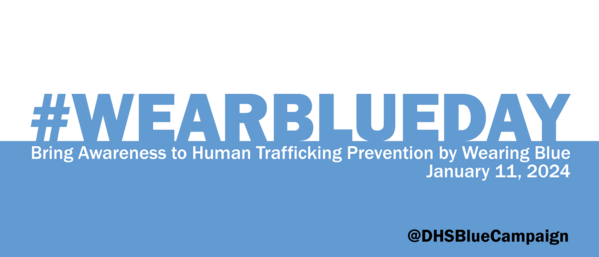
Thursday, Jan. 11, marks the annual observance of #WearBlueDay, a national initiative to raise awareness about human trafficking. DHS and FEMA encourage the public to participate by taking photos of themselves, friends, family and colleagues wearing blue clothing to share on social media platforms using the hashtag #WearBlueDay and tagging @DHSBlueCampaign on X, Facebook and Instagram. Anyone can participate – all you need is a piece of blue clothing!
The DHS Center for Faith-Based and Neighborhood Partnerships works alongside the faith community and social service organizations, law enforcement and other partners to help address the needs of people who are traumatized by human trafficking. The center supported the development of Blue Campaign resources, the Faith-Based and Community Toolkit in English and Spanish and general awareness training videos.
DHS will host a webinar, “From Awareness to Action: Recognizing and Reporting Human Trafficking.” Learn about human trafficking myths and misconceptions, who trafficking impacts, how traffickers operate and indicators of potential human trafficking situations.
To learn more about the indicators of human trafficking, the Blue Campaign and ways to help, visit Blue Campaign | Homeland Security (dhs.gov). For additional social media materials to show your support, visit Social Media Shareables | Homeland Security (dhs.gov).
FEMA announced the second funding opportunity for the Safeguarding Tomorrow Revolving Loan Fund (RLF) grant program to make communities safer from natural hazards. Funded by the Bipartisan Infrastructure Law, this program provides capitalization grants to eligible applicants nationwide. Applicants then offer low-interest loans directly to local communities to reduce their vulnerability to disasters, promote equity, foster greater community resilience and reduce disaster impacts.
Due to the high level of interest in the first opportunity, the Biden-Harris Administration has tripled the amount of money available in this round of funding to $150 million.
The Safeguarding Tomorrow Revolving Loan Fund is part of FEMA’s Hazard Mitigation Assistance program. These grant programs help communities increase resilience to extreme heat waves, drought, wildfires, floods and hurricanes by funding transformational projects that reduce risk to multiple hazards, support adaptation to future conditions, and reduce the impact of all disasters on our nation’s most at-risk, underserved and disadvantaged communities.
Applicants eligible to receive revolving loan capitalization grants include states, the District of Columbia, territories and federally recognized Tribes that have received a major disaster declaration. Local governments may use the low-interest loans provided by these entities for projects and activities to reduce the effects of natural hazards – including the many fueled by climate change.
For instance, the Safeguarding Tomorrow RLF is unique in that it is the only FEMA grant program under which extreme heat is explicitly eligible. The program allows applicants to use loan funds for projects or activities that reduce the impacts of drought and prolonged intense heat. FEMA will not require applicants to submit a benefit-cost analysis for projects.
Additional eligible project types under this program include activities that mitigate the impact of natural hazards, zoning and land-use planning changes, and adoption and enforcement of modern building codes. Loans may also be used by local governments to satisfy a local government’s non-federal cost-share requirement for other FEMA grant programs.
Of the nearly $7 billion available in Bipartisan Infrastructure Law funding to FEMA, $500 million is invested in the Safeguarding Tomorrow Revolving Loan Fund program over five years to reduce disaster suffering and avoid future disaster costs. For the first year of the program, FEMA made $50 million available in capitalization grants. In addition, there are five additional FEMA mitigation and cyber security programs to receive multi-year Bipartisan Infrastructure Law funding.
The Safeguarding Tomorrow RLF funding notice is available at Grants.gov. Eligible entities must apply for funding using the Non-Disaster (ND) Grants Management System (ND Grants). The application period opens on Feb. 1. Applications must be received by 3 p.m. ET, April. 30.
FEMA's Continuous Improvement Technical Assistance Program (CITAP) will host a webinar on survey design and distribution best practices to collect data for real-world incident after-action reviews from 1-2 p.m. ET on Tuesday, Jan. 23.
During this webinar, FEMA will equip participants with the fundamental concepts for effective survey design and distribution to support the development of after-action reviews for real-world incidents. The webinar will provide information on how to order questions to improve response rates, select an appropriate survey-building tool and develop surveys with respondents in mind.
This webinar is designed for state, local, tribal and territorial partners, non-governmental organizations, the private sector and other entities involved in emergency management functions engaged in continuous improvement efforts.
FEMA completed its 2024 placement of reinsurance to continue the National Flood Insurance Program’s (NFIP) support of resiliency and protection against flood losses. The agency transferred $619.5 million of the NFIP’s financial risk to the private reinsurance market throughout the calendar year.
For this placement, 18 reinsurance companies agreed to indemnify FEMA for flood losses from individual flood events or a named storm. FEMA paid a total premium of $121.1 million for the coverage.
The agreement is structured to cover:
- 8.9125% of losses between $7 billion and $9 billion
- 22.0625% of losses between $9 billion and $11 billion
FEMA will receive qualifying payments only if a named storm event is large enough to trigger the traditional and/or capital market reinsurance coverage. As of Jan. 1, 2024, should a named storm event result in flood insurance claims exceeding $11 billion, FEMA will receive the full $1.9195 billion of reinsurance coverage from the private markets. FEMA’s 2021 ILS reinsurance coverage from the capital markets of $575 million is scheduled to terminate in March 2024, leaving a remaining capacity of $1.3445 billion across both traditional and capital markets placements.
The agency contracted with Guy Carpenter and Company, a subsidiary of Marsh & McLennan Companies, to provide broker services to assist in securing the reinsurance placement.
Reinsurance is an important risk management tool used by insurance companies to protect themselves from large financial losses. Public entities also secure reinsurance. Examples of other reinsurance programs include the Citizens Property Insurance Corporation of Florida, the California Earthquake Authority and the Texas Windstorm Insurance Association.
For more information, visit the NFIP Reinsurance Program webpage on FEMA.gov.
Register today to reserve your spot for the 31st annual National Dam Safety Program Technical Seminar. This annual two-day seminar will be held Feb. 13 – 14 and will bring together dam safety professionals from across the nation. The theme for this year’s seminar is “Dam Safety 101: Design, Analysis, Construction and Risk Management.
The seminar will be hosted at FEMA’s Emergency Management Institute training facilities in Emmitsburg, Maryland. The seminar will feature two keynote speakers and explore the latest industry trends and insights, offering a unique opportunity to gain valuable knowledge and perspectives that will inspire and elevate dam safety practices across the nation. Participants will gain invaluable insights and expertise from seminar keynote speakers Eric Halpin from Halpin Consulting LLC and Mark Kilgore from the Virginia Department of Conservation and Recreation.
The seminar theme was selected by the National Dam Safety Review Board Work Group on Dam Safety Training and will highlight relevant issues and best practices in dam safety. The seminar will include compelling sessions for participants and incorporate engaging presentations such as:
- Developing Design Data: Field Sampling to Lab Testing.
- Data Management and Visualization During Dam Construction and Rehabilitation ‐ Lessons Learned from USACE Projects.
- Granular Filter Material Quality Testing: Best Practices and Lessons Learned.
- Use of Drones and Bathymetry to Assist with Decision Making by a State Dam Safety Program.
- USACE Robotics and AI/ML for Critical Infrastructure Inspection.
When registering for the seminar, list Tim Bush as the supervisor for application approval.
- Email: timothy.bush@fema.dhs.gov
- Phone: 256-454-5865
If you previously registered and did not receive a confirmation email, please take a moment to re-register and ensure you receive confirmation to attend the seminar.
Participants from the dam safety community are encouraged to register now and join the vast network of officials from both federal and state dam safety programs across the nation, as space at the seminar is running out.
Secure dams and levees are integral components of the nation's infrastructure, offering flood protection, water supply, hydropower, irrigation, recreation and more. The seminar offers participants the opportunity to enhance dam safety measures within their communities, improving the overall resilience of the nation. For more information about the seminar, please visit fema.gov or contact either jmalama@usbr.gov or alesia.zagara@associates.fema.dhs.gov.
FEMA seeks volunteers from state, local, tribal and territorial governments and other federal agencies to participate in the Building Resilient Infrastructure and Communities (BRIC) virtual national review panels.
The agency is accepting Expression of Interest forms through Feb. 15. These volunteers will leverage their mitigation experience and expertise to determine how sub-applications meet BRIC qualitative evaluation criteria.
The virtual panels will run from April 8 to May 3 on Zoom. Panelists will serve 30 hours on one weekly panel from 10 a.m. to 5 p.m. ET, plus a three-hour training.
FEMA anticipates that participants on the panels will commit eight hours a day over the course of five business days. All reviews will be conducted virtually and there is no compensation for participating on the panels.
The agency anticipates that participation in these panels will strengthen the BRIC review process by ensuring it is transparent, equitable and inclusive. It will also offer insight into new and creative ways communities are addressing different hazards, an expanded network of individuals and a fresh look at ways to contribute to community disaster resilience.
For more information, visit the BRIC webpage on FEMA.gov.
New Year’s resolutions are a long-standing tradition—some vow to eat healthier or quit a bad habit. A great way you can keep yourself and your family safe is to Resolve to Be Ready. The past few years taught us that it’s important to be prepared because disasters and emergencies can happen anytime.
FEMA’s Ready Campaign encourages you to kick off the new year prepared for anything that might come your way.
- Create a family emergency plan so everyone in your household knows their emergency contacts, evacuation routes, and a meet-up location in case you get separated. You can use, download and share this free Family Emergency Communication Plan to get started.
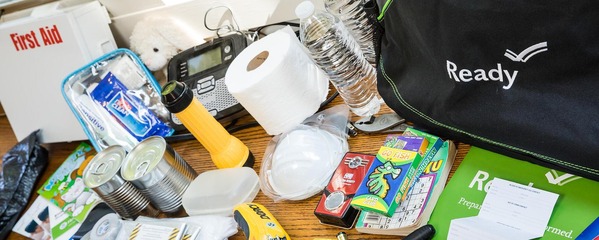
- Gather supplies for your home in case of an emergency! While you should tailor your kit to meet your family’s unique needs, a basic kit should include water and non-perishable food, a battery-powered or hand crank radio, a flashlight, a first aid kit, pet supplies, medication and hygiene supplies.
Visit Build A Kit on Ready.gov to learn more and download a printable emergency supply list.
FEMA is publishing nine National Incident Management System (NIMS) documents related to public health incident response to FEMA’s Resource Typing Library Tool. Resource typing definitions establish measurable standards of resource capabilities and performance levels of teams, personnel and equipment.
FEMA works with the community to develop and provide standardized resource typing definitions that are national in scope. FEMA assembled a working group to review existing public health-related resource types and provide essential updates to reflect the latest best practices. The group included subject-matter experts from state and local governments, plus non-profit and other federal entities.
These draft resource typing documents went through a 30-day period of national engagement from May 9 - June 8, 2023. These documents establish baseline qualifications that enhance the interoperability and effectiveness of emergency management mutual aid.
FEMA Seeks Feedback on the “Climate Adaptation Planning for Emergency Managers” Draft Guide
FEMA seeks feedback on the draft guide, “Climate Adaptation Planning for Emergency Managers,” until Feb. 9. The guide will help emergency managers incorporate climate adaptation into emergency management planning efforts.
FEMA will host a series of 60-minute webinar sessions to provide an overview of the draft guide and include facilitated discussions with stakeholders to help improve the existing draft and gather feedback from all community partners. Webinars will be held on Jan. 9, 17 and 25.
The guide is designed to walk state, local, tribal and territorial partners through the Six Step Planning Process identified in the “Comprehensive Preparedness Guide 101: Developing and Maintaining Emergency Operations Plans,” highlighting existing climate mapping tools and potential funding resources. FEMA is seeking feedback that can be incorporated into the guide, particularly real-world case studies. A line-numbered version of the draft guide is also available to allow individuals to provide comments on specific areas within the document.
To review the document and register for the webinar sessions, visit the "Climate Adaptation Planning for Emergency Managers" on FEMA.gov.
…………………………………………………………………………………………………………..
FEMA Opens Exercise Support through March 1
FEMA provides exercise support to state, local, tribal and territorial jurisdictions at no cost through the agency’s National Exercise Program. Exercise support can include assistance with exercise planning, design, scenario development, conduct and evaluation.
Applications for 2024 exercise support will be accepted from Jan. 4 through March 1, 2024. Support requests are open to all state, local, tribal and territorial governments. New applicants or applicants from underserved jurisdictions are urged to apply. There is no associated cost-share for selected jurisdictions for this exercise assistance.
In January, FEMA will host several webinars to discuss the exercise support process. Each webinar will cover the same content. Register in advance by visiting FEMA’s webinar page. The webinar dates are Jan. 9, 11, 16, 18, 22 and 24.
Visit FEMA.gov/NEP for more information, including how to request support. For any specific questions, please email the program staff at NEP@fema.dhs.gov and include “2024 Exercise Support Question” in your subject line.
…………………………………………………………………………………………………………..
Tribal Cybersecurity Grants Application Period Closes Jan.10
On Nov. 1, 2023, FEMA and the Cybersecurity and Infrastructure Security Agency (CISA) held their eighth tribal consultation with dozens of tribal representatives to discuss the Tribal Cybersecurity Grant Program. The application deadline for the Fiscal Year (FY) 2023 Tribal Cybersecurity Grant Program is Wednesday, Jan. 10.
The FY 2023 program funding is $18.2 million, including unused rollover funding from the FY 2022 State and Local Cybersecurity Grant Program. Visit FEMA.gov to learn more about the Tribal Cybersecurity Grant Program, including several changes based on input from the consultation.
…………………………………………………………………………………………………………..
Invitation to the 2024 Southeast Private-Public Partners Summit in Pearl, MS
The 2024 Southeast Private-Public Partnership Summit will be held in Pearl, Mississippi, from Jan. 31 to Feb. 1. This two-day event brings together non-governmental and private sector partners with federal, state and local emergency management representatives. Emergency managers in the private sector will join in discussions about the challenges we face as emergency management leaders to better help survivors.
Register for the summit by visiting 2024 Southeast Private-Public Partners Summit | Jan. 31 - Feb. 1. Hotel information will be emailed to you once you register.
…………………………………………………………………………………………………………..
FEMA Publishes Resources for Developing BRIC and FMA Grant Applications
On Oct. 12, 2023, FEMA announced $1.8 billion available in funding for the Fiscal Year 2023 Building Infrastructure and Communities (BRIC) and Flood Mitigation Assistance grant programs. The BRIC funding level will be $1 billion and the Flood Mitigation Assistance funding level will be $800 million.
FEMA published program support materials and launched a series of webinars and on-demand videos that provide important resources and information for prospective applicants and sub-applicants. These resources can be used to help develop applications for these two FEMA hazard mitigation grants. The application period for both programs closes on Feb. 29.
These program support materials are resources to help state, local, tribal and territorial governments prepare applications for this grant cycle. The following program support materials are:
Information about the Building Resilient Infrastructure and Communities and Flood Mitigation Assistance Funding Opportunities Webinar Series is available online and includes an opportunity to watch the video or download the presentation. This webinar provides an overview of and guidance on how to request Building Resilient Infrastructure and Communities Direct Technical Assistance in fiscal year 2023. More information about this opportunity is available on the BRIC Direct Technical Assistance webpage. Please complete this form by Feb. 29.
…………………………………………………………………………………………………………..
Application Period Open for $211M to Fund Dam Safety Grants
FEMA will commit more than $211 million in funding to enhance dam safety efforts across the nation to ensure that communities have the critical infrastructure needed to protect against disasters and prevent flooding.
The Rehabilitation of High Hazard Potential Dams program is making about $185 million available, and another approximately $26 million is available through the National Dam Safety State Assistance Grant Program. The investments funded by the Bipartisan Infrastructure Law will help protect communities from flooding, avoid disaster costs and strengthen resilience to climate change.
The National Dam Safety State Assistance Grant Program is available for any state or territory with an enacted dam safety program. The state administrative agency or an equivalent state agency, is eligible to apply. Each eligible state or territory may submit only one grant application. The funding opportunities are open now and will close on Feb. 29. Available opportunities may be found on Grants.gov.
…………………………………………………………………………………………………………..
Attend the 9th Annual Tribal Nations Training Week
FEMA Administrator Deanne Criswell, speaking to more than 2,000 tribal leaders and emergency managers at the National Congress of American Indians (NCAI) 80th Annual Convention, unveiled FEMA’s first-of-its-kind 2023 Tribal Strategy Progress Report and announced the opening of registration for the ninth-annual Tribal Nations Training Week, to be held March 9-16, at FEMA’s Center for Domestic Preparedness (CDP) in Anniston, Alabama. Register by March 6 to attend!
…………………………………………………………………………………………………………..
Application Period Open for Repetitive Flooding Mitigation Funding
An additional $300 million in Swift Current funding is available to help property owners across the nation become more resilient to flooding. This funding opportunity is the second time that FEMA is using funds from President Biden’s Bipartisan Infrastructure Law for Swift Current, part of the Flood Mitigation Assistance program. Swift Current makes homes safer and more resilient for National Flood Insurance Program policyholders with repetitively flooded properties. To be eligible, buildings must be insured through the National Flood Insurance Program.
FEMA will work with states, Tribes and territories to explore their participation during this cycle. Potential applicants who have questions may contact their FEMA regional office. The application period opened on Nov. 15, 2023, and the last eligible disaster declaration date is May 31. The funding opportunity is available on Grants.gov.
…………………………………………………………………………………………………………..
|


