|
FEMA, federal partners and territorial officials are working to determine any additional resources needed to respond to the impacts of Typhoon Mawar. The typhoon caused significant impacts to essential services throughout portions of the Commonwealth of the Northern Mariana Islands and Guam, including water, energy and transportation.
- Residents who are returning home, should be cautious when cleaning and making repairs:
- Wear protective clothing and appropriate face coverings or masks if cleaning mold or debris, and always work with someone else.
- Document any damage with photographs if possible and contact your insurance company so you can quickly file a claim.
- As power remains unrestored in many areas, residents using power generators should always use them outside to prevent carbon monoxide poisoning.
To learn more about the FEMA response to Typhoon Mawar, visit FEMA.gov.
FEMA released the agency’s response to the recommendations of the 2022 FEMA National Advisory Council Annual Report.
The National Advisory Council members were charged with making recommendations on all aspects of emergency management. The report contains 20 recommendations and is centered around the goals and objectives of the 2022-2026 FEMA Strategic Plan. The report, and FEMA’s response, includes cross-cutting recommendations that address numerous areas of focus, including equity, climate adaptation, cost-benefit analysis, readiness and the workforce.
At the direction of the Administrator, the agency implemented, or began to execute on council recommendations, including:
- Improving equity and access in grant application and evaluation processes.
- Expanding the Building Resilient Infrastructure and Communities Direct Technical Assistance initiative to increase support for resilience planning and project solution design in under-resourced communities.
- Developing certificate programs to address knowledge gaps in the emergency management profession through FEMA’s Emergency Management Institute.
- Expanding opportunities for climate-related partnerships through the multi-agency coordination Mitigation Framework Leadership Group and the integration of an all-hazard resilience resourcing tool into the existing Climate Mapping for Resilience and Adaptation platform.
- Reviewing the Environmental and Historic Preservation process to reduce complexities for grant applicants and to improve customer service, transparency and timeliness for compliance reviews.
- Developing a nationwide campaign to promote the availability of free, online courses that address disaster preparedness, response, recovery and mitigation. The campaign will promote participation in FEMA’s Community Emergency Response Teams and FEMA Corps and encourage interest in emergency management.
The council consists of up to 40 members, including a diverse cross-section of officials, emergency managers and emergency responders from state, local, tribal and territorial governments, the private sector and non-governmental organizations. Collectively, these members have the opportunity to counsel the FEMA Administrator, steering the direction of FEMA.
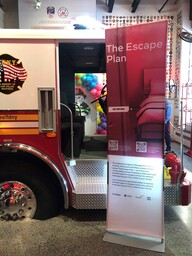
When it comes to fire safety, it’s hard to imagine what it would be like to escape a fire in your home. Making a plan is important and having first-hand experience of a fire underscores the value of being ready in the face of a fire.
On Tuesday, May 16, U.S. Fire Administrator Dr. Lori Moore-Merrill joined representatives from FEMA’s Ready Campaign, Meta and the Ad Council at the New York Fire Department Fire Zone to co-launch a new virtual reality experience about fire safety. Meta donated next generation technology to help create The Escape Plan, a free and public virtual reality experience that allows individuals to learn to safely escape a fire in their home in an immersive environment.
In The Escape Plan, users must work through various obstacles to make a timely escape from a fire, while learning the safer choices to make along the way. At the end of the experience, users will find resources to create their own fire escape plan and visit Ready.gov to further prepare themselves and their families for potential home fires and other hazards.
To learn more about creating your own personal fire escape plan, visit USFA.fema.gov or Ready.gov.
|
FEMA published an update to the FEMA Acronyms, Abbreviations and Terms Book (FAAT Book) – A Capability Assurance Job and Field Aid. The FAAT Books is a comprehensive list of FEMA and emergency management-related acronyms, terms and abbreviations.
The updated FAAT Book is available on FEMA.gov.
FEMA will not publish hard copies of the 2023 update. The link to the existing 2009 version on FEMA.gov will be updated to redirect visitors to the 2023 update.
Hazard mitigation plans are the foundation for resilience. The updated Local Mitigation Planning Policy Guide went into effect on April 19, 2023.
FEMA recently released an updated Local Mitigation Planning Handbook to help local governments—including special districts—develop and update hazard mitigation plans to meet the updated policy. It gives guidance on how to write a plan that will get approved.
The Handbook breaks down four steps to develop a local plan:
- Organize the planning process and resources.
- Assess risk.
- Develop a mitigation strategy.
- Adopt and implement the plan.
The Handbook also provides useful ideas and approaches that help communities plan to reduce long-term risk from natural disasters.
Go to FEMA.gov to learn more and to access the Handbook.
FEMA published a notice in the Federal Register seeking public comment on how to apply new legislation that will designate areas with communities most at risk and from natural hazards.
This notice is for the agency to gain better understanding in key areas that will support an effective implementation of the Community Disaster Resilience Zone Act. FEMA posted the Request for Information to learn the best ways to obtain public feedback that will help shape and inform how the agency uses the act to increase resilience efforts.
This new law amends the Robert T. Stafford Disaster Recovery and Emergency Act to use FEMA’s National Risk Index to designate community disaster zones. These represent areas with the highest natural hazard risk and a relatively lower ability to withstand their impacts.
Vulnerable communities often face difficulties in accessing disaster resilience funding. These communities will receive targeted support to access federal funding to plan for resilience projects that will help them reduce impacts caused by climate change and natural hazards.
Targeted federal support includes increased federal cost-share for the Building Resilient Infrastructure and Communities program, lessening the financial burden on communities to perform resilience-related activities. This includes a greater federal cost share adjustment and an increase in the community’s ability to afford valuable pre-disaster mitigation projects.
The law will also enable communities to work across a range of federal and private sector partners to maximize funding and provide technical assistance, strengthening community resilience.
FEMA is requesting information from the public to gain understanding in key areas that will support an effective implementation of the act. This includes learning how communities identify, use and apply risk assessment tools to reduce natural hazard effects and how to achieve equity and geographic balance when designating zones.
Comments can be submitted from 2023-11268 on the Federal eRulemaking Portal, Docket ID: FEMA-2023-0009 or by emailing FEMA-CDRZ-RFI@fema.dhs.gov. Please follow the instructions on the page for submitting comments and contact the Regulations.gov Help Desk if you have technical issues.
Visit FEMA.gov for more information.
What if we told you that homeowner’s insurance does not cover flood insurance? Homeowners may not know that homeowner’s insurance does not cover flooding, purchasing a flood insurance policy can offset the costs of repair due to flooding.
An unexpected guest showing up on your doorstep is always a shock—even more so if that guest is flooding.
Every year, more homes and businesses experience flooding due to rising river levels. Riverine flooding is when the water from streams and rivers rises over its banks and spills out into nearby low-lying land—putting inland communities, including cities, at risk. This type of flooding is especially a risk as weather gets warmer due to the combination of increased rainfall and snowmelt.
FEMA offers flood insurance through the National Flood Insurance Program (NFIP). Individuals can visit www.floodsmart.gov to learn more about the risks of riverine flooding, how flood insurance can offer financial protection and how to find a flood insurance agent. Combining flood insurance with low/no cost mitigation tactics, such as elevating utilities and safely storing important documents, will give you an advantage to protect you and your property from potential flooding during the spring riverine flooding season. It is crucial to be prepared, no matter if you’re near or far from a river.
Visit floodsmart.gov/rivers to learn more about the risks of riverine flooding, how to assess your flood risk, learn about flooding damage mitigation and find resources to share among your community.
Buy flood insurance and give yourself the peace of mind you need to protect your home or business. Visit www.floodsmart.gov and find an agent today.
The theme of Week 5 for Building Safety Month, Solving Challenges Together, is about elevating Building Safety Month to a global scale and addressing some of the issues we face as a global community.
Considering the devastating earthquakes that impacted Turkey and Syria, Hurricane Ian in Florida and the recent tornado in Mississippi, the White House and FEMA are committed to developing strategies, tools, techniques and other measures that can reduce the adverse effects of natural hazards. These efforts strengthen resilience among at-risk communities across the world.
On June 1, 2022, the Biden-Harris Administration announced a National Initiative to Advance Building Codes that will help state, local, Tribal and territorial governments adopt current building codes and standards, enabling communities to be more resilient to hurricanes, flooding, wildfires and other extreme weather events that are intensifying due to climate change.
Many existing buildings are built to older or no standards and are likely to perform poorly in the event of a natural hazard. FEMA and its partners continue working to mitigate the risk that communities face. Modern codes and standards are also ineffective if they are not adequately enforced, and there are many regional differences in adoption and enforcement across the United States. For communities to be resilient in a disaster, all new and existing buildings would need to be built or retrofitted to meet current, strong codes.
FEMA and its partners continue to work to improve methods for risk assessment, prioritization and retrofit, as well as support for developing and adopting effective mitigation policies and practices. The Applied Technology Council has made available beneficial, free training on YouTube covering FEMA P-154: Rapid Visual Screening of Buildings for Potential Seismic Hazards. The video series can be found here.
In addition, FEMA P-2090/NIST-SP-1254: Recommended Options for Improving the Built Environment for Post-Earthquake Re-occupancy and Functional Recovery Time focused on activities supporting improved community resilience. These efforts are only the beginning, and the publications and guidance FEMA disseminates are free and able to help the global community – not just within the United States.
For more information on building codes and safety, visit:
For more information on Building Safety Month, visit www.iccsafe.org/advocacy/building-safety-month/building-safety-month/.
|
FEMA Exercise Support Applications Due June 1
FEMA provides state, local, tribal and territorial governments with no-cost technical assistance for exercises through the agency’s National Exercise Program. Support is tailored to the needs of the jurisdiction and can include assistance with exercise planning, design, scenario development, conduct and evaluation.
The application period for 2023 exercise support is open now through June 1. There is no associated cost share for selected jurisdictions for this exercise assistance.
For additional information, including the application process, frequently asked questions and information on future exercise support availability, visit FEMA.gov/NEP. For questions, email NEP@fema.dhs.gov and include “2023 Exercise Support Question” in the subject line, an invitation will be sent to participate in weekday office hour sessions.
…………………………………………………………………………………………………………..
FEMA Updates Engaging Faith-Based and Community Organizations Planning Guide
FEMA and the DHS Center for Faith-Based and Neighborhood Partnerships are updating, “Engaging Faith-Based and Community Organizations: Planning Considerations for Emergency Managers.”
The document outlines best practices for engaging faith-based and community organizations before, during and after disasters to help jurisdictions improve their resilience and emergency management capabilities. FEMA will host 60-minute webinars to provide an overview of the 2018 publication and include a facilitated discussion to gather feedback on areas to improve the guide. The webinars will be on:
To learn more about the update effort and listening sessions, visit FEMA.gov.
…………………………………………………………………………………………………………..
FEMA Seeks Feedback on Public Health Resource Typing Documents
FEMA seeks public feedback on nine National Incident Management System (NIMS) documents related to public health incident response. These resource typing documents enhance the coordination and effectiveness of mutual aid by establishing baseline qualifications. This facilitates sharing deployable resources at all jurisdictional levels.
The open feedback period provides an opportunity for interested parties to comment on the draft documents to ensure they are relevant to all implementing partners. To provide comments on the draft documents, complete the feedback form and submit the form to FEMA-NIMS@fema.dhs.gov no later than 5 p.m. ET on June 8.
…………………………………………………………………………………………………………..
FEMA National Earthquake Hazards Reduction Program Opens Application Period for State Assistance
The Fiscal Year 2023 funding opportunity for the FEMA National Earthquake Hazards Reduction Program (NEHRP), Individual State Earthquake Assistance and Multi-State and National Earthquake Assistance grants are now on Grants.gov.
The application period is open until 5 p.m. ET on June 7. The application period for both funding opportunities must be submitted in FEMA Grants Outcome (FEMA GO). For more information, visit FEMA GO | FEMA.gov.
…………………………………………………………………………………………………………..
National Hurricane Program Hosts HURREVAC Webinar Series for Emergency Managers
From June 12 – 16, FEMA's National Hurricane Program will host a five-day HURREVAC training for emergency managers.
Each webinar will begin at 2 p.m. ET, topics include:
- Introduction to HURREVAC and Overview of the National Hurricane Program: June 12.
- Wind Forecast Features: June 13.
- Evacuation Timing Features: June 14.
- Storm Surge and Other Water Hazards: June 15.
- Exercise Tools and Applying HURREVAC: June 16.
HURREVAC is a free, web-based decision-support tool that assists emergency managers by providing information and tools to inform hurricane response decisions in advance of a threatening storm. Interested emergency managers can register now for this annual HURREVAC webinar series.
…………………………………………………………………………………………………………..
FEMA Updates Resilience Analysis and Planning Tool
The Resilience Analysis and Planning Tool (RAPT) is a free, no-login required online web map that makes everyone a geographic information system (GIS) analyst. RAPT gives everyone access to powerful data and GIS mapping to understand potential challenges to resilience in each community, county, state and tribe.
FEMA will host community of practice webinars for RAPT users. Register in advance to learn more.
To learn more about RAPT, including additional tools to prepare ahead of hurricane season, visit Tools for Practitioners | FEMA.gov.
…………………………………………………………………………………………………………..
$12M Available for Regional Catastrophic Preparedness Grants
FEMA released the funding notice for the Fiscal Year 2023 Regional Catastrophic Preparedness Grant Program. The program provides $12 million to eligible states and local governments to close known preparedness capability gaps, encourage innovative regional solutions to issues related to catastrophic incidents, and build on existing regional preparedness efforts.
Awards will be made on a competitive basis to applicants who present an ability to successfully meet the requirements described in the funding notice.
The application period will remain open until 5 p.m. ET on July 24. Submissions must be made through Grants.gov. The Notice of Funding Opportunity is available on Grants.gov as well as on FEMA.gov.
…………………………………………………………………………………………………………..
|


