|
In celebration of Infrastructure Week and the 18-month anniversary of President Biden signing the Bipartisan Infrastructure Law, FEMA held events to announce project selections and additional funding to help communities nationwide build climate and disaster resiliency.
The project selections announced included resilience projects funded by the Building Resilient Infrastructure and Communities (BRIC) and Flood Mitigation Assistance community-wide flood mitigation projects.
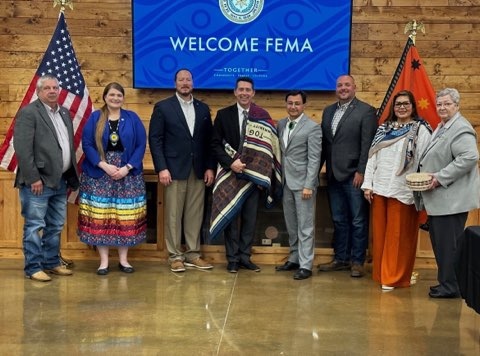
The agency also hosted in-person events in New Jersey and on the Cherokee Nation’s reservation in Hulbert, Oklahoma, to commemorate the passage of this landmark legislation and highlight projects that have benefitted from FEMA’s hazard mitigation funding.
The Cherokee Nation is in the process of building a new Community Storm Safe Shelter on their reservation in Hulbert, Oklahoma, with enough capacity to help protect everyone in the community during storms and severe weather if needed.
Participants from the Cherokee Nation and FEMA.
The city of Hoboken and the North Hudson Sewage Authority partnered for the Northwest Resiliency Park and H6-H7 Stormwater System in Hoboken, New Jersey.
This project is an element of Hoboken’s comprehensive urban water strategy and integrates with the ongoing $230 million rebuild project to mitigate flooding as a part of post-Hurricane Sandy recovery efforts.
To learn more about FEMA programs funded by the Bipartisan Infrastructure Law, visit FEMA.gov.
The Bipartisan Infrastructure Law, also known as the Infrastructure Investment and Jobs Act, provides FEMA with $6.8 billion to support existing and fund new programs for nation-wide mitigation. The Bipartisan Infrastructure Law funding will support projects that tackle the climate crisis and make communities more resilient, the law will prioritize President Biden’s Administration and FEMA’s transformational goals to provide support to historically marginalized and disadvantaged communities.
FEMA is now hiring to fill positions across the agency and the country to support these new Bipartisan Infrastructure Law funded projects.
If you or someone you know is interested in advancing FEMA’s mission through the Bipartisan Infrastructure Law, visit usajobs.gov for a list of open positions.
By choosing to work in these positions, you will join FEMA’s efforts to build national resilience and improve critical infrastructure across the country. You will play a crucial role in supporting FEMA’s commitments to environmental justice, equity and adaptation to the worsening impacts of climate change.
To learn more about the law, including funding commitments, visit FEMA.gov.
FEMA announced $160 million in additional funding for states, local communities, tribes, territories, and the District of Columbia to build climate and disaster resiliency, selecting more than 400 resilience projects and activities for awards.
The announcement includes $136 million for the Building Resilient Infrastructure and Communities (BRIC) program and $24 million for the Flood Mitigation Assistance program. FEMA intends to award these initial selections quickly to get funds in the hands of the communities that need it the most.
This comes 18 months after President Biden signed the Bipartisan Infrastructure Law. The law provides nearly $7 billion in funding to support FEMA’s resilience and mitigation programs. To date, over $370 million has been provided, or is in the process of being provided, to these two programs by this landmark legislation.
During this grant cycle, each state and territory that applied for the allocation funding were eligible to up to $2 million for mitigation projects and planning, project scoping, and the adoption and enforcement of hazard resistant building codes. In addition, more than $50 million of the overall funding includes a set-aside for Tribal Nations that applied.
The amount represents just a fraction of the more than $3 billion that these funds will ultimately enable. FEMA will make the second set of project selections later this summer include larger and more complex projects for both programs. For BRIC, this will be for projects selected for the national competition funding and for Flood Mitigation Assistance, it will include acquisitions and elevations for buildings in flood prone areas. Also, these grants can be used for local flood risk reduction projects.
For communities and Tribal Nations with limited resources, the agency is also announcing 46 selections for BRIC non-financial Direct Technical Assistance. This assistance, provided for up to 36 months, helps local and tribal jurisdictions to reduce disaster damage, build community resilience and sustain successful mitigation programs.
This brings the total number of communities benefitting from this hands-on support to 74 communities, territories and Tribes nationwide. The wide-ranging Direct Technical Assistance includes climate risk assessments, community engagement, partnership building, hazard mitigation and climate adaptation planning.
Other programs benefitting from the Bipartisan Infrastructure Law:
- $185 million in State and Local Cybersecurity Grants to address threats to information systems. In total, the agency will make available $1 billion over four years to support strong cyber security practices for states, local communities, tribes and territories. To date, $176 million has been allocated through this program.
- $733 million over five years is available for states and territories to enhance dam safety programs. In Fiscal Year 2022, FEMA awarded $15 million for the National Dam Safety Program.
- More than $30 million has been allocated of the $60 million available through the Swift Current Initiative.
- $500 million for the Safeguarding Tomorrow Revolving Loan Fund program over five years. During the first year of the program, the agency has provided $50 million in available funding to states, territories and certain federally recognized tribes.
For more information about FEMA programs funded by the Bipartisan Infrastructure Law, visit FEMA.gov. FEMA Administrator Deanne Criswell discussed how the Bipartisan Infrastructure Law helps to build resilience in communities across the nation, visit the FEMA Blog to read her full remarks.
FEMA recently finalized a new Language Access Policy which provides federal, state, tribal and territorial emergency managers, grant recipients, and community members with a greater degree of specificity regarding our commitment to language access.
Language barriers can pose significant challenges for people trying to access information and services during disasters. FEMA is committed to ensuring equal access for people who speak languages other than English.
“Language access is an important component of our commitment to equity, which is focused on fair, just, and impartial treatment of all individuals, including those from underserved communities,” said FEMA Office of Equal Rights Director Leslie Saucedo.
FEMA grant recipients must take reasonable steps to ensure meaningful access to their programs and services by limited English proficiency individuals, pursuant to Title VI of the Civil Rights Act of 1964, which prohibits discrimination based on race, color or national origin in federally assisted programs. The policy also implements Sections 308 and 309 of the Stafford Act, which prohibit discrimination based on race, color, religion, nationality, sex, age, disability, English proficiency or economic status in disaster response or recovery efforts.
In the provision of language access, reasonable steps may include written translation of documents, or oral language services from qualified interpreters, including staff members, contractors, or remote communication technology.
The policy highlights the need for written translation and interpretation services that are free to the public. FEMA is putting processes in place to support any surge in limited English proficiency needs. Additionally, there are efforts underway to ensure high quality limited English proficiency tools and products to include access to rare and indigenous languages as needed.
The Language Access Policy demonstrates the steps the agency is taking to make sure that all people who require language access services receive them. According to the U.S. Census Bureau, nearly 68 million people speak a language other than English at home in 2019. FEMA will work with community partners to proactively identify areas where language access services are needed and develop strategies to provide services.
To review the Language Access Policy, visit FEMA Policy: Language Access. To learn more about non-discrimination and civil rights laws, and to find information on filing a complaint, visit External Civil Rights Division | FEMA.gov
The Resilience Analysis and Planning Tool (RAPT) is a free, no-login required online web map that makes everyone a geographic information system (GIS) analyst. RAPT gives everyone access to powerful data and GIS mapping to understand potential challenges to resilience in each community, county, state and tribe.
The more recent RAPT update includes the latest data from the U.S Census Bureau, an updated FEMA Community Resilience Challenges Index and a curated add-in data layer list.
RAPT helps reveal important community characteristics with preloaded layers that display:
- Population challenges to resilience – this includes 22 individual indicators of resilience and a single Community Resilience Index value for counties and census tracts.
- Hazard and risk – such as real-time flood gauges, live radar, active wildfires, annualized expected losses from the National Risk Index and more.
- Infrastructure – schools, places of worship, electric lines, wastewater facilities and more.
- Equity – race and ethnicity data, broadband access, languages spoken in the home and more.
- Future climate – three sea level rise scenarios and easy import of forecasted climate data from the Climate Risk and Resilience Portal(ClimRR).
FEMA will host community of practice webinars for RAPT users. Register in advance to learn more.
To learn more about RAPT, including additional tools to prepare ahead of hurricane season, visit Tools for Practitioners | FEMA.gov.
Building Safety Month is the month of May and this week's theme is advocate for your community! Led by the International Code Council, this international campaign spearheads awareness about the importance of modern building codes and strong building code enforcement.
We all have a role in ensuring the places where we live, work and play are safe. All too often, building owners assume that their property is natural hazard-resistant and automatically safe when they’re not. It is our responsibility to know the steps to keep our spaces protected.
Local and state emergency managers, building code officials and others also share responsibility for reducing their communities’ risk in dealing with natural hazards and other adverse events – before, during and after.
As a result, these positions must engage in comprehensive conversations about topics central to mitigation. This includes conversations about how your jurisdiction can stay current with which codes they’ve adopted and understand what basic code enforcement looks like.
Ten years after the 2013 Moore Tornado, a former teacher is making a difference in Oklahoma. In 2020, Sheri Bittle, a teacher in 2013 at Briarwood Elementary School, and others are helping Oklahoma make great strides in protecting school children from natural hazards. With their strong advocacy, a newer edition of the International Building Code is being adopted by schools, including a provision requiring storm shelters to protect staff and students. Visit FEMA's YouTube channel for more.
Sign up for FEMA’s Building Science Codealition newsletter and advocate for stronger building codes, learn about funding opportunities, access free building science resources and engage with us to promote building safety practices.
FEMA released the funding notice for the Fiscal Year 2023 Regional Catastrophic Preparedness Grant Program. The program provides $12 million to eligible states and local governments to close known preparedness capability gaps, encourage innovative regional solutions to issues related to catastrophic incidents, and build on existing regional preparedness efforts.
The purpose of the Regional Catastrophic Preparedness Grant Program is to build regional capacity to manage catastrophic incidents by improving and expanding collaboration for catastrophic incident preparedness. The National Response Framework (4th edition, 2019) defines a catastrophic incident as any natural or manmade incident, including terrorism, that results in extraordinary levels of mass casualties, damage or disruption severely affecting the population, infrastructure, environment, economy, national morale or government functions.
Housing was added as a strategic priority for this grant program in 2023 to accompany equity, climate resilience and readiness. Priority will also be given to projects that address the needs of disadvantaged communities that might be at special risk as a result of current and/or future hazards, including those associated with climate change. This priority is guided by the Justice40 Initiative, which commits the federal government to delivering 40% of the overall benefits of climate and other federal investments to disadvantaged communities that have been historically marginalized, underserved and overburdened by pollution.
Awards will be made on a competitive basis to applicants who present an ability to successfully meet the requirements described in the funding notice.
The application period will remain open until 5 p.m. ET on July 24. Submissions must be made through Grants.gov. The Notice of Funding Opportunity is available on Grants.gov as well as on FEMA.gov.
FEMA Exercise Support Applications Due June 1
FEMA provides state, local, tribal and territorial governments with no-cost technical assistance for exercises through the agency’s National Exercise Program. Support is tailored to the needs of the jurisdiction and can include assistance with exercise planning, design, scenario development, conduct and evaluation.
The application period for 2023 exercise support is open now through June 1. There is no associated cost share for selected jurisdictions for this exercise assistance.
For additional information, including the application process, frequently asked questions and information on future exercise support availability, visit FEMA.gov/NEP. For questions, email NEP@fema.dhs.gov and include “2023 Exercise Support Question” in the subject line, an invitation will be sent to participate in weekday office hour sessions.
…………………………………………………………………………………………………………..
FEMA Seeks Feedback for Draft Private-Public Partnership Guides
FEMA seeks content input on the “Information Sharing Guide for Private-Public Partnerships” and the “Economic Resilience Guide for Private-Public Partnerships.” The guides are for any private-public partnership with a cooperative arrangement between two or more entities of private industry and public sector organizations for their mutual benefit. They are designed to help ensure life safety, economic security and resilience in communities.
This review allows interested parties to provide substantive content recommendations for continued development and improvement of the drafts. The results of this review will inform the development of the published versions of the guides for whole community use.
To download the documents, visit FEMA.gov. To submit feedback, email the completed form on information sharing or economic resilience to NPD-Planning@fema.dhs.gov using subject line “P3 Feedback” by May 25.
…………………………………………………………………………………………………………..
FEMA Updates Engaging Faith-Based and Community Organizations Planning Guide
FEMA and the DHS Center for Faith-Based and Neighborhood Partnerships are updating, “Engaging Faith-Based and Community Organizations: Planning Considerations for Emergency Managers.”
The document outlines best practices for engaging faith-based and community organizations before, during and after disasters to help jurisdictions improve their resilience and emergency management capabilities. FEMA will host 60-minute webinars to provide an overview of the 2018 publication and include a facilitated discussion to gather feedback on areas to improve the guide. The webinars will be on:
To learn more about the update effort and listening sessions, visit FEMA.gov.
…………………………………………………………………………………………………………..
FEMA Seeks Feedback on Public Health Resource Typing Documents
FEMA seeks public feedback on nine National Incident Management System (NIMS) documents related to public health incident response. These resource typing documents enhance the coordination and effectiveness of mutual aid by establishing baseline qualifications. This facilitates sharing deployable resources at all jurisdictional levels.
The open feedback period provides an opportunity for interested parties to comment on the draft documents to ensure they are relevant to all implementing partners. To provide comments on the draft documents, complete the feedback form and submit the form to FEMA-NIMS@fema.dhs.gov no later than 5 p.m. ET on June 8.
…………………………………………………………………………………………………………..
FEMA National Earthquake Hazards Reduction Program Opens Application Period for State Assistance
The Fiscal Year 2023 funding opportunity for the FEMA National Earthquake Hazards Reduction Program (NEHRP), Individual State Earthquake Assistance and Multi-State and National Earthquake Assistance grants are now on Grants.gov.
The application period is open until 5 p.m. ET on June 7. The application period for both funding opportunities must be submitted in FEMA Grants Outcome (FEMA GO). For more information, visit FEMA GO | FEMA.gov.
…………………………………………………………………………………………………………..
National Hurricane Program Hosts HURREVAC Webinar Series for Emergency Managers
From June 12 – 16, FEMA's National Hurricane Program will host a five-day HURREVAC training for emergency managers.
Each webinar will begin at 2 p.m. ET, topics include:
- Introduction to HURREVAC and Overview of the National Hurricane Program: June 12.
- Wind Forecast Features: June 13.
- Evacuation Timing Features: June 14.
- Storm Surge and Other Water Hazards: June 15.
- Exercise Tools and Applying HURREVAC: June 16.
HURREVAC is a free, web-based decision-support tool that assists emergency managers by providing information and tools to inform hurricane response decisions in advance of a threatening storm. Interested emergency managers can register now for this annual HURREVAC webinar series.
…………………………………………………………………………………………………………..
|