|
FEMA Administrator Deanne Criswell delivered the 2023 commencement address at Pennsylvania State University’s College of Information Sciences and Technology on May 6.
Administrator Criswell’s remarks highlighted technological advances that help FEMA and the emergency management enterprise respond to disasters, including COVID-19, but reminded the new graduates that it is the people behind the technology that are the real heroes.
“Technology helped fast-track the development of COVID vaccines, but it took people to get the shots in arms. Technology enabled virtual medical appointments, but it took people to work through the complex process of protecting patient information. And when it came to your college education, technology brought you into virtual classrooms, but it took your professors and administrators to maintain the experience of a world-class education,” remarked Administrator Criswell. “We can never forget that it is the people behind the technology that has helped us get here today. Technology is only one part of the solution -- you are the other.”
 Administrator Criswell Delivers Commencement Address at Pennsylvania State University’s College of Information Sciences and Technology (Photo Credit: Penn State)
Administrator Criswell also challenged the class of 2023 to continue to question and challenge the status quo in order to make change in their own communities, nationwide and across the globe.
“Regardless of the career you choose, I challenge you to give back to the places you call home. Use your skills to make a difference, change a life and perhaps save one too" said Administrator Criswell.
You can read the Administrator’s full remarks on FEMA.gov watch her commencement speech on YouTube.
On May 5, FEMA and the Emergency Food and Shelter Program’s National Board announced the allocation of $332.5 million to assist with migrant arrivals at the Southwest border.
This distribution allocates all remaining funding through the Emergency Food and Shelter Program-Humanitarian.
Future support for emergency migrant care will be supported by the newly created Shelter and Services Program, which has about $360 million to grant before the end of the Fiscal Year. More information about the new program is available here.
Read more on DHS.gov.
Last week, FEMA took part in the National Oceanic and Atmospheric Administration’s (NOAA) annual Hurricane Awareness Tour in Texas, Louisiana, Mississippi and Florida.
Representatives from all levels of government joined community partners to showcase the coordinated approach to hurricane readiness and response, while urging the public to prepare now.
At each stop, the public met FEMA and NOAA hurricane experts, scientists and crew members. Attendees had the unique opportunity to tour aircrafts that help forecasters keep us safe – NOAA’s WP-3D and the U.S. Air Force Reserve WC-130J.
Read the full press release on FEMA.gov.
Now is the time to start preparing for hurricane season. Sign up for your local community’s emergency alerts by downloading the FEMA App. Make an emergency plan. Visit ready.gov, or Listo.gov to create your emergency plan.
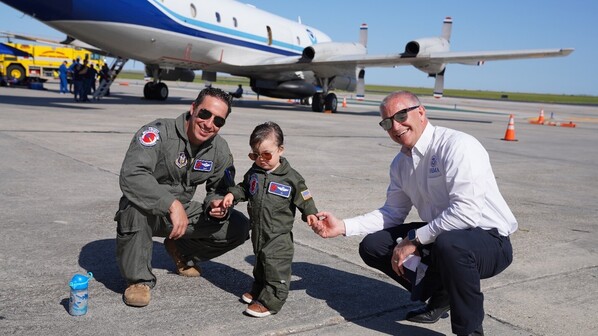 FEMA Region 6 Regional Administrator Tony Robinson (right) with Lt. Col. John Gharbi, 53rd Weather Reconnaissance Squadron and Gharbi's son at Lakefront Airport New Orleans.
FEMA is continuing its support for Building Safety Month highlights this month with this week’s theme, Exploring Careers in Building Safety. Each year, the International Code Council’s around-the-world campaign raises awareness about the importance of modern building codes and strong building code enforcement.
Building safety professionals are critical employees when considering the importance of what they do on a daily basis. By knowing how to build to code and construct facilities with care, countless lives are saved every year in the United States.
These professionals provide guidance and advice to architects, engineers and contractors to help them bring building projects to life while ensuring safety for occupants and residents. They also help keep existing buildings safe by conducting inspections and adopting the latest building codes. They are community-oriented and dedicated to making the world a safer place.
FEMA is dedicated to supporting our nation’s building safety professionals by providing numerous training opportunities. In fiscal year 2021, FEMA’s Building Science Branch trained over 1,400 individuals on hazard-resistant building codes and best practices. So far this year, FEMA has trained over 150 individuals (and counting!) on hazard-resistant building codes and best practices. For more information on Building Safety related jobs at FEMA, visit www.fema.gov/careers.
For more information on Building Safety Month, visit the International Code Council’s website.
|
FEMA and the DHS Center for Faith-Based and Neighborhood Partnerships are updating, “Engaging Faith-Based and Community Organizations: Planning Considerations for Emergency Managers.”
Originally published in June 2018, this document outlines best practices for engaging faith-based and community organizations before, during and after disasters to help jurisdictions improve their resilience and emergency management capabilities. The organizations can also be significant force multipliers, particularly in reaching high-risk and historically underserved community members.
The update to “Engaging Faith-Based and Community Organizations: Planning Considerations for Emergency Managers” will include:
- Lessons learned from real-world events.
- Updates to FEMA programs.
- Additional resources and recommendations from the public and key stakeholders.
FEMA will host 60-minute webinars to provide an overview of the 2018 publication and include a facilitated discussion to gather feedback on areas to improve the guide. The webinars will be held:
To learn more about the update effort and listening sessions, visit FEMA.gov.
If a nuclear detonation happened today, first responders would immediately respond to save lives. Yet even with the best of plans, response assets and resources would likely be overwhelmed due to the scale and complexity of the incident.
The 72-Hour Nuclear Response Guidance uses the first 72-hour time frame as a notional target to help planners focus their efforts on developing actionable strategies that would have the greatest impact on lifesaving efforts, which should be the primary focus during the first few days after a nuclear detonation.
Th guidance delineates missions and tactics that should be executed by first responders, emergency managers, and other state, local, tribal and territorial response organizations following a nuclear detonation in or near their jurisdiction. The document includes guidance on pre-detonation tactics and how to:
- Protect the lives of first responders and the public.
- Develop a common operating picture.
- Establish a coordinated multi-jurisdictional response.
- Prepare for the integration of support arriving from other jurisdictions, states and federal agencies across the country.
Visit 72-Hour Nuclear Response Guidance for the complete guide. For additional information, including the agency’s chemical, biological, radiological and nuclear response capabilities, visit Tools for Chemical, Biological, Radiological and Nuclear (CBRN) Hazards | FEMA.gov.
FEMA seeks public feedback on nine National Incident Management System (NIMS) documents related to public health incident response.
These resource typing documents enhance the coordination and effectiveness of mutual aid by establishing baseline qualifications. This facilitates sharing deployable resources at all jurisdictional levels.
The open feedback period provides an opportunity for interested parties to comment on the draft documents to ensure they are relevant to all implementing partners.
To provide comments on the draft documents, complete the feedback form and submit the form to FEMA-NIMS@fema.dhs.gov no later than 5 p.m. ET on June 8, 2023.
2023 Hazard Mitigation Workshop Call for Abstracts Due May 15
FEMA opened a Call for Abstracts for the annual Hazard Mitigation Partners Workshop, the deadline for submissions is Monday, May 15.
The 2023 HM Partners Workshop will be held virtually from Oct. 16-19. This year's theme is: All Together for Climate Resilience Communities: Equity, Partnerships, Capability & Capacity.
During that time, we will focus on building mitigation champions, driving community resiliency, providing technical assistance for grant programs, and supporting overall mitigation. Visit FEMA.gov to learn more.
…………………………………………………………………………………………………………..
FEMA Exercise Support Applications Due June 1
FEMA provides state, local, tribal and territorial governments with no-cost technical assistance for exercises through the agency’s National Exercise Program. Support is tailored to the needs of the jurisdiction and can include assistance with exercise planning, design, scenario development, conduct and evaluation.
Applications for 2023 exercise support is open now through June 1. There is no associated cost share for selected jurisdictions for this exercise assistance.
For additional information, including the application process and frequently asked questions, visit FEMA.gov/NEP. For questions, email NEP@fema.dhs.gov and include “2023 Exercise Support Question” in the subject line, an invitation will be sent to participate in weekday office hour sessions.
…………………………………………………………………………………………………………..
FEMA Seeks New Members for the National Advisory Council
FEMA is seeking qualified individuals to lend their expertise and serve on the agency’s National Advisory Council.
The council includes a geographically diverse and substantive cross-section of 40 members who advise the FEMA Administrator on all aspects of emergency management, ensuring input from and coordination with state, local, tribal and territorial governments, as well as the private and nonprofit sectors.
The agency is accepting applications for seven discipline-specific positions and up to two Administrator-selected positions. Newly selected members will serve up to a three-year term on the council. If other positions open, FEMA may select qualified candidates from the pool of applications.
If you are interested in applying to the National Advisory Council, view the Federal Register for instructions. Applications are due by midnight ET on May 21. Per the Federal Advisory Committee Act, federal employees are ineligible to apply. For a description of each position, please go to the Charter.
…………………………………………………………………………………………………………..
FEMA Seeks Feedback for Draft Private-Public Partnership Guides
FEMA seeks content input on the “Information Sharing Guide for Private-Public Partnerships” and the “Economic Resilience Guide for Private-Public Partnerships.” The guides are for any private-public partnership with a cooperative arrangement between two or more entities of private industry and public sector organizations for their mutual benefit. They are designed to help ensure life safety, economic security and resilience in communities.
This review allows interested parties to provide substantive content recommendations for continued development and improvement of the drafts. The results of this review will inform the development of the published versions of the guides for whole community use.
To download the documents, visit FEMA.gov. To submit feedback, email the completed form on information sharing or economic resilience to NPD-Planning@fema.dhs.gov using subject line “P3 Feedback” by May 25.
…………………………………………………………………………………………………………..
|


