|
May marks Building Safety Month! Led by the International Code Council, this international campaign raises awareness about the importance of modern building codes and strong building code enforcement. FEMA is a proud partner and supporter of Building Safety Month.
President Joseph R. Biden signed a proclamation which highlights the benefits of building codeS and the formation of the National Initiative to Advance Building Codes in June 2022 led by FEMA. This initiative helps state, local, tribal and territorial governments adopt the latest building standards.
This year’s theme for Building Safety Month, “It Starts with You!,” reminds us that building safety is a shared responsibility. Buildings are our refuge and our safe space. During the month, there will be a theme each week highlighting a different aspect of the importance of resilient structures, how to build them and how to maintain them.
The first week’s theme is Building Safety Starts at Home. While most of us are not building professionals, there are a number of practical resources available to provide steps you can take today to stay safe at home in the event of a natural hazard. From structural to non-structural considerations, FEMA produces a wide variety of resources for homeowners and occupants.
The Building Codes Toolkit for Homeowners and Occupants offers basic guidance and tools to help building owners and occupants learn about building codes and the process of making a building stronger against natural hazards. Building codes are the minimum design and construction requirements to protect the health and safety of building owners and occupants and the public. Step-by-step guidance, along with background information on building codes, is provided to help readers make informed decisions about building codes.
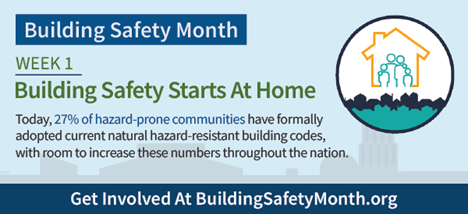
Today, 27% of hazard-prone communities have formally adopted current natural hazard-resistant building codes, with room to increase these numbers throughout the nation.
Visit inspecttoprotect.org/ to determine the building codes used in your community today and get innovative ideas for retrofitting your home to increase resilience. Contact your local government for information about building codes used in the past.
The National Hurricane Program was excited to host the first in-person annual Interagency Coordinating Committee on Hurricanes meeting since 2019! The meeting was held March 13-17 at the FEMA Region 4 office in Atlanta.
In this year’s meeting, the sessions covered a retrospective look at the 2022 hurricane season from federal and state participants. The meeting also featured partner updates and topic specific breakout sessions.
The program will leverage stakeholder input from the breakout sessions to inform development efforts and future initiatives.
The NHP recognizes that the transition of the committee’s annual meeting back to an in-person event limited the number of attendees far more than the past virtual offerings. In an effort to make valuable committee presentations and resources available to all stakeholders throughout hurricane season, staff created a 2023 Interagency Coordinating Committee on Hurricanes Virtual Meeting Room. In the room, stakeholders can find all the presentations delivered at the annual meeting, as well as additional information and resources. The virtual meeting room will remain live throughout hurricane season to support state, local, tribal and territorial stakeholders and federal partners in their hurricane preparedness efforts.
The committee is the primary mechanism for coordinating the program’s goals, products and priorities with state and territorial partners.
The National Hurricane Program is a partnership between FEMA, the U.S. Army Corps of Engineers and the NOAA National Hurricane Center. To learn more about the National Hurricane Program, including the Interagency Coordinating Committee on Hurricanes, visit Hurricane Planning and Response | FEMA.gov.
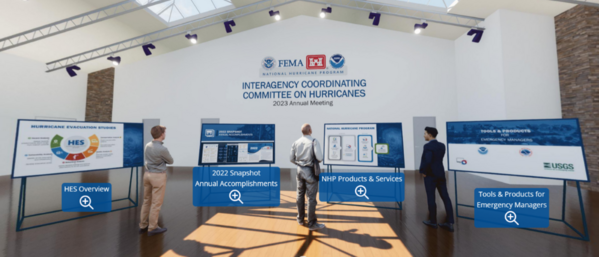
The 2023 Interagency Coordinating Committee on Hurricanes Virtual Meeting Room. Emergency managers will be able to access information and resources in the virtual room throughout hurricane season.
Data is a powerful tool for ensuring our work as emergency managers is effective and equitable. FEMA Administrator Criswell recently announced the release of the 2023-2027 FEMA Data Strategy. The strategy gives FEMA the vision, strategic goals and guiding principles needed to effectively use data to make decisions and fulfill FEMA’s mission. It can also be used as a model for the emergency management community as a whole.
The four strategic goals within the strategy outline how the agency can better utilize and care for data. This includes everything from how data is collected, to how it is processed and used to inform decision making. It commits the agency to ensuring:
- Data Enablement: Making data accessible, useful and effective.
- Data Citizenship: Empowering our stakeholders to use and care for data properly.
- Data Access and Security: Ensuring data is accessible, shared and used to the full extent allowed by legal, privacy and security requirements.
- Evidence Building: Using data to inform decision making by producing evidence with policy analysis, foundational fact finding, performance measurement and program evaluation.
Whether you are collecting information from survivors, sharing data with external stakeholders, or using statistical analysis to make program and policy decisions, we all have a role to play in strengthening our decision making with data.
Visit FEMA.gov to review the Data Strategy.
FEMA recently awarded $29.9 million to the Commonwealth of Kentucky to buy and remove 173 flood damaged homes.
The buyouts occurred after the July 2022 Eastern Kentucky flooding that swept through 14 counties and displaced thousands of residents. The affected communities will continue to face a long road to recovery and require significant resources and support to rebuild.
Buyouts typically take 2-3 years to implement; however, Kentucky is making rapid progress towards the purchasing properties, aiming to have awards granted sooner than the typical timeframe.
By Nov. 10, 2022, about three months after the flood, Kentucky was awarded $2.7 million for the first 13 properties. As of April 2023, the program has awarded $29.9 million for the purchasing of 173 properties through FEMA’s Hazard Mitigation Grant Program.
Kentucky and FEMA were able to swiftly acquire these properties because of the Commonwealth's proactive approach to work closely with its partners, simplify the review process and accelerate approvals of the buyouts.
Property owners volunteer to participate. No one is required to sell their property.
Buyouts help communities purchase flood-prone properties, remove buildings and return land to green space. FEMA is paying 75% of the buyout costs.
Despite the challenges, the communities affected by the flooding have shown resilience and determination. Many homeowners are already working to rebuild in a safer place that is less vulnerable to flooding.
Learn more about the buyouts on the Kentucky Division of Emergency Management’s YouTube channel and Twitter feed.
FEMA is releasing more data on the agency’s new flood insurance rate pricing methods.
The National Flood Insurance Program is using a new rating methodology—Risk Rating 2.0—to calculate flood insurance rates based on a unique combination of rating variables for each property to reflect its flood risk. FEMA created exhibits to show the risk-based cost of flood insurance or the full actuarial rate for single-family homes under Risk Rating 2.0, using data from single-family policies renewed before Sept. 30, 2022.
These exhibits will be updated and revised once data is available for all policyholders who have renewed their policies under Risk Rating 2.0. For more information about the switch from the legacy rating methodology to Risk Rating 2.0 visit FEMA.gov.
Site visitors can view datasets at fema.gov/flood-insurance/work-with-nfip/risk-rating/single-family-home.
Exhibit 1 of the datasets groups single-family insurance policies by price range. It shows the number and percentage of policies in each range. This shows the average replacement cost in each price range and the percentage of policyholders facing different kinds of flood perils.
All insurance costs shown in this exhibit are annual risk-based costs. They are not necessarily the current costs policyholders are paying today. Some policyholders are on a transitional path towards their full risk-based cost.
Exhibits 2, 3, and 4 show summaries at the state, ZIP code and county levels. These tables show the number of single-family policies in each area, along with the average risk-based cost of insurance, average current cost of insurance and the percentage of policies affected by specific flood perils.
Potential and existing policy holders can learn their specific rates by contacting their insurance company or agent.
Nonprofit Security Grant Program Webinar on May 4
FEMA invites nonprofit organizations to participate in the final webinar regarding the Nonprofit Security Grant Program. The program provides funding support through a competitive process for facility hardening and other security enhancements to nonprofit organizations at high risk of a terrorist or other extremist attack. For all attendees, it is strongly recommended that you review the existing program resources available FEMA.gov.
The final webinar will be held 2-4 p.m. ET on May 4. Register in advance.
If you have any questions regarding these webinars or require special accommodations, email
FEMA-NSGP@fema.dhs.gov.
…………………………………………………………………………………………………………..
FEMA and DOE Co-Host Energy Resilience Webinar Series
The Department of Energy invites FEMA stakeholders to participate in a series of energy storage webinars. Energy storage is the key to unleashing the power of renewables; relieving generation, transmission, distribution demands and hastening the transition to a decarbonized future. Experts from the national labs, regional agencies and other organizations will present and offer time for discussion and questions.
Visit energy.sandia.gov to learn more and register for the webinars. The next webinar will be held at 1 p.m. ET on May 3, register in advance.
Grants for microgrid projects are available through several FEMA Hazard Mitigation Assistance programs. Visit FEMA.gov to learn more.
…………………………………………………………………………………………………………..
FEMA Exercise Support Applications Due June 1
FEMA provides state, local, tribal and territorial governments with no-cost technical assistance for exercises through the agency’s National Exercise Program. Support is tailored to the needs of the jurisdiction and can include assistance with exercise planning, design, scenario development, conduct and evaluation.
Applications for 2023 exercise support is open now through June 1. There is no associated cost share for selected jurisdictions for this exercise assistance. On April 27 at 3 p.m. ET, FEMA will host a webinar to discuss the exercise support process.
For additional information, including the application process and frequently asked questions, visit FEMA.gov/NEP. For questions, email NEP@fema.dhs.gov and include “2023 Exercise Support Question” in the subject line. An invitation will be sent to participate in weekday office hour sessions.
…………………………………………………………………………………………………………..
FEMA Seeks New Members for the National Advisory Council
FEMA is seeking qualified individuals to lend their expertise and serve on the agency’s National Advisory Council.
The council includes a geographically diverse and substantive cross-section of 40 members who advise the FEMA Administrator on all aspects of emergency management, ensuring input from and coordination with state, local, tribal and territorial governments, as well as the private and nonprofit sectors.
The agency is accepting applications for seven discipline-specific positions and up to two Administrator-selected positions. Newly selected members will serve up to a three-year term on the council. If other positions open, FEMA may select qualified candidates from the pool of applications.
If you are interested in applying to the National Advisory Council, view the Federal Register for instructions. Applications are due by midnight ET on May 21. Per the Federal Advisory Committee Act, federal employees are ineligible to apply. For a description of each position, please go to the Charter.
…………………………………………………………………………………………………………..
FEMA Seeks Feedback for Draft Private-Public Partnership Guides
FEMA seeks content input on the “Information Sharing Guide for Private-Public Partnerships” and the “Economic Resilience Guide for Private-Public Partnerships.” The guides are for any private-public partnership with a cooperative arrangement between two or more entities of private industry and public sector organizations for their mutual benefit. They are designed to help ensure life safety, economic security and resilience in communities.
This review affords an opportunity to provide substantive content recommendations for continued development and refinement of the drafts. The results of this review will inform the development of the published versions of the guides for whole community use.
To download the documents, visit FEMA.gov. To submit feedback, email the completed form on information sharing or economic resilience to NPD-Planning@fema.dhs.gov using subject line “P3 Feedback” by May 25, 2023.
…………………………………………………………………………………………………………..
|