|
FEMA has obligated $10.28 million in flood resilience projects through the Flood Mitigation Assistance Swift Current initiative. This is the first FEMA initiative funded through President Biden’s Infrastructure Investment and Jobs Act, also known as the Bipartisan Infrastructure Law.
The initiative allocates a total of $60 million to Louisiana, Mississippi, New Jersey and Pennsylvania—all states affected by Hurricane Ida—to equitably expedite mitigation grants to disaster survivors with repetitively flooded homes. The application period opened April 1, and by Aug. 1, the funding requested exceeded the amount made available through the Swift Current Initiative by over $9 million. FEMA continues to review all other subapplications submitted to the Flood Mitigation Assistance Swift Current initiative and will announce further selections in the upcoming months.
Selections include acquiring 31 flood-prone properties in New Jersey and converting land to open space while two properties in Louisiana will be reconstructed to better withstand flooding. More information about these and other selections is available on FEMA.gov.
Swift Current seeks to substantially speed up the award of Flood Mitigation Assistance funding after a flooding event and reduce the complexity of the application process. Its goal is to obligate flood mitigation dollars for repetitively and substantially flood damaged properties insured through the National Flood Insurance Program as quickly and equitably as possible after a disaster event.
The program recognizes the growing flood hazards associated with climate change, and of the need for flood hazard risk mitigation activities that promote climate adaptation, equity and resilience to flooding. These hazards are expected to increase in frequency and intensity.
For more information about the Swift Current initiative, visit FEMA.gov.
FEMA has begun the panelist solicitation process for the Building Resilient Infrastructure and Communities (BRIC) grant program for Fiscal Year 2022. The agency is also convening a virtual National Review Panel to score subapplications.
FEMA is accepting Expression of Interest forms Dec. 1, through Jan. 15, 2023. The review panel helps increase transparency in decision-making while building mitigation capability and partnerships.
FEMA is seeking current government employee volunteers from state, local, tribal and territorial governments, and other federal agencies to participate on the panels. These volunteers will leverage their experience and expertise during the review to assess the degree to which subapplications meet the six BRIC qualitative scoring criteria.
BRIC National Review Panelists will participate and contribute to the decision-making process for program review while having the opportunity to engage with other fellow panelists for networking, knowledge sharing and partnership building.
To learn more about this opportunity and apply to be a panelist please visit FEMA.gov. Panelists will be announced by late February.
FEMA anticipates hosting the virtual panel from March 13 - April 7, 2023.
If you or someone you know is interested in serving on these panels and meets the panel participant criteria, complete an Expression of Interest form which can be found on the FEMA's BRIC webpage. FEMA will announce the selected panelists by late February 2023.
FEMA, the Cybersecurity and Infrastructure Security Agency and the DHS Center for Faith-Based and Neighborhood Partnerships, invite all interested 501(c)(3) nonprofit organizations to a Nonprofit Security Grant Program webinar at 3 p.m. ET on Dec. 8 and Dec. 18. The webinar will provide a look-back on the FY 2022 Nonprofit Security Grant Program and look-ahead for the prospective FY 2023 Nonprofit Security Grant Program.
The Nonprofit Security Grant Program provides funding for physical and cybersecurity enhancements and other security-related activities to nonprofit organizations that are at high risk of a terrorist attack. In addition, the Program seeks to integrate nonprofit preparedness activities with broader state and local preparedness efforts.
FEMA will host several webinars to provide lessons learned from the FY 2022 Grant Program cycle and share valuable information on what nonprofits should consider now in preparation for the FY 2023 Program application. Each webinar will contain similar content, including an opportunity for nonprofits to provide a platform to share investment accomplishments, feedback and ask questions.
To attend, register in advance for the Dec. 8 and Dec. 18 webinars.
After registering, you will receive a confirmation email containing information about joining the meeting via Adobe Connect. Please check both junk/spam as some email filters may redirect the attendance confirmation email.
For questions regarding these sessions or to request special accommodations, email FEMA-NSGP@fema.dhs.gov
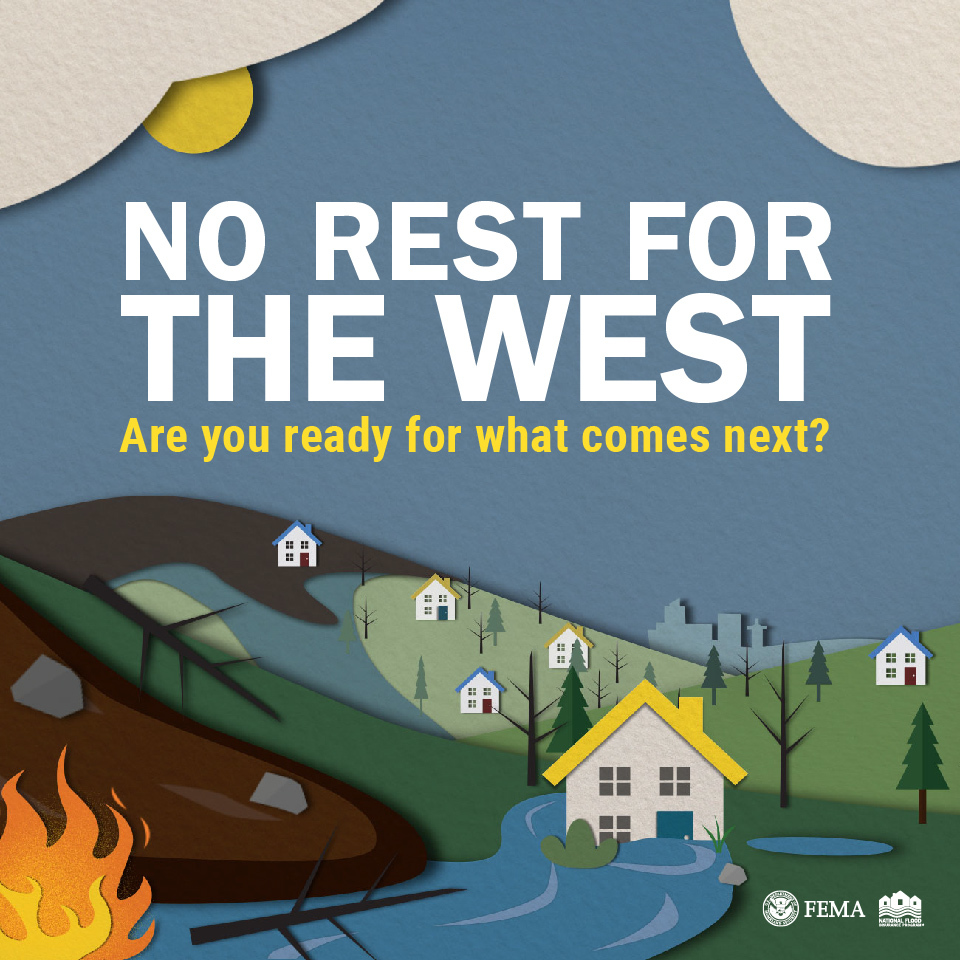
Wildfires can occur throughout the year, but the potential is always higher during periods of little or no rainfall, which make brush, grass and trees dry and easier to burn. High winds can also contribute to spreading fire. Even though the potential for wildfires may have diminished, your community may have a designated wildfire season when the risk is particularly high.
After a wildfire, it’s tough to imagine another risk ahead. Too many people think flooding only happens somewhere else or to someone else. However, flooding after a fire is a serious threat that residents and business owners in burn scar areas must prepare for with flood insurance.
It’s always been true that anywhere it can rain, it can flood. But previously rare weather events are becoming increasingly common and severe. After a wildfire, the charred soil and burnt vegetation can lead to a greater risk of flooding and mudflow for up to five years or more after a fire.
It typically takes 30 days for a new flood insurance policy to go into effect, so the time to act and educate others in your community about flood risk is now. Join the conversation about flood after fire and the value of flood insurance by sharing the resources available on floodsmart.gov to your social media platforms and networks.
Floodsmart.gov/wildfires also has additional information about understanding mudflow risk and how to find coverage. Residents can rest assured when they have flood insurance.
For general inquiries about the National Flood Insurance Program, contact the FEMA Mapping and Insurance exchange center by visiting floodmaps.fema.gov. For more up-to-date information, you can also sign up to receive email updates and follow us on LinkedIn.
FEMA Releases National Continuous Improvement Guidance
FEMA published the National Continuous Improvement Guidance. This guidance provides an approach to conduct continuous improvement activities before, during and after real-world incidents. The guidance is intended for the whole community, including state, local, tribal and territorial partners; nongovernmental organizations; the private sector and other organizations with emergency management functions.
FEMA will host a webinar session at 10 a.m. ET on Dec. 13. to provide an overview of the guidance and discuss revisions based on feedback from the national engagement period held earlier this year. Guest speakers will discuss the importance of continuous improvement in emergency management.
For questions, please contact FEMA-CITAP@fema.dhs.gov.
…………………………………………………………………………………………………………..
Nominations Open for FEMA’s Emergency Manager Exchange
FEMA’s Emergency Manager Exchange (EMX) is accepting nominations through Dec. 15. In March 2023, four selected participants from non-federal government offices will work alongside FEMA leadership and staff for a 4 to 6-month paid work exchange.
New in 2023, the staff exchange will be fully reciprocal. When the participating government organization sends their employee to work at FEMA, a full-time FEMA employee will be sent to support that non-federal government office or program in return.
For the duration of the assignment, FEMA will reimburse the participant’s home organization for the cost of the participant’s salary up to the federal GS-13 level, plus benefits. This reimbursement will include travel costs and per diem in Washington, D.C. consistent with FEMA’s travel policies.
The visiting FEMA employee will work to address capability gaps identified by the non-federal government organization in their nomination letter. The exchange is authorized under the Intergovernmental Personnel Act Mobility Program.
Each participant’s non-federal government organization must nominate their applicant to the program. The work exchange position descriptions and the nomination instructions are available on FEMA.gov.
…………………………………………………………………………………………………………..
|


