|
As federal disaster assistance is distributed to Hurricane Ian survivors since the disaster declaration date of Sept. 29. FEMA continues to provide temporary housing, essential home repairs and other uninsured and underinsured disaster-related losses.
FEMA continues to help Floridians by paying motel and hotel costs for survivors hit hardest by Ian, and to ensure disaster unemployment assistance is available to eligible survivors.
To learn more about FEMA's efforts in the aftermath of Hurricane Ian, visit FEMA.gov
Following widespread flooding from Hurricane Ian across the southeast, FEMA’s National Flood Insurance Program (NFIP) extended the Proof of Loss requirement for policyholders who suffered flood damage from 60 days to 180 days for policyholders who suffered flood damage from Hurricane Fiona.and from Hurricane Ian from 60 to 365 days.
NFIP policies are written by participating Write-Your-Own insurance company partners or through the NFIP Direct.
The NFIP also authorized its Write-Your-Own insurance company partners and the NFIP Direct to pay claims based on the adjuster’s report; without requiring policyholders to sign a proof of loss. Policyholders can submit a signed proof of loss later if they need to request an additional payment or if they disagree with the adjuster’s report.
Anyone affected by hurricanes Fiona or Ian who has a NFIP flood insurance policy and suffered flood damage should begin filing their claim. Policyholders can start their claim by contacting their flood insurance agent or company.
If you don’t know your insurance information call 877-336-2627.
If you haven't made it home, but suspect flood damage, you can begin the insurance claims process. You can provide specifics concerning the damage later once local officials say it is safe to return to your property. Before beginning repairs, check with local officials about applicable building codes and floodplain management requirements.
Policyholders can ask their insurance company or adjuster how to receive an advance payment of up to $20,000 to jumpstart recovery.
Learn more about starting a flood insurance claim by visiting floodsmart.gov, calling 877-336-2627 or on the FEMA App.
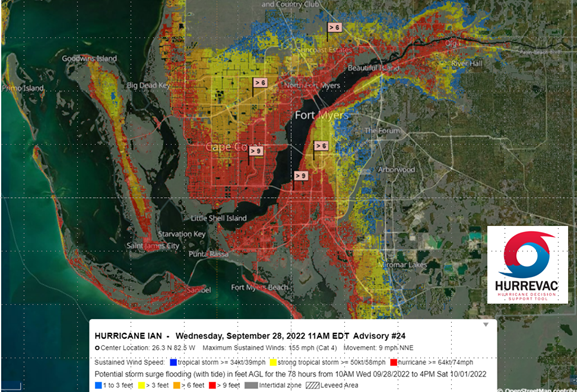
A record-breaking number of emergency managers were using HURREVAC, the National Hurricane Program's decision support tool to support preparation and response to Hurricane Ian. HURREVAC combines real-time National Hurricane Center forecast products and storm surge modeling with evacuation clearance times generated through Hurricane Evacuation Studies.
In the days leading up to Hurricane Ian’s landfall, over 1,700 new users were added to the more than 24,300 registered government emergency managers that use this tool. As Ian approached Florida, over 4,900 emergency mangers were tracking the storm on HURREVAC simultaneously, more than doubling the previous record for concurrent usage. In addition to storm-tracking, HURREVAC provides critical storm surge risk information.
Using HURREVAC to display and interact with the NOAA National Hurricane Center Potential Storm Surge Flooding Map to understand potential storm surge flooding in Lee County, Florida in response to Hurricane Ian.
Ahead of Hurricane Ian, HURREVAC users could input Hurricane Ian’s forecasted characteristic into the Storm Surge Explorer to evaluate different storm surge scenarios. Once available, registered HURREVAC users could overlay the NOAA National Hurricane Center Hurricane Ian Potential Storm Surge Flooding Map to understand their risk and help inform protective action decisions.
As Hurricane Ian approached, the HURREVAC team activated to 24-hour support, approving hundreds of new user request daily, responded to user support requests, and ensured the program was fully operational.
HURREVAC is free to use for all government emergency managers. You can register and find informational resources on HURREVAC.com. HURREVAC trainings are offered frequently. If you have interest in a HURREVAC training, send an email to NHP@fema.dhs.gov.
The application period is open for more than $3 billion for two annual mitigation grant programs that enhance climate resiliency.
The application period is open for FEMA Building Resilient Infrastructure and Communities (BRIC) and Flood Mitigation Assistance (FMA) Fiscal Year 2022 grant programs. The funding was bolstered by nearly $900 million from the Bipartisan Infrastructure Law of 2021, which provided $200 million for BRIC and $700 million for Flood Mitigation Assistance.
A total of approximately $2.3 billion is available through the BRIC program and another $800 million through the Flood Mitigation Assistance program. The grants provide funds to communities to enhance resiliency to natural hazards.
The funding notices for both programs are available at Grants.gov. Eligible applicants must apply for funding using FEMA Grants Outcomes, the agency’s grants management system. Submit applications in FEMA Grants Outcome Portal no later than 3 p.m. ET on Jan. 27, 2023. Applications received by FEMA after this deadline will not be considered for funding.
To reduce barriers in accessing FEMA programs and ensure federal funding can reach more communities, FEMA is enacting several changes to this year’s application cycle:
- First, by using money from Bipartisan Infrastructure Law of 2021, FEMA is increasing the federal cost share for the Flood Mitigation Assistance program to 90% to lower the financial burden on smaller governments and disadvantaged communities.
- Second, FEMA is expanding investment in the BRIC’s non-financial Direct Technical Assistance to at least 40 communities to help with the application process for future submissions.
- Direct Technical Assistance helps communities submit high-quality applications and implement innovative projects that reduce risk and increase resilience.
- FEMA is accepting requests for assistance now. Applicants can visit the BRIC Direct Technical Assistance webpage to find information and detailed instructions on how to submit an application in English or Spanish.
- Finally, FEMA is no longer requiring a Benefit-Cost Analysis for federally recognized Tribal Nations and underserved communities when they apply. This is one of the most common barriers to a successful application. FEMA will later help these communities complete an analysis during the pre-award process.
Interested applicants should contact their Hazard Mitigation Officer for more information. For more information visit FEMA.gov.
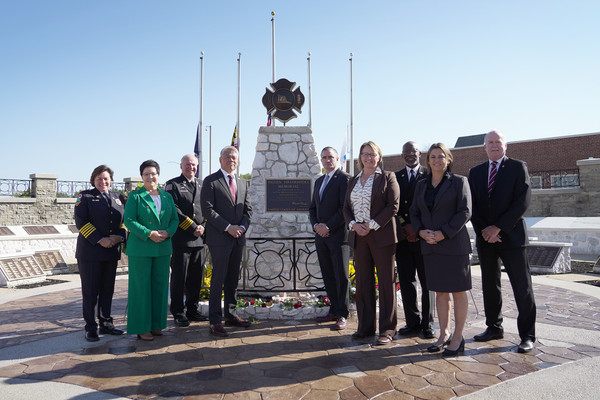 USFA and FEMA leadership pose and the Fallen Firefighters Memorial in Emmitsburg, Maryland
The U.S. Fire Administration (USFA), a component of FEMA, in partnership with the National Fallen Firefighters Foundation, hosted the U.S. Fire Administrator's Summit on Fire Prevention and Control: State of Science on Oct. 11.
A first-of-its-kind livestreaming event from the National Emergency Training Center in Emmitsburg, Maryland, the Fire Administrator's Summit on Fire Prevention and Control: State of Science featured presentations from the country's most prominent fire service leaders and researchers.
The Summit marked the 75th Anniversary of the 1947 President Truman Conference on Fire Prevention and Control that launched the America Burning Report and established the USFA.
For details from the event, please visit firehero.org.
Grab your friends, family and colleagues, and get ready to participate in the world’s largest earthquake drill - 2022 Great ShakeOut at 10:20 a.m. (local time) on Thursday, Oct. 20. Participants in homes, schools and organizations across the world will partake in the yearly earthquake drill. During this time, you should DROP to the ground, take COVER by getting under a sturdy desk or table and HOLD ON as you should do during a major earthquake.
Ground shaking during an earthquake is seldom the cause of injury. Most earthquake-related injuries and deaths are caused by collapsing walls and roofs, flying glass and falling objects. Look around you now before an earthquake. Identify safe places such as under a sturdy piece of furniture or against an interior wall in your home, office or school so that when the shaking starts you can respond quickly. Your safe place should be within a few steps to avoid injury from flying debris, an immediate response to moving to a safe place can save lives.
Register today and learn how to participate! Also, text “Shakeout” to 43362 to join the Great Shakeout distribution list.
The Great ShakeOut Drill encourages you, your community, your school or your organization to participate in the “Drop, Cover and Hold On” exercise and to update emergency plans and supplies. In addition, you should secure your space to prevent damage and injuries.
Earthquakes can strike anywhere, at any time. Below are some additional tips to consider when preparing your home and family in the event of an earthquake.
Always be prepared for earthquakes
Share Your ShakeOut Participation
- Share your ShakeOut experience and engage with us through our digital platforms by tagging @FEMA and using hashtags: #ShakeOut and #EarthquakeSafety
To learn more about ShakeOut, visit the Great Shakeout Drill website.
FEMA continues its Reinsurance Program and plans to secure a new reinsurance placement in January 2023. Reinsurance transfers financial flood risk to private markets to help strengthen the financial framework of the National Flood Insurance Program. This traditional reinsurance placement would be in effect from Jan. 1 - Dec. 31.
FEMA published the Trade Agreement Announcement notice of intended reinsurance procurement on FEMA.gov. This notice includes all the procurement, contact information and details on how to submit a request for participation.
For qualified companies to participate in the reinsurance procurement, vendors must submit a request to participate by Dec. 1. For more information about the Reinsurance Program, visit FEMA.gov.
Disclosing flood risk during real estate transactions is a timely and effective way to raise awareness and drive risk-informed investments. During the homebuying process, prospective buyers look to a network of trusted sources to help them make decision.
With this insight in mind, FEMA created the Local Flood Risk Disclosure resource. This document offers ideas and examples to help community officials and real estate professionals make flood risk information conveniently available and easy to understand before and during real estate transactions.
The resource has:
- A list of local flood risk disclosure best practices that have been implemented in communities across the nation.
- Spotlights on five communities with different geographies, demographic characteristics and flood hazard concerns. Each community has implemented best practice public information programs and real estate disclosure practices about flood risks.
- Additional information on over 80 communities in 21 states with flood risk disclosure and public information practices recognized by the Community Rating System.
To learn more about local best practices and other floodplain management resources, visit FEMA.gov.
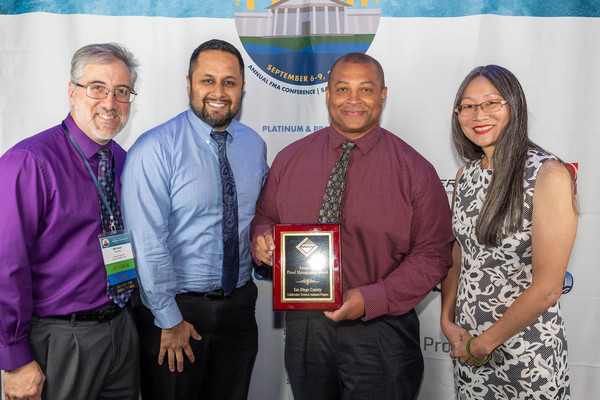 L to R: Michael Nowlan, Jose Lara, Preston Wilson and Eileen Takata accept their award
The FEMA National Dam Safety Program (NDSP) Collaborative Technical Assistance (CTA) Series along with the San Diego cohort were awarded this year’s Integrated Flood Management Award for Excellence on Sept. 7 (or use “in early September) at the Floodplain Management Association’s Annual Conference in Sacramento, California.
The FEMA National Integration Center (NIC) and NDSP, along with the City of San Diego California Office of Emergency Management (CalOES) and the US Army Corps of Engineers (USACE) California Silver Jackets, accepted the award. The award selection was based on the collaboration between multiple levels of government throughout San Diego County, as well as the impact the series had on the county. Bill White from the City of San Diego, Jose Lara from CalOES and Eileen Takata from the USACE California Silver Jackets were recognized for championing this effort.
This series is designed to help communities at risk of dam-related flooding better understand their risk landscape and the potential consequences of dam-related emergencies. Members from the City of San Diego, CalOES and the USACE Silver Jackets coordinated with multiple levels of government to meet the county’s goal of increasing state, county, community, and individual preparedness in participating jurisdictions for responding to dam emergencies. The series assisted San Diego County and participating jurisdictions in leveraging and building upon previous and ongoing community resilience to dam and levee risks.
Both federal and regional partners, as well as state and local agencies and jurisdictions, were involved in this collaboration. Since the series concluded, the county has implemented new practices to dramatically increase its dam safety resilience.
For additional information on FEMA’s National Dam Safety Program Collaborative Technical Assistance Program please visit: https://www.fema.gov/emergency-managers/risk-management/dam-safety/technical-assistance.
FEMA released the “Local Elected and Appointed Officials Guide: Roles and Resources in Emergency Management.” This guide assists senior officials in understanding, preparing for and executing their leadership responsibilities to:
- Mitigate community risks.
- Save lives.
- Protect property.
- Recover from disasters.
The guide provides an executive-level introduction to emergency management concepts and principles for local senior officials. Additionally, it identifies local senior officials’ roles and responsibilities for incident emergency management before, during and after disasters, as well as ways to access available resources.
FEMA will host a series of 60-minute webinars to provide an overview of the guide, quick reference guide and checklists. The sessions will include facilitated discussions with stakeholders and provide updates since the National Engagement Period. Advance registration is required and on a first-come, first-served basis.
To register, click on your preferred session below:
To download the quick reference guide and checklists, or to learn more about the webinar sessions, visit FEMA.gov.
Every October, FEMA celebrates National Community Planning Month to recognize the importance of hazard mitigation and planning to reduce the impact of natural disasters.
Mitigation planning prepares communities to prevent natural hazard events from becoming disasters. The process can be used to identify long-term, equitable solutions that reduce risk from natural hazards. It is the first step to help communities adapt to climate change and more extreme weather and storms. It can also help drive innovative, equitable outcomes that serve the whole community.
FEMA works with partners across different sectors to build long-term, risk-informed mitigation plans that help prepare the whole community for future natural hazards. Explore latest mitigation planning success stories on FEMA.gov and see how others have reduced their disaster risk. Also visit the Mitigation Planning YouTube playlist for training videos on using land use and building codes.
The Guides to Expanding Mitigation series highlights innovative and emerging partnerships for mitigation.
Earlier this year, FEMA released updates to the State and Local Mitigation Planning Policies. These policies support consistent evaluation and approval of hazard mitigation plans to promote planning and risk-informed decision making. The new policies will become effective April 19, 2023.
Share your mitigation success story with us at FEMA-Mitigation-Planning@fema.dhs.gov.
Read your state, local, or tribal mitigation plan to learn what actions are being taken to reduce the impacts of hazards in your community.
Visit FEMA Hazard Mitigation Plan Status to see if your community has a plan and how to access it.
FEMA awarded $6 million in grants to help enhance the nation’s ability to respond to and recover from all-hazards events. Three different recipients will receive grants from the Fiscal Year 2022 Homeland Security National Training Program Continuing Training Grants.
This competitive program attracts applicants from state, local, tribal and territorial governments, along with eligible non-profit organizations to include colleges and universities. For fiscal year 2022, FEMA will make three awards:
-
$1.5 million The Trustees of Columbia University in the City of New York’s National Center for Disaster Preparedness (NCDP). Focus Area: Operationalize Climate Resilience for Equitable Outcomes
-
$1.5 million The Georgia Institute of Technology (Georgia Tech). Focus Area: Operationalize Climate Resilience for Equitable Outcomes
-
$3 million The Center for Rural Development (Somerset, Kentucky). Focus Area: Equity in Tribal and Rural Preparedness
FEMA published the updated Emergency Operations Center (EOC) How-to Quick Reference Guide. The guide cover topics such as hazard vulnerability assessments, physical site selection, mitigation, considerations, EOC capabilities and requirements, information management systems and training and exercises.
The guide is a collection of guidance and best practices, which will contribute to development of an EOC that can successfully meet the jurisdiction’s needs. The updates include considerations for virtual and hybrid working environments.
The guide is part of the National Incident Management System (NIMS) Emergency Operations Center Toolkit. NIMS is a key component of incident management efforts and enables organizations from across the country to work together during incidents of all kinds and sizes. Implementing NIMS across the nation is a fundamental part of building our national preparedness.
On Oct. 13, FEMA will host a webinar in Spanish about the FEMA Public Assistance program and how to apply for program funding. The webinar will specifically cover ways to employ mitigation measures that will reduce future disaster losses, the Small Business Administration’s role in the disaster recovery process and empower houses of worship and private non-profits to consider mitigation measures.
The webinar will take place at 2 p.m. ET on Oct. 13. To register, visit the agency’s featured events page. To learn more about public assistance for houses of worship, visit FEMA.gov.
(Spanish Translation) FEMA llevará a cabo un seminario en línea en español sobre la asistencia por desastre para casas de adoración y organizaciones privadas sin fines de lucro
El 13 de octubre, FEMA llevará a cabo un seminario en línea en español sobre el programa de Asistencia Pública de la agencia y cómo solicitar fondos del programa. El seminario en línea cubrirá específicamente formas de emplear medidas de mitigación que reducirán las pérdidas futuras por desastres, la función que desempeña la Agencia Federal de Pequeños Negocios en el proceso de recuperación de desastres y empoderará a las casas de adoración y organizaciones privadas sin fines de lucro para que consideren incorporar las medidas de mitigación.
El seminario en línea se llevará a cabo el 13 de octubre a las 2 p.m., hora del Este. Para inscribirse, visite la página de eventos de FEMA. Para obtener más información sobre la asistencia pública para casas de adoración, visite FEMA.gov.
FEMA and Mississippi River Cities and Towns Initiative Co-Host Alliances for Inclusive Resilience
The Alliances for Inclusive Resilience virtual series is part of the 7th Annual Partnership Forum led by the FEMA Resilient Nation Partnership Network. Attendees will have an opportunity to hear from diverse speakers about community-led resilience, engage with industry peers and identify opportunities for future collaboration.
Join the RNPN and leaders from the private, public and nonprofit sectors as we explore competing priorities in the decision-making process. How do we make decisions? What do we prioritize? How can we balance the reality of trade-offs when advancing climate adaptation? We will tackle these questions and find ways to unite these priorities.
Please join us from 1-3 p.m. ET on Oct. 19 as we explore Building a Sense of Resilient Belonging.
…………………………………………………………………………………………………………..
|