|
Sept. 1 marks the start of National Preparedness Month. While preparedness is an ongoing effort, the month is an excellent time to encourage preparedness nationwide and evaluate your preparedness plans.
This year’s theme “A Lasting Legacy” was chosen to empower people to protect the life they’ve built to create a lasting legacy for themselves and their families.
Last year, FEMA’s Ready Campaign and the Ad Council produced a ground-breaking national preparedness campaign specifically tailored for the Latino community.
This year’s National Preparedness Month campaign features a call to action for the Black and African American communities. While the new marketing campaign leverages the rich, diverse cultures of the Black and African American population, it also encourages people of all backgrounds to prepare.
Throughout September, FEMA Bulletin will publish simple steps you can take to make sure you and your entire family is prepared for disasters.
The campaign was developed through the agency’s partnership with the Ad Council. FEMA’s Ready Campaign worked with black-owned and operated small businesses and members of the African American community to create culturally competent public service advertising and related messaging.
To learn more about National Preparedness Month, visit Ready.gov.
On Aug. 26, leaders of FEMA and The Salvation Army singed a new memorandum outlining how the organizations will cooperate to carry out disaster preparedness, response, recovery and other emergency management operations.
FEMA Administrator Deanne Criswell and The Salvation Army’s National Commander Kenneth Hodder signed the memorandum of agreement as the latest formalization of the longstanding partnership between the organizations.
“When helping people before, during and after a disaster, we cannot do it alone. As we continue to face the impacts of climate change and related extreme weather events, the most powerful resources we have are our partners, and this includes the dedicated team over at the Salvation Army,” said Administrator Deanne Criswell. “This memorandum of understanding between FEMA and the Salvation Army underscores the importance of this partnership and our unyielding commitment to better serve our communities.”
The first memorandum between the two organizations was signed in 1980. This update outlines how the two agencies will streamline information sharing to ensure better coordination; leverage FEMA’s authority to support private non-profit organizations; and expand The Salvation Army’s support in the National Response Coordination Center.
The Salvation Army and FEMA have collaborated to support disaster response and recovery efforts during major events such as Hurricane Andrew in 1992, the Sept. 11, 2001, terrorist attacks, Hurricane Katrina in 2005, and COVID-19. Additionally, the two organizations have also worked together for various other major projects including the development and implementation of federal response plans, including the National Response Framework. The framework is a scalable, flexible and adaptable guide that aligns key roles and responsibilities across the nation during an incident, such as a major disaster.
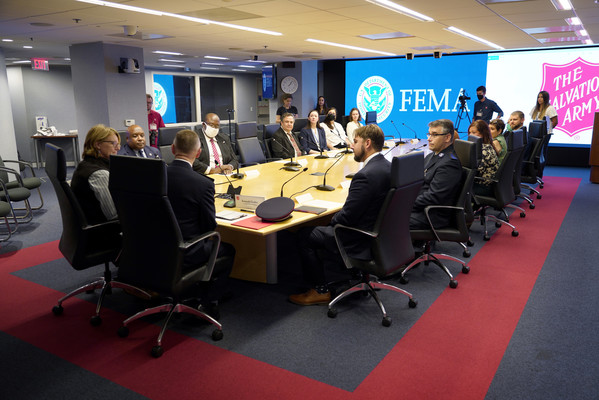 The Salvation Army and FEMA leadership sign a new memorandum of agreement.
Five years ago, three back-to-back hurricanes caused major devastation across six Southern states and two U.S. territories. Hurricanes Harvey, Irma and Maria took lives and caused extensive property loss and damage to critical infrastructure.
For each of these disasters, FEMA answered the call to respond and help residents and communities recover and rebuild.
When Hurricane Harvey blew ashore south of Houston, Texas, on Aug. 25, 2017, it was a Category 4 storm. The storm inundated the Houston area, setting record rainfall levels. Within three weeks two more record-setting storms, Hurricane Irma and Hurricane Maria, would tear across the U.S. Virgin Islands, Puerto Rico, Florida, Georgia, Alabama, Tennessee and the Carolinas.
As Hurricane Irma crossed the Atlantic Ocean, it was one of the strongest Atlantic storms on record and the first hurricane in five years to make landfall in Florida. Before it’s Sept. 10 landfall, the storm first wreaked havoc across the U.S. Virgin Islands and Puerto Rico.
On Sept. 20, Hurricane Maria, following tightly on the heels of Irma, moved just south of the U.S. Virgin Islands as a Category 5 hurricane before slamming into Puerto Rico as a slightly weaker but much larger storm. In the aftermath of the storm, 3.7 million Puerto Ricans were without electricity, resulting in the longest sustained air mission of food and water delivery in FEMA history.
The three storms caused a combined $265 billion in damage. In response, FEMA coordinated large deployments of federal personnel and commodities, both before and after the storms’ landfalls, to support response and recovery efforts across 270,000 square miles.
Since the storms in 2017, FEMA’s daily deployment level has increased to 7,165 deployments in 2022 compared to 6,664 in 2017. In fact, 2021 was the highest year on record for the average number of staff deployed on any given day, with 8,903 deployments.
Disaster recovery is a whole community effort and FEMA continues to work closely with its partners in government, the private sector, voluntary organizations, and the faith community to meet the needs of disaster-impacted communities and the survivors it serves.
To read more about how FEMA continues to support the recovery process from these three storms, visit FEMA.gov.
FEMA published a notice in the Federal Register seeking public comment on updates to its "Hazard Mitigation Assistance Program and Policy Guide."
The agency remains focused on reducing barriers so communities who need resilience funding the most can access its grant programs more easily. The guide has been updated to be more equitable, reduce complexity and address climate resilience.
As part of FEMA’s people first commitment in its new strategic plan, the updated guide will help catalyze community partnerships and promote more equitable investments to reduce risk. It will also help to better deliver mitigation grant programs to communities across the nation dealing with the worsening effects of climate change.
The updated guide provides helpful information for state, local, tribal and territorial governments seeking to successfully navigate the application and grant lifecycle processes. FEMA’s hazard mitigation assistance grant programs provide funding for actions that address risks to and reduce disaster suffering from events like wildfires, drought, extreme heat, hurricanes, earthquakes and flooding.
The update consolidates policy guidance released since the 2015 edition including addendums. It provides new and expanded content on changes to hazard mitigation assistance programs mandated by the Disaster Recovery Reform Act. The additional programs covered by the guidance include the Hazard Mitigation Grant Program and the Flood Mitigation Assistance Program.
FEMA posted the updated guide the Federal Register under Docket ID Number FEMA-2022-0023. The public comment period will run through Sept. 23, 2022.
Comments can be submitted at regulations.gov and will become publicly available. Please follow the instructions on the page for submitting comments and contact the Regulations.gov help desk if you have any issues.
The Natural Hazards Center is excited to announce the return of its popular webinar series, Making Mitigation Work. The series—which is produced in partnership with the FEMA—features free one-hour webinars that highlight progress in mitigation policy, practice and research.
On Aug. 9, an interactive presentation was held on the Diversifying HayWired Communication project. The project featured fellows from the Bill Anderson Fund who collaborated with the U.S. Geological Survey to find ways to better connect with marginalized communities and foster earthquake awareness and preparedness. View the recorded presentation, Connecting with Marginalized Communities to Improve Risk Communication, online.
You can access previous sessions of the Making Mitigation Work series on Natural Hazards Center’s website. The collection includes more than 20 videos that discuss topics such as mitigation messaging, building codes, buyout programs, disaster spending and investment, infrastructure resilience, community collaboration and racial and social equity.
Making Mitigation Works webinars are held the second Tuesday of each month and participants may qualify for continuing education credits from the International Association of Emergency Managers. Learn more on the Continuing Education Credits webpage.
FEMA is launching a notice of intent to fund resilience projects that will make communities safer from natural hazards.
The Safeguarding Tomorrow Revolving Loan Fund program will make no less than $50 million available in capitalization grants to fund low-interest loans to local governments. These loans will allow jurisdictions to reduce vulnerability to natural disasters, foster greater community resilience and reduce disaster suffering.
FEMA expects to publish the program funding opportunity before the end of the calendar year and receive applications through spring 2023.
Under the Infrastructure Investment and Jobs Act of 2021 signed by President Biden in 2021, also commonly known as the Bipartisan Infrastructure Law, Congress appropriated $500 million for the program opportunity, or $100 million per year, through 2026.
FEMA is launching the funding in its first year to increase public understanding and learn from participating communities about how to enhance the program in future iterations.
These capitalization grants complement FEMA’s other hazard mitigation grant programs to empower communities to better withstand a worsening climate.
Funds can be used for hazard mitigation projects that reduce disaster risks for homeowners, businesses, nonprofit organizations and communities. Other uses of loans include satisfying a local government’s non-federal cost-share match for FEMA Hazard Mitigation Assistance programs, update building codes adoption and enforcement, make zoning and land use changes.
FEMA’s Hazard Mitigation Assistance helps communities increase resilience to extreme heat waves, drought, wildfires, flood and hurricanes by funding transformational projects that reduce risk to multiple hazards, support adaptation to future conditions and lessen the impact of all disasters on our nations most underserved residents and disadvantaged communities.
The agency will hold a series of listening sessions with emergency management agencies and state governments. The sessions will gauge interest in this opportunity, identify challenges or barriers to implementing and managing a revolving loan fund and learn and successes from states that currently have revolving loan funds.
Visit fema.gov for more information.
FEMA has awarded $14.2 million in the first round of funding for the Fiscal Year (FY) 2021 Staffing for Adequate Fire and Emergency Response (SAFER).
These grants focus on enhancing the ability of recipients to attain and maintain fire department staffing and to assure that their communities have adequate protection from fire and fire-related hazards. FEMA will continue to make SAFER awards this summer until the $560 million appropriated for this program has been distributed.
FEMA continues to make awards for the Assistance to Firefighters Grants, with $38.3 million distributed to so far from the $414 million in available funding.
The FY 21 Fire Prevention and Safety (FP&S) program will announce its awards later this summer.
Together, these programs fund critically needed resources to equip and train emergency personnel, enhance efficiencies, and support community resilience.
FEMA published the Emergency Operations Center Management Support Team resource typing document.
This National Incident Management System (NIMS) Resource Typing Definition provides support to the Authority Having Jurisdiction and the Incident Commander with key functions relating to management, including subject-matter expertise and technical support.
For more information, including the full-scope of resource typing definitions, visit the Resource Typing Library Tool.
Resource typing is a key component of NIMS and enables organizations from across the country to work together during incidents of all types and sizes. Implementing NIMS resource management principles across the nation is a fundamental part of building our national preparedness.
FEMA Kicks-Off Hazard Mitigation Assistance Summer Engagement Series
On Aug. 4, FEMA kicked-off its 2022 Hazard Mitigation Assistance Summer Engagement Series. The 10-part series features experts and special guests who will provide information and insights on the Hazard Mitigation Grant Program, Building Resilient Infrastructure and Communities and Flood Mitigation Assistance programs. The engagement series will run until Oct. 4.
The webinars provide an overview of the fiscal year 2022 Notice of Funding Opportunity for BRIC and FMA and are designed for regional leaders and key stakeholders in states, local communities, tribes and territories and other interested individuals to learn more about the grant programs and grant application strategies.
To register, visit Hazard Mitigation Assistance 2022 Summer Engagement Series and find the webinar best suited for your jurisdiction. For special accommodations, contact fema-hmacomms@fema.dhs.gov.
…………………………………………………………………………………………………………..
FEMA Seeks Feedback on Emergency Incident Response Documents
FEMA seeks feedback on two National Incident Management System position-related to emergency incident response.
The Canine Detection Team for Explosives is responsible for conducting screening and searches to detect explosives and explosives-related substances and assist in bomb crime scene investigations. The Canine Handler for Explosives is an individual who has successfully completed canine handling in the explosives detection discipline and is part of a canine explosives detection team.
This 30-day national engagement provides an opportunity for interested parties to comment on the draft documents to ensure they are relevant to all implementing partners. To provide comments on the listed draft documents, complete the feedback form and submit the form to FEMA-NIMS@fema.dhs.gov no later than 5 p.m. ET on Sept. 23.
…………………………………………………………………………………………………………..
|


