|
FEMA recently released the 2022-2026 National Tribal Strategy, a first-of-its-kind nationwide roadmap to support tribal nations by aligning our actions to promote equity by building climate resilience, enhancing preparedness and improving disaster response in native communities.
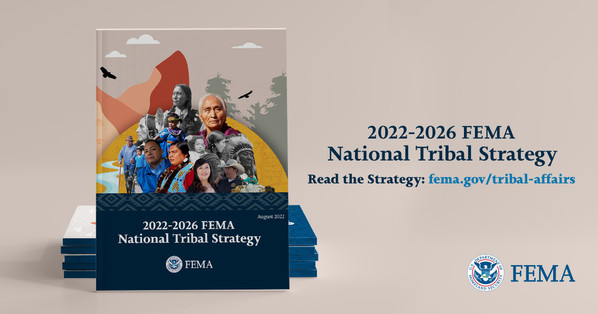
To develop this strategy, FEMA tribal affairs consulted with 135 representatives of 78 tribal nations who provided valuable feedback to help us better address our responsibilities on tribal lands.
Key issue areas include resources tailored to support tribal emergency management programs, including:
- Initiating a national study on tribal emergency management capacity and capabilities.
- Developing a comprehensive FEMA guide of programs.
- Developing tribal-specific technical assistance resources.
- Convening an annual meeting of national and regional tribal liaisons.
- Expand training opportunities for tribal nations, and other related objectives.
As we implement this plan, FEMA will create an internal Tribal Affairs Work Group to advance the priorities in an elevated and coordinated fashion across the agency.
To learn more about FEMA Tribal Affairs and the National Tribal Strategy, visit FEMA.gov.
Secretary of Homeland Security Alejandro N. Mayorkas announced final allocations for $550 million for seven fiscal year 2022 competitive preparedness grant programs. These allocations, together with the almost $1.5 billion in non-competitive grant funding announced earlier this year, total more than $2 billion in FY 2022 to help prepare our nation against man-made threats and natural disasters.
The grant programs provide funding to state, local, tribal and territorial governments, nonprofit agencies and the private sector to build and sustain capabilities to prevent, protect against, respond to and recover from acts of terrorism and other disasters. The total amount for each grant program is set by Congress and the allocations are made by the Secretary.
The following grants are competitive, with awards announced Aug. 18:
- Operation Stonegarden: provides $90 million to enhance cooperation and coordination among state, local, tribal, territorial and federal law enforcement agencies to jointly enhance security along the United States land and water borders.
- Tribal Homeland Security Grant Program: provides $15 million to eligible tribal nations to implement preparedness initiatives to help strengthen the nation against risk associated with potential terrorist attacks and other hazards.
- Nonprofit Security Grant Program: provides $250 million to support target hardening and other physical security enhancements for nonprofit organizations that are at high risk of a terrorist attack. This year, $90 million is provided to nonprofits in Urban Area Security Initiative-designated areas, and $90 million is provided to nonprofits outside those designated urban areas located in any state or territory.
- Port Security Grant Program: provides $100 million to help protect critical port infrastructure from terrorism, enhance maritime domain awareness, improve port-wide maritime security risk management and maintain or re-establish maritime security mitigation protocols that support port recovery and resiliency capabilities.
- Transit Security Grant Program: provides $93 million to owners and operators of public transit systems to protect critical surface transportation and the traveling public from acts of terrorism and to increase the resilience of transit infrastructure.
- Intercity Bus Security Grant Program: provides $2 million to owners and operators of intercity bus systems to protect surface transportation infrastructure and the traveling public from acts of terrorism and to increase the resilience of transit infrastructure.
The following non-competitive grants were awarded earlier this year to recipients based on a number of factors:
- State Homeland Security Program: provides $415 million to support the implementation of risk-driven, capabilities-based state homeland security strategies to address capability targets. Awards are based on statutory minimums and relative risk as determined by DHS/FEMA’s risk methodology.
- Urban Area Security Initiative: provides $615 million to enhance regional preparedness and capabilities in 31 high-threat, high-density areas. Awards are based on relative risk as determined by risk methodology.
- Emergency Management Performance Grant: including the funding provided under the American Rescue Plan Act, provides more than $405.1 million to assist state, local, tribal and territorial governments in enhancing and sustaining all-hazards emergency management capabilities. Relative population is considered.
- Intercity Passenger Rail: provides $10 million to Amtrak to protect critical surface transportation infrastructure and the traveling public from acts of terrorism and to increase the resilience of the Amtrak rail system. Award made per congressional direction.
- Emergency Operations Center Security Grant Program: provides more than $49 million to improve emergency management and preparedness capabilities by supporting flexible, sustainable, secure, strategically located and fully interoperable emergency operations centers (EOCs) with a focus on addressing identified deficiencies and needs. EOCGP had not been appropriated as a grant program in more than 10 years.
Further information on preparedness grant programs is available at www.dhs.gov and http://www.fema.gov/grants.
On Aug. 24, the Department of Homeland Security Center for Faith-Based and Neighborhood Partnerships will host a webinar, Sources of Disaster Assistance.
The webinar will be held at 2 p.m. ET and will cover:
- The latest policy changes under FEMA’s Individual Assistance program.
- An overview of FEMA’s Public Assistance program for private non-profits and houses of worship.
- Ways on how emergency managers can maximize local partnerships.
- How to collaborate with faith-based and community-based organizations in times of disaster.
- Resources available by the Small Business Administration.
To attend, register in advance here.
Captioning will be provided. For additional accommodations, send an email to ricardo.agudelo-doval@fema.dhs.gov or bianca.kapadia@fema.dhs.gov. Last minute requests will be accepted but may not be possible to fulfill.
To learn more about how FEMA is helping faith-based communities, visit FEMA.gov/faith.
FEMA seeks feedback on two National Incident Management System position-related to emergency incident response.
The Canine Detection Team for Explosives is responsible for conducting screening and searches to detect explosives and explosives-related substances and assist in bomb crime scene investigations. The Canine Handler for Explosives is an individual who has successfully completed canine handling in the explosives detection discipline and is part of a canine explosives detection team.
These resource typing documents enhance the interoperability and effectiveness of mutual aid and facilitate sharing deployable resources at all jurisdictional levels.
This 30-day national engagement provides an opportunity for interested parties to comment on the draft documents to ensure they are relevant to all implementing partners. To provide comments on the listed draft documents, complete the feedback form and submit the form to FEMA-NIMS@fema.dhs.gov no later than 5 p.m. ET on Sept. 23.
FEMA Kicks-Off Hazard Mitigation Assistance Summer Engagement Series
On Aug. 4, FEMA kicked-off its 2022 Hazard Mitigation Assistance Summer Engagement Series. The 10-part series features experts and special guests who will provide information and insights on the Hazard Mitigation Grant Program, Building Resilient Infrastructure and Communities and Flood Mitigation Assistance programs. The engagement series will run until Oct. 4.
The webinars provide an overview of the fiscal year 2022 Notice of Funding Opportunity for BRIC and FMA and are designed for regional leaders and key stakeholders in states, local communities, tribes and territories and other interested individuals to learn more about the grant programs and grant application strategies.
To register, visit Hazard Mitigation Assistance 2022 Summer Engagement Series and find the webinar best suited for your jurisdiction. For special accommodations, contact fema-hmacomms@fema.dhs.gov.
…………………………………………………………………………………………………………..
Automatic Extensions for Entities in SAM Grants System
The Office of Management and Budget authorized an extension to active System for Award Management (SAM) registrations through Dec. 1. All vendors and grant applicants doing business with FEMA are required to be registered with SAM. Registration is free but must be renewed annually. These extensions will help entities avoid re-registration.
No action is required on the part of entity registrants. An automatic 60-day extension will be added to any existing SAM.gov entity registration currently set to expire between Aug. 1 – 31 and Sept. 1 – 30. For example, an entity set to expire on Sept. 1 will now remain active until Oct. 31. The need for additional extensions for entities expiring in October 2022 will be assessed in mid-September.
Entity administrators impacted by this change will receive an email from samadmin@sam.gov with the subject line “60-Day SAM.gov Extension Granted for [Entity Name/DUNS/CAGE].” The new expiration dates will be included in the SAM entity management extracts and available through web services after the records are extended.
For more information, visit FEMA.gov and SAM.gov.
…………………………………………………………………………………………………………..
|


