|
On July 26, FEMA and the nation will celebrate the 32nd anniversary of the Americans with Disabilities Act (ADA).
FEMA is driven to meet our commitment to equity in emergency management and is committed to upholding the principles in the ADA which prohibit discrimination against people with disabilities by federal agencies and federally funded programs.
Thirty-two years after the passage of the ADA, the Biden Administration is committed to advancing diversity, equity, inclusion and accessibility in the federal government. To meet this goal, FEMA dedicates staff and resources to integrate the needs of people with disabilities into every facet of our disaster preparedness, response and recovery.
FEMA implements the ADA mission every day, mobilizing advisors who work to ensure FEMA programs and services are accessible to, and available for, all disaster survivors. These advisors spearhead FEMA’s efforts to integrate the ideals and goals of the ADA into the work we do to help people with disabilities before, during and after disasters.
FEMA will celebrate the ADA anniversary with a disability stakeholder engagement event at 1 p.m. ET on July 21. The event brings together the FEMA Offices of Disability Integration and Coordination and Equal Rights teams dedicated to instilling and upholding FEMA’s commitment to equity for people within all facets of our work including effective communication, facility access and reasonable accommodations for people with disabilities.
This event is open to all who register. Once registered, you will receive a confirmation email containing information about joining the meeting. Captioning and sign language interpreters will be provided.
To read more about how FEMA is helping people with disabilities before, during and after disasters, check out our ADA Anniversary blog on FEMA.gov.
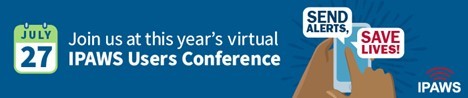
In emergencies, minutes can mean the difference between life and death. Learn how your government agency can quickly send alerts over FEMA’s Integrated Public Alert and Warning System (IPAWS) at the upcoming online IPAWS Users Conference.
"Send Alerts, Save Lives” is the theme of this year’s conference, which runs from 1 to 4:30 p.m. ET on Wednesday, July 27. This free event will introduce public safety officials not yet using IPAWS to this powerful tool for saving lives and protecting property.
- Discover how to obtain grants and funding for IPAWS training, exercising, planning, and alerting tools.
- Witness a live test of Wireless Emergency Alerts, learn best practices from a current Alerting Authority and gain insights on effective messaging from a social scientist who studies public reaction to alerts.
- Learn the four easy steps to get on-board as a new IPAWS Alerting Authority.
- Current alerting authorities will also benefit from the conference by refreshing their knowledge.
Find the full conference agenda and register for free on FEMA.gov.
Join us at this year's virtual IPAWS conference.
On July 5, the U.S. Department of Homeland Security (DHS) and FEMA announced the winners of the Cooling Solutions Challenge prize competition. Each winner was awarded funding, totaling $195,000, for their innovative and creative ideas that sought climate-friendly cooling solutions to protect people in extreme heat conditions.
The Cooling Solutions Challenge was designed to find groundbreaking solutions to protect the public against extreme heat, the nation’s leading cause of weather-related deaths. The challenge sought innovative ideas to help first responders, individuals, households or displaced populations keep cool during extreme heat events. These events have become more common across the United States with increasing frequency, intensity and duration.
“Extreme heat is the leading cause of weather-related deaths in the country, often hitting underserved communities the hardest,” said FEMA Administrator Deanne Criswell. “That is why we must bring together and empower bright minds with bold ideas to solve one of our nation’s most dangerous and complex climate challenges.”
Winners were selected by a judging panel of experts in climate change, resilience and emergency management using specific selection criteria to identify solutions that will help combat extreme heat events.
The Grand Prize Winner is Zephyr Innovations, Inc. (Jacob Miller, CTO), of Somerville, MA. Zephyr Innovations will receive $50,000 for the Ultra-Efficient Air Conditioning via Liquid Desiccant Dehumidification and Evaporative Cooling solution. Zephyr Innovations’ solution is a cooling system that uses a compressor-free/refrigerant-free technology to significantly reduce energy consumption and the associated carbon emissions. The cooling solution scored the highest in all judging criteria.
For the “Runner-up”, now renamed the Most Innovative Solution, the judges awarded $25,000 to Small World Sciences LLC (Don Chernoff), Morrisville, NC, for its Improved Cooling Textiles for Clothing, Solar Shades and Temporary Structures. This unique concept will develop fibers with heat reflective and emissive properties based on biomimicry (mimicking the behavior) of animals that have evolved to survive in extreme desert conditions, for use in clothing and building materials to reduce heat stress and save energy. Essentially, the concept takes a page out of nature and is based on how ants cool themselves.
Four “Use Case” category winners will each receive $10,000:
- TAC Jacket Cooling Solutions (Nanohmics, Inc., Austin, TX), for first responders’ personal use or helping survivors who are at risk from heat-related stress.
- Hybrid Cooling Wrap (Team: Young Ko, Evelyn N. Wang, and Jeffrey C. Grossman, Cambridge, MA) for personal use and helping cool individuals in indoor or outdoor environments.
- Fuel-Flexible Ultra-Efficient Air Conditioning System for Improved Resilience (Micro Nano Technologies, Gainesville, FL) for household, group quarter or multi-person use as an alternative to conventional air conditioning or built-in cooling solutions.
- Radiative Cooling of Structures (Hal Greenberger, Better Stuff LLC, Natick, MA) for use in indoor/outdoor venues to cool homeless or displaced populations in public settings.
- The judges also designated an Honorable Mention for Creativity to CalidGear: Wearable Thermoregulatory Device (Tayyaba Ali, Wilmette, IL), which will receive $5,000.
DHS uses prize competitions to crowdsource innovation and harness the creativity of the American public to solve critical homeland security challenges. To stay up to date with DHS Science and Technology, including prize challenges, visit the DHS Prize Challenges website.
FEMA is seeking public feedback on the upcoming national test of the Wireless Emergency Alert system (WEA). WEA is a public alert and warning system to disseminate timely and effective warnings to people in situations of war, terrorist attack, natural disaster or other hazards to public safety and wellbeing. FEMA is required to test the public alert and warning system every three years.
The tests help FEMA assess WEA's geographic reach, along with additional key parameters outlined in the IPAWS Modernization Act of 2015. FEMA and other WEA stakeholders, such as the Federal Communications Commission and congressional committees, use the test to enhance and expand WEA to further improve emergency alerting capabilities, leading to a better prepared and more resilient nation.
FEMA implements a survey to capture key technical performance factors of WEA, such as geographic coverage and carrier-related issues and non-technical aspects essential to WEA's role in national alerting, including alerting effectiveness in reaching diverse populations and traditionally underserved populations. The survey assesses public awareness of the WEA system.
Comments must be submitted before Sept. 6. To learn more and submit feedback, visit Regulations.gov.
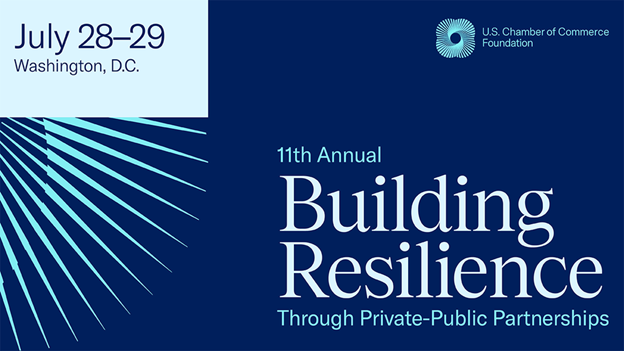
FEMA is partnering with the U.S. Chamber of Commerce Foundation to host the 11th Annual Building Resilience Through Private-Public Partnerships Conference in Washington, D.C. from July 28-29.
This year’s conference explores the need for readiness strategies and improving resilience while bringing together government, nonprofit and private sector leaders to drive effective resilience programing through greater collaboration across sectors.
The conference features action-oriented roundtables, engaging breakout sessions, substantive discussions and networking opportunities, including a Resilience Network Reception.
Additionally, FEMA Deputy Administrator Erik Hooks and Logistics Management Directorate Director Jeffrey Dorko are among the confirmed speakers for the 11th annual event.
Communities depend on the reliability of emergency management systems and institutions to perform under duress, disruptions and disasters. This dependency and system interdependency is often forgotten until a crisis occurs. To better prepare it is important to strengthen partnerships before the next crisis.
The conference is free to attend. To register and learn more, visit U.S. Chamber of Commerce Foundation.
Captioning and ASL will be provided.
This month, FEMA Administrator Deanne Criswell delivered keynote remarks at the 2022 Environmental Systems Research Institute User Conference in San Diego, California.
Criswell discussed how geospatial and predictive forecasting tools help to make communities more resilient in the face of climate change and support FEMA’s readiness to respond to disasters.
To be better prepared for future threats, the administrator elaborated how FEMA is taking charge on the evolving nature of risk in today’s world, and how technology and data advancement will help the emergency management community get ahead of those threats.
To watch the Administrator’s remarks on climate change, visit Deanna Criswell —Keynote Speaker.
The most recent update to the National Flood Insurance Program’s Watermark for the second quarter of fiscal year 2022 is available on FEMA.gov. The update presents flood insurance claims and policyholder statistics, fund resources and expenditures for the period ending on March 31.
The Watermark is a quarterly report of the program's financial standing and advances broader efforts to improve the transparency of the program’s finances to the public, policyholders, industry partners and government officials.
The Watermark also feature two stories, the first is “Office of the Flood Insurance Advocate Annual Report,” which highlights affordability issues and makes recommendations for programmatic improvements. The second, FEMA’s Swift Current Initiative Supports Increased Nationwide Resilience and Equity, reviews the Flood Mitigation Assistance program Swift Current initiative, which seeks to substantially speed up the delivery of funds following a flood event.
To read the full report, visit FEMA.gov.
FEMA released the funding notice for the National Cybersecurity Preparedness Consortium. This makes approximately $4 million in fiscal year 2022 grants available to the consortium to develop and deliver cybersecurity training solutions to first responders. The trainings must address national preparedness training gaps, be mapped to the core capabilities and be accessible to a nationwide audience.
The funding notice is posted at Grants.gov. Upon receiving an approved complete, submitted application by midnight ET on Aug. 12, FEMA will provide funding as cooperative agreements awarded directly to the University of Arkansas Criminal Justice Institute (principal for the consortium).
FEMA has released the funding notice for the Homeland Security Training Grants Mississippi State University’s Federal Aviation Administration Center of Excellence for Unmanned Aircraft Systems, making approximately $2 million in fiscal year 2022 grants available to the center to concentrate on developing training to address long-term gaps — including a regional training program for state, local tribal and territorial responders in using uncrewed aircraft systems, also known as drones, for disaster preparedness response.
The funding notice is posted at Grants.gov. Upon receiving an approved complete, submitted application by midnight ET on Aug. 12, FEMA will provide funding as cooperative agreements and awarded directly to the selected applicant.
FEMA released the notice for $6 million available in competitive funding as part of the Fiscal Year 2022 Homeland Security National Training Program's Continuing Training Grants.
The funding notice is posted at Grants.gov. Grant money will be available to applicants through a competitive process to help improve the nation’s ability to respond to and recover from all-hazards events. Applicants must submit applications for no later than midnight ET Aug. 15.
For FY 2022, program priority areas consist of select emerging threats and gaps that align with strategic priorities that recipients are expected to incorporate into products and activities funded through the CTG program to build capability across the nation.
The FY 2022 focus areas are:
- Operationalize climate resilience for equitable outcomes.
- Equity in tribal and rural preparedness.
FEMA has created the State Flood Risk Disclosure resource to help states, tribes and territories develop or refine existing real estate disclosure laws or mandated disclosure forms to strengthen their flood risk disclosure mechanisms. The report is available on fema.gov or can be directly accessed here.
Disclosing flood risk during real estate transactions is a timely and effective way to raise awareness and drive risk-informed decisions. In fact, early analyses at the state level show stronger flood risk disclosure requirements are associated with higher residential flood insurance penetration rates. This resource is intended for use by technical flood risk experts and by elected and career officials responsible for legislative action at the state and territory level.
The document contains:
- A ranking of states and territories by the strength of their flood risk disclosure requirements.
- Great form language from states with strong flood risk disclosure requirements that can easily be adopted by others.
- Additional information on each state's flood risk disclosure.
FEMA Seeks Technical Mapping Advisory Council Members
FEMA seeks qualified individuals to serve on the Technical Mapping Advisory Council to review and make recommendations to FEMA on matters related to the national flood mapping program authorized under the Biggert-Waters Flood Insurance Reform Act of 2012.
Applicants will be considered for a 3-year appointment for four council vacancies for the summer/fall 2022 term. Applications will be accepted until 11:59 p.m. ET on Aug 8.
To submit an application,
- Via email to FEMA-TMAC@fema.dhs.gov.
- Send mail to: FEMA, Federal Insurance and Mitigation Administration, Risk Management Directorate, Attn: Brian Koper, 400 C Street SW, Suite 6NW-1412, Washington, DC 20472-3020.
For more TMAC application information, visit Federalregister.gov.
…………………………………………………………………………………………………………..
FEMA Seeks Feedback on National Continuous Improvement Guidance
FEMA seeks feedback for the National Continuous Improvement Guidance draft, including edits and suggestions for additional resources and real-world examples. The national engagement period closes at midnight ET on July 31.
To review the draft guidance and provide feedback, visit FEMA.gov. To submit feedback, email FEMA-CITAP@fema.dhs.gov.
FEMA will also host a series of 60-minute webinar sessions to provide an overview of the draft guidance and to gather feedback from whole community partners. To register for a webinar, visit FEMA.gov.
-
Webinar 3: 5 - 6 p.m. ET on July 20.
-
Webinar 4 – Spanish speaking session: 11 a.m. - noon ET on July 25.
-
Webinar 5: 3 - 4 p.m. ET on July 27.
…………………………………………………………………………………………………………..
|