|
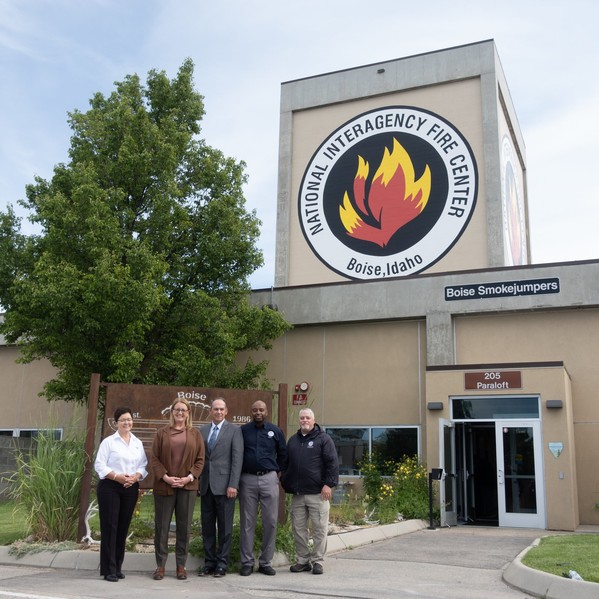
Last week, FEMA Administrator Deanne Criswell traveled to Boise, Idaho where she addressed students at Boise State University, toured the National Interagency Fire Center and met with members of the FEMA National Advisory Council (NAC).
Administrator Criswell met with Boise State University’s Hazard and Climate Resiliency Institute students. The institute is a community of researchers, practitioners and students who are dedicated to improving society’s resilience to natural hazards and the impacts of a changing climate.
Later that day, the National Interagency Fire Center representatives briefed Administrator Criswell, U.S. Fire Administrator Dr. Lori Moore-Merrell and FEMA Region 10 Administrator Willie Nunn on this summer’s fire outlook. The Center is comprised of eight different agencies and organizations that support wildland firefighting.
“Wildfires are no longer seasonal events -- fueled by climate change, they are destroying lives and property year-round,” Criswell said. “Our communities battled the nation’s most damaging wildfires in just the last few years, with wildfires accounting for 62% of the structures lost over the last 15 years. It is clear that we simply cannot shy away from the work required to mitigate future risk.”
Criswell met with members of the National Advisory Council on Wednesday at Boise State University’s Stueckle Sky Center. There she discussed climate resiliency, FEMA assistance eligibility changes and workforce recruitment and engagement.
The NAC established as part of the Post-Katrina Emergency Management Reform Act, is comprised of up to 35 members throughout the nation who represent emergency management, government agencies, the private sector and nongovernmental organizations to advise the FEMA administrator on all aspects of emergency management.
“I truly appreciate this amazing group of experts who are able to come together and make recommendations to me and our agency,” Criswell said. “We use the NAC to address the most pressing issues at FEMA and the emergency management community.”
Each year, the NAC presents a series of recommendations to the agency and the administrator. FEMA released the agency’s official response to these recommendations last week. For information on how to prepare you and your family for wildfires, visit Ready.gov/wildfires.
FEMA’s Resilient Nation Partnership Network (RNPN) and NASA releases Building Alliances for Climate Action to help communities learn how they can address the climate crisis.
Building Alliances for Climate Action provides various perspectives, personal stories, insights and resources about climate change from a Whole Community approach.
This resource builds on the success of the Alliances for Climate Action Forum, co-hosted by the RNPN and NASA. The RNPN is a diverse network with representation from over 1,500 organizations united to help communities become more resilient to natural disasters and climate-related events.
The forum is one of the largest federally hosted climate events with 37 speakers sharing their perspectives and paths to bolstering collective climate action. Over 3,250 viewers from over 900 organizations joined this critical conversation. Watch the whole series here.
Building Alliances for Climate Action is the second resource of the series. The RNPN and National Oceanic and Atmospheric Administration (NOAA) developed “Building Alliances for Equitable Resilience,” a result of collaboration by 26 partners in the fields of equity and resilience.
The RNPN, NASA and NOAA’s collaboration on the “Building Alliances” series demonstrates a commitment to a Whole Community approach as we collectively address some of the most pressing challenges facing our nation today.
To learn about how you or your organization can get involve visit, FEMA.gov.
On May 20, FEMA joined other stakeholders and officials for Reno, Nevada to commemorate the city’s first high-water sign.
FEMA, Reno officials and other Truckee River Flood Management Authority, the U.S. Army Corps of Engineers, and National Weather Service held a ceremony at Wingfield Park on the Truckee River to commemorate the city’s high water sign, displaying a historical photo from 1997 and a QR code that links to Truckee River’s flood history.
This year marks the 25th and 5th anniversaries of the 1997 and 2017 Truckee River floods. The 1997 flood caused $1.2 billion in damages (adjusted for inflation) and led to the formation of the Truckee River Flood Management Authority; established to improve the area’s protection against floods. In 2017, flood levels were similar to 1997, however damages were less severe due to mitigation measures completed since 1997.
Floods are the most common, widespread and costliest of all weather-related natural disasters. The annual damage from floods exceeds that of hurricanes, earthquakes and wildfires. Just one inch of water in a home will cost more than $25,000 to repair.
FEMA Region 9, once a month, meets with Reno community representatives and other federal and state agencies to discuss and support future plans to promote flood safety messaging and public outreach through the High Water Mark Initiative.
In 2013, FEMA initiated the program as a pilot project as part of its National Flood Insurance Program. Reno was the 38th community to promote flood safety, disaster preparedness and community resilience through the program.
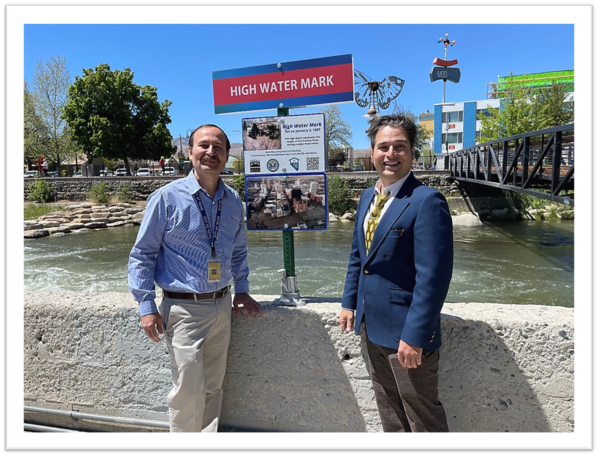 On May 20, the city of Reno dedicated its first high water mark sign on the Truckee River. Pictured on the left is Reno (Sr. Engineering Technician I) Sergio Gutierrez and right is (Nevada Division of Water Resources Public Outreach Manager) Carlos Rendo. The red “High Water Mark” bar shows the approximate flood elevations during the 1997 Truckee River floods.
FEMA releases Simple Guides for nine different types of structures and their unique characteristics to help agents generate flood insurance policy quotes easier under Risk Rating 2.0: Equity in Action.
For the first time in the National Flood Insurance Program’s history, policyholders pay premiums that fairly reflect what it costs to insure their property based on their unique flood risk under Risk Rating 2.0: Equity in Action. This great change involves many factors and takes time to learn and fully implement.
The guides provide snapshots of important information included in the Flood Insurance Manual and can be used when searching for quick answers and tips. They contain key aspects of the rating and quoting elements for agents and are helpful two-page resources for anyone who wants to understand how flood risk and rates are calculated.
To read the nine Simple Guides and other flood insurance resources visit, Risk Rating 2.0: Equity in Action on FloodSmart.gov.
FEMA’s U.S. Fire Administration released the “Wildland Urban Interface: A Look at Issues and Resolutions,” report earlier this week.
The report raises awareness and initiates collaborative efforts to facilitate change in wake of catastrophic wildfire losses in the wildland urban interface. This report highlights the wildland interface issues in the United States and will help the wildland and structural firefighting community and neighborhoods unite around key actions to reduce risk to themselves, to firefighters and the environment.
“Wildfires are no longer seasonal events -- fueled by climate change, they are destroying lives and property year-round,” said FEMA Administrator Deanne Criswell. “Our communities have battled the nation’s most damaging wildfires in just the last few years, with wildfires accounting for 62% of the structures lost over the last 15 years. We simply cannot shy away from the work required to mitigate future risk,” she said. “In addition to the mitigation grants that FEMA provides to state and local communities to bolster their climate resilience to wildfires, this Wildland Urban Interface report lays out a unified, strategic approach to risk reduction at the national, state, regional and local levels to achieve that critical objective.”
Wildfires are among the worst natural and man-made disasters facing our nation. Factors such as climate change and reduced land management practices are significantly contributing to the cause, increasing the frequency and intensity of wildfires.
“While the resolutions to the challenges identified may seem daunting, they are achievable,” said U.S. Fire Administration Administrator Dr. Lori Moore-Merrell. “Together, we can take action to change the trajectory of the ever-increasing wildfire threat in America and create resilient landscapes for generations to come.”
Federal agencies are working with partners to address many of the wildland interface challenges discussed in this report. These efforts include:
- Increasing forest and rangeland resiliency through prescribed burning and mechanical thinning.
- Strengthening communication strategies and engagement operations through wildfire prevention and mitigation programs.
- Proactively planning for and mitigating the continued effects of climate change.
- Other high-priority areas in the report are also focused on firefighter health and safety, especially mental and behavioral health and public safety through improving evacuation procedures with efforts such as Reverse 911.
To help prepare yourself and your family for wildfires, visit Ready.gov/wildfires.
FEMA Co-Hosts the 11th Annual Building Resilience Conference
FEMA is partnering with the U.S. Chambers of Commerce Foundation to host the 11th Annual Building Resilience Through Private-Public Partnerships Conference in Washington, D.C. from July 28-29.
The conference brings key players from government, nonprofits and the private sector to drive effective resilience programing through greater collaboration across sectors.
This year's agenda is designed to inspire action and spark insightful discussions that will drive solutions to some of the greatest challenges. Speakers will address key issues such as ensuring equity in disaster response, supply chain coordination, cross-sector collaboration, climate adaptation, pre-disaster resilience investment and more.
The conference is free to attend. To learn more visit, U.S. Chamber of Commerce Foundation.
…………………………………………………………………………………………………………..
FEMA Provides Funding for National Standards in Emergency Management
FEMA made $825,000 in funding available for the FY2022 Emergency Management Baseline Assessment Grant program to support investment in national level standards for emergency management that target critical functions necessary to prepare for and manage disasters.
This application period closes at 5 p.m. ET on July 7.
The program provides funding for:
- Supporting Emergency Management Program Accreditation.
- Supporting Emergency Manager Certification.
State, local, tribal and territorial jurisdictions are eligible to apply for an Emergency Management Baseline Assessment Grant. Initial applications must be submitted through Grants.gov. FEMA will notify eligible applicants to proceed with submitting their complete application package in the Non-Disaster (ND) Grants System by the application deadline.
…………………………………………………………………………………………………………..
Save the Date for Extreme Heat Forum
June, the Resilient Nation Partnership Network’s topic during the monthly Ideation Hour is Extreme Heat Resilience.
The discussion will focus on the impacts of extreme heat across the country. We encourage you to bring your resilience ideas, projects, resources and collaboration opportunities to the conversation.
This event will be on ZOOM at 1 p.m. on June 29. Registration is now open.
To learn more about the Resilient Nation Partnership network, visit FEMA.gov. For additional information on heat awareness, including tips on how to stay prepared, visit Ready.gov.
…………………………………………………………………………………………………………..
FEMA Seeks Public Feedback on Resource Typing Documents
FEMA seeks public feedback on the Radio Direction Finding Team resource typing definition. This 30-day national engagement period will conclude at 5 p.m. ET on June 24.
The Radio Direction Finding Team is responsible for conducting electronic direction-finding operations in support of search and rescue operations. The updated document only specifications for Type 1 or Type 2 Radio Direction Finding NIMS-typed teams.
This resource typing document enhances interoperability and effectiveness of mutual aid by establishing baseline qualifications for Radio Direction Finding NIMS-typed teams. This facilitates the sharing of deployable resources at all jurisdictional levels.
National engagement provides an opportunity for interested parties to comment on the draft documents to ensure they are relevant to all implementing partners.
To provide comments on the draft documents, complete the feedback form and submit the form to FEMA-NIMS@fema.dhs.gov no later than 5 p.m. ET on June 24.
…………………………………………………………………………………………………………..
FEMA Publishes Mitigation Funding Opportunity
FEMA published on Grants.gov the Fiscal Year 2022 funding opportunity making approximately $154 million available to support 68 mitigation projects nationwide.
The funding for these projects will be made available through FEMA’s Pre-Disaster Mitigation grant program, in addition to funds provided through other FEMA's Hazard Mitigation Assistance programs.
Communities with projects identified for funding must apply by June 24.
For general questions about Pre-Disaster Grant congressional community projects, please contact the appropriate State Hazard Mitigation Officer or FEMA Regional Office. The Hazard Mitigation Assistance Helpline is also available by telephone at 866-222-3580.
FEMA will offer a webinar series for applicants. To register for an upcoming webinar, visit FEMA.gov.
For additional information, email FEMA-Ask-PDM@fema.dhs.gov.
…………………………………………………………………………………………………………..
FEMA Hosts Grants Webinar for Houses of Worship
FEMA Region 6 is offering a free online presentation on how houses of worship can take advantage of public assistance and hazard mitigation grants. FEMA developed a house of worship informational webinar designed to provide communities impacted by Hurricane Ida help with submitting grant applications for repairing or rebuilding damaged buildings. The webinar is open to the public.
Mitigation grants can help you reduce the risk of physical damage to your buildings and structures in a disaster, or help you rebuild stronger after.
You’ll learn the steps you need to take to apply for grants after a disaster is declared, including important points of contact for the process.
FEMA provides captioning services for the webinars. If you need additional accommodations, send an email to Rebecca.Dake@fema.dhs.gov or Paul.Albertson@fema.dhs.gov. Last minute requests will be accepted but may not be possible to fulfill.
To learn more about how FEMA is helping faith-based communities, visit FEMA.gov.
…………………………………………………………………………………………………………..
FEMA Accepting Community Assistance Grant Applications
The Community Assistance Program State Support Services Element FY22 funding opportunity is posted on Grants.gov. The final application due date for the grant is June 20.
The Community Assistance Program's – state support services element helps states proactively identify, prevent and resolve floodplain management issues in participating communities before a flood event occurs. The program provides funding to states to provide technical assistance to communities in the National Flood Insurance Program and to evaluate community performance in implementing floodplain management activities.
Please note that June 20 is a federal holiday to observe Juneteenth. State NFIP coordinating offices should continue to work with their FEMA regional coordinators to finalize their proposals ahead of submission. To learn more about the program, visit FEMA.gov.
…………………………………………………………………………………………………………..
|


