|
On March 15, FEMA announced it has provided over $2 billion in COVID-19 Funeral Assistance to support more than 300,000 applicants grappling with the financial stress and burden caused by the pandemic. FEMA is also launching a new outreach campaign and continuing to process applications to ensure that this program reaches additional eligible families in need.
FEMA is committed to reaching all affected communities. To achieve this, the agency will begin a targeted paid media campaign this month. FEMA recently hired a media contractor to tailor media efforts to reach the most impactful population-specific outlets.
These new paid advertisements will be directed to localities identified with high rates of COVID-related deaths, low funeral assistance application rates and a high Social Vulnerability Index data.
The advertisements will help ensure information about FEMA’s Funeral Assistance reaches underserved communities that have experienced a high COVID-19 death rate but have low registrations for assistance.
The four selected areas will be in California, New York, Pennsylvania and Texas.
FEMA is also hosting media roundtables with several community outlets in African American, Hispanic and Latino and Asian American Pacific Islander communities to encourage local press to help spread the word about the Funeral Assistance program. Additionally, FEMA’s multilingual services, available through the Funeral Assistance Helpline, has provided assistance in 76 different languages when requested by the caller.
Eligible applicants may qualify for up to $9,000 for each deceased individual per application, with a maximum of $35,000 for families who may have multiple funeral expenses. Since the assistance began on April 12, 2021, the average amount of assistance awarded is $6,500.
The Coronavirus Response and Relief Supplemental Appropriations Act of 2021 and the President’s American Rescue Plan gave FEMA the authority to provide COVID-19 Funeral Assistance and provided the funds for this program.
Additional information, including eligibility requirements, can be found at COVID-19 Funeral Assistance on FEMA.gov.
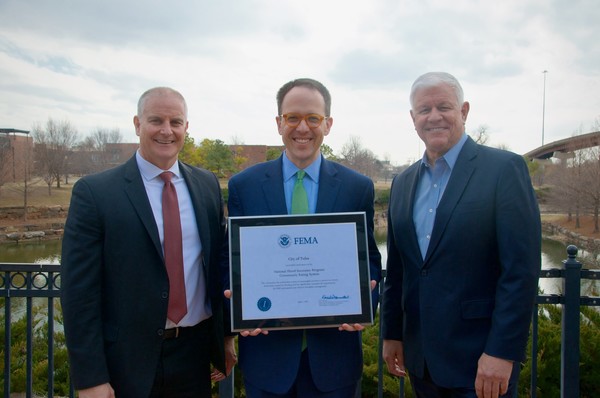 Mayor G. T. Bynam receives an achievement plaque from FEMA representatives, Region 6 Administrator Tony Robinson (left) and Deputy Administrator for Federal Insurance and Mitigation David Maurstad (right). Tulsa is recognized for reaching the highest rating in the National Flood Insurance Program’s Community Rating System.
Tulsa, Oklahoma has always had a flood problem. A turning point came in 1984 when the Memorial Day flood left 14 people dead, injured 288 and flooded approximately 7,000 buildings. This devastating flood was a wake-up call to take action and set things in motion for city leaders.
Since then, Tulsa has stood out as a leader in risk reduction. As a model community they have spent decades developing lofty stormwater management goals including drainage system maintenance and floodplain development priorities. These actions help to reduce risk from future flooding and to save lives.
On April 1, Tulsa will hit the highest possible rating under the National Flood Insurance Program’s Community Rating System. Achieving a Class 1 rating has only been accomplished by one other city in the country, Roseville, California. What sets Tulsa apart are their leaders and planners who long ago realized something had to be done to avoid future losses from floods.
Visit the FEMA Blog to read more about this community’s efforts to reduce flood risk.
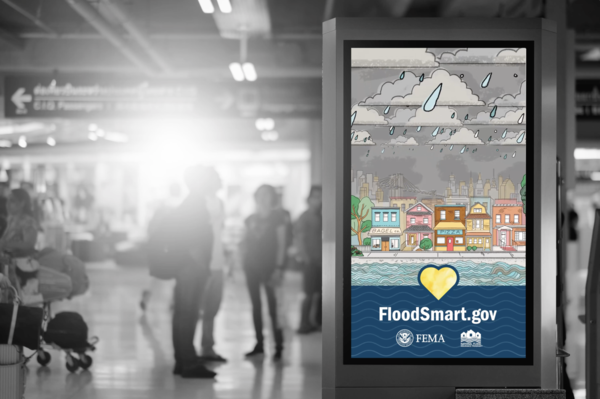
FEMA's National Flood Insurance Program (NFIP) “Keep Home” advertising campaign was recently recognized by the American Advertising Federation. The Advertising Club of Washington, D.C. presented four silver Addy Awards and the International Awards Associate presented five MUSE Creative Awards.
The campaign focused on raising flood risk awareness and flood insurance options in Atlanta, Florida, Louisiana, New York City and Texas. The targeted campaign used local artists commissioned to create original works depicting each region.
The campaign ran during 2021 hurricane season in English and Spanish across a range of digital and outdoor media, reaching more than 638.1 million views.
These awards help shine a bright light on the campaign’s audio, video and creative design elements promoting flood insurance.
FEMA will host a webinar on the implementation of continuity strategies during disasters. Join FEMA and the Naval Support Activity Bethesda to discuss continuity of essential functions after the Naval Support Activity Bethesda firehouse caught on fire in 2019.
Join us at 1:30 p.m. ET on March 30 for a one-hour discussion on continuity strategies and implementation. The webinar will include a question-and-answer period with the speaker panel.
To register for the webinar, visit FEMA’s Eventbrite webpage. The webinar will be recorded for future viewing. However, live attendance is encouraged to maximize the time for questions and answers with the presenters.
Visit FEMA’s Continuity Resource Toolkit for additional information and resources for continuity. For questions, contact the Policy and Plans Branch. Captioning services will be provided for the webinar.
On March 21, FEMA published a funding notice on Grants.gov for the Swift Current initiative, making an estimated total of $60 million available to the states of Louisiana, Mississippi, New Jersey and Pennsylvania. To launch the initiative, FEMA identified four states affected by Hurricane Ida, one of the most powerful and rapidly intensifying storms to hit the United States in recent years.
Swift Current is a FEMA initiative within the Flood Mitigation Assistance (FMA) program that seeks to expedite awards after a flooding event and reduce the complexity of the application process. The application period opens April 1 and closes Oct. 3.
The initiative’s goal is to obligate flood mitigation dollars for National Flood Insurance Program (NFIP)-insured and substantially damaged properties as quickly and equitably as possible after a disaster event. These funds help protect buildings and comply with local community requirements through property acquisition and demolition, floodproofing, relocation and elevation.
To be eligible, buildings must be insured through the National Flood Insurance Program for FEMA to consider them for this funding opportunity.
Swift Current is the first FEMA initiative to be funded through the Infrastructure Investment and Jobs Act. The act provides $3.5 billion in Flood Mitigation Assistance grants over five years.
The estimated $60 million in Swift Current funding will be distributed as follows:
- Louisiana, $40 million.
- Mississippi, $5 million.
- New Jersey, $10 million.
- Pennsylvania, $5 million.
The federal cost share will range from 75-100%. FEMA is offering a higher federal cost share of 90% for buildings located in socially vulnerable communities. These communities often face challenges in meeting the non-federal cost-share match. The federal cost share for the Flood Mitigation Assistance program is 100% for severe repetitive loss properties and 90% for repetitive loss properties.
The initiative promotes equity in line with President Biden’s Justice40 Initiative. The Swift Current funding opportunity aims to prioritize help by providing 40% of the benefits to disadvantaged communities.
All applications must be submitted in the Mitigation eGrants system, will be reviewed on a rolling basis, and must be submitted no later than noon ET on Oct. 3. Applications received by FEMA after this deadline will not be considered for funding.
Interested subapplicants in Louisiana, Mississippi, New Jersey and Pennsylvania should contact their State Hazard Mitigation Officer for more information. Learn more about the initiative on FEMA.gov.
FEMA is seeking feedback on the draft “Local Elected and Appointed Officials Guide: Roles and Resources in Emergency Management.”
This guide makes it easier for senior officials to understand, prepare for and execute their leadership responsibilities to help:
- Mitigate community risks.
- Save lives.
- Protect property.
- Recover from disasters.
The document provides an executive-level introduction to emergency management concepts and principles for local senior officials. It identifies local senior officials’ roles and responsibilities for incident emergency management before, during and after disasters. The draft guide also explains how to access resources.
FEMA will host a series of 60-minute webinar sessions to provide an overview of the draft guide and gather feedback from whole community partners. The sessions will include facilitated discussions with stakeholders to help improve the existing draft. FEMA seeks input -- especially real-world case studies -- that can be incorporated into the guide. A line-numbered version of the draft guide is available to allow individuals to provide comments on specific areas within the document.
Advance registration is required to participate in the webinar sessions, and it is on a first-come, first-served basis. To register, click on your preferred session below:
The national engagement period will conclude on April 22. To review the document and learn more about the webinar sessions, please visit the FEMA website. To provide input, download the draft "Local Elected and Appointed Officials Guide" and feedback form to NPD-Planning@fema.dhs.gov.
The Resilient Nation Partnership Network’s next “Resilience Exchange” is a discussion about the many intersections between adaption and the arts.
Featured Speakers include:
- Golden Triangle Business Improvement District (DC) Executive Director Leona Agouridis.
- FEMA Region 2 Supervisory Community Planner Jack Heide.
- Majestic Collaborations Co-Founder Matthew Ché Kowal.
- Justice + Joy Consulting Founding Director Mallory Rukhsana Nezam.
This free event will take place at 1 p.m. ET Wednesday, March 30. More information about the each speaker and participation details are on the registration page.
The Resilience Exchange series offers monthly learning sessions on a specific subject to share knowledge and advance conversation around a particular area of natural hazard resilience.
FEMA Seeks New Members for National Advisory Council
FEMA is seeking qualified individuals to lend their expertise and serve on the agency’s National Advisory Council.
If you are interested in applying to serve on the National Advisory Council, please follow the instructions found in the Federal Register for submitting an application package no later than midnight ET on March 31.
…………………………………………………………………………………………………………..
FEMA Seeks Public Comment to Enhance the Agency’s Programs
As part of its commitment to advance equity in underserved communities, FEMA proposes collecting demographic information from applicants participating in certain FEMA programs.
The deadline to submit comments is March 28. Learn more and submit your comments on the Federal Register website.
…………………………………………………………………………………………………………..
FEMA to Host Nonprofit Security Grant Program Webinars
FEMA is hosting a series of webinars for the Fiscal Year (FY) 2022 Nonprofit Security Grant Program. These webinars are for all nonprofit organizations interested in learning more about the program and its priorities, eligibility and application process.
To register, click on your preferred session below:
For questions regarding the webinars or to request special accommodations, contact FEMA-NSGP@fema.dhs.gov.
…………………………………………………………………………………………………………..
FEMA Seeks Feedback on Resource Typing Definition
FEMA is seeking public feedback on a resource typing definition document. The 30-day national engagement period will conclude at 5 p.m. ET on April 1.
The national engagement period provides an opportunity for interested parties to comment on the draft document to ensure that it is relevant for all implementing partners. To provide comments on the draft, complete the feedback form on FEMA.gov and submit the form to fema-nims@fema.dhs.gov.
…………………………………………………………………………………………………………..
Register to Learn About the SAM.gov New Identifier
As a reminder, a big change is coming soon that affects grant applicants and recipients using FEMA grants management systems.
By April 4, the federal government will stop using the Dun & Bradstreet number (DUNS) to uniquely identify entities registered in the System for Award Management (SAM). At that point, entities doing business with the federal government will use a Unique Entity Identifier (UEI) created in SAM.gov.
GSA will host a forum at 1 p.m. ET on Wednesday, March 23 to demonstrate what the change to the new identifier means for those using FEMA grants management systems.
Register on GSA.gov if you’re interested in participating in the webinar. For more information about the transition, go to fsd.gov and select the “Help on UEI Transition” button.
…………………………………………………………………………………………………………..
FEMA Exercise Support Deadline is April 1
FEMA is accepting applications for the next round of exercise assistance through its National Exercise Program. To be considered for the Spring 2022 round exercise assistance, submissions are due by April 1.
Instructions for how to submit a request for support are on FEMA.gov. For jurisdictions not ready to submit a request at this time, the National Exercise Program will hold additional exercise support rounds in fall 2022 and spring 2023.
For questions, contact the FEMA's National Exercise Division.
…………………………………………………………………………………………………………..
|


