|
FEMA received a record-breaking request for nearly $5 billion in funding for Fiscal Year 2021 mitigation grant programs.
FEMA made $1.16 billion available in funding for FY 2021 across two programs. Building Resilient Infrastructure and Communities (BRIC) made $1 billion available in funding and received requests for $4.16 billion. Every state and territory, and several tribes, applied for BRIC funding.
The Flood Mitigation Assistance (FMA) program made $160 million available in funding and received requests for $534 million.
FEMA received requests from applicants in 25 states for the FMA program. This response demonstrates the need for FEMA to continue investing in programs that address climate resilience and to ensure funds reach communities with the greatest need.
Both programs support state, local, tribal and territorial governments to strengthen community resiliency by reducing the risks they face against the disaster and natural hazards. The application period closed Jan. 28.
“FEMA is committed to delivering more equitable outcomes and funding access through our Hazard Mitigation Assistance grant programs. As part of our strategic mission, we’ve been working to help disadvantaged communities through all our grant programs,” said FEMA Mitigation Assistant Administrator Katherine Fox. “By fostering connection and promoting equity, we strive to bring communities together to help them consider risk and mitigation in all investment decisions and ensure that partners have equitable access to our programs.”
FEMA anticipates releasing a more detailed analysis of the applications that were received after beginning the reviews. The agency will convene subject matter experts from other federal agencies, state, local, tribal and territorial governments to support the reviews. The coordinated review aims to increase transparency in decision-making while building mitigation capability and partnerships.
Visit FEMA.gov for more information about Hazard Mitigation Assistance Grants
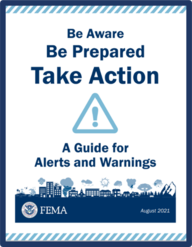
Your phone suddenly buzzes, sending you an alert about an imminent hazard. Do you know what to do, and how to protect yourself, your family and your pets?
To help you learn how to respond to emergency alerts, FEMA created the "Guide for Alerts and Warnings." This guide also helps emergency managers share important information about hazard alerts and protective actions.
This guide covers a variety of situations — from tsunamis to winter storms — and includes information on:
- Preparedness actions.
- Protective actions.
- Hazards.
- Alerts and warnings.
Download or order free copies of FEMA’s Guide for Alerts and Warnings. The guide provides information about 17 hazards and the protective actions you can take when you receive an alert.
A condensed, magnetic version of the guide is available for ordering through FEMA's publications warehouse. The warehouse ships free preparedness products at no cost and can accommodate individual and group orders. Copies are available for order online, at https://orders.gpo.gov/icpd/ICPD.
|
As part of its commitment to advance equity in underserved communities, FEMA proposes collecting of demographic information from applicants participating in certain FEMA programs.
Collecting this information will help FEMA ensure that people who apply for assistance are treated fairly and that FEMA programs comply with civil rights, nondiscrimination and equity requirements. Participation is voluntary. FEMA urges stakeholders, community groups and the public to comment on the information collection initiative.
Collecting demographic data from individuals who participate in, or benefit from the agency's programs and activities will allow FEMA to evaluate the accessibility of its programs and the equal distribution of disaster assistance, identify possible gaps and make alterations to existing programs.
The deadline to submit comments is March 28. Learn more and submit your comments on the Federal Register website.
FEMA is seeking public feedback on an updated "Emergency Operations Center (EOC) How-To Quick Reference Guide." The 30-day national engagement period opens today and will conclude at 5 p.m. ET March 1.
The guide is a collection of guidance and best practices which will contribute to developing an emergency operations center that can successfully meet the jurisdiction’s needs. The updates include considerations for virtual and hybrid working environments.
To provide comments on the drafts, complete the feedback form on the webpage and submit the form to fema-nims@fema.dhs.gov no later than 5 p.m. ET on March 1.
FEMA is hosting a series of webinars to aid jurisdictions with filling out the feedback form. Each stakeholder webinar will cover the same information, so choose the session most convenient for you.
Advance registration is required due to space limitations. Registration is on a first come, first served basis. To register, click on your preferred webinar session from the list below.
If you require accommodations to participate in these events, please provide details in the Disability Related Accommodations field on the registration page or contact FEMA-NIMS@fema.dhs.gov. Please make accommodation requests as early as possible; late requests will be accepted, but they may not be possible to fulfill.
For the past three years, FEMA has coordinated with two federal agencies regarding ways the agency’s National Flood Insurance Program (NFIP) can help protect threatened and endangered species.
FEMA is announcing a partnership with the U.S. Fish and Wildlife Service and the National Marine Fisheries Service (the services) and developed the NFIP’s Endangered Species Act Section 7(a)(1) Conservation Action Program. This program will provide opportunities and benefits for reducing flood risk and lowering flood insurance premiums while conserving habitats essential for threatened and endangered species. The program includes new Community Rating System activities for communities to earn credits for their species conservation efforts.
The program has three key components that effectively promote the conservation of listed species and their habitats:
- Building awareness among communities participating in the NFIP of the benefits of threatened and endangered species and habitat conservation that is published on the Floodplains and Wildlife Conservation webpage.
- Using the Flood Risk and Endangered Species Habitat web-based mapping tool to help communities identify floodplains where threatened and endangered species reside.
- Incentivizing natural floodplain function activities and threatened and endangered species conservation through the National Flood Insurance Program’s Community Rating System.
From these coordination efforts, FEMA signed a Memorandum of Understanding with the U.S. Fish and Wildlife Service and the National Marine Fisheries Services in December 2021, establishing a framework for collaboration on the new program. As part of the planning activities, FEMA started pre-consultation coordination discussions with the services.
In addition, FEMA published a Federal Register Request for Information about the National Flood Insurance Program’s minimum floodplain management standards that include considerations for impacts on listed species and their habitats. The public comment period was open from Oct. 12, 2021 – Jan. 27. FEMA also conducted three virtual public meetings to obtain feedback and input on possible changes to the minimum floodplain management standards and compliance.
Firefighters Grants Application Deadline is Approaching
FEMA is accepting applications for the Fiscal Year 2021 grants that constitute the Assistance to Firefighters Grants program.
The application period is now open for $46 million in funding for the Fire Protection and Safety grants; it will close at 5 p.m. ET on Feb. 18. These grants focus on enhancing the safety of the public and firefighters with respect to fire and fire-related hazards.
The funding notice and technical assistance documents for this program will be available at grants.gov and FEMA.gov. For questions, contact FEMA's Fire Grants Helpdesk via email at firegrants@fema.dhs.gov.
…………………………………………………………………………………………………………..
FEMA Recruits the Next Generation of Emergency Managers
FEMA is accepting applications for the Youth Preparedness Council. All applications are due no later than midnight on March 6. If you know a teen interested in preparedness and community service, encourage them to apply.
FEMA will host an applicant information session on Feb. 17 for those interested in learning more about the council and the application process. Help us spread the word about this year’s Youth Preparedness Council by using #YPC2022 on social media when sharing this news.
To learn more about the Youth Preparedness Council, visit Youth Preparedness Council | Ready.gov.
|
…………………………………………………………………………………………………………..
FEMA Seeks New Members for National Advisory Council
FEMA is seeking qualified individuals to lend their expertise and serve on the agency’s National Advisory Council.
The National Advisory Council includes a geographically diverse and substantive cross-section of 35 members who advise the FEMA Administrator on all aspects of emergency management, ensuring input from and coordination with state, local, tribal and territorial governments as well as the private and nonprofit sectors. For more information about what each position entails, please see the council’s charter.
Individuals appointed to the council bring their experience and diversity of views to provide the administrator consensus recommendations on a broad range of issues.
If you are interested in applying to serve on the National Advisory Council, please follow the instructions found in the Federal Register for submitting an application package no later than midnight ET on March 31.
…………………………………………………………………………………………………………..
|


