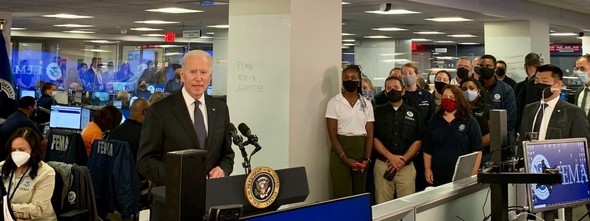
 President Joe Biden visits FEMA’s National Response Coordination Center on Sunday to talk about the impacts of Hurricane Ida.
FEMA continues to track Ida, which made landfall as a dangerous Category 4 hurricane near Port Fourchon, Louisiana on Sunday afternoon.
Although the storm was downgraded to a tropical depression on Monday, Ida will continue to bring heavy rain and possible flash flooding from the Tennessee and Ohio valleys into the central and southern Appalachians and mid-Atlantic through Wednesday.
FEMA, along with our federal, state, tribal and local partners, as well as non-government agencies and private sector entities, remain fully postured to support impacted states and tribes to fulfill identified requirements.
"This is an extremely dangerous storm. Our concern is to ensure that people are keeping themselves and their families safe and are aware of the changing conditions surrounding them," said Administrator Deanne Criswell.
"We are highly concerned about the post-storm life-safety and emergency measures that may be needed after these intense rains and life-threatening storm surge and flash floods. There are search and rescue resources already in place from the state as well as some additional federal assets."
Currently, 22 interagency partners are working in coordination at FEMA's National Response Coordination Center to support the planning, preparedness and response efforts needed in Louisiana and Mississippi, and any other states impacted by Hurricane Ida. Federal partners planning response report efforts are now shifting to search and rescue, sustaining food and water, providing shelter and power and water restoration.
FEMA has shipped more than 4.4 million meals, 3.2 million liters of water and 124,000 tarps, with millions more meals and water on order. The agency has also shipped more than 190 generators to the affected areas.
Urban Search and Rescue teams deployed to conduct search and rescue operations in affected areas. In addition, the Louisiana National Guard is activated and has staged high-water vehicles, boats, engineer work teams and other deployable resources. More than 1,300 FEMA employees are deployed to support Ida response and recovery efforts.
On Aug. 29 President Biden approved a Major Declaration for the State of Louisiana. The declaration authorizes Individual and Public Assistance for 25 parishes, Public Assistance for 39 parishes and hazard mitigation statewide.
Additionally, President Biden approved Mississippi’s emergency declaration on Aug. 28. The declaration was amended to include all 84 counties and the Mississippi Band of Choctaw Indians. Additional damage assessments are ongoing.
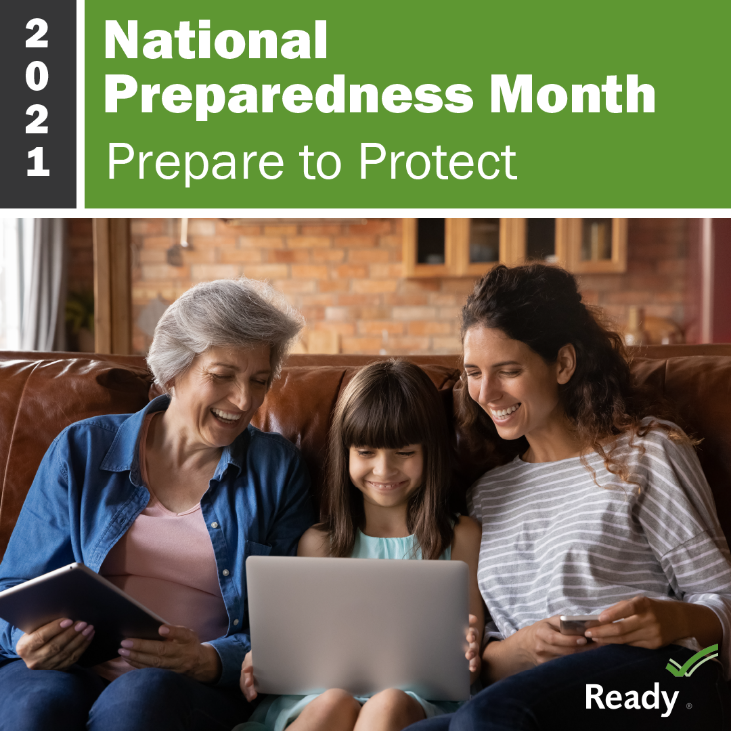
Each September, FEMA’s Ready Campaign uses this time to encourage people to take steps to prepare for disasters and emergencies that could happen anywhere and at any time. This year’s theme is “Prepare to Protect.”
Preparing for disasters is protecting everyone you love. Act now to prepare yourself and your family before disaster strikes.
Throughout the month, weekly themes will be used to highlight basic preparedness activities that everyone can do, including:
- Week 1, Sept. 1-4: Make A Plan.
- Week 2, Sept. 5-11: Build A Kit.
- Week 3, Sept. 12-18: Low-Cost, No-Cost Preparedness.
- Week 4, Sept. 19-25: Teach Children about Preparedness.
Follow FEMA on Facebook, Twitter and Instagram, and share posts about preparedness. In addition, the Ready Campaign has developed a toolkit for creating content for social media posts.
Later this month, the Ready Campaign and the Ad Council will launch a series of PSAs aimed at family and personal preparedness efforts. This year, the campaign will specifically feature the Latino/Hispanic demographic to ensure campaign messages are culturally competent and meeting the needs of historically underserved populations.
Remember to use #PreparetoProtect and #BeReady hashtags with a mention to the Ready Campaign. For more information, visit Ready.gov/September.
FEMA announced $12 million in competitive awards for fiscal year 2021 Regional Catastrophic Preparedness Grant Program. These grants to 15 state and local governments assist in developing innovative regional solutions to issues related to catastrophic incidents, including pandemic preparedness.
The grant program supports the building of core capabilities, which address the nation’s greatest risks and are essential to achieving the National Preparedness Goal of a secure and resilient nation. Delivering core capabilities requires the combined effort of the whole community, rather than the exclusive effort of any single organization or level of government.
The 2021 grants focus on planning, organization, training and exercises to build regional capabilities in FEMA’s Health and Medical and Food, Water and Sheltering Community Lifelines. In addition, applicants were encouraged to address the needs of socially vulnerable populations in their project proposals.
Information on the Regional Catastrophic Preparedness Grant Program may be found on FEMA.gov.
On Aug. 27, a new interim FEMA policy began requiring certain structures in Special Flood Hazard Areas to conform to higher flood elevation standards if they use Hazard Mitigation Assistance (HMA) grant funds.
FEMA published the Partial Implementation of the Federal Flood Risk Management Standard for Hazard Mitigation Assistance Programs (FEMA Policy FP-206-21-0003) to better align with Executive Order 14030 Climate-Related Financial Risk, which aims to strengthen resiliency nationwide. This new standard is in the fiscal year 2021 notices of funding opportunity for the Building Resilient Infrastructure and Communities (BRIC) and Flood Mitigation Assistance (FMA) programs.
In addition to BRIC and FMA, it also applies to the Hazard Mitigation Grant Program (HMGP) for any major disaster declared on or after Aug. 27 and assistance authorized for all 59 COVID-19 disaster declarations. In addition, the interim policy applies to HMGP Post Fire for any Fire Mitigation Assistance Grant declarations issued on or after Aug. 27.
The interim policy partially implements the Federal Flood Risk Management Standard by requiring higher flood elevations established by the Freeboard Value Approach for certain actions such as elevation, dry floodproofing and mitigation reconstruction in the Special Flood Hazard Area. The Freeboard Value Approach is the Base Flood Elevation plus two feet. Under the interim policy, FEMA does not require the partial implementation Freeboard Value Approach if using it would cause the project to be unable to meet applicable program cost-effectiveness requirements.
FEMA anticipates this approach will ensure communities affected by future flood disasters are less vulnerable to the loss of life and property and reduce the effects of a changing environment.
To learn more about the interim policy, please visit FEMA.gov.
FEMA has released the National Incident Management System’s National Qualification System Implementation Objectives Fact Sheet for final publication. The objectives reflect the concepts and principles to promote consistency in the National Qualification System implementation nationwide.
The implementation objectives clarify the National Qualification System requirements in the 2021 Emergency Management Performance Grant funding notice. Performance grants recipients are strongly encouraged to implement National Qualification System components with their grant funding. Beginning in October 2021, FEMA intends to leverage the Emergency Management Performance Grant program to make the implementation of the National Qualification System a requirement of eligibility for program funding. Jurisdictions will need to achieve or work toward achieving each of the objectives.
The objectives aim to develop organizational qualification procedures, certification program and credentialing standards in alignment with the National Incident Management System Guideline for the National Qualification System. These indicators serve as actionable activities that jurisdictions can use to demonstrate National Qualification System implementation. The indicators are a tool to assist jurisdictions and organizations in meeting the new implementation objectives.
FEMA plans to release a supplemental FAQ for the NQS Implementation Objectives in calendar year 2022.
On Aug. 27, the FEMA Emergency Management Institute Superintendent, Dr. Jeffrey Stern announced the 1000th graduate of its National Emergency Management Advanced Academy.
The National Emergency Management Advanced Academy student cohort hosted by South Carolina Emergency Management Office announced Robert Graham, Deputy Director of the Charlotte-Mecklenburg Emergency Management Office became the 1000th graduate since the advanced academy's inception in 2013. This milestone represents a significant achievement for the institute's 70th anniversary and its Emergency Management Professional Program, the institute's flagship program.
The Emergency Management Professional Program serves as the preeminent management school of continuing and professional studies to serve emergency managers throughout their careers.
To read more about the program and the academy, visit training.FEMA.gov.
FEMA will host three public meetings from Sept. 7 – 9 for interested persons to hear about the proposed changes to the National Flood Insurance Program’s Community Rating System. All meetings will contain the same content.
FEMA will provide the following information to participants and an opportunity to provide verbal comments for the public record.
The dates and times for the three public meetings are;
- 11 a.m. – 1 p.m. ET on Sept. 7.
- 1 – 3 p.m. on Sept. 8.
- 2 – 4 p.m. ET on Sept. 9.
When registering, an option is available to select the meeting date and if you wish to provide verbal comment during the webinar. Once a registration is confirmed, participants will be emailed a unique URL link for the meeting and should not be shared with others.
Participants must register in advance via the FEMA Zoom page; registration is on a first-come, first-served basis. The maximum number of participants per session is 1,000 attendees. All public meetings will be recorded, and comments will be a part of the official record.
Visit FEMA.gov for additional information .
FEMA posted in the Federal Register a Request for Information to gather public feedback about ways the agency could consider modifying, streamlining and/or innovating to improve the National Flood Insurance Program’s Community Rating System. The comment period will close Sept. 22.
These efforts aim ensure the Community Rating System program includes necessary, properly tailored and up-to-date requirements that effectively:
- Reduce and avoid flood damage to insurable property.
- Strengthen and support the insurance aspects of the National Flood Insurance Program.
- Encourage a comprehensive approach to floodplain management.
To submit written comments, use Docket ID: FEMA-2021-0021 in the Federal eRulemaking Portal. Follow the instructions on the page and contact the Regulations.gov Help Desk if you have technical issues.
For additional information on the Community Rating System Request for Information, visit FEMA.gov.
FEMA Announces Funding Opportunities for BRIC and FMA Grant Programs
FEMA posted funding notices for two hazard mitigation grant programs for $1.16 billion.
The Flood Mitigation Assistance and the Building Resilient Infrastructure and Communities provides funds to states, local communities, tribes and territories for eligible mitigation activities to strengthen our nation’s ability to build a culture of preparedness. These programs fund projects that invest in a more resilient nation, reduce disaster suffering and avoid future disaster costs.
The application period opens on Sept. 30 and the funding notices are available on Grants.gov.
Eligible applicants must apply for funding using FEMA Grants Outcomes, the agency’s grants management system. Submit applications in FEMA Grants Outcome Portal no later than 3 p.m. ET on Jan. 28, 2022. Applications received by FEMA after this deadline will not be considered for funding.
Interested applicants should contact their hazard mitigation officer for more information. For more information visit FEMA.gov.
…………………………………………………………………………………………………………..
FEMA Offers Exercise Assistance to Stakeholders
FEMA is accepting requests for exercise support through the National Exercise Program. State, local, tribal and territorial jurisdictions can request no-cost assistance for exercise design, development, conduct and evaluation to validate capabilities across all mission areas.
FEMA is hosting webinars for all interested governments and other community partners on the exercise support process.
Please visit the webinar webpage to register. The webinar dates are:
- 2 p.m. ET on Sept.7.
- 3 p.m. ET on Sept. 15.
- 4 p.m. ET on Sept. 23.
- 1 p.m. ET on Oct. 1.
Fall 2021 requests for support are due no later than Nov. 1. To submit a request for exercise support, download the nomination form, then email the completed form with any supporting documentation to NEP@fema.dhs.gov. Awardees will be notified by Dec. 10. FEMA will hold additional exercise support rounds in the spring and fall of 2022.
For questions, contact FEMA at NEP@fema.dhs.gov.
…………………………………………………………………………………………………………..
|


