|
Voluntary and faith-based organizations are critical lifelines to communities, providing resources and services that improve communities every day.
FEMA’s Voluntary Agency Liaisons (VALs) work with these groups to support survivors and their communities before, during and after disasters. The COVID-19 vaccine effort was no exception.
In partnership with local voluntary organizations, FEMA VALs identified, scheduled, coordinated and monitored over 2,800 clinical and non-clinical volunteers as they facilitated more than 225,000 vaccinations throughout the nation.
FEMA paid travel expenses for 689 clinical and nonclinical volunteers and established a standard operating procedure to simplify the process for future events.
FEMA has partnered with a diverse group of voluntary organizations: Information Technology Disaster Resource Center, American College of Surgeons - Stop the Bleed, Team Rubicon, International , Islamic Relief USA, Focus Humanitarian Assistance, Buddhist Tzu Chi, BAPS Charities and the Islamic Medical Association of North America.
FEMA is grateful for the support of these voluntary organizations, who have provided clinical and non-clinical volunteers to administer COVID-19 vaccines through fixed and mobile vaccination centers.
Join FEMA at 2 p.m. ET on Aug. 26 to get tips, tools and resources for people with disabilities that you can share with your communities during National Preparedness Month in September.
Now is a great time for people with disabilities to get informed on preparedness, make a personal preparedness plan, build an emergency kit and be involved in community preparedness. Learn about the new preparedness resources from FEMA to share with your communities and hear how some of our experts with disabilities prepare for disasters.
To attend this Office of Disability Integration and Coordination stakeholder call, dial (800) 263-0877 using the participant passcode:1667315. Registration is requested. Closed captioning will be provided via Captionedtext.com using event #4869949.
On Aug. 16, FEMA announced the full application launch of the National Risk Index, an online resource that provides a holistic view of community risk. It provides baseline relative risk scores and ratings for 18 natural hazards in addition to community resilience, social vulnerability and expected annual loss.
The tool was originally released in November 2020 at a limited capacity. Now, fully available for use by state, local, tribal and territorial partners, the National Risk Index includes the ability to generate more customized analyses and reports, including community risk profiles and risk comparison reports for any county or Census tract.
Users can now share reports via unique links, save them as printable PDFs or extract the underlying data in spatial or tabular formats. The Index based ratings on data from the best available resources from 2014 through 2019. Routine updates are expected to keep ratings current.
The National Risk Index is free and easy to use by anyone interested in planning for mitigation or learning about their community’s natural hazard risks. Visit FEMA's National Risk Index webpage for more information.

FEMA, in coordination with the Resilient Nation Partnership Network, is hosting Resilience Exchange from noon – 1:30 p.m. ET on Aug. 18. Resilience Exchange is a discussion on resilient decision making to better prepare stakeholders at all levels.
Every year, resilient decision making becomes increasingly critical to a community’s ability to withstand and recover from hurricanes, wildfires, earthquakes, flooding and other disasters. Considerations of resilient decision making includes equity, climate change, budget limitations, stakeholder values and other factors.
Join the Resilience Exchange to hear from:
- National Governors Association, Senior Policy Analyst Carl Amritt.
- Groundswell, Senior Program Director Majora Carter.
- Oregon State Resilience Officer Mike Harryman.
- Palm Beach County, Commissioner Gregg Weiss.
- Ohio State University, School of Environment and Natural Resources Professor Robyn Wilson, Ph.D.
To join the resilience discussion, register on Eventbrite.com.
|
FEMA, in coordination with the Federal Communications Commission, successfully tested the nation’s public alert and warning systems on Aug. 11.
FEMA sent a test message to television, radio and cable systems nationwide over the Emergency Alert System. Wireless carriers also reported receiving the Wireless Emergency Alerts (WEA) test alert.
FEMA and the FCC are partnering with various agencies and other stakeholder groups to assess information about the performance of the opt-in WEA test. Data collected from voluntary observers and data from additional sources will be analyzed and used to evaluate the performance of, and future improvements to, the alert and warning systems.
More information about FEMA’s Integrated Public Alert and Warning Systems is available at FEMA.gov.
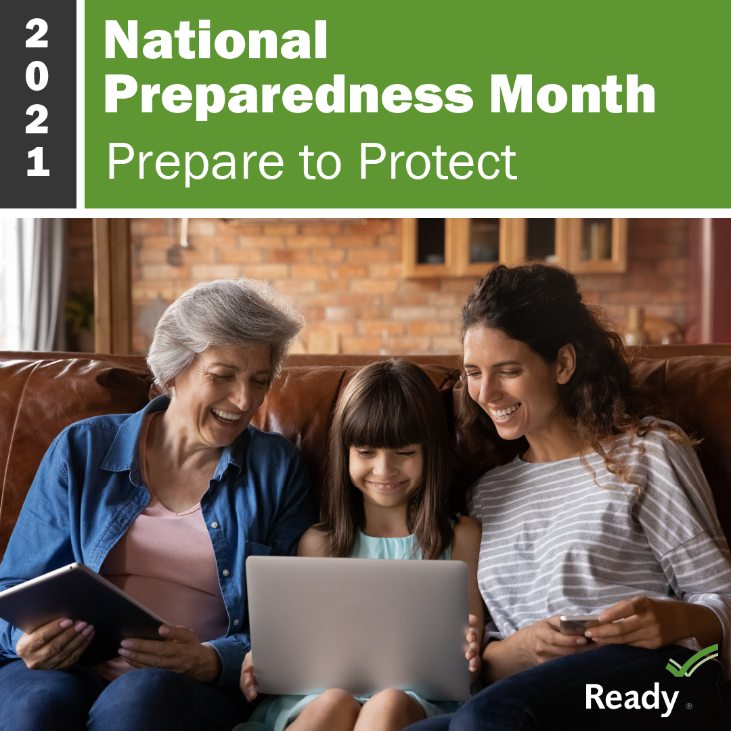
September is National Preparedness Month. Managed by FEMA’s Ready Campaign, in association with the Ad Council, the month is observed to encourage everyone to take steps to prepare for disasters that could at any time.
This year’s theme, “Prepare to Protect,” highlights how preparing for disasters is protecting everyone you love.
For the first-time ever, National Preparedness Month will include a series of Hispanic public service advertisements (PSAs), which will be released (in English and Spanish) mid-month, near the start of Hispanic Heritage Month. The PSAs will air during the peak of the hurricane and wildfire seasons.
Throughout the month, Ready.gov/September will feature weekly themes that highlight basic preparedness activities that every everyone can do.
Help us, help others encourage our friends and family to prepare for disasters and emergencies today. Together, let’s prepare to protect. For free, easy to use social media content, and more information, visit: Ready.gov/September.
FEMA Seeks Public Feedback on NQS Position
FEMA is seeking public feedback for the "National Qualification System’s Radiological Emergency Preparedness Program Incident and Exercise Evaluator" position documents. This national engagement period will conclude at 5 p.m. ET on Aug. 26.
FEMA worked alongside state, local, tribal and territorial partners to draft and refine the documents. These documents will help intergovernmental partners define evaluators for radiological emergency preparedness program incidents and exercises.
To provide comments on the draft, complete the feedback form and submit the form to FEMA-NIMS@fema.dhs.gov.
…………………………………………………………………………………………………………..
FEMA Announces Funding Opportunities for BRIC and FMA Grant Programs
FEMA posted funding notices for two hazard mitigation grant programs for $1.16 billion.
The Flood Mitigation Assistance and the Building Resilient Infrastructure and Communities provides funds to states, local communities, tribes and territories for eligible mitigation activities to strengthen our nation’s ability to build a culture of preparedness. These programs fund projects that invest in a more resilient nation, reduce disaster suffering and avoid future disaster costs.
The application period opens on Sept. 30 and the funding notices are available on Grants.gov.
Eligible applicants must apply for funding using FEMA Grants Outcomes, the agency’s grants management system. Submit applications in FEMA Grants Outcome Portal no later than 3 p.m. ET on Jan. 28, 2022. Applications received by FEMA after this deadline will not be considered for funding.
Interested applicants should contact their hazard mitigation officer for more information. For more information visit FEMA.gov.
…………………………………………………………………………………………………………..
|


