|
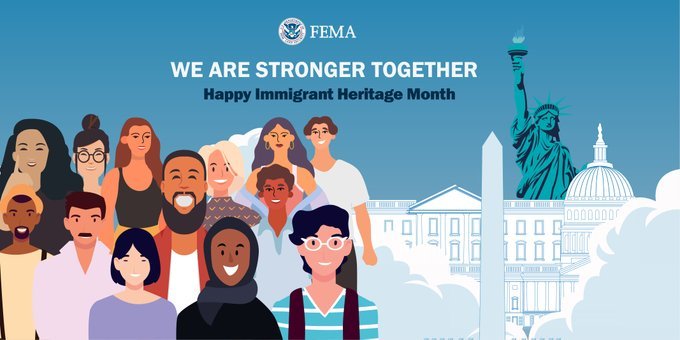
One of FEMA’s greatest strengths is that our workforce resembles the country that we serve. At all levels of the agency, in all 10 regions and at Joint Field Offices around the nation, we represent the immigrant cultures that brought us here. This diversity creates an environment that is welcoming to both those we serve and our colleagues, and we continually strive to build a culture that reflects the agency’s values.
The unique perspectives, experiences and cultures of immigrants are part of the rich tapestry of this great nation.
To celebrate Immigrant Heritage Month, check out the FEMA Blog and the agency’s social media channels to read the immigration journeys of our diverse workforce.
Today, FEMA announced the 2021-2022 Youth Preparedness Council members. The agency welcomes nine new members to the council. FEMA selected these individuals based on their dedication to public service, community involvement and potential to increase community resilience throughout the country. They join six returning members, who will be serving their second and final year on the council.
FEMA created the council in 2012 to bring together diverse young leaders interested in strengthening disaster preparedness efforts both nationally and within their communities. During their two-year term, members complete local- and national-level projects, while sharing their opinions and experiences on youth preparedness with each other, FEMA leadership and other preparedness organizations.
Members also attend the annual Youth Preparedness Council Summit each summer. This year’s summit will be held virtually in late July and center on the theme “Equity into Everything: Building a Culture of Resilience for the Whole Community.”
Please join us in welcoming the newest members of the Youth Preparedness Council:
- Isaac Doll of Colorado.
- Aubrey Dockins of Florida.
- Miles Butler of Idaho.
- Beitris Boyreau-Millar of Maryland.
- Ranjana Ramesh of Massachusetts.
- Mirika Jambudi of New Jersey.
- Megan Cameron of New York.
- Amira Seay of Texas.
- Shivani Jayaprakasam of Washington.
The next application cycle will open in early 2022. To learn more and apply to the council, visit Ready.gov.
|
FEMA released the latest “Taking Shelter from the Storm: Building or Installing a Safe Room for Your Home” and “Safe Rooms for Tornadoes and Hurricanes: Guidance for Community and Residential Safe Rooms.”
“Taking Shelter from the Storm,” the 2021 edition of FEMA P-320, features updated residential safe room guidance and prescriptive safe room designs for one- and two-family dwellings.
The 2021 edition of “Safe Rooms for Tornadoes and Hurricanes,” also known as FEMA P-361, updates and refines planning guidance, best practices and funding criteria for safe rooms that provide occupants with near-absolute protection from wind and wind-borne debris.
Both FEMA publications reference the “Standard for the Design and Construction of Storm Shelters.” This is the latest edition from the International Code Council and the National Storm Shelter Association.
Additional resources regarding safe rooms and storm shelters can be found on FEMA.gov. To learn more about FEMA’s building science work, visit the Building Science frequently asked questions page.
Do you want to help your community during a disaster? Consider joining a Community Emergency Response Team (CERT).
By joining a CERT you will receive training in basic disaster response skills such as team organization, disaster medical operations, fire safety and light search and rescue. When CERT volunteers perform these activities, professional responders can focus their efforts on more complex, essential and critical tasks.
Your participation can also build equity by ensuing the team reflects the diversity of the community it serves.
Recently, four FEMA employees teamed up with the Arlington, Virginia Department of Public Safety Communications and Emergency Management and Community Emergency Response Team (CERT) to help launch the county’s first-ever Spanish-language CERT volunteer training. Held virtually, the training was designed to ensure a more equitable, culturally competent response to the COVID-19 pandemic and other emergencies.
An additional benefit to conducting training in a virtual environment is the ability to teach without borders and host international observers to foster international knowledge sharing. For this training, Arlington hosted observers from the government of Mexico’s Centro Nacional de Prevención de Desastres and Patricio Poblete Saavedra, CERT founder for Chile, Mexico and Haiti joined to foster international knowledge sharing.
Both international observers are exploring similar programs in their home countries, with plans to expand CERT programming in Latin America and the Caribbean.
Learn more about the goals of the Arlington, Virginia’s Spanish language CERT courses. If you’d like to help your community be more resilient and prepared, you can search for a CERT in your neighborhood. CERT Program Managers can order translations of the CERT basic training materials, as well as a host of other great preparedness materials from the FEMA publications warehouse by visiting FEMA’s online ordering tool.
Incorporating mitigation measures into the rebuilding process can help minimize the potential for reoccurring damage. As part of FEMA’s commitment to help make communities stronger and more resilient from the impacts of climate change, the Individuals and Households Program may assist eligible disaster survivors with making investments that reduce risk.
Homeowners who are approved for Home Repair Assistance through the Individuals and Households Program may receive additional funds for several mitigation measures. Funding for mitigation measures will be awarded as part of program’s Home Repair Assistance for owner-occupied primary residences with specific damaged items and causes of damage. This additional assistance will be available for all disasters declared on or after May 26. FEMA will notify applicants if they have received mitigation funds as part of their Individual and Household Program assistance.
Because disasters can happen unexpectedly, taking steps to strengthen, repair and rebuild is vital for community and personal resilience. The following mitigation measures may now be covered for eligible applicants:
- Roof repair to withstand higher wind speed and help prevent water infiltration.
- Elevating a water heater or furnace to avoid future flood damage.
- Elevating or moving an electrical panel to avoid future flood damage.
These measures will allow homeowners to rebuild in ways that make their homes more resilient to severe weather events, reducing disaster suffering and the likelihood future federal assistance will be needed.
FEMA released the “National Incident Management System Guideline for Resource Management Preparedness” containing resource management preparedness information and best practices.
The document supplements the National Incident Management System resource management component by providing additional details on resource management preparedness processes, best practices, authorities and tools.
The guide is useful to any state, local, tribal or territorial authority having jurisdiction that is responsible for acquiring, inventorying, storing, or sharing resources – whether building a new resource management program or working to improve an existing one.
FEMA will host three, 30-minute webinars to discuss the NIMS Guideline for Resource Management Preparedness and answer related questions. All webinars are open to the whole community. Advance registration is required and on a first-come, first-served basis:
To review the draft National Qualifications System Implementation Objectives and for additional webinar information, visit
FEMA released the Incident Complexity Guide: Planning, Preparedness and Training. The guide is intended for use during planning, preparedness and training efforts and not as a decision-making tool during a response.
The Incident Complexity Guide promotes a common language and shared understanding of incident complexity across the whole community to determine the complexity or difficulty of managing a disaster, incident, event or exercise. Using a common approach and consistent method for determining incident complexity will improve the effectiveness and implementation of the National Incident Management System and the National Preparedness System, to improve or maintain the qualifications of incident management personnel.
FEMA released the draft in January 2021 for a 30-day national engagement period. During the national engagement period, FEMA hosted a series of webinars for stakeholders to provide comments to the draft. The project team reviewed and adjudicated the comments in consultation with multiple stakeholder groups.
FEMA will host two, 30-minute webinars to discuss the Incident Complexity Guide and answer related questions. All webinars are open to the whole community. Advance registration is required and on a first-come, first-served basis.
To review the Incident Complexity Guide and for additional webinar information, visit FEMA.gov.
In coordination with the Federal Communications Commission, FEMA will conduct a nationwide test to assess the capabilities of the Emergency Alert System and Wireless Emergency Alert at 2:20 p.m. ET on Aug. 11 with a backup date of Aug. 25.
This is the sixth national Emergency Alert System test and the second national Wireless Emergency Alert test. This time, however, the wireless portion of the test will be directed only to those cellphones where the subscriber has opted-in to receive emergency alert test messages. The test will assess the operational readiness of the infrastructure for distribution of a national message and determine whether technological improvements are needed.
Both portions of this nationwide test will be sent through FEMA’s Integrated Public Alert and Warning System, the nation’s modern alert and warning infrastructure that automatically authenticates alerts. The test is intended to ensure public safety officials have the methods and systems that will deliver urgent alerts and warnings to the public in times of an emergency or disaster.
Cell towers will broadcast the wireless test for approximately 30 minutes. During this time, cell phones that have opted-in to receive Wireless Emergency Alert test messages, are switched on, within range of an active cell tower and configured to receive emergency alert test messages should receive that message. Phones should receive the message once, reading, “THIS IS A TEST of the National Wireless Emergency Alert System. No action is needed.” Phones set to Spanish will receive a translated message. Wireless Emergency Alerts are accompanied by a unique tone and vibration. The national test will use the same special tone and vibration.
The Emergency Alert System test is made available to Emergency Alert System participants (i.e., radio and television broadcasters, cable systems, satellite radio and television providers, and wireline video providers) and is scheduled to last approximately one minute. The test message will be similar to regular monthly test messages with which the public is familiar.
Funding for Regional Preparedness Grants Now Available
FEMA released the funding notice for the fiscal year 2021 Regional Catastrophic Preparedness Grant Program. The application period will close at 5 p.m. ET on July 16.
Applicants are encouraged to consider the needs of underserved and socially vulnerable populations and to involve representatives from the affected communities in the proposed project to ensure their needs are sufficiently addressed.
Awards will be made on a competitive basis to applicants who present an ability to successfully meet the requirements described in the funding notice.
For additional information and to review the notice of funding opportunity, visit FEMA.gov. Applicant submissions must be made on grants.gov.
…………………………………………………………………………………………………………..
FEMA Offers Planning Support for Disaster Response and Recovery
The emergency management community has been operating in a pandemic environment for over a year. FEMA released the "COVID-19 Pandemic Operational Guidance: All Hazards Incidents Response and Recovery."
The document was designed to help emergency managers plan for disaster response and recovery, while adhering to public health guidelines to prevent the spread of COVID-19. The guidance serves as a tool for governments, outlining guidance related to new priorities that have arisen in recent months.
FEMA is offering a series of webinars focused on the guidance throughout the month of June:
- Webinar 4 – 7 p.m. ET, June 16
https://fema.connectsolutions.com/cpog_webinar4/event/registration.html
- Webinar 5 – 1 p.m. ET, June 17
https://fema.connectsolutions.com/cpog_webinar5/event/registration.html
To sign up for a webinar, simply click on the registration link associated with the preferred date of attendance.
…………………………………………………………………………………………………………..
FEMA Announces Funding Opportunity for High-Hazard Dams
FEMA announced $12 million in funding is available for non-federal dams to reduce dam risk, increase community preparedness and provide flood protection.
The annual funding is part of the Rehabilitation of High Hazard Potential Dams grant program for fiscal year 2021. The application period will close June 25.
In a state or territory with an enacted dam safety program, the state administrative agency, or an equivalent state agency, is eligible to apply for the grant. Each eligible state may submit only one grant application. Eligible subrecipients, including local governments and nonprofit organizations, are encouraged to review the notice of funding opportunity announcement on Grants.gov.
Email the Rehabilitation of High Hazard Potential Dams grant program with comments or questions. For more information about the grant or general program information, visit the Rehabilitation of High Hazard Potential Dams grant program or the National Dam Safety Program webpages on FEMA.gov.
…………………………………………………………………………………………………………..
FEMA Hosts Webinars for New Best Practice Guides
FEMA’s National Exercise Division recognized that exercise practitioners have struggled to adapt exercises to the unique challenges that the COVID-19 pandemic produced. The National Exercise Division collected and compiled lessons learned and best practices from across the whole community of exercise professionals related to two topics, virtual exercise best practices and safe exercise practices for in-person events.
The webinars will introduce the two new guides, providing stakeholders with an overview of the products and how to use and locate them.
FEMA will host three webinars for whole community exercise practitioners. The webinars will be held:
- 4 p.m. ET on June 16.
- 11 a.m. ET on June 17.
If you are unable to attend one of the webinars, a recorded webinar will be made available later on FEMA.gov. Each webinar will cover the same content.
Visit the Homeland Security Exercise and Evaluation Program webinar webpage to register.
…………………………………………………………………………………………………………..
FEMA Hosts Webinar on Climate Change and Equity for Underserved Populations
FEMA posted in the Federal Register a Request for Information to assist in identifying programs, regulations and policies for addressing climate change and equity for underserved populations. The feedback will assist FEMA in identifying specific action that will better address climate change and underserved communities and populations. The comment period has been extended through July 21.
FEMA encourages public comment on sixteen questions and seeks any other data that commenters believe are relevant to the agency’s review efforts. FEMA will host a webinar to collect verbal comments on the Request for Information.
Participants must register and may indicate interest in providing a comment in the registration link. The webinar is limited to 1000 participants, and we encourage the public to attend. Please note verbal comments will be limited to 3 minutes.
Comments can be submitted via the Federal eRulemaking Portal, Docket ID: FEMA-2021-0011. Please follow the instructions on the page and contact the Regulations.gov Help Desk if you have technical issues.
For additional information on the request for information, visit FEMA.gov.
…………………………………………………………………………………………………………..
|


