|
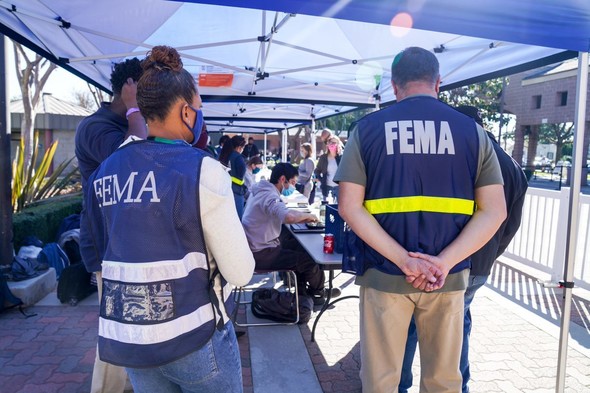
April 1 marks FEMA's 42-year anniversary. Created in 1979 by President Jimmy Carter, FEMA consolidated the federal emergency response functions across government under a single agency. Since then, FEMA has supported more than 4,000 emergency, fire and major disaster declarations. This total includes COVID-19 major disaster declarations in all 50 states, the District of Columbia, 5 territories and three tribes.
In the past 12 months, the agency has faced unprecedented challenges: the COVID-19 pandemic, a record setting Atlantic hurricane season and the current nationwide drive to provide a COVID-19 vaccine to anyone who wants one. At its core, FEMA's strength comes from the hard work of its employees. Through their dedication, the agency achieves its mission of helping people before, during and after disasters.
Watch this video to see some of the actions FEMA and its partners have taken in the last year to support communities across the nation over the past year.
After suspending in-person training at the agency’s campuses in March 2020, FEMA will reopen its campuses with reduced student populations on April 5, 2021.
In-person training will resume at the Center for Domestic Preparedness in Anniston, Alabama and at the National Emergency Training Center in Emmitsburg, Maryland, which is home to the Emergency Management Institute and the National Fire Academy.
Upon reopening, FEMA will test all students and instructors for COVID-19 – including those who have been partially or fully vaccinated against the virus upon their arrival on campus and a second time 72 hours later. All staff members will also be routinely tested. In addition, daily temperature checks of all students, instructors and staff will be conducted and, if warranted, additional COVID-19 testing may be performed.
FEMA will also require all students, instructors and staff to use cloth face coverings and practice social distancing while on campus. Additionally, students will be billeted in single rooms with private bathrooms at both campuses.
Students at the Center for Domestic Preparedness will be provided to-go meals, while students at the National Emergency Training Center will be served cafeteria-style meals in dining areas where they will be expected to social distance.
Any changes to scheduled course deliveries will be communicated to students and instructors no later than the Thursday prior to the course start dates.
In a typical year, FEMA and its partners train approximately 2.2 million first responders and other officials, including 52,000 in person at campuses managed by FEMA and its partners. This training is critical to enhancing the resilience of responders and their communities across the nation to prevent, mitigate, respond to and recover from disasters.
To prepare for the 2021 hurricane season, the National Hurricane Program is offering its first three-day online training. The training will cover hurricane hazards, hurricane forecast products, forecast uncertainty and informed decision-making.
Past trainings have been done in-person. Hosting the training online allows for expanding participation for hundreds of registered individuals across the country.
Classes are available to anyone who has, or can obtain, a HURREVAC account. HURREVAC is a free, web-based platform available to government emergency managers that provides data and analytics to support decisions during hurricane response. HURREVAC combines real-time National Hurricane Center forecast products and storm surge modeling with evacuation clearance times from hurricane evacuation studies.
The webinar series will be from:
- 9 a.m. to noon ET on March 30 - April 1.
- 1 to 4 p.m. ET on May 4 - 6.
To register, select from either the March/April webinar or the May webinar and provide your occupational details.
The National Hurricane Program provides data, resources and technical assistance for hurricane evacuation planning and response for state, local, tribal, territorial and federal government partners. The National Oceanic and Atmospheric Administration’s National Hurricane Center, FEMA and the US Army Corps of Engineers, the three program partners, will provide instruction for this webinar series.
In addition to planning efforts, the program provides preparedness training, operational tools and risk information to emergency managers to support their hurricane evacuation and response decisions.
FEMA released 48 updated core capability development sheets. These updated versions include revised suggested training for each core capability.
The core capability development sheets provide state, local, tribal and territorial jurisdictions with suggestions for how to improve their core capabilities and close capability gaps identified through the Threat and Hazard Identification and Risk Assessment , the Stakeholder Preparedness Review or other capability analysis.
First released in June 2017, each core capability development sheet provides:
- The core capability definition and tasks.
- Relevant trainings.
- Example capability targets.
- Typed resources.
- Critical planning partners.
- Validation techniques.
- Additional organizations that support the development of the specific core capability.
By working with local jurisdictions and using this information, jurisdictions can improve their capabilities and close gaps identified in the Stakeholder Preparedness Review or other assessments.
The FEMA core capability development sheets can be found on FEMA.gov. The set of core capability icons are also available for jurisdictions to use.

The FEMA and AmeriCorps partnership program, FEMA Corps, is seeking talented and enthusiastic, early career professionals to serve as team leaders to help people before, during and after disasters.
Team leaders are assigned a team of eight to ten corps members. This role is not a staff position; however, team leaders are expected to guide and support the team throughout the service term. In addition, team leaders also serve as the liaison between the team, the project sponsor and AmeriCorps National Civilian Community Corps staff.
Serving as a team leader with FEMA Corps is an excellent way to:
- Conduct daily team activities and learn how to lead others.
- Receive training in emergency management.
- Develop budgeting and reporting skills.
- Make a difference in the community served!
The application period closes April 1 for team lead positions. For more information, go to AmeriCorps.gov or FEMA.gov. For questions, contact fema-corps-program@fema.dhs.gov.
|
FEMA Accepting Spring Nominations for Exercise Assistance
The FEMA National Exercise Division is now accepting Spring 2021 exercise assistance nominations to the National Exercise Program. Spring nomination submissions are due by April 1 and decisions will be sent by May 3. Submit the nomination form and any supporting documentation to the National Exercise Division. FEMA will hold additional exercise nomination rounds in Fall of 2021 and Spring of 2022.
Watch the NEP Spring Nominations Overview Webinar recording for more information.
…………………………………………………………………………………………………………..
Department of Homeland Security Seeks Input on Improving the Effectiveness and Efficiency of its Mission
The Department of Homeland Security put out a call for ideas and suggestions from its stakeholders across public and private sectors familiar with or interested in improving the effectiveness and efficiency of the department's mission.
Input can be submitted in the form of questions, hypotheses or problems focused on any area of the Department of Homeland Security's work.
Contributions made will inform the department's selection of priority questions critical to the mission of the agency. Selected priority questions will guide development of specific proposals and plans for research, policy analysis, performance measurement or program evaluation studies the Department of Homeland Security will conduct in the next five years.
Submit suggestions by visiting the Federal Register (86 FR 8921).
…………………………………………………………………………………………………………..
|


