|
Congress created the National Flood Insurance
Program (NFIP) on August 1, 1968, to provide federally backed flood insurance in communities that
voluntarily adopt and enforce floodplain management ordinances which meet the
minimum NFIP requirements.
In the last 50 years of the
NFIP, the program has supported 2.3 million policyholders
impacted by flood damage paying more than $64 billion dollars in flood claims
losses. Insured survivors recover faster and more fully after a flood than
uninsured survivors. The NFIP provides the primary source
of flood insurance in the United States for homeowners, renters, and businesses.
Today,
the NFIP manages flood risk for more than 22,000 participating communities by
providing insurance and protecting the natural and beneficial functions of
floodplains through land use and development requirements. The program supports
more than 5 million flood insurance policies, insuring more than $1.2 trillion in
assets.
The NFIP thanks the
state, local, tribal, and territorial governments as well as insurance and
floodplain management partners and many others for their partnership and assistance in servicing the nation. Through the
decades, the NFIP has met its humanitarian mission to save life and
property through these partnerships and will continue to manage, inform, and
insure flood risk.
For more information visit www.fema.gov/nfip50; to learn more about
flood insurance, visit www.floodsmart.gov.
|
For
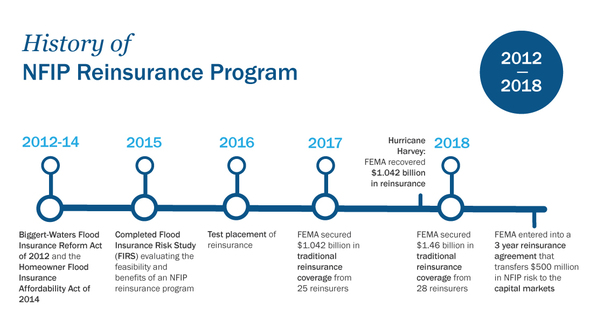
the first time, FEMA has transferred flood risk to capital markets. Announced
on July 31, this placement complements the National Flood Insurance Program’s
(NFIP) existing traditional reinsurance coverage for calendar year 2018.
FEMA
entered into a three-year reinsurance agreement with the reinsurance company,
Hannover Re (Ireland) Designated Activity Company. Hannover Re acted as a
“transformer,” transferring $500 million of the NFIP’s financial risk to
capital market investors by sponsoring the issuance of a catastrophe bond
through a special purpose reinsurer.
Under
this August 2018 reinsurance agreement, Hannover Re will indemnify FEMA for a
portion of flood claims that result from a qualifying flood event that occurs
between the dates of August 1, 2018 and July 31, 2021. The agreement is
structured to cover, for a given flood event, 3.5 percent of losses between $5
billion and $10 billion, and 13 percent of losses between $7.5 billion and $10
billion. FEMA will pay $62 million in premium for the first year of coverage.
Combined with the January 2018
reinsurance placement, FEMA has transferred $1.96 billion of the NFIP’s flood
risk for the 2018 hurricane season to the private sector. If a catastrophic
flood event triggers the reinsurance placements, the NFIP will have an
additional way to fund payment of flood claims. The August 2018 placement is also significant because, for the first time,
capital markets investors are directly backing NFIP reinsurance coverage. By
engaging both the traditional reinsurance markets and the capital markets, the
NFIP can reduce risk transfer costs, access greater market capacity, and
further diversify its risk transfer partners.
Congress
granted FEMA authority to secure reinsurance from the private reinsurance and
capital markets through the Biggert-Waters
Flood Insurance Reform Act of 2012 and the Homeowner
Flood Insurance Affordability Act of 2014.
For additional
information about this capital markets inverstors reinsurance placement, you
can read the NFIP chief executive’s blog post, “Building a Culture of
Preparedness with Reinsurance."
Frequently Asked Questions and other details about this reinsurance
placement are also available at www.fema.gov/nfip-reinsurance-program.
FEMA released "Planning Considerations:
Complex Coordinated Terrorist Attacks" to aid all community partners,
including all levels of government, infrastructure owners and operators, small
businesses, non-profit organizations, and volunteer organizations, in planning
and preparing for complex coordinated terrorist attack scenarios.
Complex coordinated terrorist
attacks represent an evolving and dynamic terrorist threat with the potential for
mass casualties and infrastructure damage anywhere and at any time. The guide
includes the unique characteristics of complex coordinated terrorist attacks,
identifies potential challenges, and discusses the six-step planning process as
it relates to complex coordinated terrorist attacks. The guide also provides
information on identifying the capabilities necessary to respond to complex
coordinated terrorist attacks using the Threat and Hazard Identification and
Risk Assessment, and it includes a list of relevant, available resources.
To download a copy
of "Planning Considerations: Complex Coordinated Terrorist Attacks," visit www.fema.gov/plan.
FEMA’s Emergency Management Institute (EMI) hosts a series of
“One Link, One Bridge, Many Voices” e-Forums every Wednesday from 3-4 p.m. ET. EMI e-Forums are
1-hour, moderated webinars where EMI and the emergency management community
gather to discuss matters of interest related to emergency management and
national preparedness. The sessions facilitate a panel discussion with our
whole-community partners - your peers - sharing their experiences in an
informal exchange of ideas. EMI e-Forums are free of charge and available to
anyone who wishes to participate.
August
EMI e-Forums
- 8/15: Planning for Complexity: Leading Emergency Management
in a Constantly Evolving and Complex Environment
- 8/22: Texas
A&M Engineering Extension Service (TEEX): Bigger than just the National
Emergency Response and Recovery Training Center (NERRTC)
- 8/29: NIMS
Training 2018: What to expect after 100.c
Participation
link: https://fema.connectsolutions.com/emieforums
Conference
call-in: 800-320-4330, PIN 107622
Questions: https://training.fema.gov/contactus/sendcomment.aspx
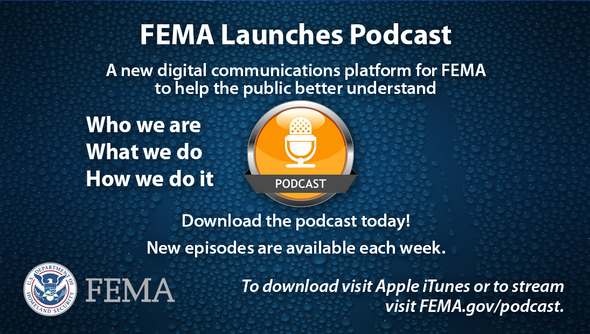
On this week's episode of the FEMA Podcast, Josh Dozor, FEMA's Director of the Planning and Exercise Division, discusses how FEMA and its partners plan for a variety of disaster and emergency scenarios. From hurricanes to space weather or tornadoes to Ebola -- this episode of the FEMA podcast is all about disaster planning.
The FEMA Podcast is a new
audio program series available to anyone interested in learning more about the agency, hearing about innovation in the field of emergency management, and
listening to stories about communities and individuals recovering after disasters.
The FEMA Podcast is available on Apple iTunes
to stream or download. Approximately 20 to 30 minutes in length, the podcast
will be updated with a new episode on a weekly basis. By subscribing, new
episodes will automatically update on a listener's device. For more
information, visit www.fema.gov/podcast.
Register for the Emergency Management Institute's Chlorine Emergency Response Virtual Tabletop Exercise
FEMA’s Emergency Management
Institute (EMI) Virtual Tabletop Exercise (VTTX) Program in cooperation with The Chlorine
Institute, will offer three chlorine response VTTX sessions August
21, 22, and 23, 2018. The VTTX will address contamination recognition and
subsequent response efforts after a major chlorine release. The VTTX occurs 12
p.m. – 4 p.m. ET. To participate, send an email to Doug Kahn at douglas.kahn@fema.dhs.gov or call 301-447-7645. Also, send a courtesy copy email
to the Integrated Emergency Management Branch at fema-emi-iemb@fema.dhs.gov or call 301-447-1381. Content is the same each day and
participants should attend only one session. Additional information is
available at https://training.fema.gov/programs/emivttx.aspx. The registration deadline is August 10, 2018.
|


