|
Mr. Keith Victor, SAFECOM At-Large
(Connecticut Capitol Region Council of Government)
Author: Wes Rogers, Cybersecurity and Infrastructure Security Agency (CISA), and Keith Victor, SAFECOM At-Large, Connecticut Capitol Region Council of Government

SAFECOM, CISA's premier public safety communications advisory council, is made-up of public safety stakeholders with a diverse set of experiences and backgrounds. Mr. Keith Victor, of the Connecticut Capitol Region Council of Government, offered to share some of his insights about SAFECOM and the direction of the public safety communications community.
Mr. Victor has been a SAFECOM member since 2018. He is the Communication Unit Leader (COML) for the Connecticut Fire Rescue Disaster Plan as well as the Region III Emergency Support Function (ESF)-2 Representative for the Connecticut State Interoperability Committee. He has over 20 years of experience in public safety communications and over 50 years of experience in fire service. CONTINUE READING
|
|
|
RECENT PUBLICATIONS
SAFECOM and NCSWIC Develop Global Positioning System for Public Safety Location Services: Use Cases and Best Practices
Author: Ralph Barnett, III, Cybersecurity and Infrastructure Security Agency (CISA), Joint SAFECOM-National Council of Statewide Interoperability Coordinators (NCSWIC) Project 25 User Needs Working Group Federal Lead

Looking for information about Global Positioning System’s (GPS) uses in public safety? SAFECOM and NCSWIC are pleased to announce the release of Global Positioning System for Public Safety Location Services: Use Cases and Best Practices. This white paper compiles uses cases from public safety practitioners tasked with providing real-time location capabilities to their agencies. GPS for Public Safety Location Services: Use Cases and Best Practices explores real-world applications of P25 GPS, its limitations, and implementation considerations as learned through a series of interviews, a review of the P25 technical standards, and research into current application of GPS technology for public safety. LEARN MORE
|
SAFECOM Releases New Resource for Cloud Adoption
Author: Ted Lawson, Cybersecurity and Infrastructure Security Agency (CISA), SAFECOM Cybersecurity Working Group

Cloud computing offers myriad benefits to public safety organizations, though adoption of such technology may not be as easy as it seems. SAFECOM has released Considerations for Public Safety Cloud Computing Adoption to assist public safety practitioners in asking the key consideration questions. Composed of questions in a checklist format, the document guides practitioners through determining 1) needs and scope, 2) requirements, and 3) a questionnaire to solicit key information. While not all suggested considerations may apply to individual circumstances, they stimulate thought and initiate conversation with peers, leaders, and decision-makers. These considerations could assist public safety organizations at any stage of cloud adoption to ensure that their selection is operable, secure, resilient, and compliant with rules and regulations. LEARN MORE
|
The P25 Steering Committee, the Compliance Assessment Process and Procedures Task Group (CAPPTG), and the Joint SAFECOM-NCSWIC P25 User Needs Working Group (UNWG) release Project 25 Link Layer Encryption Informational Session
Author: Jim Downes, Cybersecurity and Infrastructure Security Agency (CISA)
Link Layer Encryption (LLE) is a security service that provides confidentiality for user identities, voice, data, supplementary services, and other information sent over the control channel. This informational session, held on October 11, 2023, was developed to provide a greater understanding of how LLE will work upon completion of the LLE Project 25 (P25) Standard and how it may interface with current P25 land mobile radio (LMR) systems. The P25 LLE Informational Session is led by Telecommunications Industry Association subject matter experts (SME). These SME engineers are members of the APCO Project 25 Interface Committee (APIC) Encryption Task Group (ETG) and are currently developing the LLE P25 standard. LEARN MORE
|
SAFECOM Publishes SAFECOM Governance Operating Processes and Procedures
Author: Ralph Barnett, III, Cybersecurity and Infrastructure Security Agency (CISA)
The SAFECOM Executive Board and SAFECOM Governance Committee is pleased to announce the publication of the SAFECOM Governance Operating Processes and Procedures (March 2024 update). The SAFECOM Governance Operating Processes and Procedures was updated to codify membership dormant status and leadership qualifications when conducting elections. Updates were made to the following sections:
Section 3.1: Membership Dormant Status was added to codify the process for removing inactive SAFECOM members. LEARN MORE
|
|
CISA ENGAGEMENTS
FBI and CISA Release Joint PSA, Just So You Know: Ransomware Disruptions During Voting Periods Will Not Impact the Security and Resilience of Vote Casting or Counting
Author: Cybersecurity and Infrastructure Security Agency (CISA)
WASHINGTON – Today, as part of their public service announcement (PSA) series to put potential election day cyber related disruptions during the 2024 election cycle into context for the American people, the Federal Bureau of Investigation (FBI) and the Cybersecurity and Infrastructure Security Agency (CISA) jointly released Just So You Know: Ransomware Disruptions During Voting Periods Will Not Impact the Security and Resilience of Vote Casting or Counting. FBI and CISA are issuing this PSA to inform the public that while ransomware attacks against state or local government networks or election infrastructure could cause localized delays, they will not compromise the security or accuracy of vote casting or counting processes.
CISA Releases Secure by Demand Guide
Author: Cybersecurity and Infrastructure Security Agency (CISA)
WASHINGTON – The Cybersecurity and Infrastructure Security Agency (CISA) and Federal Bureau of Investigation (FBI) released today Secure by Demand Guide: How Software Customers Can Drive a Secure Technology Ecosystem which helps organizations buying software better understand their software manufacturers approach to cybersecurity and ensure that secure by design is one of their core considerations.
An organization’s acquisition staff often has a general understanding of the core cybersecurity requirements for a particular technology acquisition. However, they frequently don’t assess whether a given supplier has practices and policies in place to ensure that security is a core consideration from the earliest stages of the product development lifecycle.
CISA Names First Chief Artificial Intelligence Officer
Author: Cybersecurity and Infrastructure Security Agency (CISA)

WASHINGTON – Today, the Cybersecurity and Infrastructure Security Agency (CISA) announced its first CISA Chief Artificial Intelligence Officer, Lisa Einstein. This selection reflects CISA’s commitment to responsibly use AI to advance its cyber defense mission and to support critical infrastructure owners and operators across the United States in the safe and secure development and adoption of AI. Einstein has led CISA’s AI efforts since 2023 as CISA’s Senior Advisor for AI. Since 2022, Einstein also served as the Executive Director of the CISA Cybersecurity Advisory Committee.
“I am proud of how our team at CISA has come together in the last two years to understand and respond to rapid advancements in AI—many of which have significant implications for our core missions of cyber defense and critical infrastructure security,” said CISA Director Jen Easterly. “Lisa Einstein has been central to that effort. Beyond her technical expertise, she’s an inspirational leader who has brought together colleagues across the agency around a clear and impactful vision. I could not be more thrilled to have her take on this important new role, which will help us continue to build AI expertise into the fabric of our agency and ensure we are equipped to effectively leverage the power of AI well into the future.”
|
|
|
CISA Updates Toolkit with Nine New Resources to Promote Public Safety Communications and Cyber Resiliency
Author: Dave Nolan, Cybersecurity and Infrastructure Security Agency (CISA) Emerging and Advanced Technology Branch, Nationwide Interoperability Services
The Cybersecurity and Infrastructure Security Agency (CISA) collaborates with public safety, national security, and emergency preparedness communities to enhance seamless and secure communications to keep America safe, secure, and resilient. Any interruption in communications can have a cascading effect, impacting a public safety agency’s ability to deliver critical lifesaving services to the community. Therefore, public safety agencies carefully plan, implement, and review communications capabilities for resiliency to maintain daily communications abilities and prepare in advance for emergency events.
To assist public safety agencies in navigating the wealth of information available regarding communications resiliency, CISA created the Public Safety Communications and Cyber Resiliency Toolkit to identify and address emergent trends and issues, consolidate resources, educate stakeholders at all levels of government, and propose mitigations to enable resilient public safety communications. The Toolkit is designed to assist public safety agencies and others responsible for communications networks by providing the tools necessary to evaluate current resiliency capabilities, identify ways to improve resiliency, and develop plans for mitigating the effects of potential resiliency threats. READ MORE
The Federal Partnership for Interoperable Communications (FPIC) Releases the Transition to Advanced Encryption Standard White Paper
Author: Jim Downes, Cybersecurity and Infrastructure Security Agency (CISA), FPIC Federal Lead Coordinator
The Federal Partnership for Interoperable Communications (FPIC) has released The Transition to Advanced Encryption Standard White Paper. The White Paper highlights the vulnerabilities of the continued use of the Data Encryption Standard (DES) and non-standard algorithms and provides an overview of actions and next steps being taken to support state, local, tribal, territorial (SLTT) agencies transition to Advanced Encryption Standard (AES) capabilities. It also provides background information on the Criminal Justice Information Service (CJIS) Policy, and the Protected Critical Infrastructure Information (PCII) Program. The document can be used by public safety agencies to better understand the vulnerabilities to sensitive information from using DES and other non-standard encryption algorithms. Agencies can also find background information about CJIS policies and resources, like the PCII Program, to better protect critical infrastructure and information. READ MORE
|
|
NCSWIC Planning Training, and Exercise Committee releases the Human Factors Resource Guide
Author: Cary Martin, Cybersecurity and Infrastructure Security Agency (CISA)
The National Council of Statewide Interoperability Coordinators (NCSWIC) Planning, Training, and Exercise (PTE) Committee is pleased to announce the publication of the Human Factors Resource Guide. The Human Factors Resource Guide is a curated list of resources that includes both live support and self-guided tools to support telecommunicators mental health.
Telecommunicators are the emergency call takers that respond to a wide array of routine and traumatic calls daily. With the implementation of new technologies, such as Next Generation 911 (NG911), that enable callers to exchange multimedia messages with Emergency Communications Centers we understand that this has the potential to induce additional stress and vicarious trauma on the telecommunicator.
NCSWIC Releases Roles and Responsibilities: Statewide Interoperability Coordinators Document
Author: April O’Reilly, Cybersecurity and Infrastructure Security Agency (CISA)
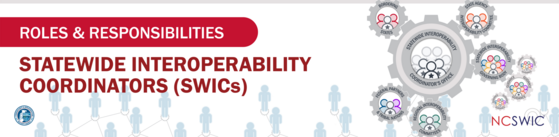 The National Council of Statewide Interoperability Coordinators (NCSWIC) has released the Roles and Responsibilities: Statewide Interoperability Coordinators (SWICs) handout, which illustrates the SWICs' role in supporting and advocating for public safety communications. SWICs perform an integral role in ensuring their states have communications resources that emergency responders need and help facilitate responder communications during emergencies and planned and unplanned events. This handout provides an overview of SWICs’ responsibilities at both the state and national levels and illustrates their role in state, regional, and federal interoperability governance, planning, and coordination.
NCSWIC Releases the NCSWIC Video Series
Author: April O’Reilly, Cybersecurity and Infrastructure Security Agency (CISA)
The National Council of Statewide Interoperability Coordinators (NCSWIC) is pleased to announce the publication of the first three videos in a NCSWIC Video Series, which serves to promote the roles, duties, and daily operations of the Statewide Interoperability Coordinator (SWIC) and the importance of the many facets of emergency communications and interoperability.
In the “What is a SWIC” video, members of NCSWIC discuss how they support interoperability and emergency response and communications, their role as key partners for state and federal agencies, and how they work at the intersection of policy and technology. The “What are Emergency Communications” video explains emergency communications systems, their importance to first responders, and why they are critical to protecting the nation.
|
|
|
|
|